This is part two of a multi-part series on the origins of the time divisions of a day. Part one can be found here.
Minutes
While there was great demand for clocks accurate enough to measure individual minutes, they did not become a reality until 1656! Even the most accurate clocks in 1400 were expected to drift as much as 15 minutes per day. As such, the word minute does not appear in English until the mid-1400s. Instead, people subdivided hours into halves and quarters when they needed to be more precise. This can be seen preserved in phrases like “half past eight” and “quarter of nine”.
Minute comes from classical Latin minūta, meaning “very small”, and arrives at English through both Arabic and French. Specifically, the Latin phrase pars minūta prīma, meaning “first very small part”, was used in geometry to describe subdivisions of degrees. The ancient Sumerians used a sexagesimal (base-60) numeral system. Nearly all the attributes of the minute time unit stem from Sumerian astronomy dividing circles into 360 degrees, and then each degree into 60 subparts. This convention was passed down for 5,000 years through Babylonian, Greek, Roman, Arabic, and French astronomers before arriving in England.
The invention that finally enabled clocks accurate to the minute was the pendulum. Galileo’s studies on the mechanics of pendulums, first published in 1602, would go on to inspire Dutch scientist Christiaan Huygens to construct the first pendulum clock in 1656. By 1690, after a lifetime of iterative improvement, clockmakers had refined the design into what are recognizable as grandfather clocks today. Boasting just seconds of drift per day, these clocks were the first to commonly include minute hands.
Another key component of this hundredfold increase in precision was the addition of a control system. Even pendulums are subject to the laws of physical reality, and exhibit tiny variations in speed due to wear, temperature, and dozens of other variables that stubbornly resist exact calculations. The solution clockmakers ended up devising was a balance spring that measured the speed of the oscillation, then sped it up if it was too slow, or slowed it down if it was too fast.
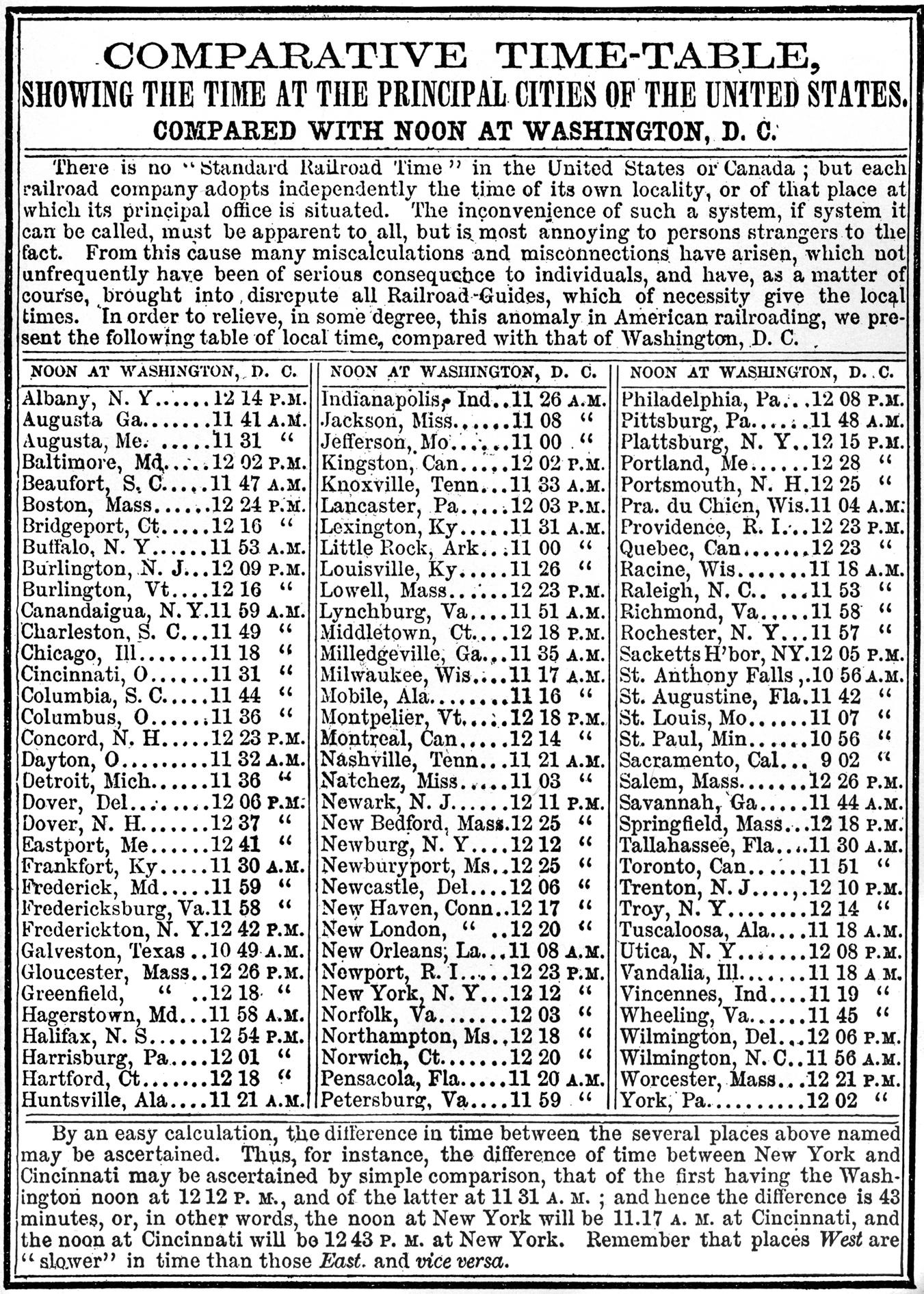 Scan of a printed page from an 1857 American guide to train travel. Most of the page features a table of US cities and their respective local times when it is noon in Washington, DC. The rest of the page describes how to use the table.
An additional wrinkle is that sunrise and sunset times also change based on your longitude (east-west location). In 1700, the solution to this problem was for every town to keep its own clock synchronized to its own solar noon. This solution started creating new problems when unimaginably fast rail travel became common in the mid-1800s. In 1799, it was impossible to send information, let alone people or cargo, any faster than a person on a horse. You might imagine sailing ships going faster than that, but skilled crew sailing with favorable winds might only reach an average speed of 10 km/h (6 mph).
European countries solved this new problem by coordinating on a single standard time per country. For example, the UK began tracking “railway time” in 1840 based on the time observed in Greenwich, London. This solution did not work for the US, which spanned so much longitude that when it was 12:12 in New York (and 12:24 in Boston, and 11:18 in Chicago), it was also 9:02 in Sacramento. The eventual solution of resetting every single city’s time to standard hour-wide time zones was only proposed in 1870 and enacted in 1883, on an occasion called “The Day of Two Noons”.