This is part three of a multi-part series on the origins of the time divisions of a day.
[Part 1: Hours] [Part 2: Minutes]
Seconds
In 1707, four British warships miscalculated their position and ran aground off the Isles of Scilly, killing 2,000 sailors in what is still one of the worst maritime disasters in British history. For lack of a better approach, the way ships calculated their longitude at that time was dead reckoning, basically guessing how far they’d gone from the last known port. The disaster led to the Longitude Act of 1714, establishing a £20,000 (over £4M today) bounty for the deployment of a reliable way to determine a ship’s longitude within 30 minutes (half of a degree).
This is relevant to our history because one theoretical approach to determining longitude was to precisely measure the sun’s position and compare it to solar noon at a known location, such as the Greenwich Royal Observatory. If you knew the exact time, you could calculate your exact longitude from that single observation. The problem with this approach was, no one knew any way to get the exact time at sea. Our marvelous pendulum clocks wouldn’t work on the open ocean, because of the motion of the waves.
The problem lit a fire in the imagination of English clockmaker John Harrison, who presented his first prototype for a marine chronometer to the Royal Academy in 1730. A lifetime of iteration and experimentation resulted in his fourth attempt finally winning the prize in 1761. In its maiden test, his H4 chronometer drifted just 5 seconds over the course of an 81-day voyage, enabling a longitude measurement accurate within 1.25 minutes.
As alluded to earlier, the word second comes from classical Latin secunda, in particular its presence in the Latin phrase pars minūta secunda, meaning “second very small part”. We could have called minutes “primes” or “firsts” instead to maintain internal consistency, but that is not what we did.
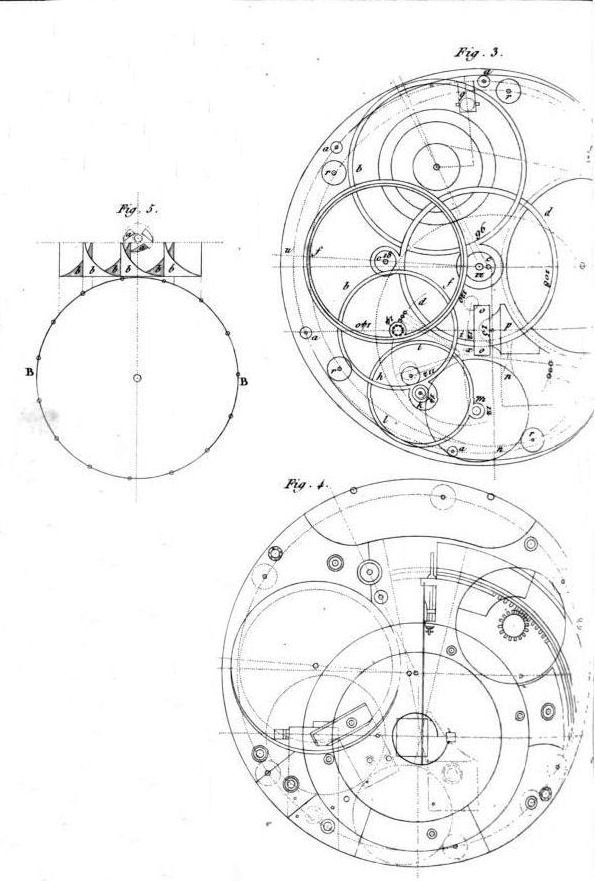 Scan of a diagram laying out the inner workings of the H4 chronometer. Several figures illustrating different cross-sections of the clock its mechanisms are labeled with letters.
The delicacy and expense involved in the construction of a device so precise made this solution barely affordable for even the richest country in the world. One chronometer cost one-third the price of an entire ship. Ordinary people wouldn’t have access to clocks with second accuracy until replaceable parts and manufacturing methods made them affordable in the mid-1800s.
The first implementation of the metric system, adopted by French revolutionaries in 1799, only covered base units of distance and mass (meters and kilograms), not time. Carl Gauss proposed using the second, to be officially defined as 1/86,400 of a day, as the standard metric unit of time in his millimeter/milligram/second measurement system in 1832. Over the next thirty years, his proposal found wide approval among scientists. The second was formally adopted as an official metric unit under the centimeter/gram/second measurement system, proposed in 1874 by a committee that included James Maxwell, Lord Kelvin, and James Joule.
Miniaturization followed mass production, resulting in the creation of pocket watches. Widely available second accuracy enabled new levels of coordination unviable just decades earlier. Military watches were first issued to officers in the 1880s. At the beginning of a battle, everyone would synchronize their watches to keep their maneuvers coordinated. In particular, it was important to agree on the exact second to expect an artillery strike. The phrase “synchronize your watches” is an artifact of the second era. You might not know the absolute time, but you could act like you did if you kept everyone’s relative times the same.
If you did in fact need to know the absolute time, observatories began broadcasting official time signals by telegraph in the 1850s. This wasn’t a service the average person would have access to. That begins with the 1924 appearance of radio time stations. Time hotlines that you could telephone for an accurate time signal started operating in 1933, gradually displacing the radio time stations.
Wristwatches, then called “bracelet watches”, were originally a women’s fashion accessory. They only lost their genderedness after military wristwatches entered common use around the world in the 1880s and 1890s. Newly verified as manly, men’s wristwatches became a standard fashion accessory in the 1900s. They remain the most popular men’s jewelry item to this day.