For nearly a hundred years after its founding, there were no US federal holidays. Each state observed its own holidays. This only started changing with the passage of an 1870 bill (16. Stat 168) that officially established the four most commonly observed state holidays to be paid days off for DC-based federal employees. Those were New Year’s Day on January 1, Independence Day on July 4, Christmas Day on December 25, and Thanksgiving, which the bill did not attempt to pin down to a specific day.
In 1879, Congress revised the act (20. Stat 38) to add the fifth most frequently observed state holiday, George Washington’s Birthday, on February 22. An 1885 amendment (23. Stat 516), actually established what we now consider federal holidays, guaranteeing those five paid days off for all federal employees regardless of circumstance.
Decoration Day on May 30, today celebrated as Memorial Day, was added to the growing list in 1888 (25. Stat 353) to honor Civil War veterans. Labor Day on the first Monday of September was established as the seventh federal holiday in 1894 (28. Stat 96) to commemorate the labor movement. November 11 officially became Armistice Day, today celebrated as Veterans Day, in 1938 (52. Stat 351) to honor Great War veterans.
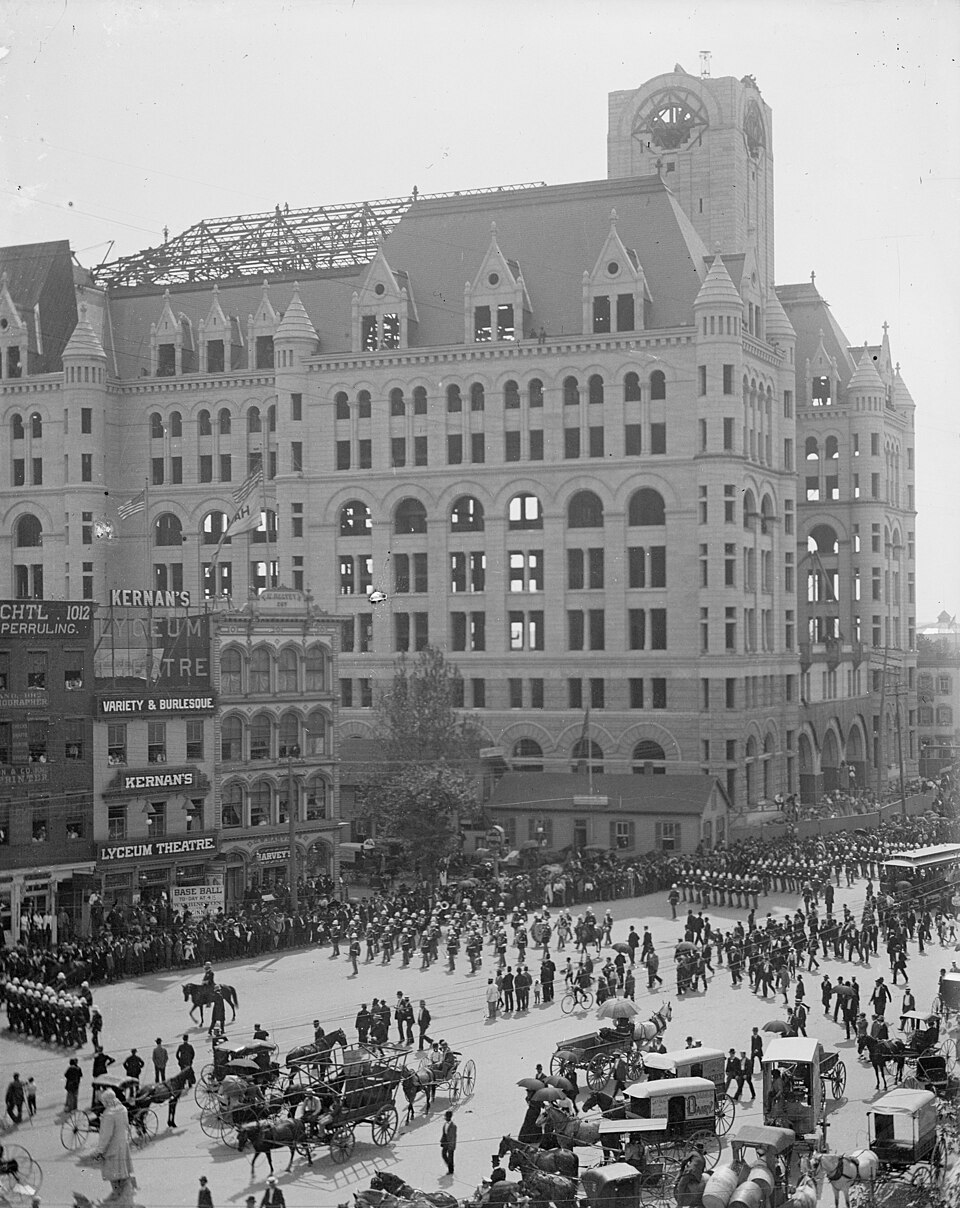 1894 photo of the Labor Day parade on Pennsylvania Avenue, Washington DC. The top two-thirds is dominated by a gigantic building under construction. The bottom third shows a parade of primarily infantrymen amid a crowd of onlookers in suits, horse carriages, and a tram.
The 1968 Uniform Monday Holiday Act (82 Stat. 250) made the most changes to federal holidays in US history. It enshrined the second Monday in October as Columbus Day to commemorate Italian-Americans. It also codified the public preference for long weekends by officially observing Washington’s Birthday, Memorial Day, and Veterans Day on their nearest Mondays. Veterans Day observations were returned to November 11, the actual day of the armistice, in 1975 (89 Stat. 479).
We have only made two adjustments to federal holidays since. In 1983 (97 Stat. 917), Congress recognized the third Monday in January as Martin Luther King Jr. Day to commemorate civil rights. Finally, Congress established June 19 as Juneteenth in 2021 (135 Stat. 287) after a contentious process lasting over a hundred years to commemorate emancipation.