
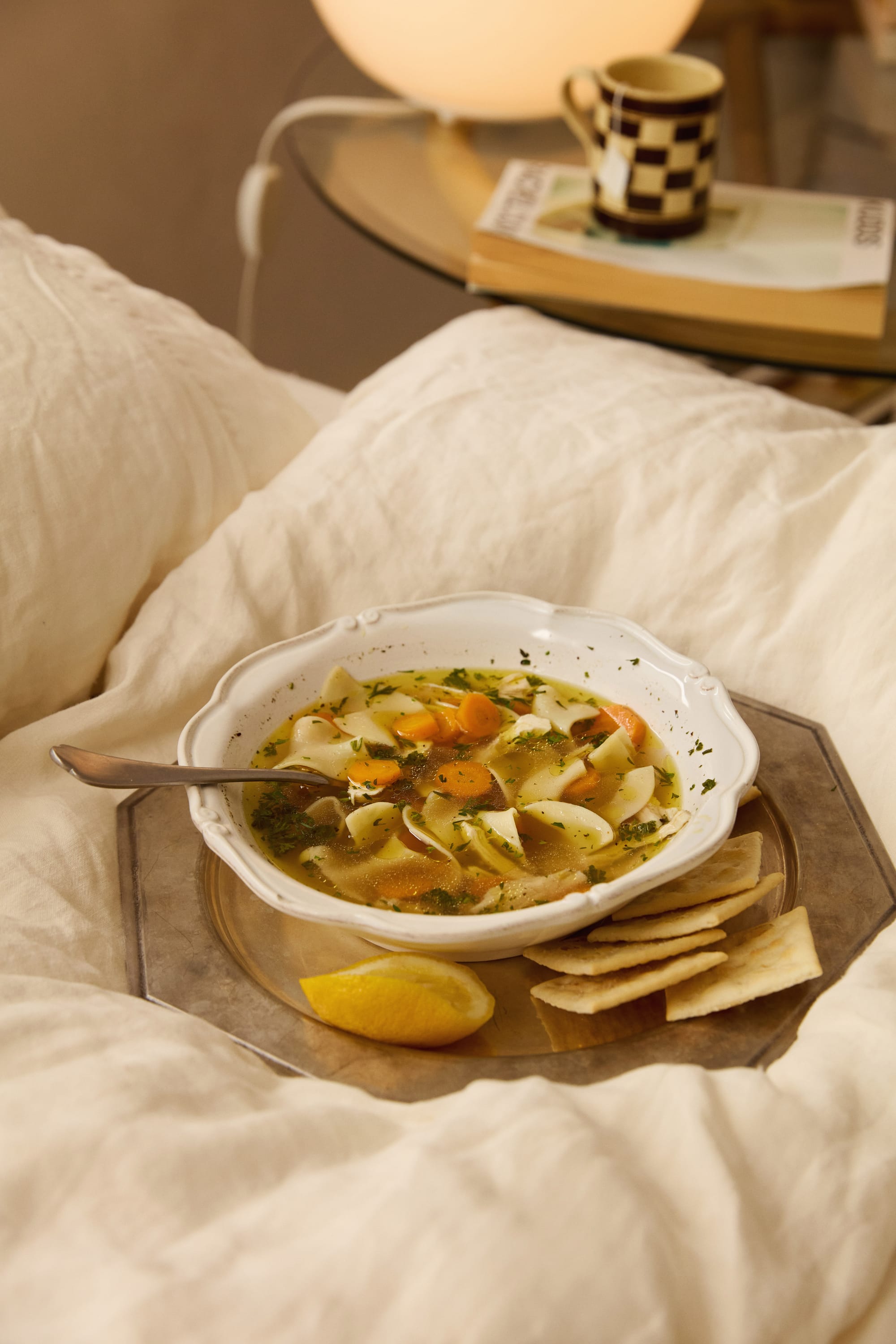
Earlier this week, my husband saw me working from the couch, draped in a wool blanket wearing a fuzzy cozy-looking cardigan and said I was really “deep in a winter look” (April 13th). One thing about me is that if it’s overcast and below 72, this will be my look. I’ve never been to The Cotswolds, but if the sun isn't out, that’s where I am, mentally. Until it is positively too hot to function outdoors, I will always be “a bit cold” and you will find me drinking hot coffee in the morning and eating hot soup for lunch.
But today is April 16th, 77 degrees and sunny, the third in a four-day stretch of unseasonably warm weather. It’s beautiful and everyone is happy and the birds are singing perched on a budding branch like we’re in a Disney film from the 50s. This is not the day I would have picked for extolling the virtues of chicken soup, but it’s the day we have, and thank god for it.
While I was recovering from my C-section, I ate chicken soup in all its permutations every day for about three months straight. Because of its glorious shape-shifting potential, I never got tired of it. Extra vegetables and it’s chicken vegetable soup. Noodles? You have yourself a real classic. Finish with fish sauce and lime and beansprouts and you’re halfway to an approximation of pho. Have excellent chicken broth on hand and you, too, can eat chicken soup every day for three months without getting bored. That’s the chicken soup promise.
Three most FAQ, chicken broth edition:
What’s the difference between chicken broth and bone broth and chicken stock?
I know there’s a real answer, but often people dismiss the answer and just call it whatever they want. That said, chicken broth will typically have aromatics (onion, celery, carrot, etc.) and be made with all sorts of chicken parts (whole bird, wings, feet, backs, etc.)– closer to a soup, or the start of one. Bone broth/stock, which are more closely related, are usually made with only the bones of said animal, and stock specifically, (according to me?), tends to be made with roasted/browned bones. I like making, saying and drinking “chicken broth.”
How do you get your chicken broth to have so much collagen and gelatin that it jiggles?
Even I was shocked at how firm my chicken broth was the other day– I took about 73 videos of it like it was my child. Cutting up your chicken to expose the interior of the joints and bones beforehand will help you get there, so will starting your broth with high collagen parts like wings and feet. Even the addition of two pounds of chicken feet in this particular recipe (that’s what I did) will go far. Above all, do it the long way– the parts need time to release all that will make it taste good, all that will make it jiggle. A beautiful concept we should apply to everything in our lives.
Are the meat and vegetables worth saving after your broth to include in your soup?
The chicken is, yes. I often will pluck out the meat and return the skin, bones etc. to the pot to continue simmering and giving up their goods. If you are organized enough to pluck the breast first (cooks the quickest) followed by the legs and thighs, you will be rewarded with perfectly cooked chicken all around (though I don’t necessarily perceive a slightly overcooked breast in the context of soup).
The vegetables– well, that’s more a texture concern for me. I want my chicken soup to have textured, vibrant, springy vegetables in it so I always treat them separately– vegetables for the broth (to simmer, strain, discard– thank you for your service), vegetables for the soup (to further flavor the broth, make your soup fabulous and alive). That said– one of my favorite treats in the world (!) is the celery that’s been cooked in the broth. The opposite of most celery experiences, it’s supremely tender, tastes deeply chickeny and is one of my favorite things to snack on on Chicken Broth Day.
Suggestion Box
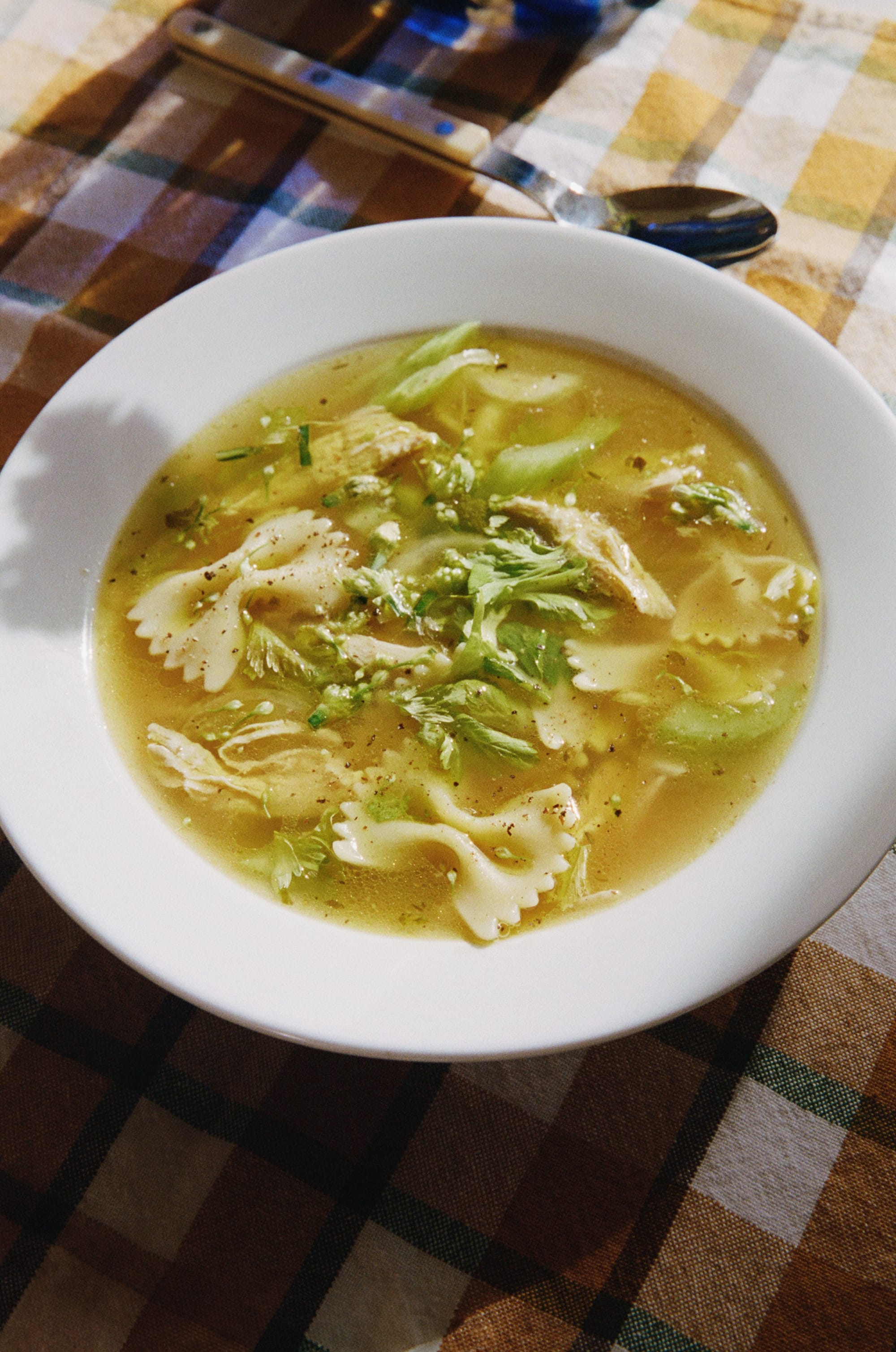
Among all the ways that soup can be exciting, sometimes all you want is for soup to be whatever the opposite of that is. Comforting. Calming. Soothing. Basic. Expected. Frankly, I don’t want any surprises from my chicken noodle soup. I want tender, puffy, nearly overcooked noodles swimming in a savory, golden broth, lightly sweetened from little coins of carrots or leaves of torn up cabbage. I want lots of dill floating on top of a thin layer of chicken fat, I want perfectly cooked shredded bits of chicken throughout, I want it pleasantly sour from tons of lemon, and I want it to make me feel better, even if I’m not all that sick.
It goes without saying (but I’ll say it anyway) that this soup will only be as good as your broth, and this recipe alone is worth the hours of simmering that it takes to make your own. If you were waiting for a sign to make a batch of chicken broth, consider this that sign.
1. Cook the noodles in a large pot of salted boiling water until just before al dente (if using egg noodles, this will happen faster than pasta, around 4 or 5 minutes). Drain and set aside.
2. Bring the chicken broth to a simmer in a large pot. Add the pasta, cabbage, celery and fish sauce, if using, and bring to a simmer. Cook gently until cabbage is just wilted but still has some nice bite, five or so minutes.
3. Add the dill, chives and any garlicky things to the broth. Bring to a simmer and season again with salt, lots and lots of pepper, and a dash more fish sauce if you like. Add the lemon juice and remove from heat.
4. To serve, divide among bowls, maybe serving with saltines on the side and more herbs on top.
DO AHEAD: Chicken soup can be made 3 days ahead, stored in the refrigerator. Sans noodles, it can be made and frozen up to 3 months ahead (simply reheat and add the noodles when you’re ready to eat).
This is my basic and very general recipe for chicken broth. It is also extraordinary, in the way that only chicken broth, made with love, care, salt, and plenty of bone-in, skin-on chicken can be. I like to use a cut-up chicken, rather than a whole, uncut one. It’s something I learned in Oaxaca, watching cooks prep soup in a market stall—a romantic, if fuzzy, memory. Cutting up the chicken does two things. First, it allows you to remove the chicken parts at different times, so that the breast can come out once it’s poached, while the leg/thigh can continue to simmer and become more tender. Second, hacking up the chicken exposes the inside of the bones, which releases all that collagen and marrow into your broth, making it richer and more flavorful. If your preference is to purchase parts instead (and you’re just after broth, no meat), I would go for all wings—or backs, if available, which are cheaper, less wasteful, and have the highest ratio of skin and bone to meat.
1. Place the chicken, chicken feet (if using), onions, garlic, celery, carrots, peppercorns, and bay leaf (if using) in a large pot and cover with 12–14 cups water. (Basically, you want to fill your pot to the top with water.)
2. Season with a good amount of salt (not quite salty like the sea, but you can really season it well, keeping in mind it will reduce down a bit) and bring to a boil. Reduce the heat to medium-low (the broth should be gently simmering) and continue to simmer until the chicken is cooked through and falling apart, the vegetables are nearly mush (but still taste good), and the broth is as seasoned and delicious as you’d want it to be when serving, about 1 ½ hours or so (you can go longer, upwards of 2 ½–3 hours, but I would not go shorter). If you want to pluck the chicken pieces out and pick the meat from them for later use, you should (I do!).
3. Strain the broth. (I use a basic strainer—no need for cheesecloth.) Keep it hot if using right away or let it cool before refrigerating.
NOTE: You can purchase a whole chicken and cut it up, have the butcher do it for you, or simply purchase parts (wings, backs, legs, etc.). Or use a whole, uncut chicken and plop it right in there. You can also save up the carcasses from your whole roasted or rotisserie chickens and make broth that way, using three or four carcasses instead of one fresh chicken.
DO AHEAD: Broth can be made 5 days ahead and refrigerated, or several months ahead and frozen.