This week we published The Leadership Corridor: How James Kilts Built Leaders at Gillette. The case comes from Kilts’s 2007 book Doing What Matters, which we’ve covered in the past in The Only Thing That Matters. In that piece I mentioned that Kilts had attempted something remarkable: hewrote a book about the ‘reduce down to one thing that matters’ skill that is so common amongst experienced businesspeople. We presented Kilts’s story through the primary narrative frame of his book: the first few months when he took over at Gillette as a turnaround CEO, at the behest of legendary investor Warren Buffett. Kilts wanted to teach readers how he did what he did; unfortunately, I do not think he succeeded: the skill is simply too difficult and too context-specific to articulate on the page. But I appreciate that he tried.
There was one other thing that struck me as remarkable about the book: Kilts was reallyproud of his track record creating a deep bench of effective, successful execs. He had done this for most of his career as a CEO — many of his reports, from three different companies, went on to top leadership roles in the FMCG (Fast Moving Consumer Goods) sector.
This is not normal.
This track record is very unusual because most large companies struggle to produce even one capable successor. Many see their senior ranks consumed by internal conflict with executives vying to capitalise on the power vacuum rather than building capability beneath them. Others, like Howard Schultz’s Starbucks, discover that the entire organisation falters the moment a founding CEO tries to step back. The most common outcome in corporate America is a succession crisis, not a deep bench.
So how did Kilts do it? The short answer is that he implemented a system. I found this interesting for reasons that might be obvious to you: most corporate leadership training programs are ineffective and do not result in the kind of outcomes that Kilts was able to achieve. A system, though? If the system were deeply integrated into the business and its business model — I could see it working.
This week’s case describes that system, and how he implemented it in Gillette ... in the midst of a turnaround. In truth, what Kilts implemented wasn’t something he’d invented: he had picked up the training approach from Kraft, where he was an Executive VP from 1994 to 1997. The Kraft system had itself produced a whole slate of remarkable business leaders — Kilts being one of them.
And where did that system come from?
The answer traces back to a management development framework called the Leadership Corridor, built at Kraft in the 1980s by CEO Mike Miles and his head of human resources, John Tucker.
Most companies treat leadership development as something that happens in a classroom. These commonly include (but aren’t limited to) off-site programmes, case studies, and topical courses that run outside of the day-to-day work of the organisation.
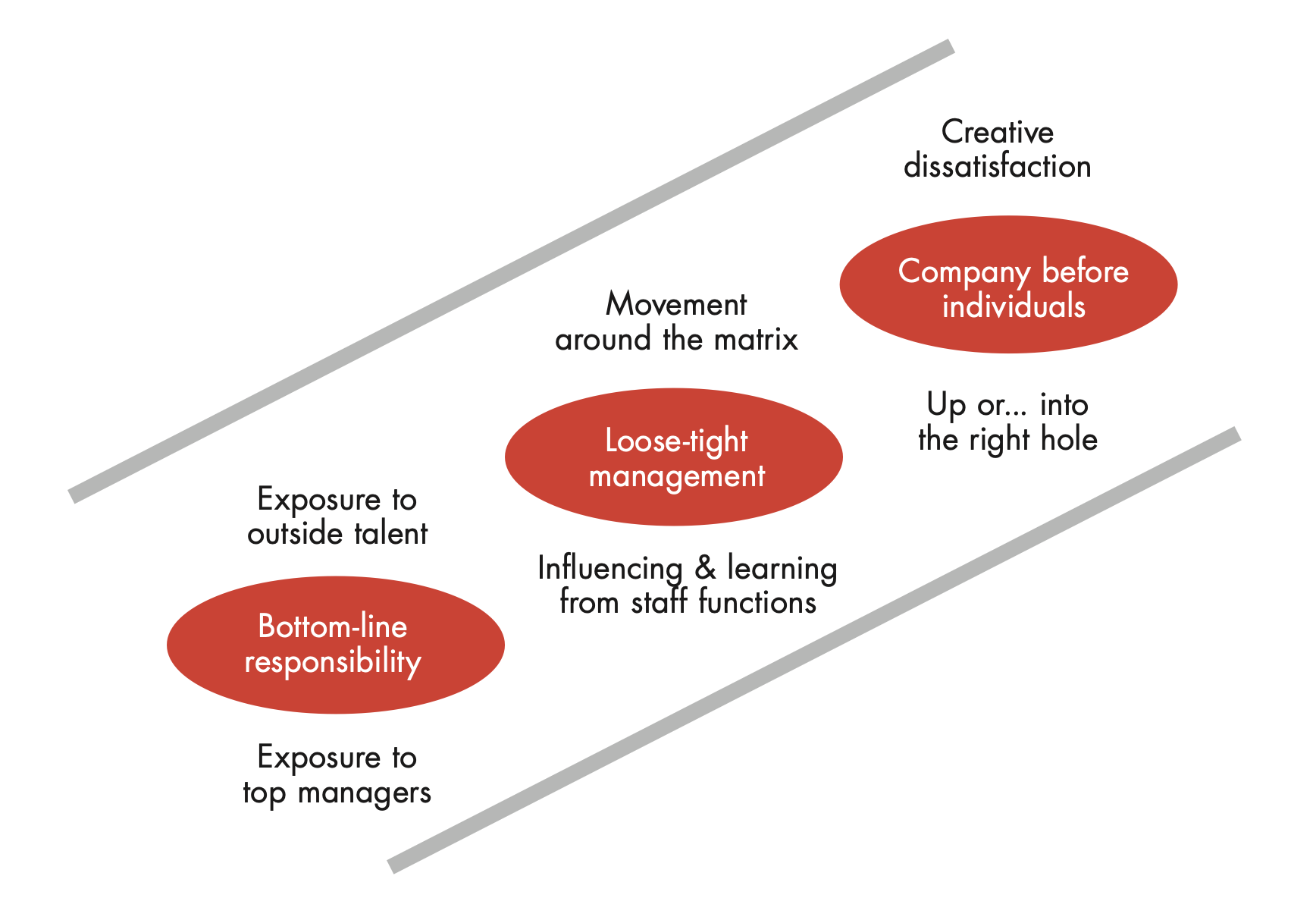
The Kraft system was different because development took place on the job, and for the job. As managers advanced, they moved through a series of experiences organised around three stages, each tied to a core principle of how Kraft actually ran its business. These stages were:
Assuming bottom-line responsibility — the dominant development principle in a Kraft’s manager’s early years was responsibility for the bottom line. This underscored Kraft’s belief that cost reduction was not a one-off, reactive program, but an ongoing process for freeing-up cash to invest in brand marketing. (Kilts internalised this belief; he brought it to Gillette with him). Managers were thus expected to deeply understand the supply-side of the business: often with the expectation that they should go down to the farms to understand the inputs to their products, or walk the factory floor to eke out productivity enhancements alongside production specialists. During this stage, early-career managers were exposed to good outside talent, and to top leaders within the company (Kraft attempted to limit the number of management layers, so that junior managers would have access to the top).
Practicing loose-tight management — once young managers had developed a broad understanding of the business, Kraft would let them loose. The company set tough financial objectives but gave managers enormous autonomy in hitting targets. They would then also begin to move managers around the matrixed organisation, to train them in the art of influencing others who didn’t report directly to them.
Putting the company’s interests ahead of their own — finally, making it to the end of the leadership corridor required a manager to consistently put the company’s interests ahead of their own. The nuance here is that at the very top, managers were expected to go beyond welcoming challenges to actually seeking it out. The expectation for senior execs at Kraft was that they were constantly agitating for ways to improve the company’s products and processes.
There are two things in the case that stood out to me.
First, you may have come across the idea that practice should be separate from performance, based on the belief that learning on the job is less effective. See, for instance, Tyler Cowen:
Recently, one of my favorite questions to bug people with has been “What is it you do to train that is comparable to a pianist practicing scales?” If you don’t know the answer to that one, maybe you are doing something wrong or not doing enough. Or maybe you are (optimally?) not very ambitious?
I’ve always been dissatisfied with this frame. My initial reaction was one of mild despair: most companies I know would never be able to dedicate the same level of resources to practice as, say, an NBA team; the frame also suggests that performance is never ideal to learn from. But the Kraft system demonstrates a middle path. If we cannot create a clean separation between practice and performance, fine: but make it such that folks can learn whilst on the job, in the pursuit of business excellence.
I think this belief — that the ‘best’ practice is separate from performance — comes from music, sports, and the performing arts, where there is a built-in divide between practice and performance. (To be clear, there are advantages if you can separate the two: we have a large body of research built around the study of expertise.)
But what if you’re not in a sport? Business does not have a natural separation between ‘practice’ and ‘performance’, and it takes genuine effort for businesses to continually invest in training. It would be better if the day-to-day operating of a business affords managers many opportunities to learn.
The Kraft system was designed to enable this, albeit through indirect means. Give your managers bottom-line responsibility, and then grant them exposure to top management (who have business expertise) and to external talent (so that new ideas proliferate into the org). As your leaders progress, move them around the matrix organisation so they develop empathy for both staff and line roles. Make it clear to them that the only way to advance is to learn the art of influencing others who do not directly report to you. (Both are necessary to become effective corporate leaders, since the matrix organisation is the most dominant structure in corporate America.)
Finally, set a culture of “put the company first”, and design mechanisms to get rid of all those who are brilliant assholes. Promote managers who continually push the boundaries of process and product improvement, again for the good of the company.
Is the Kraft system a training system, or is it a selection system? I think it is a bit of both. A learning & development person might say that this isn’t really training, since it assumes that managers must be capable of self-learning — from a plethora of ad-hoc sources — in order to succeed. But then most large companies don’t seem capable of producing the deep bench that Kraft has produced (and that Kilts later produced in Gillette). So I don’t think it’s just selection: even self-learners have to be given the opportunities — and incentives — to learn and grow.
The second observation I have is about the integration of training and business strategy. Notice this key piece from the case excerpt above (bold emphasis mine): the dominant development principle in a Kraft’s manager’s early years was responsibility for the bottom line. This underscored Kraft’s belief that cost reduction was not a one-off, reactive program, but an ongoing process for freeing-up cash to invest in brand marketing. (Kilts internalised this belief; he brought it to Gillette with him). Managers were thus expected to deeply understand the supply-side of the business: often with the expectation that they should go down to the farms to understand the inputs to their products, or walk the factory floor to eke out productivity enhancements alongside production specialists.
This is really only a thing in FMCG companies — and the proof is that the practice was brutally effective when Kilts brought it over to Gillette. Operational discipline led to increased cash, increased cash led to more dollars available for marketing, more marketing dollars invested meant brand defence, and therefore higher sales and higher market share for the brands and brand extensions managers were responsible for. This dynamic seems transferrable within the FMCG segment; there is no guarantee this would work for products in other kinds of businesses.
In fact, the authors of the Bain paper that explicated the Kraft Leadership Corridor had this to say at the end of their paper(bold emphasis mine):
Can other companies follow Kraft’s lead? Yes and no. Management development at Kraft is tailored to the company’s business strategy, so it would be a mistake to try to replicate it blindly. What’s right for Kraft is unlikely to be right for another company.
But it is possible to adopt the basic approach.
Any company can think carefully about its strategy and the principles underpinning it. Any company can chart a career course for managers that reinforces those principles. And any company can give its young execu- tives the responsibility to think and act like well-rounded chief executives.
This is ultimately why I wanted to publish this case: I’ve not seen many examples of remarkably effective executive training programs — and fewer still that have worked when implemented in multiple companies. Kraft’s is one. I’ll be keeping my eyes peeled for other examples.
Note: if you know of other examples, feel free to drop a comment below (you’ll have to be a paying member to leave a comment).