Finding a safe way to let LLMs modify your document tree in a way that is natural and doesn’t totally bork the document state is a hard problem. We want many timed and concurrent changes in small pieces like keystrokes, surgically mutating nodes, without abruptly swapping out big chunks.
Our System
Macro documents aren’t regular markdown documents. They’re a tree (an ASTree) of all the common nodes (headers, lists, tables), and a bunch of awesome custom ones — like our @mention node that points at other documents, document preview chips, etc. AI’s really great at pumping out Markdown, but for the case of Macro documents, we’re a bit beyond vanilla MD.
For our first pass, we took a simple approach: let the LLM only swap entire top
level blocks with generated hunks of Markdown that we parse right replacement
subtrees (we use Lexical for our editor and doc
representation). We thought it’d be easier for LLMs to produce quality MD than
to reason “bolding this word means splitting a text node into three nodes,
with a bold child.” a markdown **bold** word is a natural sentence for AI.
This was true-ish, but the “swap the entire block” approach was much too
coarse, and it’d often either edit way too much, or not get the job done. We
eventually un-shipped the implementation.
The second time around, I put focus not just on correctness, but also on editing
having a more natural, definitively noncreepy human vibe. So I built a black box
(I love black boxes) that pretends to be a human that can edit your documents on
your behalf. You say POST “update my tables and checklists” and Bob (AI) Sam (AI) and Lilly (AI) pop in and start editing all over the document. It’s fun,
the job gets done, and the way we do it the agents have full control down to the
deepest leaf in your document’s node tree. Let’s get building.
Other people who have done similar things before. The Electricsql folks have a blog about using a tool-call based system where the LLM operates like a human editor — it walks to a spot and “starts streaming” text. One idea that I had was to just give an agent full access to a real Neovim instance. But the issues with these kinds of approaches are that fundamentally our documents are not flat. We need a system that properly understands the tree structure of our documents.
Views
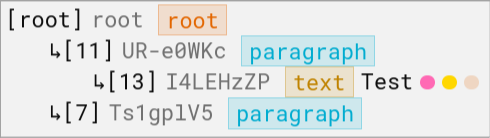
My first step was playing around with a bunch of different formats for presenting documents to AI. I imagined we needed a way where we would have the power to know exactly what node changed so as to emit proper CRDT events. We assign a stable ID to every node, and being able to see the ID in the input and output of the view we give the LLM makes it easier for us to produce a diff.
For example, the easiest path was just give it the raw JSON state
{
  "root": {
    "type": "root",
    "children": [ {
        "type": "paragraph", "$": { "id": "UR-e0WKc", "searchText": "Test" },
        "children": [ { "text": "Test", "$": { "id": "I4LEHzZP" } } ]
	  }, ],
    "$": { "documentMetadata": { ... }, "id": "root" }
  }
}
And have it produce JSON-patches to get us to a new state. Or we have it produce tool calls like “insert node after” on this JSON. But it turns out LLMs are absolutely terrible at producing good patches or JSON diffs, and the JSON itself overloads its context with complicated structure that it struggles to reason about.
We could use a fancy markdown-with-ID stamp view
# Test {j79y-kQTrLC}

- Test {TmIbYUa2T0B}
{list YDo797VdY9Q}
Where we could see what node is what if the LLM edited while keeping IDs next to nodes, and inserted some sort of placeholder when it wanted to create new ones. We also could use raw markdown, where we “infer” what the changes are. But going down this route would mean writing a complicated parser, and having to deal with serializing all of our custom nodes properly.
What I ended up settling on is an XML tree view
<doc>
  <p id="UR-e0WKc">
    <t id="I4LEHzZP">Test</t>
  </p>
</doc>
It’s easy, the LLM can understand the structure, and it’s natural for AI to think about things in XML. The main drawback here is that XML balloons pretty quickly, and context is expensive $$
What I realized is that we don’t need the input format for the LLM to match
its output! My initial approach was to just have it edit some serialized view
and tell it to go crazy with sed and python, but instead I got more
creative.
Claude Code recently added “dynamic workflows” recently, which is a feature where a primary agent writes a script to orchestrate a complicated flow of tasks.
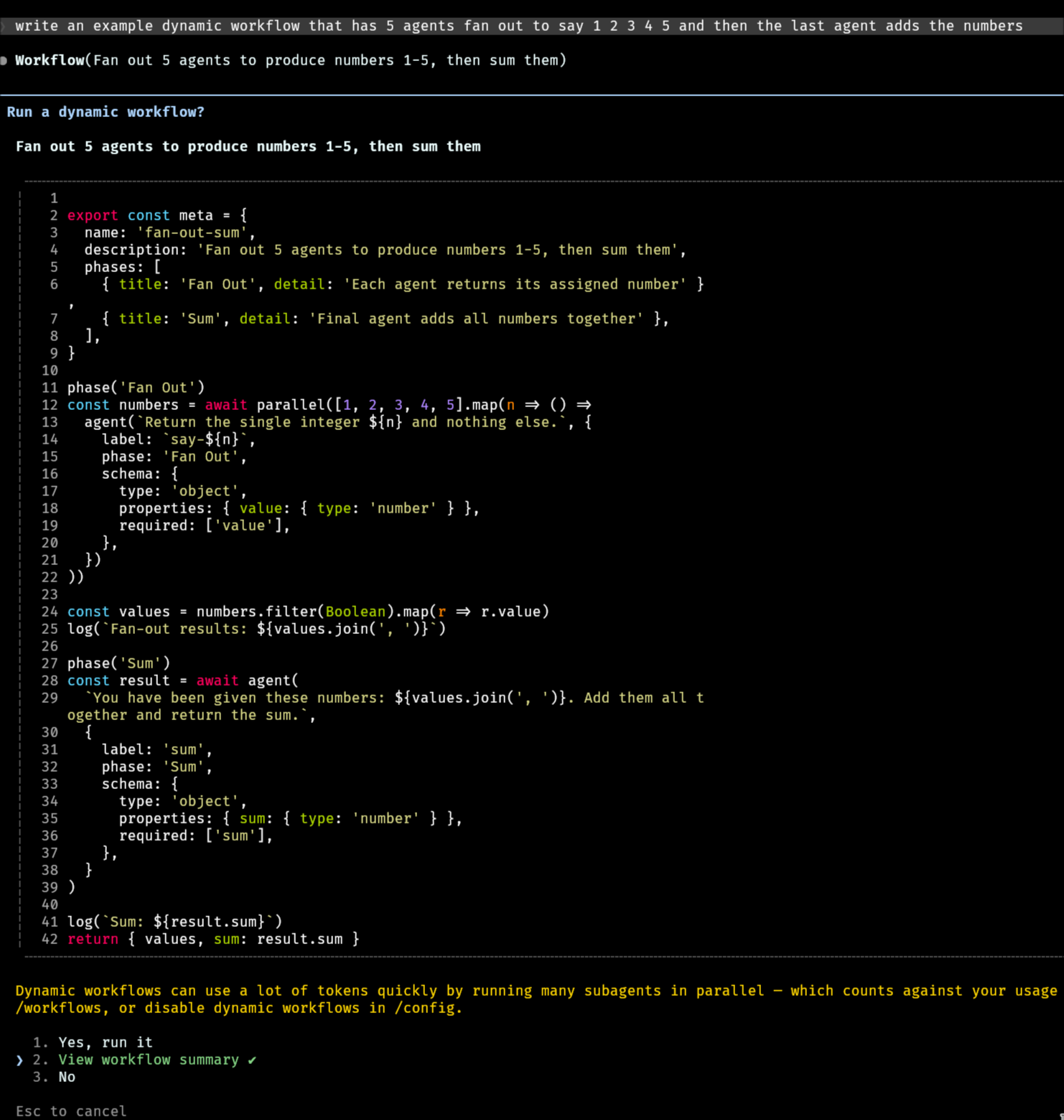
Rather than have the AI read some input and modify it, it got me thinking: maybe it’d most natural if the view is more of a “lens” that helps the agent figure out what it needs to do to edit the document, and it isn’t the one to make the changes. It can have small “editors” write code against a fake library that it believes actually modifies the AST. My thesis: having many small agents complete hyperspecific tasks produces a better result than having a single giant agent do everything at once because the semantics of document structure are delegated.
For the library I expose to these coders, I wanted it thin: it doesn’t literally act on our (Lexical) tree, but instead accumulates intended edits, so that I could do post-processing on the edit events to simulate animation, and more easily write tests.
Rather than literal imperative mutations
import { $getNodeByKey, $createTextNode } from 'lexical';

editor.update(() => {
  const para = $getNodeByKey('UKTNFKdd');
  if (!para) throw new Error('node gone');
  para.append($createTextNode('Hello, world!'));
});
It writes simple mutations.
editor.setText('UKTNFKdd', 'Hello, world!');So that the “editors” can be cheap models that don’t need much cognitive overhead to make real changes. These changes nest into a nice list of “operations,” like
[ { "kind": "setText", "node": "UKTNFKdd", "text": "Hello, world!" } ]And we can “chop” it up with an animation post-processing framework to make it look human.
[
  { "kind": "awareness", "x": { "type": "cursor", "node": "UKTNFKdd", "at": 0 } },
  { "kind": "pause", "ms": 120 },
  { "kind": "edit", "y": { "kind": "insertText", "node": "UKTNFKdd", "at": 0, "text": "Hel" } },
  { "kind": "edit", "y": { "kind": "setText", "node": "UKTNFKdd", "text": "Hello, world!" } }
]
Our animation “framework”:
A giant match on every op. Another unintended upside of going this route: we can run the generated code in a cheap quickjs sandbox with no libraries, and print out a JSON serialization super easily.
I ended up breaking up the task of editing and planning the edits.
Our magic trio of agents looks like:
- An “interpreter” sonnet thinking agent to digest the request. What do you want? Why do you want it?
- A “supervisor” haiku agent, that dispatches “writers” to write to the document, and keeps iterating until it’s happy with all the changes and feels the request has been met
- And a “team” of writers that work to execute simple mechanical tasks “add a heading”, “fill in the table,” “repeatedly check and uncheck these checkboxes and swap around the order to mess with Eric.” These agents write very simple code, and I’ve found success with cheap and fast Cerebras OpenAI OSS agents
The supervising agent doesn’t have to think at all about how the document is edited. It just reasons out a list of tasks for writers “insert paragraph next to node ID X that says Y,” “set the cell (2,3) in table ID Z to be blank,” etc.
One more fun trick: the supervisor doesn’t actually generate prose. It
generates “snippet specifications.” We let our coders reference prose that
doesn’t exist yet off of a magic snippets object, like
snippets.frogPoemParagraph. As they write code to edit the document, we have
n agents generate the snippets necessary to reassemble things. Eventually,
these snippets could be streamed and properly hook into our animation
framework so that mutli-coder-agent sessions can begin displaying aas!
Okay enough of the details. Now we’re both experts, let’s go through a real example here…
Let’s edit a document with our new AI editing system!
The first step to kicking off the flow is asking our Macro agent to edit your document. Let’s try a creative request
“write hello world in my document”
This will get it to call the document edit tool…
The user is asking me to edit the @Frog Report document. This is a request to edit an existing document. I will use my DocumentEdit tool to dispatch the edit.
Which will kick off the system. Now the interpreter agent will understand what you want…
# Interpretation
1. Literal ask: Write "Hello, world!" into the document.
2. Underlying goal: A minimal smoke-test of the editing pipeline.
3. End state: One <p> containing the text "Hello, world!".
4. Scope: Single paragraph. No structural changes.
5. Style: Plain text. No format to conform to.
6. Success checklist:
   - Paragraph holds the literal string (no placeholder).
   - No extra nodes introduced.
The supervisor reads the interpretation and dispatch the “editors” (potentially more than one at once!) to get the job done.
**dispatch** — 1 edit(s)
1. In paragraph id='UKTNFKdd', set its text to snippets.text.
Each editor writes a tiny bit of code, using our custom library,
const snippets = {
  text: "Hello, world!"
};
editor.setText('UKTNFKdd', snippets.text);
And we can now easily use a small Lexical translation layer to map the setText to the real document. But instead we pre-process the edits into a broken-up animation sequence and push them into a queue that will stream the events to everyone looking at the document…
…meanwhile, the supervisor will get a “report” back of how applying the code went:
1. ✓ APPLIED

+ Hello, world!
And then report back to the main Macro agent to conclude the tool call
Done! The paragraph now contains "Hello, world!" as a single text node.Which will then have it tell you that the job has been done. Now, the document is left being typed out by real looking editors.
If you found this interesting, Macro is open source, so feel free to check out the code here!