After decades of explosive growth, Austin, Texas, in the 2010s was a victim of its own success. Lured by high-tech jobs and the city’s hip reputation, too many people were competing for too few homes. From 2010 to 2019, rents in Austin increased nearly 93%—more than in any other major American city. And home sale prices increased 82%, more than in any other metro area in Texas.
But starting in 2015, Austin instituted an array of policy reforms aimed at encouraging the development of new housing, especially rentals. The city changed zoning regulations to allow construction of large apartment buildings, particularly near jobs and transit. In 2018, voters approved a $250 million bond measure to build and repair affordable housing. Permitting processes were reformed to speed development and reduce costs.
The efforts worked. From 2015 to 2024, Austin added 120,000 units to its housing stock—an increase of 30%, more than three times the overall rate of growth in the United States (9%).
Rents fell. In December 2021, Austin’s median rent was $1,546, near its highest level ever and 15% higher than the U.S. median ($1,346). By January 2026, Austin’s median rent had fallen to $1,296, 4% lower than that of the U.S. overall ($1,353). This decline occurred even though the city population grew by 18,000 residents from 2022 to 2024. In apartment buildings with 50 or more units, rents fell 7% from 2023 to 2024 alone—the steepest decline recorded in any large metropolitan area. Rents declined about 11% in older non-luxury buildings that cater to lower-income renters, known as Class C buildings.
Austin’s success serves as an important example of how regulatory barriers to building more housing are often varied and interconnected. No single solution can solve a housing shortage, but Austin has taken multiple steps that have helped to unlock large amounts of housing supply in its market and reverse rent growth, including rent for tenants of lower-cost, older apartments. The city continues to take forward-looking steps—among them reforming building codes, streamlining permitting, and facilitating the construction of small apartment buildings—to reduce housing underproduction and improve affordability for existing and future residents.
Austin’s regulatory reform efforts have focused on both new supply and affordability
Over the past two decades, Austin has made myriad changes designed to encourage more housing. These include opening more areas to more types of homes, such as mixed-use buildings and accessory dwelling units (ADUs)—small homes usually located in a basement, backyard, or garage—as well as allowing taller buildings with more units and reducing parking requirements in certain neighborhoods. The reforms include:
- Mixed use. In 2007, the city created a new zoning category, Vertical Mixed Use (VMU), which relaxed mandates for projects that met requirements related to building-design quality, eco-friendliness, and other features that the city wanted to incorporate. VMU zoning incentivized construction by allowing more units per site and reducing minimum parking requirements by 60%. As of February 2024, more than 17,600 units either were built or were in the process of being built in VMU-zoned areas. Both market-rate and income-restricted homes are allowed under VMU; most of those built were market rate.
- Targeted rezoning. The city strategically modified zoning rules in certain neighborhoods and sites targeted for growth. These areas, including downtown Austin and neighborhoods near the University of Texas at Austin, have added substantial numbers of units through density bonus programs, which increase maximum building heights if developments include income-restricted units. These programs, adopted over the past two decades, have added more market-rate and affordable homes.
- ADUs. In 2015, the city amended its land development code to ease regulations for ADUs by reducing the minimum lot size from 7,000 to 5,750 square feet, removing the requirement for a second driveway, and reducing the number of required parking spaces from two to one. Because of these changes, ADUs, which previously were allowed on only a minority of single-family lots, are now permitted on the vast majority of them. From 2015 to 2024, Austin permitted 2,850 new ADUs, or more than 250 annually—nearly four times the rate of new ADU permits from 2010 to 2014.
- Parking. In 2023, Austin removed minimum parking requirements for nearly every kind of property citywide. Austin remains the largest city in the country to enact this change.
A key piece of Austin’s strategy has been to encourage the construction of affordable housing. The city pursued this goal through density bonuses—allowing taller buildings with more units when they include income-restricted units—and bond levies to build more affordable homes. In 2018, for example, city voters approved a $250 million bond measure to support the construction of affordable housing. A year later, the City Council approved a program called Affordability Unlocked that eased building height and unit number restrictions, parking requirements, and other development regulations for projects in which at least 50% of units are income-restricted.
Austin’s commitment to subsidizing affordable housing development allowed the city to lead the country in affordable housing construction in 2024. Austin has implemented several policies in recent years that facilitated the building of 4,605 affordable housing units, more than double the number built in 2023. The policies included:
- Density bonuses. The University Neighborhood Overlay (UNO) program, a density bonus initiative targeting the area adjacent to the University of Texas at Austin, was first passed in 2004 and was updated in 2014 and 2019. Currently, building height maximums in the UNO range from 60 feet (in the Dobie area) to 300 feet (in the inner West Campus area). Since program implementation, the UNO has led to the development of more than 572 income-restricted units and more than 911 beds. A similar initiative, the Downtown Density Bonus Program (DDBP), was first passed in 2014. For projects that meet program requirements, including reserving at least 50% of units for affordable housing, restrictions are eased to allow building heights ranging from 90 feet to more than 400 feet, with restrictions on floor-to-area ratios (a building’s combined floor area versus the size of its lot) ranging from 3-to-1 to 25-to-1. In 2025, building heights in the DDBP were capped at 350 feet. In 2024, Austin implemented a density bonus program via an Equitable Transit-Oriented Development Density Bonus District that eased restrictions to allow buildings up to 90 feet in height if income-restricted housing is included.
- Municipal bonds. The city has also committed hundreds of millions of bond dollars toward affordable housing, with many measures receiving overwhelming local support. For example, in 2022, Austin taxpayers approved a $350 million bond measure that passed with 71% of the vote, and funds are nearly fully committed. Bond funds will go toward buying land and building homes, or repairing homes already occupied by low-income residents. This bond measure follows a similar $250 million measure that was passed in 2018 and whose funds have been nearly depleted.
Austin rents decrease while affordability improves
Austin city and metropolitan-area construction has surged since 2015, helping to make the Texas capital one of the only major cities where rent has fallen since the pandemic. Asking rents decreased 4% in both the city and the surrounding suburbs from 2021 to 2025. (See Figure 1.) In real terms, inflation-adjusted rents in the city of Austin fell 19% from the 2021 average to the 2025 average. This trend contrasts favorably with the national rent growth of 10% and the 6% increase in high-growth Texas.
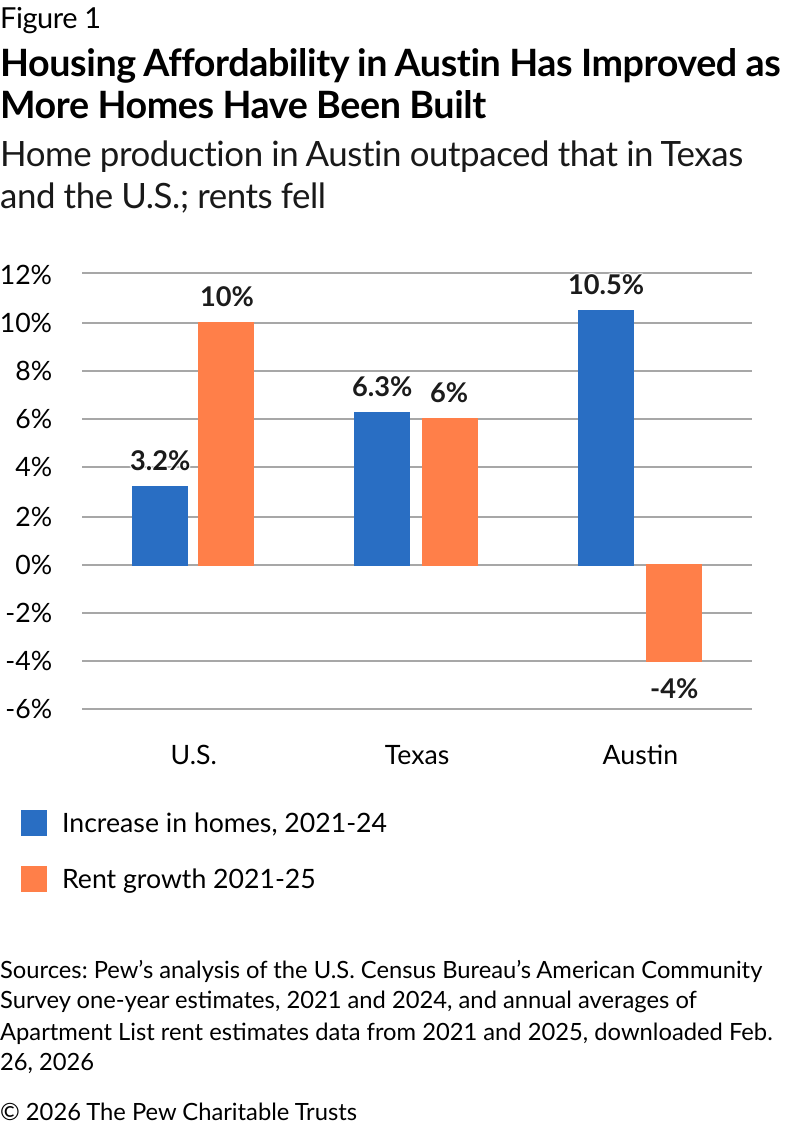
In Austin and its metropolitan area, rents in large apartment buildings decreased by 7% from 2023 to 2024—the greatest drop in any U.S. metropolitan area. This decrease was most pronounced (-11.4%) in Class C buildings, the older, non-luxury structures that offer affordability for renters at the lower end of the income spectrum. In Class A buildings, which are newer and more high-end, rents fell only 2.6%.
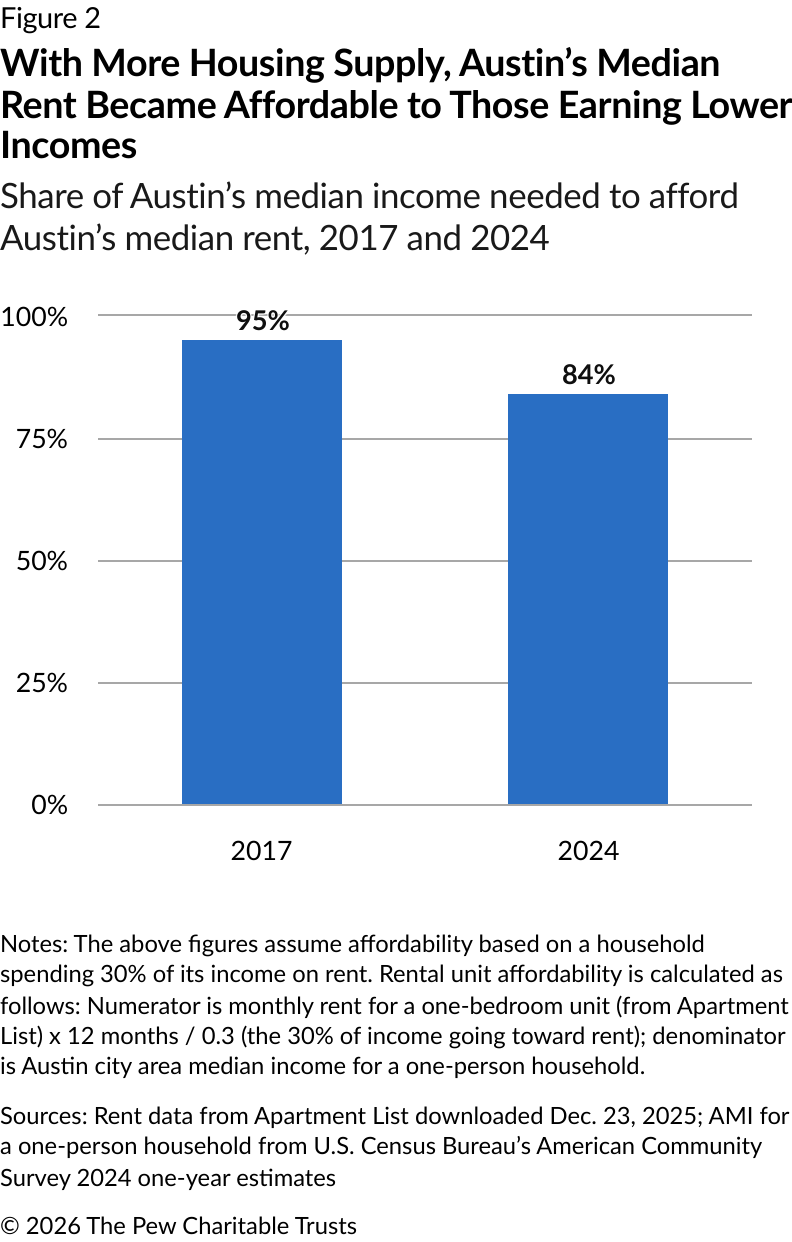
These decreases in rent have led to real improvements in affordability for Austin renters. In 2017, the city’s median rent for a one-bedroom unit was affordable to a single-person household earning 95% of the area median income (AMI). Seven years later, that number had declined to 84%. (See Figure 2.)
Construction boom adds a variety of new homes in Austin
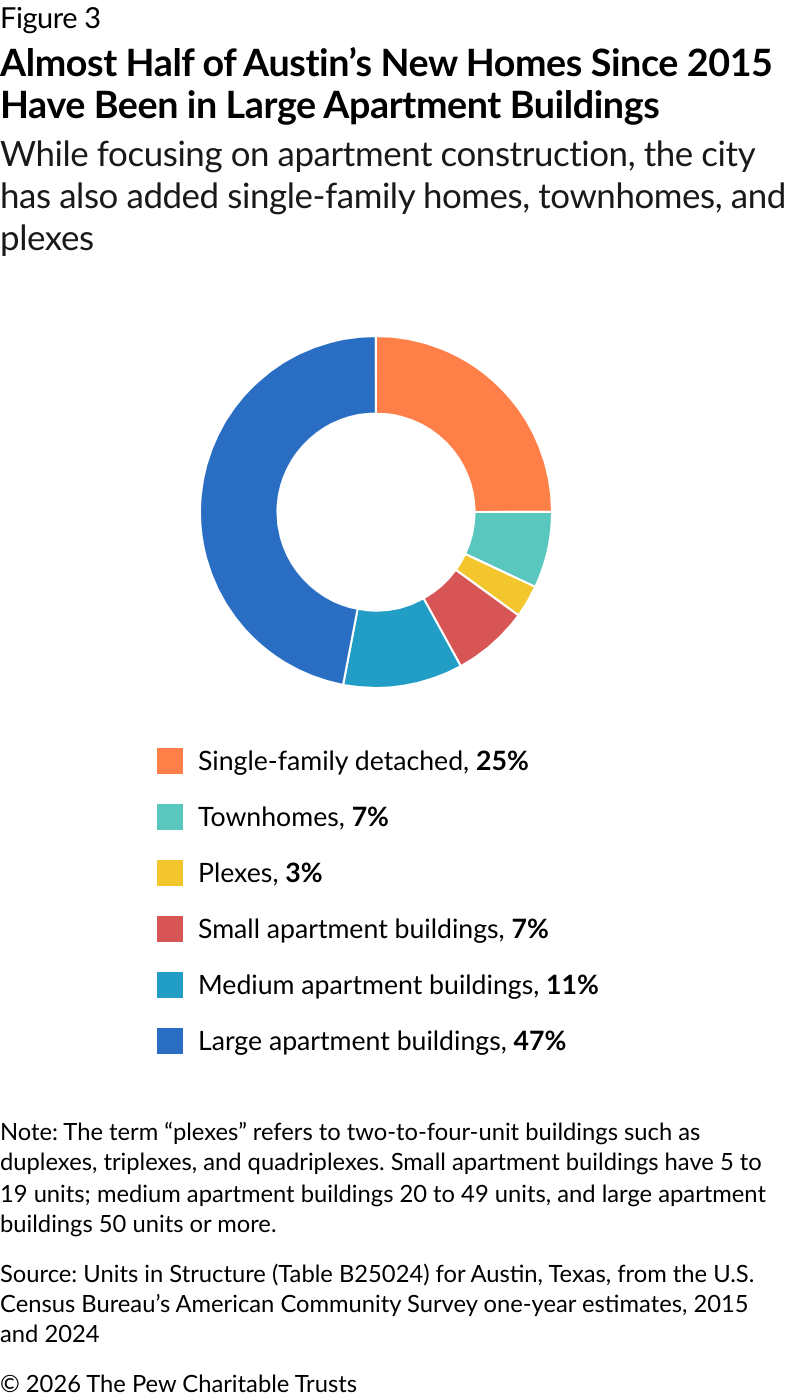
Austin added 120,000 new homes from 2015 to 2024 by encouraging a variety of home types throughout the city. (See Figure 3.) Large apartment buildings account for almost half of the new units, while one-third were new single-family homes or townhomes. Construction of 2,850 ADUs accounted for a meaningful share (7%) of Austin’s new detached and attached single-family homes and townhomes. Austin’s suburbs have also grown, adding 214,000 new units from 2015 to 2024, but with a different type of housing: 77% were single-family homes or townhomes.
Austin’s recent embrace of apartments has been so successful that it has shifted the housing typology of the city. In 2024, less than half of the housing units in Austin were single-family homes or townhomes, in contrast to 71% of U.S. housing and 80% in Austin’s suburbs. From 2021 to 2023, builders in Austin averaged permits for 957 apartments for every 100,000 residents, outpacing all neighboring regions. For comparison, the area in Texas with the second-highest production of permits—San Antonio—averaged only 346 apartments per 100,000 residents in the same period.
Despite this growth, the need for additional housing remains. Up for Growth, a housing equity advocacy organization, estimated that the Austin metropolitan area had an underproduction of more than 23,000 units in 2022. Housing gaps for lower-income city residents, especially those looking to buy a house, are even greater. One city-commissioned study in 2014 found a gap of 48,000 rental units for would-be homeowners making less than $25,000 (around 30% of the local AMI). Austin’s continued demand for housing and a slowdown in apartment completions may see rents trend upward again. Austin has looked at additional reforms to continue the pace of adding new housing that’s affordable to different income groups, and of streamlining the process to approve and permit new homes.
Forward-looking reforms seek to continue housing momentum
Austin recently has pursued additional forward-looking reforms to simplify building permitting, amend building codes, and provide an even greater variety of home types. The reforms include:
Plexes, ADUs, and building renovations. The HOME initiative passed in two phases, one in 2023 and the other in 2024, has made it easier to build duplexes, triplexes, and ADUs and has simplified building renovations. The reform also simplified regulations for two-to-three-unit buildings. It has removed some ADU dimensional requirements, including maximum size. Renovations may increase the number of units in existing buildings through a preservation or sustainability bonus if the renovation maintains at least half of the existing building and the entire street-facing facade.
Lot size minimums. The HOME initiative has also eased minimum lot size and width requirements. Austin’s minimum lot size reduction from 5,750 square feet to 1,800 square feet followed a similar reform in Houston that led to a wave of small-lot homes that cost less than other single-family detached homes.
Height flexibility near single-family homes. In 2024, Austin revised compatibility standards, a zoning regulation that limits the height of buildings near single-family homes, reducing compatibility enforcement zones from within 540 feet of single-family homes to within 75 feet to allow more height flexibility. Also in 2024, Austin exempted “lower-intensity multifamily” zones, a land use designation that allows for “missing middle” homes like duplexes and triplexes, from compatibility standards.
Permitting: Austin has pursued permitting reform to speed up the building process. The city enacted its Site Plan Lite and Infill Plats initiatives to remove impediments to building small-scale housing. Phase One of Site Plan Lite, initiated in July 2023, extended a site plan exemption for three-to-four-unit projects. Phase Two, passed in 2025, simplified regulations for certain residential developments of five to 16 units.
In 2023, Austin also implemented an expedited building plan review program, for which most residential projects are eligible. This concerted effort to simplify zoning has helped the city to speed up permitting. From 2023 to 2024, the city reduced site plan review times and follow-up turnaround times by more than half. This improvement was sustained through 2025, as reflected in city performance metrics. In 2025 as part of this program, Austin also piloted an AI precheck tool, a joint project with Archistar that seeks to provide feedback and highlight potential problems with plan applications within one business day. The city expects the tool to halve the total time of the review process.
Single-stairway midrise apartments. Austin also passed a single-stair ordinance in 2025 for apartment buildings up to five stories, allowing buildings with no more than 20 units above grade to have one stairway, which reduces construction costs and allows buildings to fit on small, underused lots or above individual stores or restaurants.
Conclusion
Austin’s rapid growth and escalating housing costs in the 2010s led local officials and stakeholders to act decisively to remove barriers to adding homes. These actions, combined with enormous demand for housing, kicked off a long-running building boom. Proactive city policies have allowed development in neighborhoods of all income levels and have benefited households with the greatest affordability struggles. The policies:
- Welcome apartment buildings. Code reform and zoning reform, including reducing and then eliminating parking mandates, enabled development of smaller and larger apartment buildings.
- Focus on affordability. Density bonuses, housing bonds, and regulatory relief for buildings with income-restricted units spurred more housing development.
- Make the development process easier. Streamlined permitting and site plan review reduced delays for all new housing developments.
- Encourage starter homes. Reducing lot-size minimums, allowing ADUs, and allowing duplexes and triplexes provided housing choices across neighborhoods.
A combination of strong demand and proactive policy changes spurred Austin’s housing supply surge, benefiting its residents, who saw the steepest rent declines of any large U.S. city from 2021 to 2026.
Seva Rodnyansky is a manager and Dennis Su is an associate with The Pew Charitable Trusts’ housing policy initiative, and Liz Clifford is an associate with Pew’s research quality and support team.