DISCLOSURE: If you buy through affiliate links, I may earn a small commission. (disclosures)
I recently rewrote my blog from C# to Rust as a way to further explore High-Level Rust. Both versions serve the same 1,025+ posts from memory using the same architecture: parse all posts at startup, build indices, serve everything from memory. So I thought it was a good opportunity to benchmark them side-by-side.
The result: Rust uses 4.6x less memory and is 2-8x faster on p50 latency across seven endpoints at three concurrency levels for essentially the exact same logic.
Caveat: all benchmarks have asterisks. We'll go through the methodology and limitations so you can judge the results for yourself.
Test Setup
Most Rust vs C# benchmarks compare synthetic hello-world endpoints. This one compares the same real-world application - my markdown blog - running on both stacks with equivalent content and architecture.
- Rust stack: axum 0.7, Maud templates, rayon for startup parsing
- C# stack: ASP.NET Core, CinderBlockHtml (HTML DSL), same in-memory approach
- Endpoints tested:
/,/about,/blog,/blog/2025-reflection,/tags/finance,/tags,/stats - Benchmark tool: custom Rust CLI wrapping hey, measuring full response time through body consumption
- Environment: Docker containers on the same machine (mirrors production), memory measured via
docker statswith 10s post-startup baseline - Load levels: light (5K requests, 10 concurrent), medium (10K, 50 concurrent), heavy (20K, 100 concurrent)
Known limitations:
- Single machine — server and bench tool compete for resources
- Limited warmup for C# (5 requests) — JIT benefits from more, though p50 across 5K+ requests amortizes this
docker statsincludes kernel overhead which inflates both numbers slightly and is imprecise in sampling- Single runs of each benchmark — no statistical averaging across multiple runs
Memory: 4.6x Less in Rust
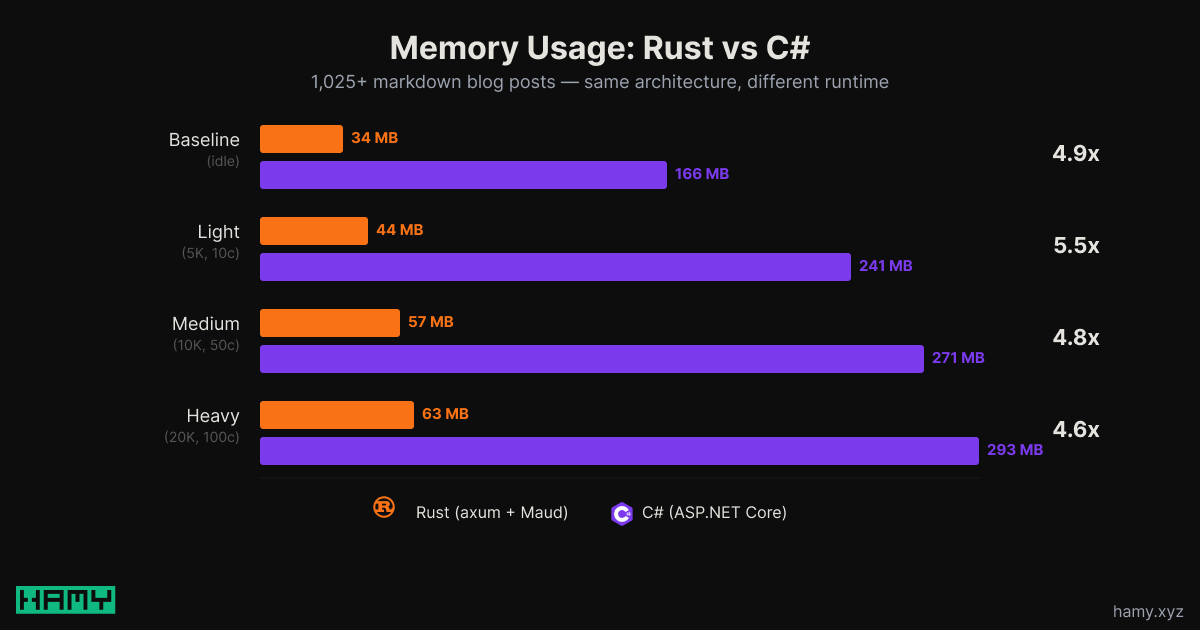
| Rust | C# | Ratio | |
|---|---|---|---|
| Baseline | 34 MB | 166 MB | 4.9x |
| Light load (5K, 10c) | 44 MB | 241 MB | 5.5x |
| Medium load (10K, 50c) | 57 MB | 271 MB | 4.8x |
| Heavy load (20K, 100c) | 63 MB | 293 MB | 4.6x |
Rust with all 1,025+ posts loaded in memory uses almost 1/5th the RAM that C# uses just to start up with nothing loaded.
Why C# uses more: .NET has significant runtime overhead from its garbage collector, JIT compiler, and type system metadata. Microsoft's docs show ~50MB for a Hello World ASP.NET Core app so our 166MB baseline with 1,025 posts loaded is reasonable.
Why Rust's memory grows under load: This is heap fragmentation, not a memory leak. It's well-documented in the tokio ecosystem — it's the same "stair-step" pattern Svix saw in production. I verified by running the heavy load benchmark 3x back-to-back without restarting: 63MB, 71MB, 67MB. The plateau signals no leak (we'd expect ~linear growth with a leak).
Latency: 2-8x Faster in Rust
Here are the results under heavy load (20K requests, 100 concurrent):
| Endpoint | Rust P50 | C# P50 | Speedup | Rust Req/s | C# Req/s | Req/s Speedup |
|---|---|---|---|---|---|---|
/ |
444µs | 2.17ms | 4.9x | 1,283 | 388 | 3.3x |
/about |
406µs | 1.65ms | 4.1x | 2,058 | 575 | 3.6x |
/blog |
811µs | 6.83ms | 8.4x | 1,063 | 139 | 7.7x |
/blog/slug |
599µs | 2.65ms | 4.4x | 1,411 | 361 | 3.9x |
/tags/finance |
508µs | 1.04ms | 2.0x | 1,690 | 445 | 3.8x |
/tags |
1.73ms | 10.84ms | 6.3x | 535 | 82 | 6.5x |
/stats |
533µs | 1.83ms | 3.4x | 1,601 | 498 | 3.2x |
A few patterns stand out:
Heavier pages show bigger gaps. /blog (listing all posts) hits 8.4x, /tags (listing all tags with post counts) hits 6.3x. These pages render the most HTML, so the advantage of Maud's compile-time template generation compounds.
Simple pages still show 3-4x. Even /about and individual blog posts — relatively lightweight pages — are consistently 3-4x faster.
The gap widens with concurrency. /blog goes from 4.1x at 10 concurrent to 5.6x at 50 to 8.4x at 100. This is consistent with GC pressure - as concurrency increases, the garbage collector has more work to do, and the occasional GC pause shows up more in p50 numbers. Rust's tokio runtime has no garbage collector; it only yields at .await points, so there are no stop-the-world pauses (though stop the world starvation / deadlocks are still possible and arguably more likely in a language like Rust).
Results at Other Load Levels
For completeness, here are the light and medium load results:
Light load (5K requests, 10 concurrent):
| Endpoint | Rust P50 | C# P50 | Speedup |
|---|---|---|---|
/ |
101µs | 345µs | 3.4x |
/about |
118µs | 245µs | 2.1x |
/blog |
222µs | 906µs | 4.1x |
/blog/slug |
160µs | 361µs | 2.3x |
/tags/finance |
144µs | 346µs | 2.4x |
/tags |
475µs | 2.35ms | 4.9x |
Medium load (10K requests, 50 concurrent):
| Endpoint | Rust P50 | C# P50 | Speedup |
|---|---|---|---|
/ |
237µs | 1.48ms | 6.2x |
/about |
287µs | 815µs | 2.8x |
/blog |
541µs | 3.03ms | 5.6x |
/blog/slug |
364µs | 1.27ms | 3.5x |
/tags/finance |
344µs | 1.18ms | 3.4x |
/tags |
1.09ms | 9.14ms | 8.4x |
The Outlier: /stats Was 0.9x (C# Won)
In the initial benchmark, /stats was the one endpoint where C# was slightly faster — 0.9x. Here were the initial heavy load results:
| Endpoint | Rust P50 | C# P50 | Speedup |
|---|---|---|---|
/stats |
2.07ms | 1.83ms | 0.9x (C# wins) |
The root cause wasn't a language difference but an implementation gap. The C# version pre-computed all stats at startup (post counts, word totals, yearly groupings) then renders the HTML on each request. The Rust version was recomputing everything per request: 4 full scans of all 1,025 posts, HashMap grouping by year, and tag counting with visibility filtering.
After fixing the Rust version to pre-compute stats at startup (matching the C# approach):
| Metric | Before Fix | After Fix |
|---|---|---|
| Rust P50 | 2.07ms | 533µs (3.9x faster) |
| vs C# P50 | 0.9x (C# faster) | 3.4x (Rust faster) |
| Rust Req/s | 453 | 1,601 (3.5x more throughput) |
So the 0.9x outlier was a missing optimization that the C# version already had. Once the implementations matched, /stats showed the same 3-4x Rust advantage as every other endpoint.
Does Any of This Matter?
For a personal blog? Not really. Sub-millisecond vs low-millisecond latency is imperceptible to users. Nobody is hitting my blog with 100 concurrent requests and the network latency from my Hetzner box in Finland to US East (~100ms) drowns out any gains from faster rendering.
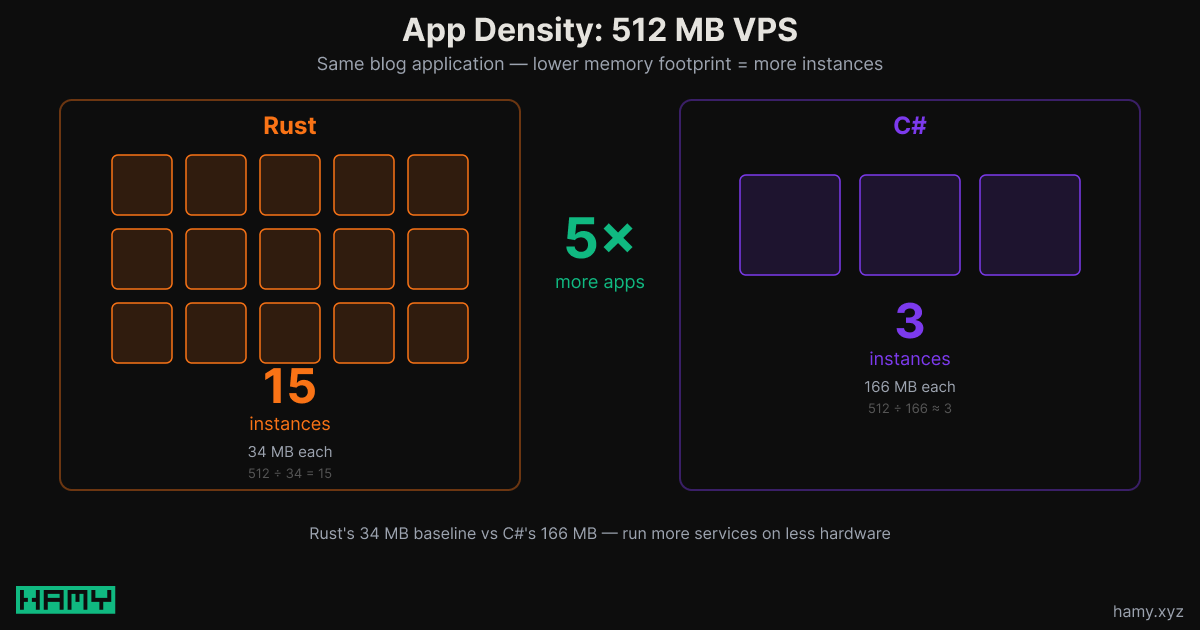
Where it does matter:
- Hosting costs. 34MB vs 166MB baseline means running more apps comfortably on smaller instances.
- Tail latency at scale. The p99 gap is larger than the p50 results we showed here due to GC pauses, so at scale this can have a larger impact on your e2e latency.
- Container density. In Kubernetes, benchmarks show Rust at ~9MB vs C# at ~200MB — that's 22x more containers per node.
A few counter-arguments worth acknowledging:
- .NET is getting better. .NET continues to improve with features like DATAS server GC and AOT reducing memory footprint and impressive yearly performance improvements so I'd expect the memory / latency gap to shrink in the coming years.
- Developer productivity. C# is still faster to write for most teams as Rust's borrow checker has an infamous learning curve. Techniques like High-Level Rust and AI can help but don't fully eliminate it.
Next
Rust is 2-8x faster and uses 4.6x less memory than C# for running my markdown blog. The advantage is largest on heavy pages and under high concurrency.
But performance isn't the only reason to choose a language. I wrote about why I use high-level Rust — the performance is a bonus on top of the type system and ownership model. And with agentic AI engineering, the productivity gap is narrowing.
If you're considering Rust for a web project, the performance story is real and I personally think the learning curve can be vastly improved with the right approach. I'm building CloudSeed - a fullstack Rust boilerplate - using this paradigm to help improve devx and ship speed. You can get it now for an early access discount for a limited time.
If you liked this post you might also like: