
This was sent as an email on 9 November 2026 to the Commoncog newsletter, as part of a series of emails promoting an upcoming Tactical Decision Game (TDG) Design Workshop by ShadowBox. I’m republishing on the Commoncog website because the ideas here are useful. The full email is available below.
Hi there,
This email was supposed to tell you that the deadline for applications for ShadowBox's Tactical Decision Game Design Workshop closes tomorrow. But Jared Peterson (of ShadowBox) tells me (Cedric) that they’d like a few extra days to market to ShadowBox's own audience, so the deadline is now extended to the 13th of November.
So you have three extra days to sign up. Seeing as there’s only five seats left, though, well ... let’s see how long that lasts.
But this delay gives me an opportunity to send one final email about TDGs.
I should take this opportunity to reiterate that I have no financial interest in this workshop. I did pitch ShadowBox the idea, and I did have one requirement — which was that Commoncog members get first dibs. And then I helped them do the marketing for the launch, because that was in my wheelhouse. But I’ve mostly done this because I want this workshop to be available to the public — John Schmitt rarely does this outside of select organisations. (Who have to pay him for a training engagement!)
Now, the majority of folks who have signed up for this workshop are Commoncog members. And because I know them, I can say with some confidence that — unlike me — folks are trying to learn TDGs to:
and ...
Wait, did you say maths?!
Well, yes.
I wrote a Twitter thread explaining this idea. It ... got a little out of hand. I’ve adapted that thread to this email, with minor edits, so forgive the slightly snappy prose, which was written with that medium in mind.
The idea, though, is important enough that I think it’s still worth reading.
This email explains why the learning science behind TDGs are more powerful than you might think.
Over the last few days I’ve spent a lot of time talking about how ‘sensemaking is the heart of expertise.’
You know: “if you can get novices to see like experts, you’ll accelerate their expertise”
Which, cool!
But a common question is: “ok ... so what about maths?”
And maybe not maths per se, but “what about traditional school topics, the kind that my kids struggle with at school?”
Or: “It’s great that all of these methods exist for US Marines and businesspeople, but what does this have to do with traditional school learnin’?”
As it turns out: a LOT. Let’s use maths as an example, because it’s convenient.
The short answer is that you CAN accelerate ‘sensemaking’ with maths as well.
But the term ‘sensemaking’ may be a bit confusing here. We need to take a step back to define the concept.
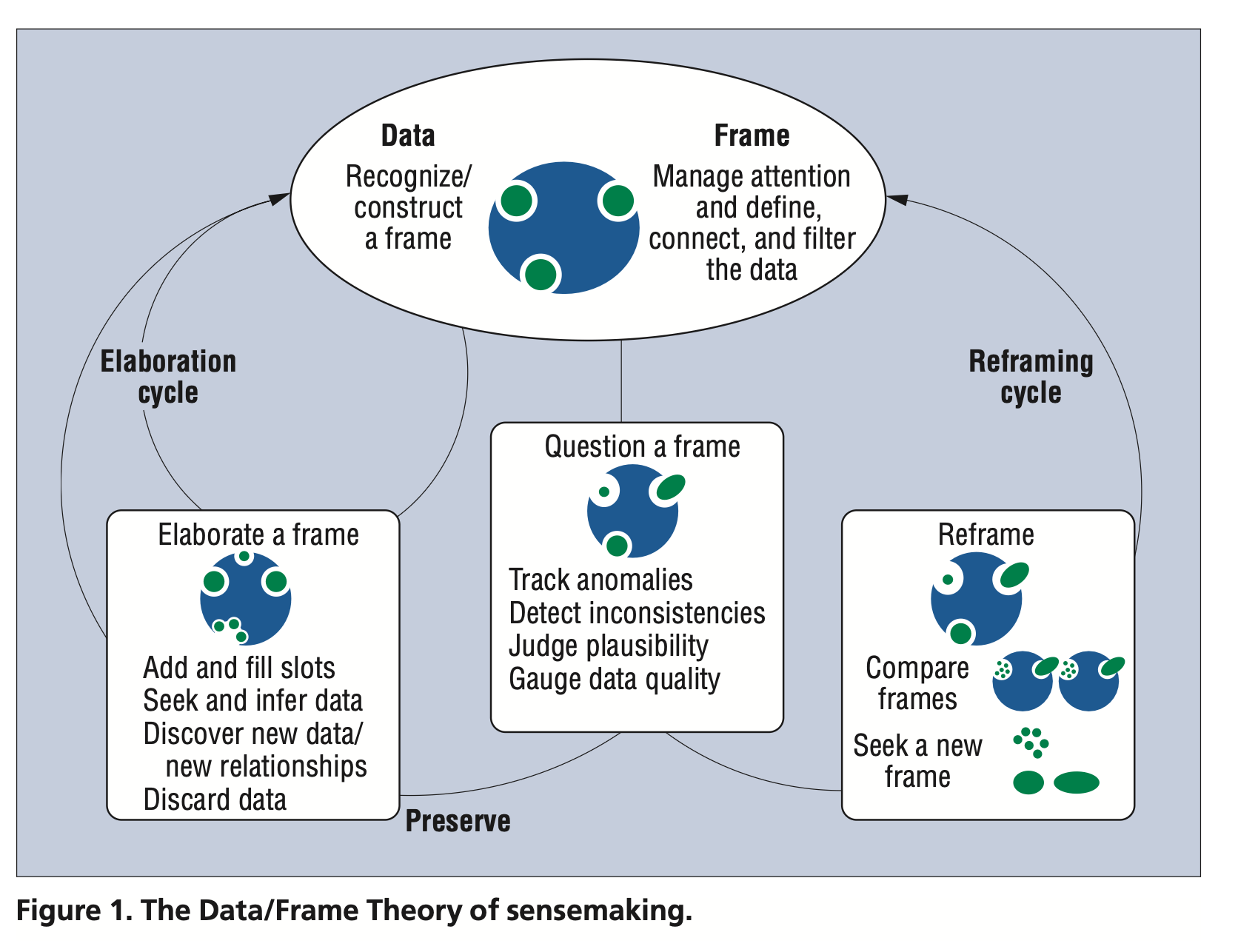
The best theory I’ve found to explain how people make sense of things is the Data Frame Theory of Sensemaking. This says, basically, that humans only make sense of information in the context of a ‘frame’.
This is intuitive, I think.
If you ask an insurance appraiser to look at a house, they would see different things from a firefighter or carpenter.
If you ask a novice rock climber to look at a cliff face, they would see different things from an expert.
I go in depth on this theory and its implications here: How Experts Sensemake.
Now, in the original Data-Frame paper, the authors state that they’re using ‘frames’ are a catch-all term for a whole bunch of psychology constructs.
Amongst them are ‘schemata’, ‘scripts’, ‘mental representations’.
If we want to apply this to maths, we need to know we’re talking about schemata. Here’s a snippet from the original paper:
There is an ample literature on frames (Goffman, 1974; Minsky, 1975; Rudolph, 2005; Smith, Giffin, Rockwell, & Thomas, 1986) and similar concepts such as scripts (Schank & Abelson, 1977) and schemata (Bartlett, 1992; Neisser, 1976; Piaget, 1952, 1954). Rudolph (2005) asserts that the way people make sense of situations is shaped by cognitive frames that are internal images of external reality. For Minsky, a frame is a type of data structure in which individual cases are defined in terms of a set of features on each of a number of feature parameters, which are used to organize a listing of case attributes and provide a common representational format for all cases of the same type. For Goffman, a frame is a culturally relative system of rules, principles, and so on, that are used to organize society and guide individual behavior. For Schank and Abelson, a script is a regularly occurring sequence of events or activities that can be formulated as a template for structuring a description of particular instances of events or activities of the same kind. For Piaget, a schema is a mental representation of the persistent features or attributes of objects. For Bartlett, a schema is a mental representation of the structure of event descriptions (e.g., stories), usually taking the form of regularly occurring and culture-specific sequences of dramatic subevents. For Neisser, a schema is a situation- or domain-specific cognitive structure that directs external information search, guides attention management, organizes information in memory and directs its retrieval, and becomes more differentiated as a function of experience.
That is: we’re talking about the mental representations that you have in your head.
So the real question is: what mental representations (or frames) live in the heads of professional mathematicians that the rest of us don't have?
Thankfully, we have a former professional mathematician who has written about how the pro mathematicians got good. And it’s not like what you think.
This is David Bessis, in his 2024 book Mathematica.
So what do you see when you look at a maths problem? And then: what does an expert mathematician see?
Now, I’m particularly bad at maths. So when I look at an equation, I see symbols on a page.
Bessis points out that expert mathematicians do NOT see symbols. They instead see some ... thing. Some representation.
Now: what representation do they have exactly?
This is where things get interesting. Bessis explains that most pro mathematicians learn from an early age that they need to spend time daydreaming — making up new objects in their heads.
Why?
Because if you have the right object in your head, suddenly a whole class of problems become solvable through intuition alone.
This seems a little bizarre. So let’s use Bessis’s favourite example.
Suppose Bessis hands you some equations. One is for a circle, one is for a line.
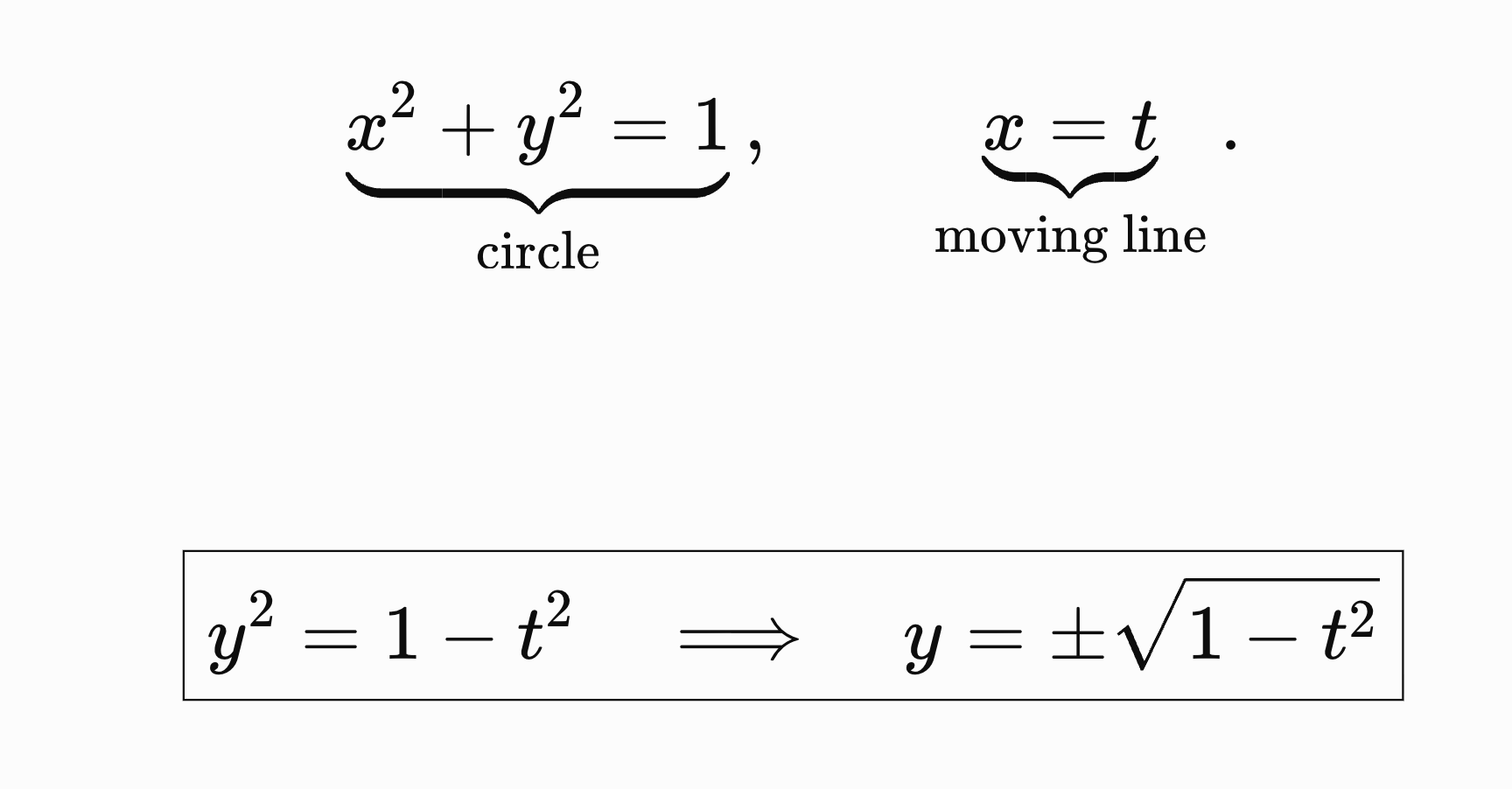
He asks you “Can a straight line intersect a circle at three points?”
I (being a maths doofus) look at the equation and see symbols on a page. You (a maths prodigy) look at the equations and imagine the following thing:
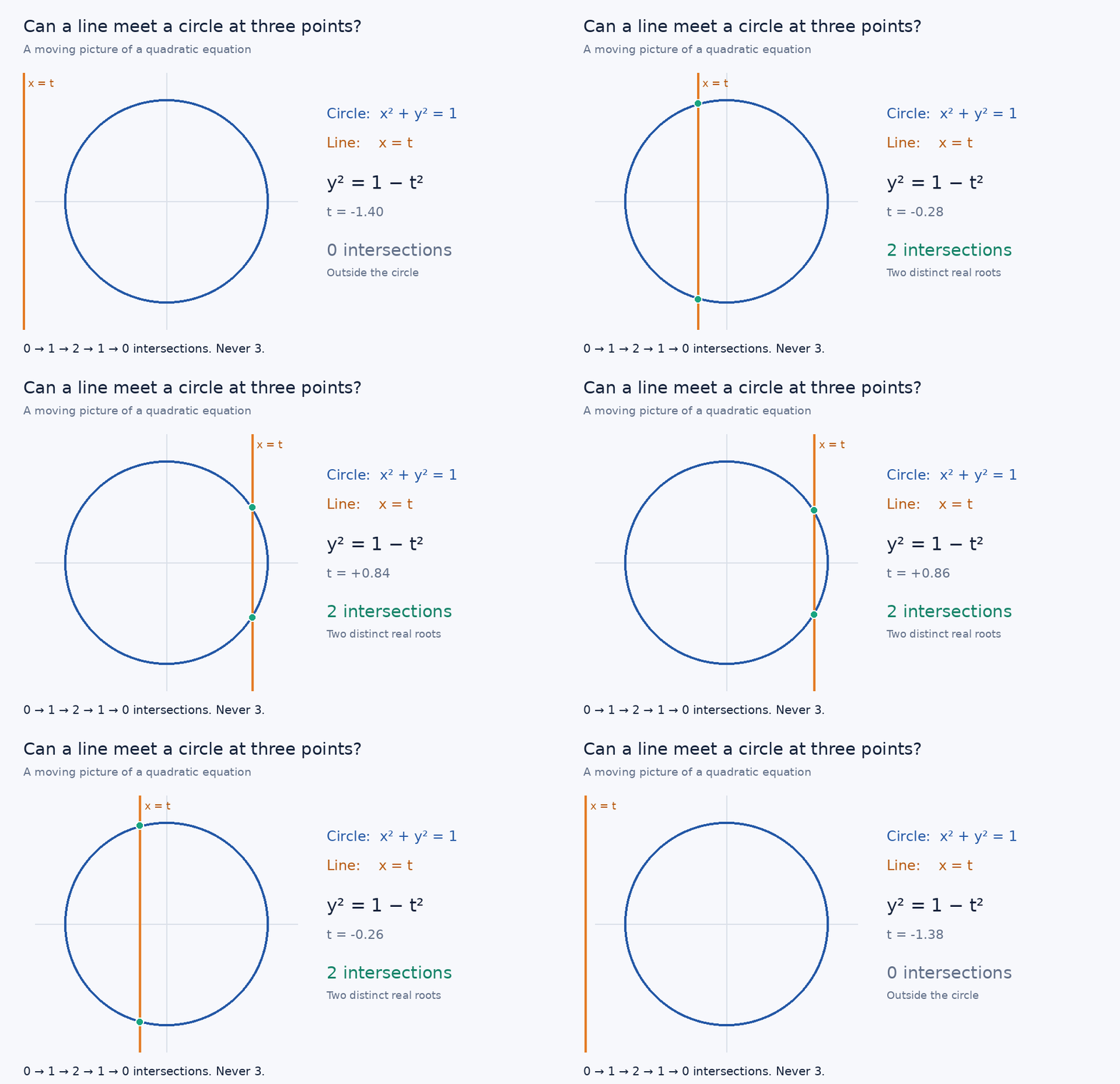
Your intuition immediately answers: “no, at most two.”
The thing is, the maths person has spent the time constructing this visualisation in their head, so they can translate trivially between equation and image.
That representation is what allows them to answer quickly. Intuitively.
They’ve spent time day-dreaming. Whereas I have not, so I cannot.
Why is this notable?
Well, think about it: when was the last time a maths teacher told you that if you took some time to ‘daydream’, you can come up with a mental representation that would make a whole class of math problems (let’s say quadratic equations) TRIVIAL to solve?
And when did they tell you that “you can keep doing this for everything. The more representations in your head, the more you can build on so you can solve more and more complex maths!”
Ok this might not hit you hard enough, so let me make this more visceral.
Most of us think that getting good at maths in school is about grinding problem sets.
Grind the simple problem sets, get good at them, move on to higher level concepts.
If your child comes back with a C in maths, for instance, you’d say “do more exercises.”
Well ... maybe ... no?
Look, the reason we think like this is because we think maths is about computation.
Some of us can get very far on that basis alone. See this piece by Sinead O’Sullivan for instance: How to Become a Mathematical Genius.
O’Sullivan is clearly VERY intelligent. She got to a PhD at MIT by grinding it out on computation alone before the maths got too hard for her.
When she read Bessis’s book, her mind was blown.
The idea that you can construct mental objects in your head to make maths EASY was a completely foreign concept to her.
As it was to me.
Even crazier, Bessis points out the more objects you create, the better you become. In other words, the representations you create become building blocks for other, higher level maths concepts. It compounds.
And your ability to invent new representations also improves.
And so the child of a mathematician may be seen doing problem sets just like other kids, but the thing that’s happening in their heads and the conversations the mathematician will have with their child are VERY different.
Us: “oh you got a C, I need to send you to tuition / you need to grind more problem sets.”
Them: “What object do you have in your head? Can we come up with a better one?”
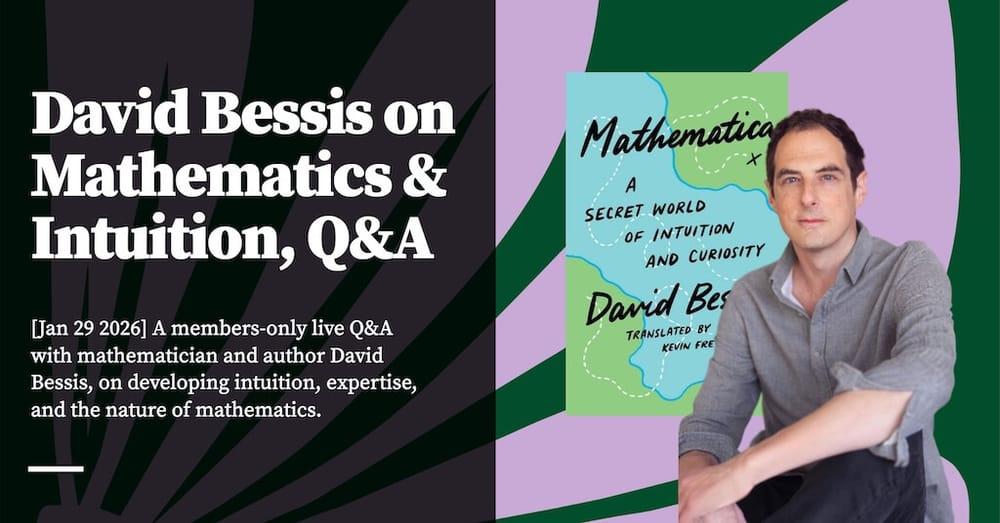
When we did a Commoncog members-only Q&A with Bessis, I asked him what he was doing to teach his (very young) children.
You know what he said?
He said from a very early age, he asked his son: “Last night did you have a dream? If so, describe it to me.”
Describe dreams?! Why?
Bessis says it’s a huge part of the ‘mathematical experience’: the ability to describe something only you can see in your head.
Bessis is laying the groundwork to talk about the representations in his son’s head, when he starts learning maths.
Now imagine, for a moment, if we had a way to pass the representations in Bessis’s head to his son.
Or to the head of any child under Bessis’s tutelage?
Would that not be accelerated mathematical expertise?
Hmm.
By the way. At this point seven Fields Medallists have read Bessis’s book and said, effectively: “yes, this is how we got good.”
Bessis should know. Two of his classmates became Fields Medallists. He picked up this method late — at age 19, whilst at a hardcore French maths program that was responsible for the country’s stellar share of Fields Medallists. (Despite having less than 1% of the world’s population, France produces nearly 20% of all Fields Medallists). But what he learnt was a little too late for him to become a first class mathematician.
And it’s not like it's a big secret or anything. During the Commoncog Q&A he told us that this way of getting good at mathematics is widely known to professional mathematicians. It is, after all, how they got good. And all professional mathematicians believe that the way we teach maths is stupid.
Bessis was just the first to have found the language to describe what they all did in their heads. He attributes this to recent developments in cognitive science. This method of doing maths was what he figured out when he was 19. (Whereas he speculates that the first rate mathematicians — the Fields medallists, say — all learnt this earlier in their lives).
So what does this have to do with sensemaking?
Everything. It has everything to do with sensemaking.
The typical approach to maths education is ‘grinding problem sets’, from easy to hard. Somehow this is called ‘mastery learning’. And it’s not wrong, not really.
But it misses the point. Are you:
Because if you’re doing the former, you’re going to hit a wall.
If you’re doing the latter, you can scale arbitrarily high.
But how do you check? If all you have are p-set scores, how do you know which strategy your student / child is doing?
Bessis points out that this difference is actually everything in maths.
Because if you get really good at constructing novel representations in your head, you just might prove something new, and become a Fields medallist.
Again, something he wish he knew when he was younger.
So now, we are back to sensemaking.
The Data-Frame theory is ostensibly about sensemaking, but it’s actually about how that sensemaking happens.
Which means it gives you a mechanism for improving it.
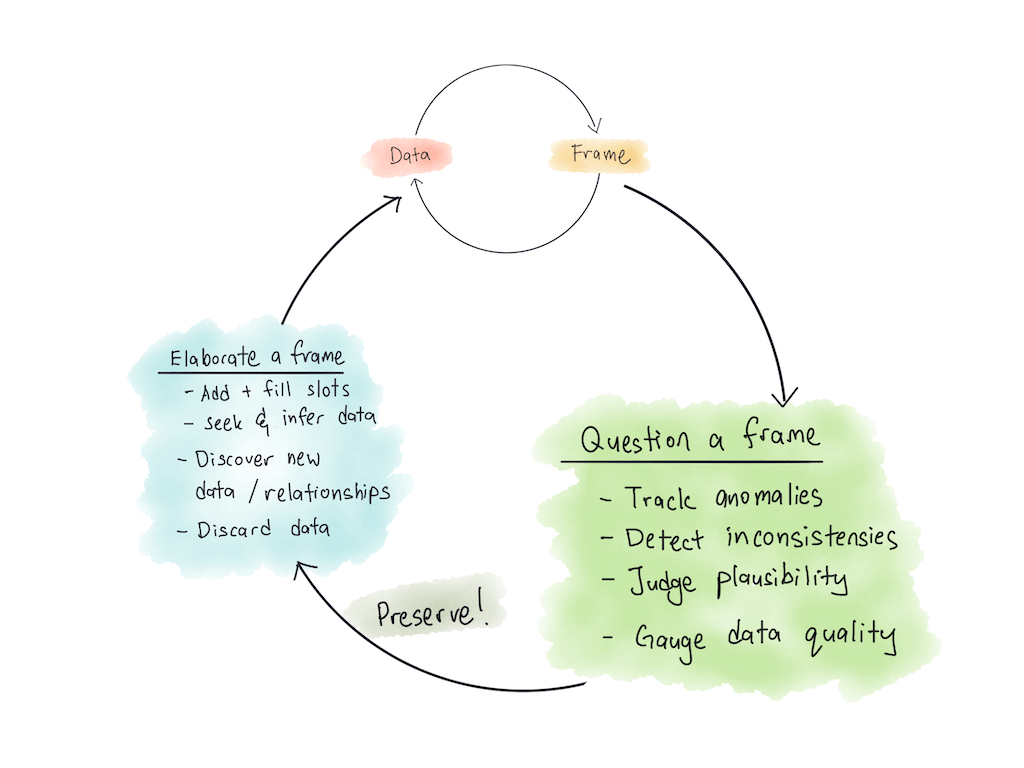
The mechanism of the Data-Frame theory is the SAME mechanism used to construct new mental representations.
And Tactical Decision Games are one way of training that construction.
THIS is why some Commoncog folks are interested in adapting TDGs for other domains. Yes, even maths.
A quick note: I don’t want to make this seem like you’re going to get a straightforward ‘how-to’ on applying this to mathematics with this workshop.
Significant trial and error is going to be necessary to figure out how to apply this technique to topics like mathematics (or, in Commoncog’s case, to business). And in fact right now I’m talking to a turnaround expert to adapt some of his experiences into TDGs for Commoncog members. I expect there to be some iteration. And some wild experimentation. (But that’s what members are paying us for, right?)
But my point is that the promise of TDGs is not just that they are a proven accelerated expertise training method for messy, real world domains. It is that the learning theory TDGs are built on is incredibly deep, and currently overlooked.
If you want ‘noob gains’, as the bodybuilders put it, or you want ‘low hanging fruit’ for accelerating learning. Well, I don’t have to repeat myself. You probably already know who John Schmitt is, and you know why this workshop is rare.
You may or may not also know that Gary Klein, who founded ShadowBox, came up with the Data-Frame Theory of Sensemaking.
Anyway. You’ll get one final reminder on the 12th of November, before sales close on the 13th. Assuming seats aren’t sold out by then.
Here’s the link one final time.
Warmly,
Cedric (and Jared, though this email was mostly Cedric).
PS: Alert readers will notice that the ideas in this email are actually universal. There’s always a mental object you can construct to make the thing you want to learn intuitive. Let’s take for instance: reading financial statements.
Here’s an excerpt from Commoncog’s Pritzker family case (one of America’s richest families; bold emphasis mine):
Edwin Darby describes Jay as “a world-class sprinter when it comes to reading a financial statement.” Jay was fond of handshake deals and distrustful of what he called “lawyer-lawyers,” whom he believed were different from “business-man-lawyers.”
The case has example after example of Jay Pritzker skimming through a handful of financial statements, and then naming a price to acquire a company.
Do you think Jay Pritzker was reading a financial statement like you and me? Hell, do you think Warren Buffett reads a financial statement like you or me?
No way. It’s more likely that they’re reading into a representation of a business in their heads, the way Bessis looks at a maths problem and immediately conjures up a shape in his head.
Now, wouldn’t it be nice if we could take that representation and pass it on to novices ...
Hmm.
I’ll stop here. The implications are left to the alert reader.