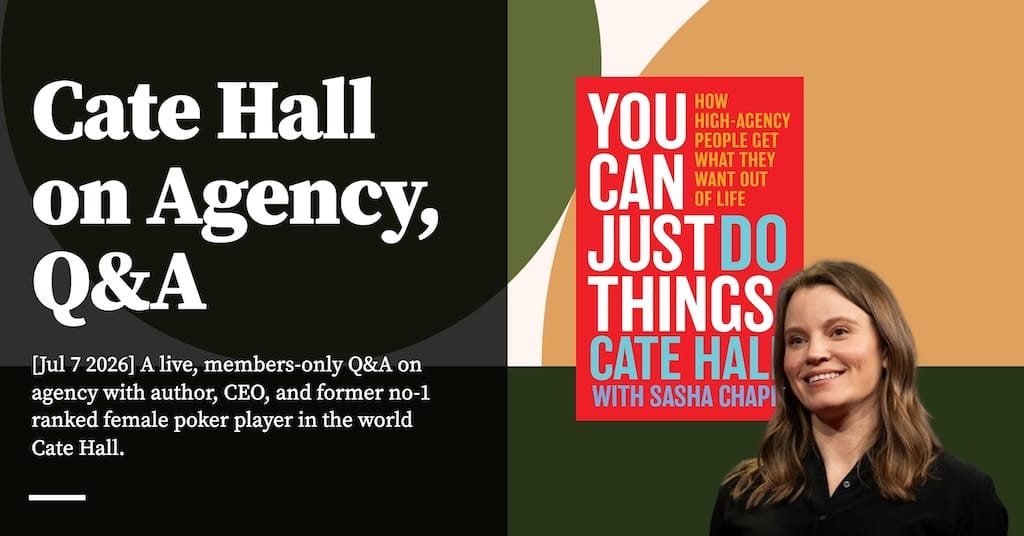
I’m pleased to announce a special Commoncog members-only live Q&A with Cate Hall, the author of the upcoming book You Can Just Do Things: How High-agency People Get What They Want Out of Life. If you’ve been a Commoncog member for a bit you may already know her; we’ve talked about her ideas a fair bit in the members forum! She also writes beautifully and pragmatically about agency on her Substack Useful Fictions.
This Q&A is an opportunity to ask her questions about how to become more agentic in your own life.
If you’d like to skip all the explanations and just sign up for the event, click here.
What is agency? Hall defines agency as “the capacity to both see and act on all of the degrees of freedom that life offers.” According to her, this definition has two components: “One is noticing degrees of freedom, the other is taking action on the basis of them.”
While that definition is good, I really like the version Hall gives in her Dying Breed interview: “the ability to see the hidden doors in the walls of life.”
The fact that Hall has written a book about this tells you that she’s thought very deeply about this.
I’ve got a short story about agency for you. Hall’s writing plays a big part in it.
(If you already believe that agency is a big deal and can’t wait to hear Cate Hall in person, you may skip this section entirely and scroll down to the next section for event details!)
In January 2025 I was irritated enough by the growing discourse around agency to start a thread in the Commoncog members forums. I titled it Disastisfaction with the Agency Discourse. The gist of my irritation was, basically: “Is agency really such a big deal? After all, it’s possible to be high agency and incompetent.”
Within days someone posted what I consider to be the ‘mic-drop’ response of the entire thread. We practice Chatham House rules in the Commoncog forums, so I can’t say who this person is, though I can quote them.
What that member said was this: yes, they believed that agency was one of the most important human qualities. They were Ukrainian, and they had seen multiple examples of agency being massively important ever since the Ukraine war started.
The first story was that of the mother of their close friend. She lived in a town that was rapidly overtaken by Russian forces in the earliest stages of the war. She stayed there for a month, but as the situation deteriorated and the Russians began executing her neighbours, she decided to leave. She was one of the few who had the courage to attempt the journey to Ukrainian controlled territory, joining a small convoy of cars. The journey was hard. The convoy had to pass through many Russian checkpoints. At one point, one car was shot at, and all its passengers were killed. Despite these horrors, she managed to reach Ukrainian controlled territory and now lives safely in the Western part of Ukraine. She did all of this alone.
All of her neighbours who decided to stay in the occupied town were killed.
The second story had less blood-shed but in some ways was more gut-wrenching. This member had two friends, both of them product managers (PMs) in tech.
When the war started, the first PM realised that everything had changed forever and that he needed to adapt. Despite knowing nothing about drones, he teamed up with another guy and together they launched a drone piloting course. Over the course of two years, they transitioned to drone production. Now they employ over 200 people and have a successful drone production business.
The second PM decided to keep a low profile, staying home to avoid being drafted. Three years later, he’s struggling with depression, drinking heavily, and having trouble in both his marriage and career. He blames everyone and everything around him for his situation.
The member then goes on to say: “I’ve come to understand that agency isn’t just the ability to take action. I now believe it’s a core human trait—an irrational, almost instinctive belief that, despite the odds and logic, things will somehow work out. And if you are lucky enough not to get killed — you eventually find the way.”
After reading this response, I changed my mind. I now think that agency is one of the most important traits that you can have.
Shortly after this post, folks started linking to Cate Hall’s Substack, where she writes wonderfully about various aspects of this trait. I think I was alerted to Hall’s writing by one of the members in the topic thread who was already a big fan. I subscribed immediately.
The one Hall essay that I continue to think about, and recommend, is titled I used to be a high-performing robot.
Hall writes about how she used to be an addict. At first it was alcohol. Then it was drugs. She writes:
I consider the state of addiction to be the opposite of agency. Agency is the ability to recognize all of the degrees of freedom one has. Addiction strips them away, reduces life to one option, and subordinates everything else in service of making sure that option is selected over and over again.
To some extent, you can think of addiction and agency as two sets of labels on the same dial, like hot and cold on a tap. Addiction is automaticity. Agency is its opposite. Success is a completely different dimension, consistent with anywhere the dial might be set.
Hall, by the way, is incredibly high agency. So to hear her say this — and to hear her say that once upon a time she was an addict — is really quite startling. She’s experienced both ends of the agency spectrum. That makes her uniquely qualified to talk about agency.
I highly recommend the following list of essays, though just going through Hall’s Substack archive at random is likely to be rewarding.
Of course, if you'd like to ask questions about any of these ideas, event details are below!