What’s the deal with playing cards? From the perspective of someone learning about them for the first time, rather than something you’ve known all your life, they start to seem pretty weird. Clubs are clearly actually clovers, and spades look more like speartips. What’s a jack, and why is it on the same level as a king or queen? Earlier this year, I was surprised to learn that the last common ancestor of every tradition of playing cards was likely Chinese money cards in the 1300s.
In Xanadu did Kublai Khan the first national paper money decree. Chinese regional and national governments had tried to legitimize paper currency several times since Bi Sheng first invented movable type around 1044. The ability to cheaply print a different serial number on each banknote was the innovation that made this theoretically possible. Most of the earlier attempts to issue paper money had ended in either hyperinflation, or the entirely reasonable refusal to accept paper money over proper coinage due to hyperinflation. Kublai Khan’s 1260 decree finally resulted in the first time paper money was more widely circulated than coinage.
Like everything else, people found a way to gamble with paper money. But they also found it inconvenient and risky to play games with actual paper money. So some people printed up fake Monopoly money to gamble with instead. And some people came up with gambling games you could play with just the set of Monopoly money. The earliest one we have a record of is 馬弔 (mǎdiào), from the 1300s. A set of mǎdiào cards contains 38 cards in 4 suits:
- Cash, representing hundred-wen coins, numbered from 1 to 9.
- Strings of coins, representing thousands of 1-wen coins, numbered from 1 to 9.
- Myriads, representing 10,000s of wen, numbered from 1 to 9.
- Tens of myriads, representing 100,000s of wen, numbered from 2 to 9, plus three extra cards numbering 10, 100, and 1000.
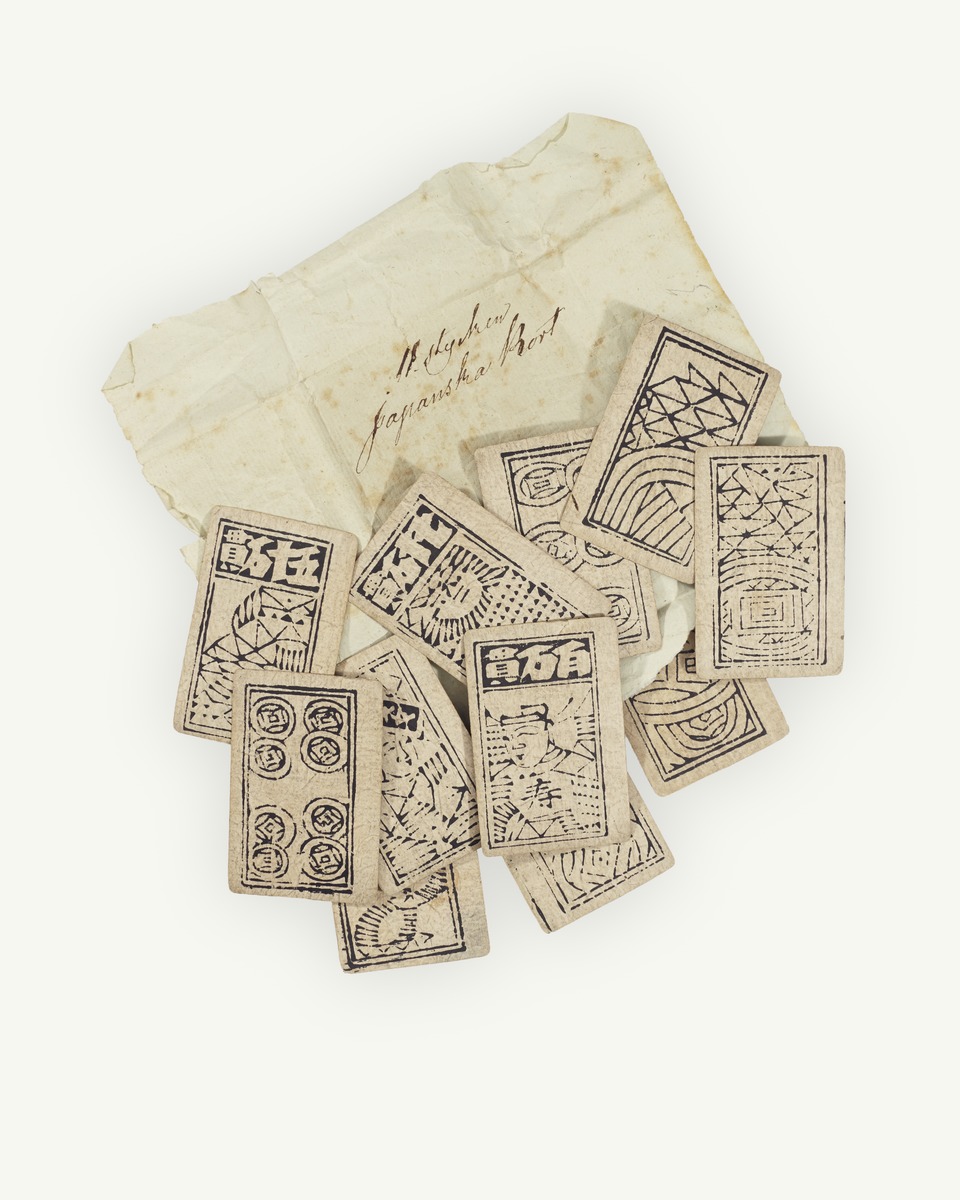 Photo of eleven madiao cards in front of a torn page incorrectly identifying them as “Japanese playing cards”. The cards are illustrated and printed in stark black on white.
This is clearly a direct representation of amounts of money. (Strings of coins, which had holes in the middle to facilitate this, were well known as the traditional way to carry large amounts of money.) You can find descendants of this groundbreaking deck in playing card traditions throughout Southeast Asia, as far off as Indonesia. The part that matters to our history of English playing cards is their spread west to the Kipchaks in central Asia. What later evolved into the Mamluk Egyptian tradition of playing cards featured the following suits:
- Coins, as the cash cards were illustrated with coins.
- Polo sticks, possibly the closest cultural referent to strings of coins?
- Cups, resembling the Chinese character for myriad (万) when seen upside-down. The name of the suit is the Turkic word for “myriad”.
- Swords
In the Mamluk deck, each suit contains 12 cards: ten of them numbered from 1 to 10, and face cards representing a king and a viceroy or deputy king. A third face card representing an under-deputy was added later.
By the late 1300s, we can tell that the Mamluk deck had spread to Eastern Europe and Islamic Spain by the presence of laws banning its use. Spanish playing cards descend from this tradition. They remain widely used throughout Central and South America. Spanish cards originally came in 52-card decks, but were later reduced to 48-card decks. They display the four suits of:
- Oros (coins)
- Bastos (clubs), the closest cultural referent to polo sticks
- Copas (cups)
- Espadas (swords)
The suits are numbered from 1 to 9, with the 10 later dropped for ease of printing. Each has three face cards, the rey (king), caballo (knight), and sota (page or squire). Notably, Spanish playing cards were the first variety to spread in England. When they were supplanted by French playing cards, the Spanish names for two of the suits stuck, clubs and espadas (spades).
By 1480, French playing cards had developed their own identity, influenced by the nearby German suits of leaves, hearts, bells, and acorns. The French suits drastically simplified the ornate illustrations found on German cards down to our familiar icons:
- Carreaux (tiles), from leaves
- Trèfles (clovers), from acorns
- Cœurs (hearts)
- Piques (pikes), from bells
The face cards here are our familiar king, queen, and knave (meaning “commoner”). In English, the knave was renamed the jack in 1864, as it was easier to distinguish K, Q, and J than K, Q, and Kn. Jack meant then what “guy” does now, a generic word for man.
Owing to their prevalence in the UK, US and Commonwealth, the English deck is widely known today. It is the ancestor of many newer playing card traditions. A notable exception is Japanese playing cards (hanafuda), also oddly not descended from the Chinese tradition, but instead based on Portugese playing cards in the late 1500s.