Cassie Pritchard, on Twitter:
I get why so many liberals are fundamentally disdainful of democracy these days—it’s because liberalism is exhausted. It’s out of answers. Liberalism won, it delivered the world it promised, and people still aren’t content. They’re not satisfied. So the people must be wrong.
We are unfathomably richer than our ancestors. Output per capita in America today is on the order of 900 times greater than before the invention of agriculture, about ~225 times higher than in 1 CE, and about the same (225 times) higher than Europe in 1000 CE. If measurable productivity were really the greatest object of human society, then we shouldn’t just be a little bit happier than people in the distant (or even recent!) past—we should be ecstatic. We should already be living in a utopian age of overwhelming contentment. We should be currently experiencing a kind of paradise.
The Kingdom of Heaven, as liberalism conceives of it, has already been made real on Earth. We are living in their Eden, and 20% of people are depressed. We’ve stopped reproducing ourselves. We’re overwhelmingly dissatisfied with our governments, anxious about our economies, and pessimistic about the future.
Based on Pritchard’s own politics, I imagine she is using this to argue for socialism, but other people use the same reasoning to push fascism, theocracy, or other postliberal commitments. It’s a fair argument and deserves an answer. We’ll start with an elegant mathematical response which will satisfy nobody, then try to address the emotional impact.
The elegant mathematical response is: happiness scales with log(income), not with income:
In a large U.S. sample, the shape of the association between happiness and Log(income) was extremely systematic: from $10,000/y to over $500,000/y, average happiness rose almost perfectly linearly with Log(income), with group-level correlations of 0.98-0.99 across a range of happiness measures, including both in-the-moment experience and overall life satisfaction.
So if income increased 225x since the medieval era, then using observed coefficients, happiness should have increased about three points on a 1-10 scale. If the average serf would have rated his condition 3/10, we should be at 6/10.
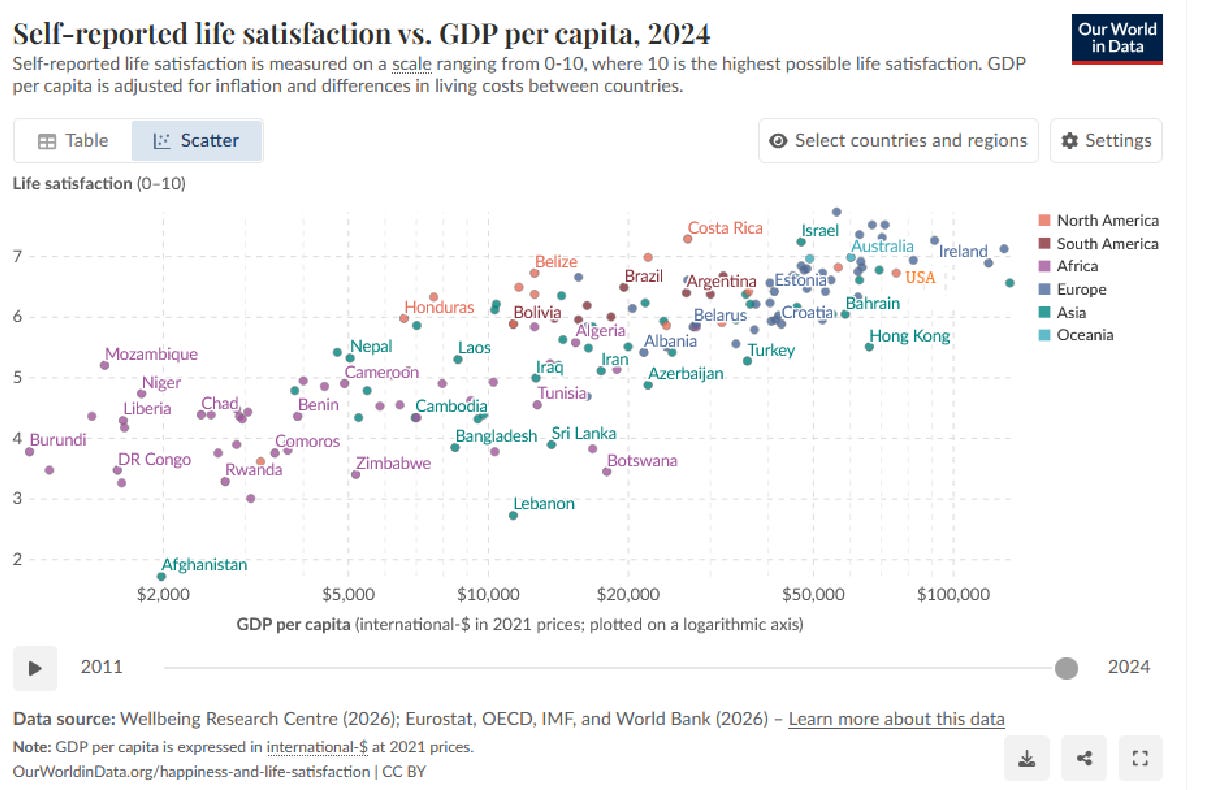
These “observed coefficients” are from graphs like this one, from Our World In Data:
According to the Maddison Project, medieval England c. 1000 AD had a GDP per capita of $1,151. The closest country on this graph is Burundi at $1,031. Asked to rate their happiness on a 1-10 scale, most Burundians say 3 - 41; most Americans say 6 - 7.
This relationship survives various potential challenges2. The graph above shows the correlation on a national level, so isn’t just about relative position in society (there’s a different relationship for that). And there’s no sign that the effect plateaus near the current level - see the Killingsworth/Kahneman/Mellers collaboration for more. You can just keep making people happier and happier by giving them more income, maybe forever. It just takes a lot of cash. Also, at some point you’ll need a better scale (if average US happiness is 7, the 1-10 scale commits you to the dubious claim that it’s impossible to be twice as happy as the average American, but in fact there are probably long tails of bliss and suffering).
So why don’t we feel happier than ever?
One answer is that log-linear relationships are hard to move. Back in the 1950s when everyone assumes everyone was happy, US GDP per capita was about $20,000 (compared to $75,000 today). Looking at the graph, that predicts that happiness then should have been 6/10, compared to today’s 6.5/10.
But the graph has wide error bars: Mexico has GDP of ~$20,000 and predicted happiness 6/10, but in fact their happiness is 7/10, even higher than current America’s. Why? Probably culture or something. If the US had a happier culture (or other advantages) back in the 1950s, that could easily overwhelm the ~0.5 point expected benefit from our greater current wealth.
But isn’t our current happiness deficit more than 0.5 points? Didn’t happiness “peak in the 1970s”, and isn’t it now at “historic lows”?
This is how articles usually present the data, and it’s technically true, but - as usual - you should hold out for the graph:
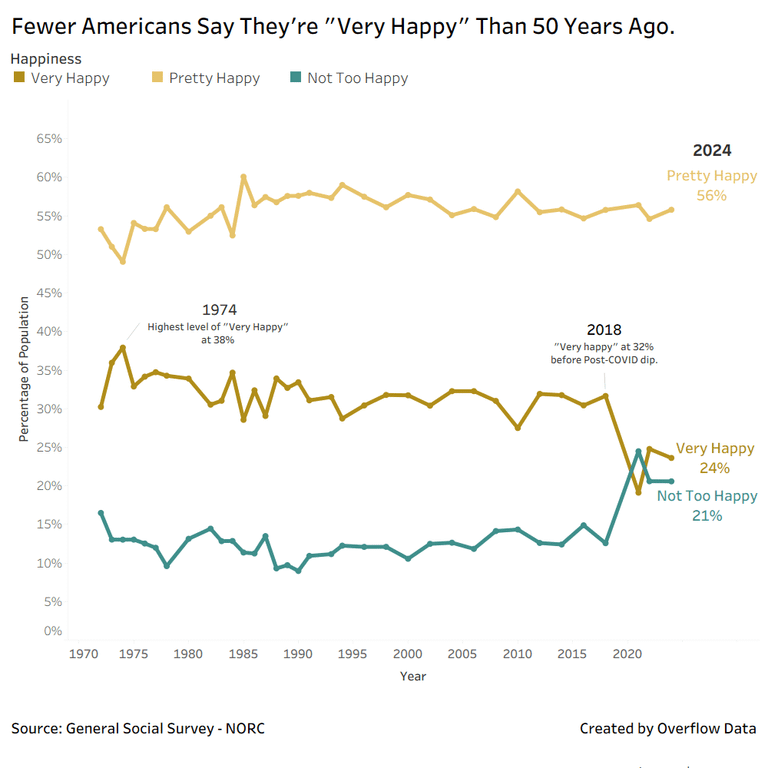
Happiness more or less followed a random walk from the beginning of the graph in 1970 to 2020, then suddenly cratered.
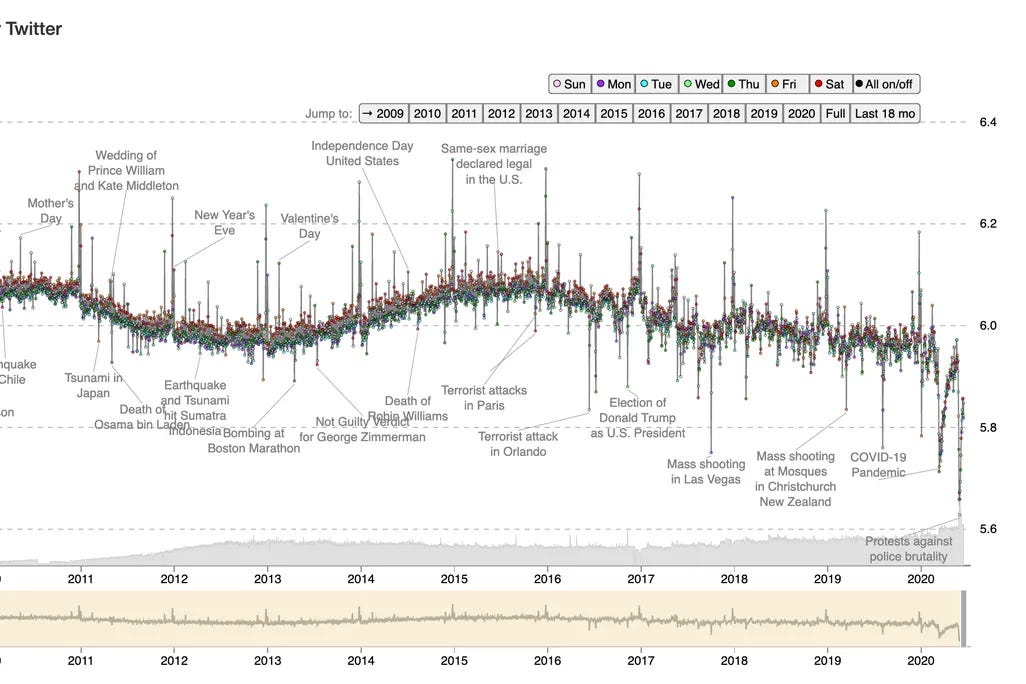
We didn’t invent liberal capitalism in 2020, so liberal capitalism didn’t cause our current round of unhappiness. The simplest explanation is the pandemic. I’m not sure it’s exactly that simple, because some preliminary results suggest happiness hasn’t rebounded as much as you’d expect after the pandemic ended. I went into this in more in my vibecession post, but I think the lingering national bad mood is a combination of:
Happiness levels are sticky after shocks. People are less willing to be publicly happy when the national mood is low, so the COVID-era dip is a self-sustaining attractor.
Media incentives have always leaned towards scaring and outraging people, but the advent of cable, Internet, and smartphones have intensified the competition for clicks and made those incentives more powerful.
People are rightly unhappy that they can’t afford housing. But this doesn’t prove that liberalism, capitalism, and wealth can’t make people happy - it proves that we’ve failed to live up to liberal capitalist ideas, we’re poor in one particular way, and people are unhappy with their poverty.
This doesn’t rule out that maybe we could be even happier with socialism or fascism or [insert your preferred politics here]. The best-case scenarios here are Finland (which embodies some of the left-wing virtues like cradle-to-grave welfare) and Israel (which embodies some of the right-wing virtues like ethno-religious purpose), and which are both about 0.5 - 1 point happier than the US, adjusted for wealth.
(although both are still within the liberal mainstream, and no country outside the liberal mainstream has ever managed to equal current US happiness levels. The closest near-misses are Singapore at 6.5, and Saudi Arabia at 6.6.)
What’s the point of liberalism, if plausible rates of GDP growth can only buy us about one point of extra happiness per century?
The question answers itself. All of the great policies above in Finland/Israel/etc can only buy 0.5 - 1 extra point over the countries that screw them up or pursue the exact opposite policies. Meanwhile, economic growth has earned us three whole points since medieval times. And these are stable; no opposite-party administration can take them away. So long as technological civilization continues to function, we can keep rising and rising, until in 300 years we approach the 10/10 barrier and have to get a new chart. We can say with confidence that we are giving our children and grandchildren better lives. Sure, only one point better for our grandchildren in particular - but one point on a ten point scale is a big deal, larger than the entire COVID drop!
The whole thing is terribly romantic. Our plans are measured in centuries3; how are the communists’ and fascists’ plans going?
Were the ancients really so much less happy than we are? This is a tough question, partly because most of them were peasants and slaves who left few historical records, but partly because everyone thinks their own happiness level is normal. Still, sometimes you notice a jarring streak of pessimism in ancient accounts. The Buddha said life is suffering; the Greek Stoics declared that the best life was one spent trying really hard not to feel the pain of misfortune; the caliph Abd-al Rahman “diligently numbered” all the happy days of his life, and found that they amounted to fourteen. Sometimes you open up the Bible to a random page and find stuff like:
I hated life, because the work that is done under the sun was grievous to me. All of it is meaningless, a chasing after the wind. I hated all the things I had toiled for under the sun, because I must leave them to the one who comes after me. And who knows whether that person will be wise or foolish? Yet they will have control over all the fruit of my toil into which I have poured my effort and skill under the sun. This too is meaningless. So my heart began to despair over all my toilsome labor under the sun. For a person may labor with wisdom, knowledge and skill, and then they must leave all they own to another who has not toiled for it. This too is meaningless and a great misfortune. What do people get for all the toil and anxious striving with which they labor under the sun? All their days their work is grief and pain; even at night their minds do not rest. This too is meaningless.
…and I know you’re supposed to think of this as some saintly person pointing out that life is meaningless without God, but there certainly has been a secular decline in the number of people saintly enough to think this way, and maybe that’s not a coincidence.
One challenge it doesn’t survive: people who are doing something extremely different from normal society can be anywhere. Hunter-gatherers are somewhere between 6 and 8 despite their apparent poverty. The Amish are confusing and hard to measure, with different studies finding them either above or below where their wealth level suggests.
Unless we get a technological singularity; Plan A’s economic growth numbers would have us off the charts happiness-wise by 2040.