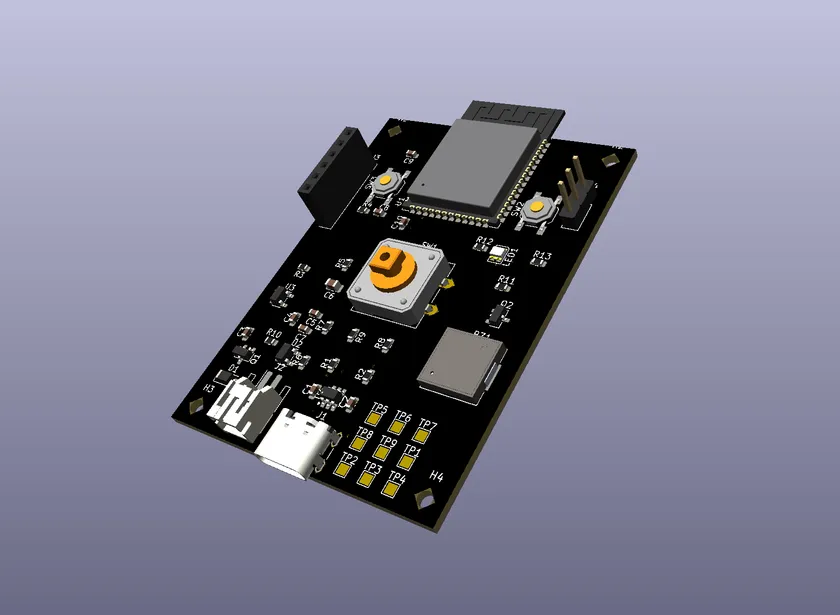
Proven on real copper.
Open Telegraph: pocket-size ESP32-S3 Morse key, built end to end with this workflow. Every decision, every check, every file is public.
Eight stages, start to finish.
You write the brief. copperhead runs the stages in order, each one its own agent run. A stage has to leave its artifact on disk before the next starts. If a gate fails, the run stops there.
in
brief.md
what you want, written in your own words
- 01
spec
docs/SPEC.mdgatea budgets section, actually filled in
- 02
architecture
docs/SUBSYSTEMS.mdgatereal reasoning under every subsystem
- 03
parts
docs/BOM.mdgatepart numbers chosen against datasheets
- 04
schematic
design.kicad_schgatesymbols placed, docs agree, ERC clean
- 05
layout
design.kicad_pcbgatefootprints on the board, DRC clean
- 06
outputs
gerbers / drill / STEPgategerbers actually on disk
- 07
firmware
firmware/ / pins.hgatesources on disk, pins from the pinout
- 08
dev plan
docs/DEVPLAN.mdgatea written bring-up and test plan
out
a design package
gerbers, firmware, docs. One commit per stage.
- Every hop is a gate: no real work on disk, no commit.
- Copper border: verified by KiCad itself, ERC and DRC clean.
copperhead is open core. The CLI is free and always will be, and it does the real work on its own. You pay to host it, to work as a team or to give an auditor what they ask for.
CLI
Free
Apache-2.0, forever
Design on your own, on your own machine.
Get startedIncludes:
- The full agent: do, create, init, check, watch
- Bring your own Claude or GPT-5 key
- Runs on your KiCad files, in your own git repo
- Plain markdown, JSON and KiCad output. No lock-in.
- Runs locally, never metered
- Community support
- Most popular
Cloud
$49per user / month
Free for open hardware repos
Hosted runs on private repos, with a web viewer.
Let's talkEverything in CLI, plus:
- Hosted runs, no local setup, from anywhere
- Private repositories
- Web viewer: chat, live schematic and board render, ERC/DRC status
- Run history and shareable check reports
- One-click gerber, DXF/STEP, render and BOM export
- BYO key, or managed inference with 200 credits a seat
Team
$49per user / month
+ $199 / mo platform
Cloud, with governance and CI for a whole team.
Let's talkEverything in Cloud, plus:
- CI bot: run check as a required PR status check
- Shared, versioned constraint libraries across the org
- SSO / SAML, role management, central billing
- Managed credits pooled across the team
- Shared run history
Enterprise
Customannual
Self-hosted, built for procurement, one price a year.
Talk to salesEverything in Team, plus:
- Self-hosted or VPC, so design data never leaves your network
- Altium support beyond KiCad
- RBAC, security review, dedicated support and an SLA
- An audit trail your compliance team can hand over
- Flat annual license, no per-run metering
Questions, before you ask them.
What is copperhead?
An open source AI agent that designs, documents and verifies printed circuit boards. You describe a change or hand it a product brief, and it edits your real KiCad files, updates every document that references them, and runs KiCad's own checks until they pass. Longer introduction here.
What problem does it actually solve?
Drift. A hardware design spreads one decision across a schematic, a bill of materials, a power budget and several documents, and nothing breaks when they fall out of sync. The inconsistency is found at bring-up, and a respin costs 5,000 to 50,000 dollars and six to eight weeks. The full argument is here.
What do I need installed?
Node 20 or newer, KiCad with kicad-cli on your path and a model API key of your own. Then npm i -g copperhead.
Does it work on a design that already exists?
That is the main case. Point it at a KiCad repository, run copperhead init and start asking for changes. It can also run the full pipeline from a written brief with copperhead create, but iterating on real designs is what it is best at.
What will it refuse to do?
It refuses to run on a dirty git tree, refuses to edit any design file before a validated change proposal exists and refuses changes that break a budget or constraint you have documented, citing the line it would violate. It also never invents a part number it cannot justify from a datasheet.
Will it rewrite my whole schematic?
No. Edits are surgical changes to the KiCad s-expression source, so your diffs stay small and reviewable and untouched parts of the file stay byte-identical. A tool that regenerates the file to move one net has made its own work impossible to review.
Never ship a board your docs no longer describe.
copperhead is open source and free to use. Install once, describe the board you want in a short brief.md and run create.
npm i -g copperhead
export ANTHROPIC_API_KEY=<api-key>
copperhead create --brief brief.md
# Pocket Bluetooth speaker

A palm-size Bluetooth speaker that plays for a day on one charge.

- ESP32, Bluetooth audio (A2DP sink)
- 3 W class-D amp into a 4 Ω driver
- Li-Po cell, USB-C charging
- Standby current budget: 100 µA