The control center dashboard enters English in 1847 as a hyphenated compound of dash, here meaning “mud or water splashed up from moving quickly”; and the board that shielded a carriage driver from it. The protective board was in use before the word dash-board. People were calling it a splash-board in 1826. The compound word gradually lost its hyphen around the 1860s.
French engineer Émile Levassor invented the modern automobile in 1891. One of his innovations was moving the Daimler engine from the back of the car to the front. This opened up more room for passengers while also increasing the importance of the dashboard, which now also shielded the driver from the engine’s heat and oil spatter. As cars’ mechanical complexity increased over the next few decades, the dashboard’s location between the driver and the engine made it the natural place to add new gauges and controls.
The more recent semantic shift that generalized “the control panel for cars” into “the control panel for computers, or anything really” only started in 1990. The further shift to “data visualization hub” or “control center” began this century. Meanwhile, dashboard camera is from 1971. Its clipping dashcam first shows up in 1998.
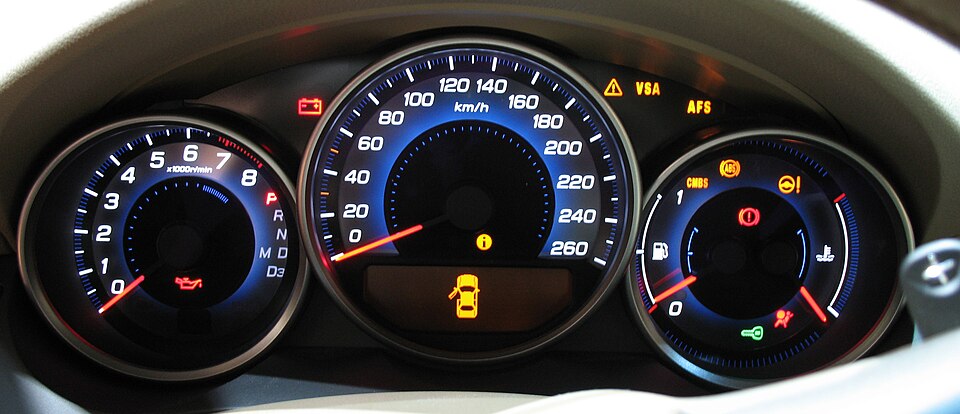 2006 photo of a softly glowing car dashboard. The prominent gauges are a tachometer on the left that includes a gear indicator, a speedometer displaying km/h in the center, and fuel and coolant gauges on the right. Most of the indicator lights are on.
Dash is regularly found by 1300, when we start seeing many more samples of written English. Arising from uncertain origins, we find cognates in some Germanic languages but not others. Its original sense was “strike”. One possible origin is an onomatopoeia dating to perhaps 1000 or 1200, inspired by words like clash, crash, smash, and bash. Dash picked up many different senses over the centuries. “Splash”, as seen in dashboard, is present by 1530. The punctuation symbol dash shows up in the 1600s. The nonviolent quick movement we typically associate with the word now is from 1796.
Board can be reconstructed back to Proto-Indo-European, over 6000 years ago. The word had a very different meaning then, perhaps “top” or “strike”. Its contemporary meaning “plank of wood” can be traced to Proto-Germanic, narrowing the shift to an unhelpfully vast temporal range of 2000 to 4000 years ago.
For a glimpse into a minor alternate universe, the American motorcar industry was not the only successful English-language auto industry in the 1910s. The US and UK industries thrived separately in an era when transatlantic communication was difficult and cumbersome. They naturally each developed their own sets of terms and jargon. For example, here are some consumer-serviceable car parts with two different, but still clearly English, names.
| enGB | enUS |
|---|---|
| accelerator | gas pedal |
| aerial | antenna |
| bonnet | hood |
| boot | trunk |
| cubby box | glove compartment |
| fascia | dashboard |
| indicator | turn signal |
| nave plate | hubcap |
| rev counter | tachometer |
| wing | fender |
This alternate universe is also visible through the pairs of terms that describe either motorcars’ internal mechanics, or the developing social rules around the novel act of driving.
| enGB | enUS |
|---|---|
| accumulator | battery |
| damper | shock absorber |
| estate car | station wagon |
| gearbox | transmission |
| give way | yield |
| lorry | truck |
| manual | stick |
| petrol | gas |
| puncture | flat tire |
| saloon | sedan |
| silencer | muffler |
| tickover | idle |
And then there’s a few small differences that provide local color, like how mathematics could be clipped to math or maths by default.
| enGB | enUS |
|---|---|
| brake lights | tail lights |
| car park | parking lot |
| demister | defroster |
| driving license | driver's license |
| gearstick | gearshift |
| number plate | license plate |
| tyre | tire |
| windscreen | windshield |