The musician DJ is first seen in print in a 1948 issue of Billboard magazine as an abbreviation of disc jockey. Until around 1980, it was typically rendered D.J. to mark it as an abbreviation. The less common form deejay shows up a little earlier, in 1946.
The musician disc jockey is first seen in print in a 1941 issue of Variety magazine, combining the “driver” meaning of jockey with the disc storage medium of recorded music. Jockey started meaning “driver” in 1912 as a generalization of its “horse rider” meaning. Jockey has most commonly meant “horse rider” since the 1690s, a narrowing of its 1640s meaning, “person who works with horses”. Before picking up that meaning, jockey was a diminutive form of “Jock”, which was a Scottish variant of “John”, and referred generically to any young man.
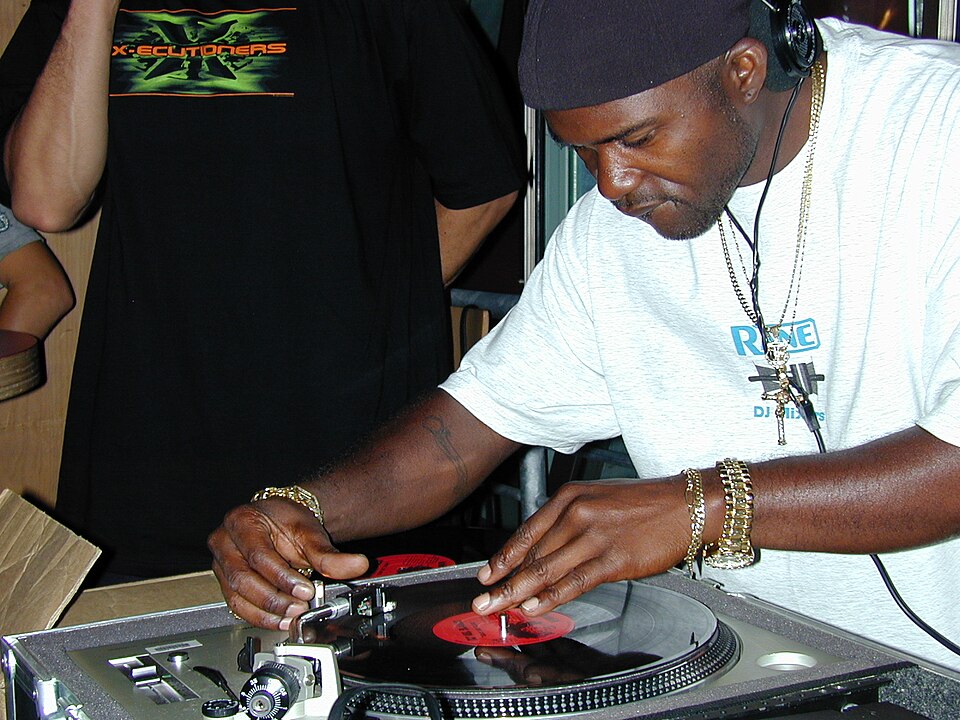 2002 photo of NYC-based DJ Grand Wizzard Theodore demonstrating the now ubiquitous DJ scratch technique that he invented in 1975. Theodore has brown skin and is wearing a black durag, light gray t-shirt, headphones, and gold jewelry. He is intently working a turntable.
The music storage medium disc is named for its disc shape. It appears as a synonym for record as early as 1879, at the dawn of recorded music. The shape disc goes back to the 1660s, describing the shape of a discus. It was either a clipping of discus, or a borrowing from Middle French disque. Discus can be traced all the way back through Classical Latin discus from Ancient Greek δίσκος (dískos), meaning “discus”. δίσκος originally comes from the verb δικεῖν (dĭkeîn), meaning “to throw”. (The suspiciously discus-shaped dish is also descended from Classical Latin discus, but through Germanic rather than French.)
The first fifty years of recorded music saw discs and cylinders compete for form factor. Discs gained their dominant majority in the 1920s, becoming synonymous with recorded music. You can track this through coinages. Discotheque is a 1929 borrowing from French. The word’s suffix comes from its original meaning of “music library”; bibliothèque is the French word for “library”. Discography first appears in 1930, with its contemporary meaning. Discophile shows up in 1932.
Even as discs’ material changed from wax to shellac to vinyl to plastic, the synecdoche endured. In the 1950s, the meaning of discotheque shifted to “club where music is played”, which was commonly clipped to disco by 1957. By 1966, the kind of music played at a disco was called disco music, like what we’d call dance music today. The emerging musical genre was named after disco music’s clipping to just disco by 1975.
Meanwhile, the storage medium’s American spelling disk took on fresh importance as they were repurposed for digital data storage. Disk drive is from 1952. The diminutive diskette was coined by IBM in 1973 to describe its tiny new 8-inch floppy disks. The decidedly less floppy hard disk also originates in 1973. The data storage usages eventually died out in the 2010s. For portable data storage, they survived the transition from floppy disks to compact discs and even digital video discs. But SD card just stands for “Secure Digital card”. And for fixed data storage, hard disk drives gave way to solid-state drives around the same time.