This is a blog post version of the talk I delivered at Software Should Work 2026. Shoutouts to Isaac Van Doren for running such a delightful conference and nailing it first try, and for infecting us all with his charming enthusiasm for Columbia, Missouri.
Part 1: The Pill

When I gave this talk, I warmed up the crowd by asking the audience who liked the 1999 film The Matrix. Roughly half raised their hands. But the kicker was the followup question, "who has never seen this movie?". 10 brave youngsters raised thair hands to audible gasps.
In this movie, there's an iconic moment where our hero, Ted "Theodore" Logan, is presented with two choices, the red pill or the blue pill.
The question is essentially "Do you want to know an uncomfortable truth?"; the blue pill means "no" and the red pill means "yes".

To the audience, the answer is obvious. If the main character chose blue, the credits would roll before anything happened. But the metaphor is so strong and the cinematography kicks so much ass that the scene influenced our culture and language to the point where people who haven't even heard of the film say the phrase "based and red-pilled".
Let's talk about the "black pill".


It comes from "incel" culture. The word is a portmanteau of "involuntary" and "celibate". Basically, young men who had trouble dating started complaining about it together on the Internet. So far, so good, but an unfortunate feedback cycle emerged. Those who used the space in a productive manner, such as brainstorming, encouragment, mentorship, etc., tended to shape up, mature, work through their problems, and, to put it bluntly, get laid. At that point, they didn't really feel like sticking around and commiserating anymore, so they left. This was a natural filtering process. Thus, when new, impressionable youngsters entered the community, they were greeted only by miserable, hopeless, antisocial losers. Over time the culture became so toxic that the accepted wisdom became, essentially, "Give up. The game is rigged. There is nothing you can do. You might as well lie down and rot."
In short, the "black pill" is nihilism mixed with depression mixed with anger, and in the worst case leads to outcomes like suicide or school shootings.
I almost fell into this trap. Speaking from experience, entering the dating scene as a young man can be challenging to the point of despair. I was raised by conservative Christian parents and had so, so much to learn and to unlearn about the world in order to date comfortably and confidently.

Perhaps you may be surprised to hear this but what helped me get out of this spiral was listening to pick up artists. Looking back, I think what these guys mainly have to offer is its own form of nihilistic, manipulative toxicity, but one of them said something that I instantly realized was key. He said that you shouldn't focus on the outcome of "the pick up". The actual move, he said, is to work on being attractive, in general, to everybody. Platonic friends included. You should try to make everyone want to be around you, because you genuinely care about them. Listen intently to what they say. Make them laugh. You offer people whom you interact with meaningful experiences that make them remember you and invite you to future events. You put effort in to make everyone have a good time. By doing this, you create more circumstances where there is a chance for romance to spark. It's genius!
My takeaway here is that the kids are alright. Even when exposed to a bunch of bad ideas, if good ideas are also in the mix, they'll figure it out.
Let's bring this a little closer to home.
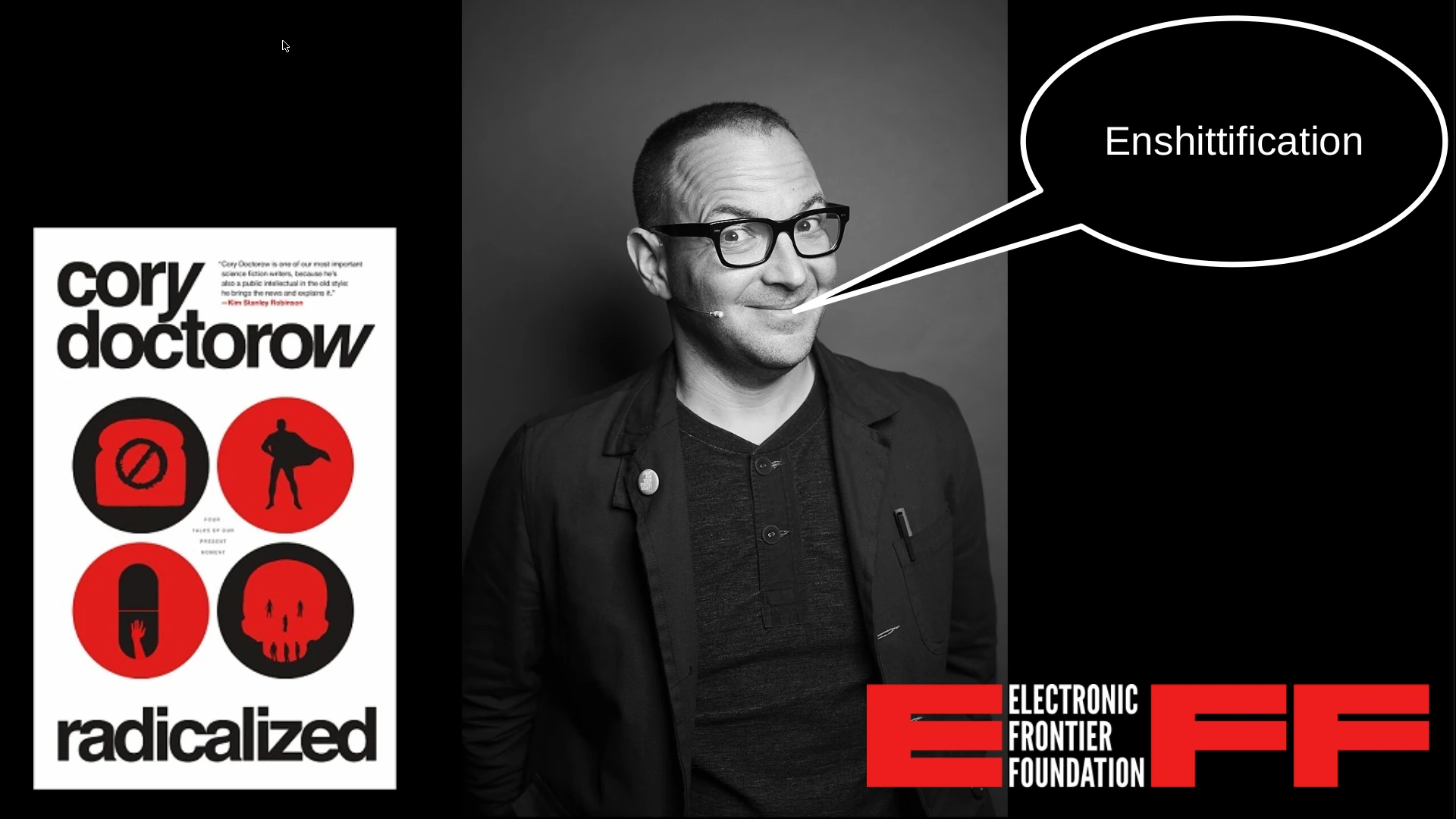
This is Cory Doctorow. He's the guy who coined the term "Enshittification". He worked for Electronic Frontier Foundation for a while before becoming a fulll-time writer. In 2019 he published a short story called "Radicalized". The story centers around an online forum of people who commiserate together because they got screwed over by heath insurance companies. Listen to this excerpt and see if it sounds familiar:
In a forum for ex-drunks, there’s a big group of elder statespeople who’ve been sober for years and years. They’re a wise, moderating voice, and they are the existence of proof of life after addiction. Whenever someone on the forums went on a bender and was recriminating with themselves, there was a dried-out elder who could tell a story to top theirs, about being put out on the street, losing their kids, losing their limbs, even, and coming back from it.
Fuck Cancer Right In Its Fucking Face did not have those people. The people who got over their furious grief left [the forum], chased away by its rage culture. The people who stayed were really into their anger, clinging to it like a drunk refusing to let go of a bottle.
If your anger took you to a place you couldn’t handle, a place that scared you, the elders of [the forum] would help you all right: they’d explain to you that this was the right reaction, the only reaction, and it was never, ever going to get better. This was your life from here on in.
Five years after Doctorow published this fictional short story, the real life CEO of the American health insurance company UnitedHealthcare was shot to death, bullets cased with the words "deny, defend, depose".
Part 2: Software Should Work
The main purpose of a conference like this is technical. At its core, it's a "safe space" where the attendees already agree that software should work, and it should be fast, and it should prioritize the user experience, and so all we have to do is share tips, tricks, demos, and research with each other on how to better accomplish these things.
But if we neglect the meta examination here, our efforts are in vain. The implication of the phrase "software should work" is that often in the real world, we find that it doesn't work.
Right?
Why not?
What's stopping software from working?
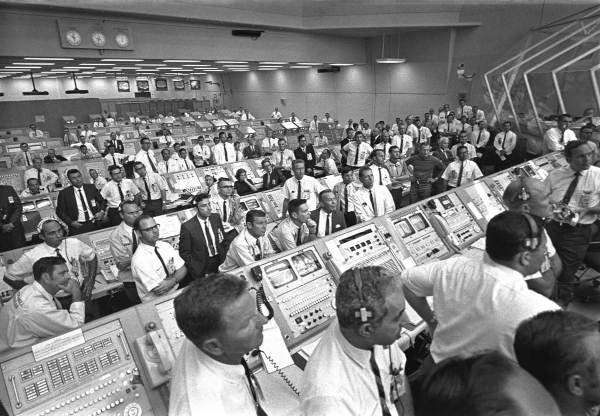
Is the problem simply ignorance?
Are programmers not programming hard enough?
Is the software engineering field too nascent?
Have we not discovered how to make robust software yet?
I would argue that mankind discovered how to make robust software before I was even born. There's a case to be made that the overall robustness and performance of software has decreased since then, despite hardware being many orders of magnitude more capable.
What gives?
Have you, dear reader, ever attempted to make software work better at a company you worked for as an employee or contractor, and you were shot down by management, saying that the business had other priorities?
Thanks for reading my blog post.