Civil liberty concerns spur FAA to revise drone no-fly zones near ICE vehicles.
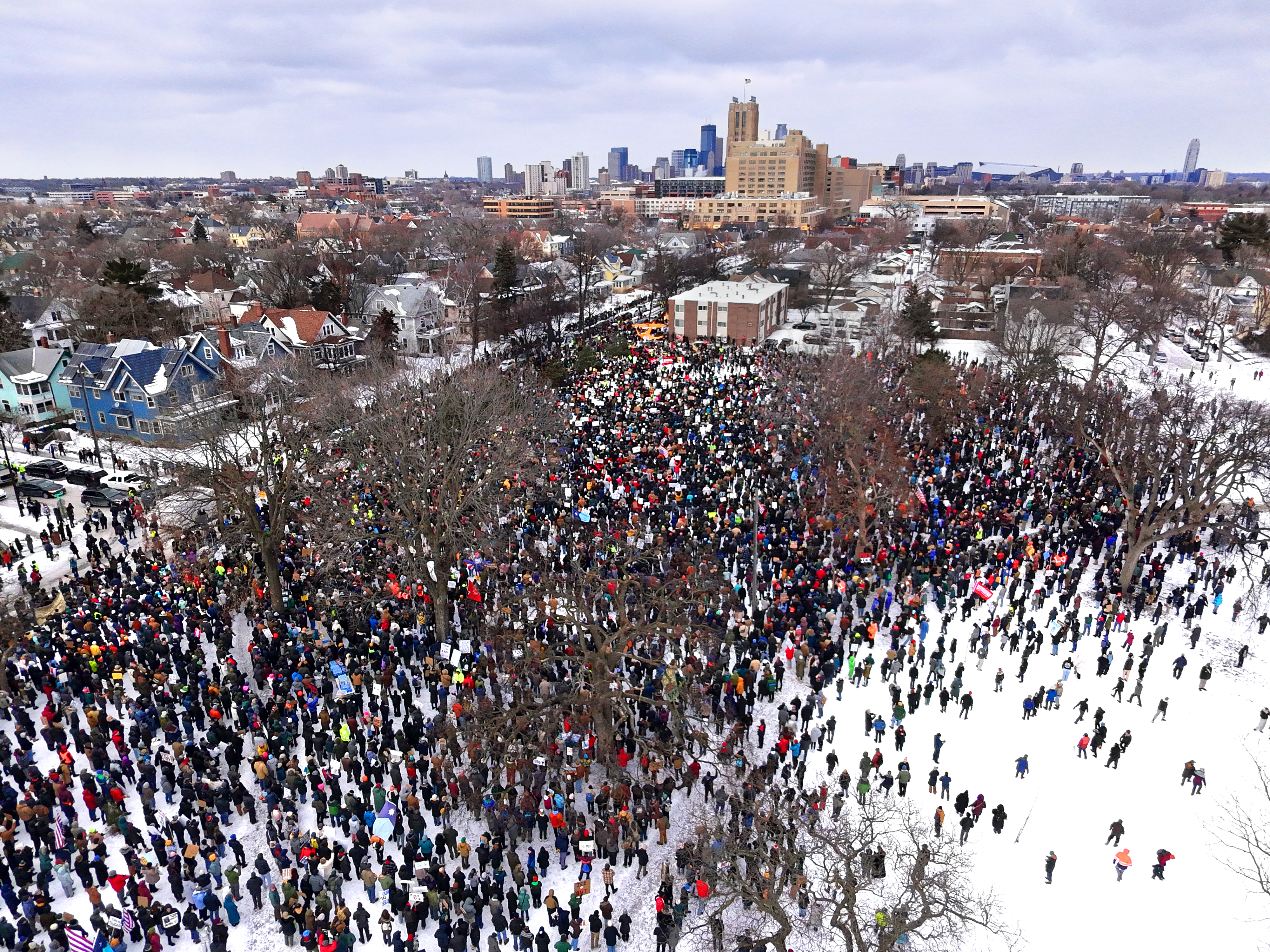
Drone photography shows demonstrators gathered in Powderhorn Park in Minneapolis on January 10, 2026, to protest the killing of Renee Good by an ICE agent. Credit: Rob Levine
Drone photography shows demonstrators gathered in Powderhorn Park in Minneapolis on January 10, 2026, to protest the killing of Renee Good by an ICE agent. Credit: Rob Levine
In January 2026, during the height of protests against immigration raids in Minneapolis, federal agents shot and killed 37-year-old Renee Good. Before even gathering all the facts, the Department of Homeland Security labeled the mother of three an “anti-ICE rioter” who “weaponized her vehicle against law enforcement” in an “act of domestic terrorism.”
Days later, the feds announced a major expansion of “no-fly zones” in the name of national security. While such no-fly zones used to be about controlling aircraft, they now often focus on small drones. The expanded no-fly zones announced on January 16 prohibited such drones from flying within 3,000 lateral feet and 1,000 vertical feet of federal facilities.
But for the first time, the order extended no-fly zones to ground vehicles belonging to the Department of Homeland Security. Even while the vehicles were in motion. Even if they were unmarked. And even if their routes had not been announced.
This exceptionally ambiguous policy posed real danger to people like Rob Levine, a freelance photojournalist and commercial photographer in Minneapolis for nearly four decades. Since Levine got his remote-pilot certification and bought his first drone in 2016, he has flown a small fleet of DJI quadcopter drones to take aerial photographs and videos of Minnesota’s rivers, bridges, and cities, along with crowds gathered for outdoor concerts and parades. More recently, he has documented Twin City residents protesting the increased presence of federal agents in their community.
Levine immediately stopped flying when he saw the no-fly notice. The notice said government agencies could shoot down or seize drones “deemed to pose a credible safety or security threat,” and it warned of civil and even criminal penalties for drone operators.
“I saw what these federal agents were willing to do, the violence they were willing to visit upon even constitutional observers here in the Twin Cities who were just photographing what they were doing,” Levine told Ars.
Good’s killing had occurred just six blocks from his home. “It didn’t take much imagination to think what they would do to somebody with a drone, and so for weeks I didn’t go fly,” he said.
A week after the no-fly zone warning, the situation in Minneapolis escalated further when Customs and Border Protection officers killed Alex Pretti, a 37-year-old intensive care nurse, after wrestling him to the ground and shooting him multiple times.
Levine wanted his drones back in the air. But when he sought guidance from the Federal Aviation Administration, the agency candidly acknowledged that the no-fly zone warning was “ambiguous” and “therefore, any flight carries the risk of inadvertent violation.”
Could such a policy possibly be legal?
Hidden no-fly zones
The FAA had previously only advised that drone pilots avoid flying near “mobile assets” operated by the Department of Defense and Department of Energy, such as naval warships and truck convoys transporting nuclear materials between US national labs. But the “notice to airmen” alert in January—NOTAM FDC 6/4375—had created the equivalent of roving, 3,000-foot no-fly zones around federal agents’ cars and other vehicles operating in cities and towns across the country. And it didn’t just affect those trying to film federal agents. Because it was practically impossible to ensure compliance with the new flight restrictions, any drone pilot could be at risk during any flight.
“It created a whole lot of fear in the community,” said Vic Moss, CEO and cofounder of the Drone Service Providers Alliance, a drone industry trade association based in Lakewood, Colorado. In a post on March 11, Moss described the FAA flight restriction as posing an “impossible compliance problem” for drone operators, who could end up “ensnared inside a restricted zone with no way of knowing it.”
Drone pilots in the United States must use apps such as Air Control to seek official permission to fly in controlled airspaces. Any drones larger than 0.55 pounds must be registered with the FAA and have a Remote ID module that can “squawk” the drone’s identification and location at all times. That makes it easy for federal agents or authorities to see where drone operations are taking place. But the system provided no way for drone operators to avoid unmarked government vehicles in motion.
The no-fly zone restrictions were also exceptional in their length and scope. The FAA regularly issues temporary flight restrictions during natural disasters or to protect the airspace around government officials and sporting events such as professional baseball or football games. Most restrictions last just hours or days and cover specific geographic locations, according to the Electronic Frontier Foundation.
But the restrictions issued on January 16, 2026, would last until October 29, 2027—21 months—while covering many federal facilities and vehicles across the entire United States.
Pushing back
Given these unprecedented restrictions, the Electronic Frontier Foundation joined other members of the News Media Coalition—an international organization that includes more than 50 news organizations—in sending a letter to the FAA’s Office of the Chief Counsel.
The letter detailed “significant concerns regarding the FAA’s January 16, 2026 sweeping and unprecedented Temporary Flight Restriction.” It described the flight restrictions as violating the First Amendment by making it more difficult to record law enforcement officers. The letter also argued that the policy’s ambiguity violated the Fifth Amendment to the US Constitution, which guarantees the right to due process before being deprived of liberty or property by the government.
Back in Minnesota, Levine spent weeks looking for lawyers who could help him challenge the FAA flight restriction as a freelance photojournalist—but he was racing against a deadline. One law firm alerted him that he had only 60 days to file a petition regarding the FAA decision. But he couldn’t find a law firm willing to back him.
“To me, this was an obviously unconstitutional rule by the FAA,” Levine told Ars Technica. “Even when I was looking for a lawyer, I had a lot of sympathetic ears, but nobody offered to take the case or to even help me with it.”
Levine eventually called a hotline for the Reporters Committee for Freedom of the Press, a nonprofit in Washington, DC, that offers free legal services. The organization took the case and filed a lawsuit, designated Levine v. FAA (26-1054), with the Court of Appeals for the DC Circuit on March 16.
They had barely beaten the petition deadline.
Partial relief
By March 16, it was common knowledge in the aviation industry that the FAA was aware of the issues and had prepared a revised version of its flight restriction notice, Moss said. But another federal agency was apparently holding up the revision. Many suspected that the agency responsible for the delay was the Department of Homeland Security (DHS).
“I think anybody with more than four synapses firing at the same time can realize that this was a DHS issue,” Moss said.
A Department of Homeland Security spokesperson told Ars only that “DHS routinely coordinates with the FAA on airspace restrictions to support operational security and safety of the Department.”
On April 10, Levine and his lawyers pressed ahead by filing an emergency motion seeking to temporarily suspend the FAA flight restriction until the court had a chance to review the case.
That may have expedited the government’s next move. On April 15, the FAA removed the no-fly zones by replacing the sweeping flight restrictions with a “national security advisory” titled NOTAM FDC 6/2824. The revised notice dropped all mentions of flight restrictions and criminal charges. It instead “advised” drone pilots to avoid flying near “covered mobile assets” belonging to the Department of Homeland Security and several other federal agencies.
The revised notice was intended to “clarify drone operations based on user feedback,” according to an FAA statement shared with Ars. An FAA spokesperson confirmed that “the revised NOTAM removes the flight prohibition and instead advises pilots to use caution near protected operations while enabling federal security partners to assess and respond to potential threats.”
Levine and his lawyers were pleased. “First and foremost, our goal was to get the restriction thrown out so that Rob [Levine] and other journalists could be up in the air again,” said Grayson Clary, a staff attorney at the Reporters Committee for Freedom of the Press. “So on that front, we think this is already a victory.”
But Clary still plans to press ahead with the lawsuit.
“We’re cognizant that the FAA is doing this because they don’t want to have to defend what they did here on the merits in front of the DC Circuit, and we are going to fight back on that tactical gamesmanship,” Clary said. “We do plan to make clear to the DC Circuit that this shouldn’t have happened in the first place.”
The lingering chill
The new FAA advisory wording is “a lot better than it was,” but it still comes off as “too ambiguous,” according to Moss at the Drone Service Providers Alliance. He suggested that the Department of Homeland Security could handle any potential drone concerns rather than making it an FAA issue.
“If there’s somebody harassing them with a drone, then I think there’s other ways that can be dealt with,” he said.
The FAA advisory is also potentially problematic because it still creates a “chilling effect to dissuade people from taking photos and videos, particularly of immigration enforcement agents, from the air,” said Sophia Cope, a senior staff attorney at the Electronic Frontier Foundation.
Like the earlier notice, the new advisory warns that federal agents can seize, damage, or destroy drones “deemed to pose a credible safety or security threat to covered mobile assets.”
Kaleidoscope of Love performance art captured by Rob Levine’s drone.
“The threats that [drones] present to the national security and mission of DHS are evolving, and the approaches to securing the locations and personnel of the Department must also evolve,” the Department of Homeland Security spokesperson said. “We ask that the [drone] user community respect the security of DHS operations, personnel and facilities and refrain from operating in vicinity of known enforcement activities, and all federal facilities.”
The FAA advisory cites three existing laws as giving the federal agencies authority to seize or destroy drone threats.
But those laws first require federal agencies to have performed risk-based assessments to identify specific drone threats to the covered assets. It’s unclear whether agencies have done those assessments, Cope said, and therefore, “they’re just disincentivizing people from engaging in lawful, First Amendment protected activity.”
That chilling effect was very real for Levine while the initial flight restriction was in place. Hesitation cost him the chance to take aerial photos of protestors putting up roadblocks in his neighborhood to stop federal agents’ vehicles toward the end of the US government’s Operation Metro Surge. Even when a friend asked him to help take drone videos and photos of a performance art event on February 28, he had to think hard about the risks.
As he tells it, “I eventually just screwed up my courage, as little as I have, and said ‘OK, I’m gonna do it.’”

Jeremy Hsu is a reporter exploring a wide range of topics across deep tech and AI. He has previously written for New Scientist, Scientific American, IEEE Spectrum, Wired, Undark Magazine and MIT Tech Review, among many other publications, about topics such as deepfakes, data centers, drones, battery tech, robotics, and GPS jamming. He also has a Master of Arts in Journalism from NYU, and a bachelor's degree from University of Pennsylvania in History and Sociology of Science, with a minor in English.