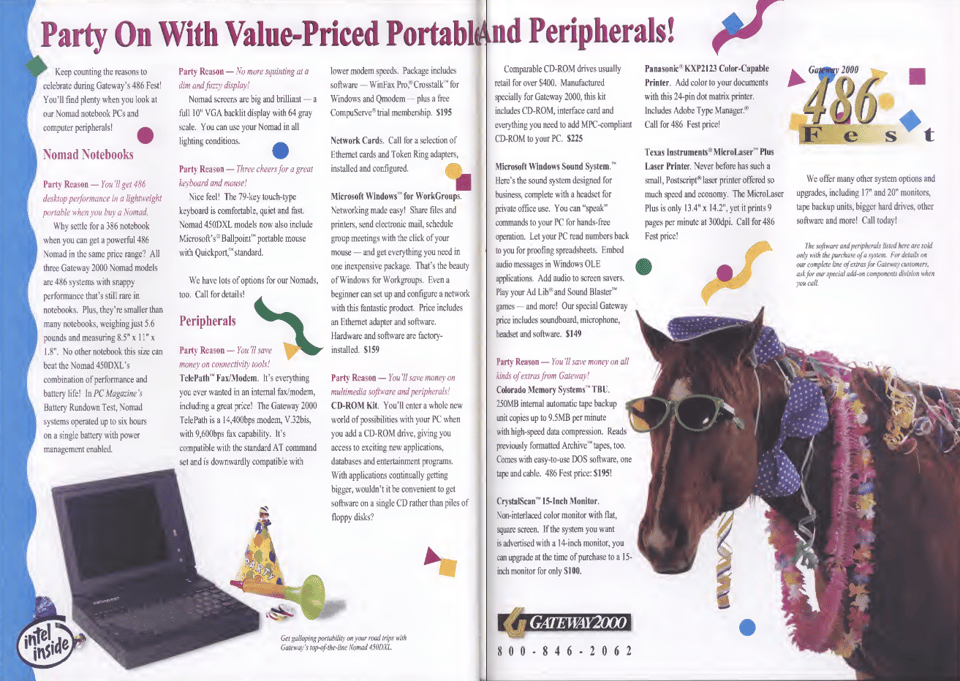
Party hats and sunglasses on animals are the fart jokes of advertising. Somehow lazy and effective, shallow yet infectious, and definitely not too tasteless for Gateway 2000 or its wunderkind president.
"I've used soap dishes as ashtrays in the best hotels in the world,” Ted Waitt bragged during one of his New York Times interviews, explaining in another article that he picked his 1990 Porsche Carrera-C4 because it was “the only car I could find that would go 160 miles an hour in the snow with the top down." Restraint didn’t rocket him or his company to $1 billion in sales over six short years. And it was never a part of the marketing strategy.
The 486 Fest spread pictured above was eleven pages long. It had 28 wildly unnecessary “Party Reason” subheadings, more than a dozen barnyard puns, and a photo of all 2,000 Gateway 2000 employees in front of the cow-spotted headquarters in Sioux City.
“When I worked at PC Magazine in the early 1990s, Gateway 2000 regularly ran 8-to-12-page ad inserts, often featuring cows, cornball jokes, or both,” Lance Ulanoff wrote earlier this year. And that was never more apparent than the months following the company’s eminently unexpected IPO.
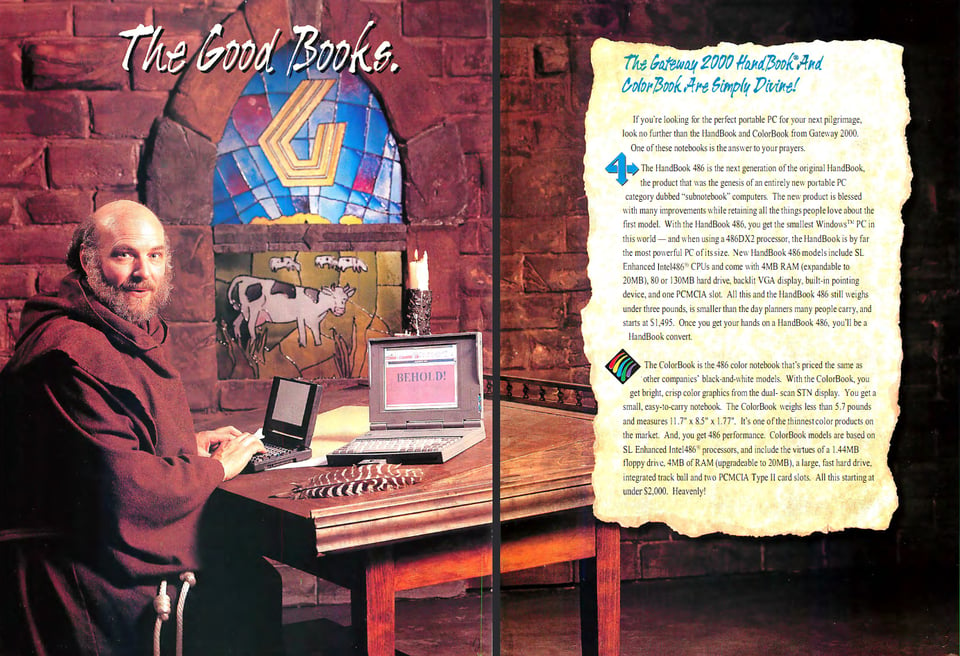
Gateway had opened its first international headquarters in Dublin one month before this ad, selling mail-order computers in Britain (propped up by marketing in local, region-specific magazines), and working on plans to expand into other parts of Europe.
The “pilgrimage” was not without, uh, trials and tribulations, however, and Waitt’s prayers were not answered (this time, at least. He did go on to fund the expedition that successfully unearthed the Gospel of Judas in the Egyptian desert but I digress). The hope was that an IPO would buoy some of the unexpected costs from crossing the Atlantic. A gamble that minted one of America’s first tech billionaires.
“Gateway hit the market at $15 a share. It shot up, then dipped and is now double the original trading price,” according to one article two-years post offering. “Forget that Waitt owns only one suit (a bad-fitting one, to boot), typically sports blue jeans and seldom wears socks, when he hit Wall Street, he blew away any notions by investment bankers that they were dealing with a rube.”
By December of 1993, Gateway was running cheesy 26-page Christmas ads in Byte and had expanded from a manure-ridden livestock exchange building to the Nasdaq stock exchange.
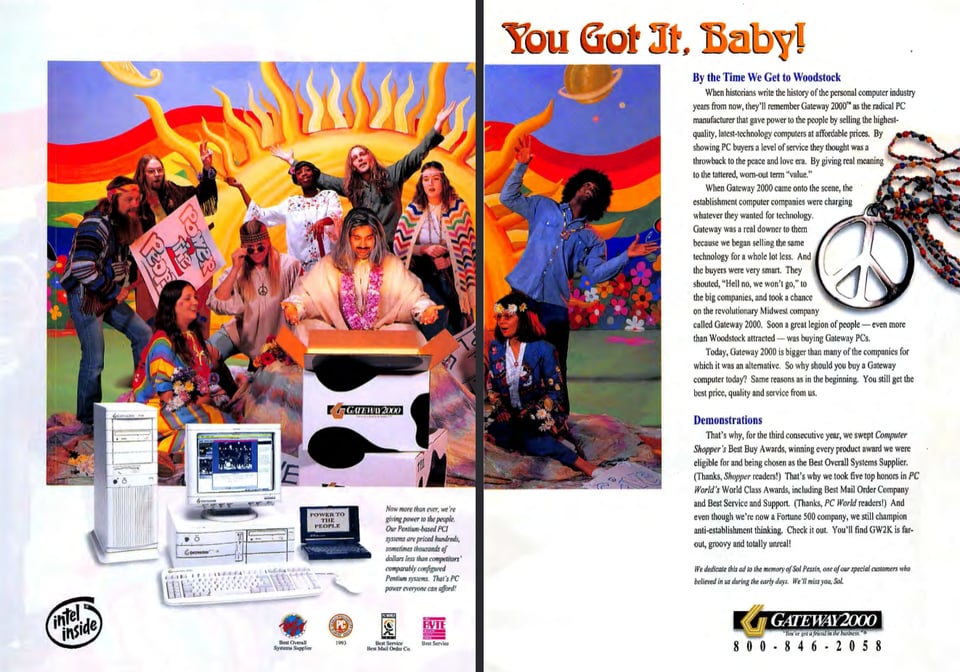
A few not-so-obvious things worth noting about this ad include (but are not limited to!):
The cosmic ennui of the woman standing at one o’clock.
The creepy ogling of Mr. Sunglasses.
The massive downer of dedicating the page to a dead customer.
The historical context that these two pages (along with the 13 others in this ad buy) ran when Gateway 2000 was more corporate and plagued by customer complaints than ever.
Sure, the company was hoping to crack the corporate buyer market, but a public SEC filing claimed that, until that happened, “over 50% of the Company's business is believed to be attributable to either previous buyers of Gateway 2000 PCs or new customers referred by previous buyers.” So, in an effort to shore up its base, technical support headcount was doubled, its one-year warranties were tripled, replacement parts were bumped up to one-day deliveries, and the phone lines were open 24 hours.
Still, What’s Luck Got to Do With It cited a market research study from around this time that claimed 87% of potential buyers knew little to nothing about Gateway 2000, hence the spray-and-pray approach to increasing brand awareness. But surely they could have done better than Julius Caesar getting stabbed (while buying eucalyptus lip balm?) because “Sometimes it’s hard to know who to trust,” preceded a few pages earlier by the Leaning Tower of Pisa guy opining that “Mama-mia! What’sa matta me! That’sa last time I buy a kit from the Towers-R-Us catalog.”
"We get horrible marks from the marketing-guru types," Waitt told Inc. Magazine a few years earlier. "But it seems to work." By 1995 Gateway 2000 had purchased additional manufacturing facilities in Virginia and Malaysia, and scooped up an 80% stake in one of Australia’s largest computer retailers–revenues were up to $3.7 billion.
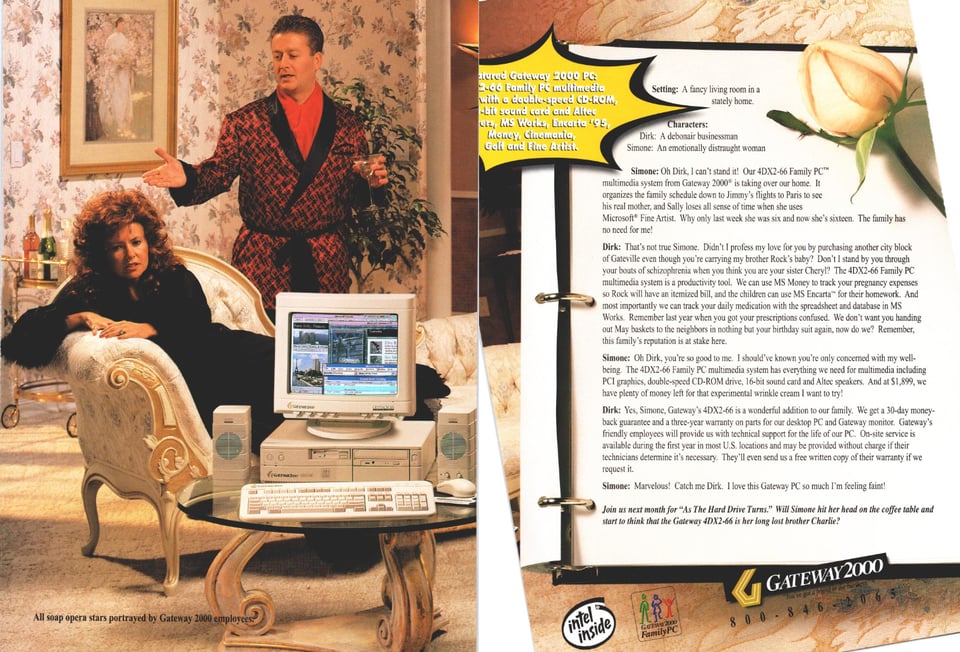
This faux soap opera nails all of my criteria for a Bad Ad. There are a full 230 words wasted on Simone’s “bouts of schizophrenia,” public nudity, and mixed up medications before mention of the first hardware spec. And even if the story was more concise and the details better integrated, how is soap opera parody more relevant to the target audience than, say, IT Crowd style satire. All of that to say nothing of the white-on-yellow text near the top or black-text phone number hiding in shadow near the bottom. It’s a trifecta of terrible!
Of course, this was the same company that shipped an enveloped ad where an insert would transform from black-and-white to color as you pulled it up and out. Waitt was so mad when the intitial quote came back at $3 per piece that he “had the ad printed locally and paid church groups, employees on their free time, and temporary workers to assemble it. The ad came in ‘far under’ that original price.” It’s not hard to organize events like that when your personal assistant is the former mayor of the city your $3-billion-a-year business operates in.
Like almost all of the ‘93-’96 Gateway 2000 magazine ads, As The Hard Drive Turns was actually several loosely related vignettes printed across 10+ pages in Byte, PC World, and Computer Shopper. Sometimes appearing two months in a row with almost imperceptible updates in the interim.
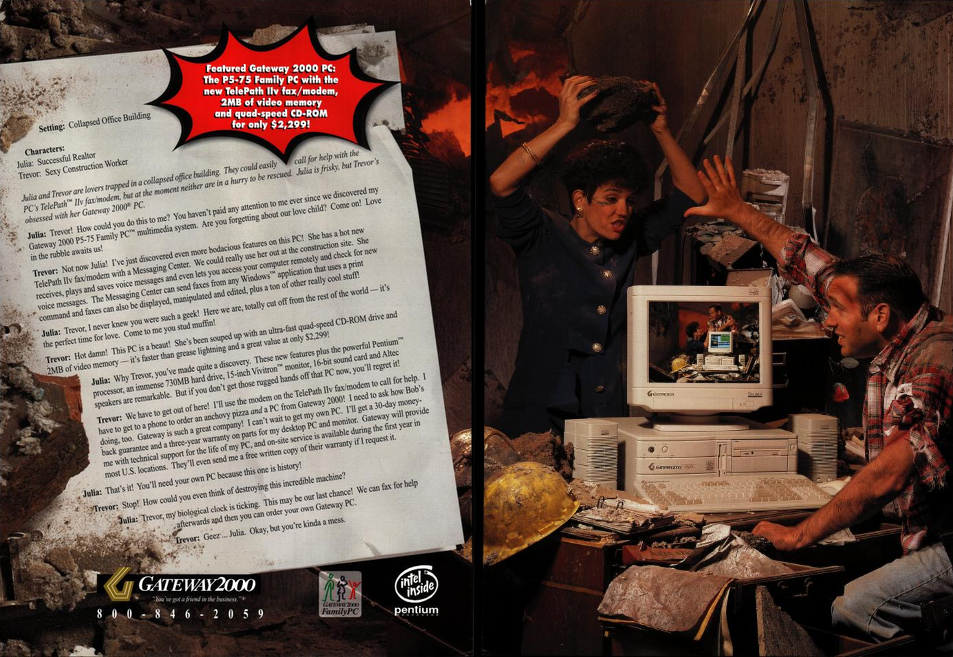
Please, if you only take the time to open and read one ad from this issue, beginning to end, make it this one. “Come to me you stud muffin…love in the rubble awaits us!” Julia the Successful Realtor begs, only for Trevor the Sexy Construction Worker to swat away her advances as he reads off the P5-75’s “bodacious features” while…viewing a screen grab on the monitor of the barely different ad version from the previous month? Sure, why not.
This is, hands down, peak Bad Tech Ads. What started in the early 80s as costumed old men confusing then-cutting-edge hardware with science fiction eventually evolved into Gateway 2000’s perfected pastiche of puns and pop culture, allusion and allegory. It’s all downhill from here, folks, for Ted Waitt, for Gateway 2000, and delightfully campy computer marketing in general.
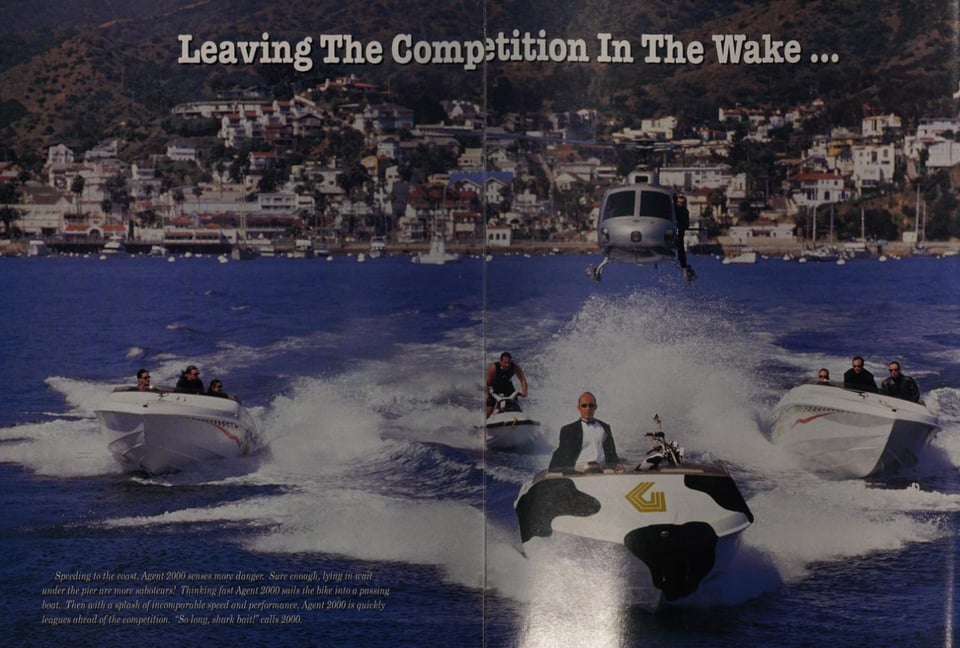
Once again, we have Ted himself starring in an elaborately staged, costumed, and produced multi-page Gateway 2000 saga. In fact, I’m willing to bet either the cow-spotted boat or motorcycle on this page, or the private jet on the last page, or all three, are not props but from Waitt’s real-life garage. And maybe I’m trying to bend history to fit my narrative, but it just isn’t as fun as his appearance in the saloon spread or the Robin Hood shoot. Those were stories of geeky underdogs beating the odds. Agent 2000 is about a rich, well-equipped, veteran agent effortlessly outperforming B-movie henchmen to “Defend All PC Buyers.” I could not care less.
Still, Gateway 2000 retained most of its hard-earned reputation for another year or two. It launched its first website in 1996, the same year it began opening brick-and-mortar stores in the suburbs, where it would show off the poorly reviewed and quickly discontinued Destination 2000 home entertainment PC/TV/modem.
But in 1997, the company began ditching its iconic Holstein cow branding “in an attempt to refine its image,” and started gobbling up companies like Amiga. A year later it dropped “2000” from its name and moved its headquarters to San Diego, so Waitt could spend more time at his 16,000 square-foot, mountaintop property in La Jolla.
"The thing I would definitely do over again is the whole San Diego thing," Ted told the Sioux City Journal in 2007. "That was probably the single biggest mistake."
Things didn’t calamitously implode. But the decline was obvious. Ted resigned in 1999, with each successive product performing worse than the last, and the dot-com bubble destroying the balance sheet.
You can still buy Gateway computers today, manufactured in Shenzhen and sold exclusively through Walmart.com. But you won’t see Waitt in any 12-page spreads advertising them. And you won’t get to brag that you own a computer from Iowa.
Cited References:
PC Computing Jul '93 (Archive.org)
Ted Waitt Isn't Walking Away From Gateway (The New York Times)
Sound Bytes: On the Near Side of 30, at Gateway 2000 (The New York Times)
Remember Gateway 2000? (TechRadar)
Byte Nov '93 (byte.tsundoku.io)
Gateway 2000 UK ad (The Spotty Box)
Gospel of Judas Surfaces After 1,700 Years (The New York Times)
Gateway hits the Nasdaq (Virginia Tech / VA-Pilot)
Byte Dec '93 Christmas ads (byte.tsundoku.io)
Byte Feb '94 (byte.tsundoku.io)
Gateway 2000 SEC filing (SEC.gov)
What's Luck Got to Do With It (Archive.org)
Remember the Gateway 2000 advertisements? (/r/vintagecomputing)
Byte Jun '94 (byte.tsundoku.io)
Betting the Farm (Inc. Magazine)
PC World Feb '95 (Archive.org)
Bad Ads Defined (Such Bad Tech Ads)
Remember the Gateway 2000 advertisements? (Reddit)
Computer Shopper Mar '95 (Archive.org)
PC World Aug '95 (Archive.org)
Gateway 2000 website, 1996 (Wayback Machine)
Computer Shopper Jul '96 (Archive.org)
International Directory of Company Histories (Archive.org)
Gateway: One awesome ride (Sioux City Journal) (Wayback Machine)
Uncited References:
Gateway Inc. (Wikipedia)
How Outsourcing Led Gateway 2000 Astray (Tedium.co)
From Dropout to Billionaire: Founder of Gateway Resigns (The New York Times)