Google's AI answers are taking clicks from websites in the search results. In a randomized experiment, researchers hid AI Overviews from some US desktop users. Comparing them with users who still saw Overviews shows that an Overview cuts clicks to outside websites by about 40%. Those Overviews now appear on more than half the US keywords DataForSEO tracks, up from 6% two years ago. The industry's answer, GEO (generative engine optimization), has yet to show a way to compensate for the loss. While AI citations correlate with the same kind of link profile that goes with higher Google rankings, in March AI assistants sent websites just 0.3% of their traffic.
Search engine optimization (SEO) still decides whether you can be found, but where an AI answer appears, a ranking brings 40% fewer visits than it used to. Generative engine optimization (GEO), the practice of getting your content cited in AI-written answers, looks mostly like SEO plus two additions: being present on the third-party sites AI answers draw from, and writing pages that are easy to quote. We found little evidence for any other tactic.
Google answers first
An AI Overview is a generated summary that Google places above the ordinary results, with links to the pages it drew on. In DataForSEO's monthly panel of 20 million keywords, the share of results showing one climbed from 5.93% in September 2024 to 61.43% in August 2026. The chart at the top of this post shows that climb. Over the same period the featured snippet, the quoted passage Google used to show at the top of a page, fell from 8.96% to 0.44%, and the discussions and forums block fell from 21.13% to 7.42%. Video results rose from 9.67% to 19.98%, though that is down from a peak of 31.05% in October 2025, and local map listings rose from 19.98% to 25.99%. DataForSEO's dataset covers 190 million keywords, 165 million AI answers, and 1.1 billion backlinks, mostly for US English searches. Pew Research Center's data gives an independent check. Pew logged the searches of 900 US adults in March 2025, re-ran them in April, and found summaries on 18% of them. DataForSEO's figures for those months are 14.67% and 17.63%, close to Pew's.
You can't reliably avoid Overviews by choosing different keywords. Between the fourth quarter of 2025 and the third quarter of 2026, the rate rose for every type of search intent:
| Search intent | Q4 2025 | Q3 2026 |
|---|---|---|
| Informational (looking something up) | 48.42% | 70.44% |
| Commercial (comparing options) | 26.30% | 51.35% |
| Navigational (looking for a site) | 17.04% | 34.03% |
| Transactional (ready to buy) | 10.82% | 28.64% |
Low-volume keywords aren't safer either. In the third quarter of 2026, keywords with 201 to 300 monthly searches showed Overviews 58.59% of the time, against 48.62% for those above 600. A separate dataset, from June to September 2026, covers difficulty and price. The easiest keywords showed Overviews 60.64% of the time and the hardest 53.76%. Keywords costing advertisers more than $5 a click were at 49.55% and those under 25 cents at 50.54%, with a low of 42.63% between $0.51 and $1.00. More than half the result pages have no price data and show Overviews 60.06% of the time. The rate does vary by industry. Health is at 69.68% and finance at 68.80%, while apparel is at 37.48%, dining at 29.37%, and real estate at 22.27%.
Queries are also getting longer, especially on desktop. Over a year, queries of five or more words grew from 29.3% to 34.8% of unique desktop queries and from 29.6% to 31.9% on mobile. Three and four word searches are still the most common.
What happens to the clicks
The strongest evidence is an experiment. Saharsh Agarwal and Ananya Sen gave US desktop Chrome users an extension that put each of them at random into a group. One group saw Google as usual, and another had AI Overviews hidden. The researchers then watched two weeks of real searches in January and February 2026. On searches that would show an Overview, the group that could see them averaged 0.37 clicks to outside websites per search, against 0.62 for the group that couldn't, which the authors report as a 39.8% reduction. Searches ending with no outbound click went from 54% to 73%. Clicks on ads didn't change, which suggests Google takes care not to cannibalize its own revenue. Across all searches, with and without an Overview, the authors put the loss at roughly 18.5% of the organic clicks a site gets from Google. The authors expect the loss to grow as Overviews appear on more searches. This is a randomized controlled trial, the most reliable kind of study for separating cause from correlation or coincidence. The effect was statistically significant for informational searches. The navigational and transactional samples were too small to settle anything. This is a working paper, not yet peer reviewed, and it covers desktop only. A separate preregistered experiment by Wang and colleagues, with 1,100 people, also found that removing AI Overviews and AI Mode raised clicks to publishers.
Observational data points the same way. Pew found people clicked an ordinary result on 8% of visits to a results page with a summary and on 15% without one, and ended their browsing session on 26% against 16%. Pew's comparison isn't a controlled experiment, because the searches that draw a summary tend to be longer and phrased as questions.
Click-through rate (CTR) is the share of people shown a result who click it. Across more than 2,000 websites in DataForSEO's panel, the desktop CTR of the first organic result fell from 17.83% in September 2025 to 7.43% in August 2026, a drop of 58%. Mobile fell from 25.17% to 20.80%, a drop of 17%.
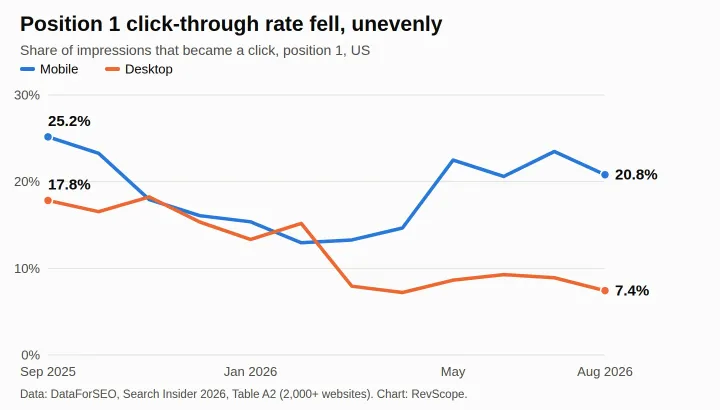
Desktop plunged from 15.18% to 7.94% between February and March 2026. AI Overviews can't easily explain that step since the report has them almost flat that month, at 42.79% and then 43.38%. A change in the format or quality of the Overviews might explain part of it, though that is speculation on our part. Mobile, meanwhile, sank to 12.96% and then rebounded to 22.49% by May. The report itself says its data "does not establish" whether AI answers, layout changes, or changes in behavior are the cause. Its sample may also be shifting underneath it, since the unique desktop queries it counts fell by a third over the year, from 1.97 million to 1.32 million. Whatever the cause, a top ranking on desktop now earns less than half the clicks it did a year earlier.
DataForSEO also estimates where clicks go on pages with and without an Overview. By its model, the first organic result holds 9 to 16 points less click share on pages with one, though these are different searches on a single day's snapshot:
| Search intent | Position 1, no Overview | Position 1, with Overview | Overview's cited links |
|---|---|---|---|
| Informational | 37.1% | 20.7% | 42.4% |
| Navigational | 33.4% | 24.1% | 44.8% |
| Transactional | 37.6% | 21.4% | 43.0% |
| Commercial | 33.8% | 21.1% | 42.2% |
The click share for the Overview's cited links looks promising, but it comes from a model. Pew, which logged real browsing, saw people click a link inside a summary on just 1% of visits, against 8% for ordinary results. Eighteen months and a large change in the product separate the two measurements, so it is difficult to say which is closer to the truth.
Google disputes that search traffic to websites is declining. In August 2025 its head of Search, Liz Reid, wrote that total organic clicks were "relatively stable year-over-year" and that Google was sending "slightly more quality clicks", meaning clicks where people don't quickly come back. She gave no figures to back that up.
Your site can't see whether someone goes back to Google, so you can't check Google's quality-clicks claim yourself, but you can check what your Google clicks are worth. RevScope, our product, shows your revenue per visitor from Google, AI Overviews included, and which landing pages earn the most.
Who the answers cite
If people read the summary and stop there, it matters which sites the summary cites. The report compares Google's AI Overviews with ChatGPT. Their most-cited lists overlap, but a different kind of site leads each one.
| Rank | Google AI Overviews | Citations | ChatGPT | Answers citing it |
|---|---|---|---|---|
| 1 | youtube.com | 51.9M | wikipedia.org | 4.88M |
| 2 | reddit.com | 25.1M | reddit.com | 3.25M |
| 3 | facebook.com | 20.4M | fandom.com | 670K |
| 4 | wikipedia.org | 19.9M | britannica.com | 486K |
| 5 | google.com | 15.9M | nih.gov | 476K |
The report warns that the two platforms' counts aren't comparable, so compare where a site ranks within each list. Reddit and Wikipedia rank near the top of both, and by our count 16 of the 30 domains in each top 30 appear on both lists. The differences are still large. YouTube is first in AI Overviews and nineteenth in ChatGPT. Facebook, Instagram, and TikTok make Google's top ten and miss ChatGPT's top 30, while Reuters, The Guardian, AP News, and The Washington Post make ChatGPT's top 30 and miss Google's. ChatGPT also often cites nobody: 27.3% of its answers had no source, against 0.7% for AI Overviews. So, as the report puts it, strength on one platform "doesn't automatically guarantee" the same on another.
Reddit also appears in Google's ordinary top ten for 32.15% of the report's tracked results, nearly eight times Quora's 4.11%. Two limits apply to all of this. The first is that the answers come from prompts DataForSEO collected, and the report doesn't explain how they were chosen or whether they match what people really ask. The second is that big platforms do about as well in ordinary results: Pew found Wikipedia, YouTube, and Reddit made up 15% of the sources in AI summaries and 17% of those in standard results. Still, the common belief that AI favors Reddit holds up in this data.
GEO looks mostly like SEO
Google's position is that there are "no additional requirements to appear in AI Overviews or AI Mode, nor other special optimizations necessary", beyond a page being indexed and eligible to show with a snippet. Since that is a company describing its own product, we looked at outside data on two questions. The first is which sites get considered, and the second is which page on a site gets picked.
Which sites: link profiles correlate with citations
A referring domain is another website that links to yours. DataForSEO measured how closely referring domains track AI citations using Spearman's correlation, a score where 0 means no relationship between two rankings and 1 means they match exactly. The score was 0.406 for AI Overviews and 0.377 for ChatGPT. Links marked as coming from user-generated content, such as forum posts, scored lower, at 0.342 and 0.314.
These are moderate relationships, and they don't show that links cause citations, since large, well-known sites tend to have more of everything. The samples also contain only domains cited at least once, so they can't tell you what it takes to get cited for the first time. A similar pattern shows up in ordinary rankings: domains ranking first had a median of 111 referring domains against 85 for positions 4 to 10, with heavy overlap between the groups. For AI Overviews, the median cited domain had 282 referring domains on the easiest keywords and 1,571 on the hardest, after the report excluded giant platforms like YouTube and Amazon and any domain with fewer than 50 referring domains. Small sites weren't measured at all. The ranges are also wide, at 518 to 5,765 for the middle half of domains on the hardest keywords, so sites with very different link profiles get cited.
Which page: cited pages often don't rank for the query
Ranking for a query and being cited for it are drifting apart. Ahrefs found 76% of pages cited in AI Overviews ranked in the top 10 for that query in July 2025, and about 38% in March 2026. The two studies differ in sample, parsing, and the Gemini model behind the Overviews, so the size of that fall isn't a clean measurement. One possible mechanism is what Google calls query fan-out: its documentation says these features may issue "multiple related searches across subtopics and data sources". A page could then be cited because it ranks for a related question the reader never typed. Ahrefs offers this only as a possibility, and its earlier study tested the idea and found that the data didn't support it.
The most careful test of page-level tactics we found is a study by the SEO software company SISTRIX, published in October 2026. It paired 48,527 pages cited by ChatGPT, AI Mode, or AI Overviews with uncited pages from the same site, which removes the site's overall strength from the comparison. In the table, a factor of 2.7 means pages with the feature were cited 2.7 times as often as pages without it.
| Page feature | Factor | What SISTRIX says about it |
|---|---|---|
| Current year in the title | 2.7 | A rough stand-in for maintained content, not a title trick; an initial indication |
| Table of contents with jump links | 1.7 | Only 14% of pages had one; 2.5 on editorial sites |
| FAQ structured data | 1.5 | At 833 URLs it pointed the opposite way, a warning about small GEO studies |
| Visible last-updated date | 1.3 | 1.9 on editorial sites, but 0.7 on shops; only 5% of pages showed one |
| Ten or more external links | 1.3 | Linking out to sources |
| Product structured data | 0.8 | 0.5 in AI Overviews, but "not a lever, but no cause for concern either"; it should stay |
| Many features combined | 2.1 | Against barely optimized pages |
An experiment in the paper that gave GEO its name points the same way as SISTRIX's correlations. Aggarwal and colleagues rewrote web pages and measured how much of a generated answer drew on them. On their 10,000-query benchmark, adding quotations raised a page's visibility by about 41%, adding statistics by about 31%, and citing sources by about 27%, while keyword stuffing lowered it by about 8%, all on their main measure, the position-weighted share of the answer's words. Lower-ranked pages gained the most: citing sources lifted a page ranked fifth by 115% and cut the top-ranked page by 30%. They also tried Perplexity, an AI search product, on 200 samples, uploading the source text as files rather than letting it search. The gains on that measure were smaller, at about 21% for quotations and 9% for statistics. The main test used GPT-3.5 reading the top five search results, which is well behind today's products, so the percentages are dated even if the direction still holds.
The most debated shortcut has nothing behind it so far. llms.txt is a proposed file that tells AI systems what a site contains. SE Ranking analyzed nearly 300,000 domains and found no correlation with citations. SISTRIX also concluded there is "no measurable effect", though it cautions that domains with the file differ from others in many ways, so this part of its data doesn't have the same-site pairing. Google says "you don't need to create new machine readable files, AI text files, or markup" for its AI features. The data agrees about the files, though SISTRIX's FAQ structured data result suggests some markup may help.
AI sends little traffic, but it is growing and may convert well
AI assistants sent 0.28% of total traffic across 74,752 websites in March 2026, according to Ahrefs. That was about 3.5 million visitors, against 345 million from Google, or roughly a hundred to one. Ahrefs describes it as small but growing fast. The true figure is somewhat higher because some visits, especially from mobile apps, get counted as direct traffic. The same Ahrefs article reports that on its own site, AI search visitors were 0.5% of visitors and 12.1% of signups. Ahrefs sells SEO software, so its audience may be unusually likely to use AI tools, and one site proves little. Still, on that site an AI visitor was about 24 times as likely to sign up as the average visitor. Some of the value never shows up as traffic. People read an AI answer, form an opinion, and never click.
To count what AI visits are worth on your own site, RevScope reports when ChatGPT, Claude, Perplexity, and other assistants send visitors and whether they buy. It also tracks when AI and search engine bots crawl your pages.
Google's own reporting has a gap too. It counts traffic from its AI features inside the overall "Web" numbers in Search Console. Since 2026 Search Console also has generative AI reports, which Google says show how often your URLs appeared in those features, along with pages, countries, and devices. The announcement describes impressions and doesn't mention clicks, so you learn how often you appear, not how many visits or sales that brings. Rank tracking can't fill the gap, since a page can hold position 1 and earn fewer clicks than it used to.
What to do about it
- Keep the fundamentals. Pages must be indexable and eligible for a snippet. Referring domains correlated with citations more strongly than user-generated links did, and higher-ranking domains had moderately more of them, so links from other sites remain a reasonable investment, even though neither relationship proves cause.
- Find out who gets cited on your topics, per platform. Check your important queries in AI Overviews and ChatGPT and note the sources. Being described accurately there may matter as much as your own page. Take part in the communities those answers cite, such as Reddit, so that you are mentioned there.
- Write pages worth quoting. Answer related questions directly, add original data and named sources, and use clear headings. If you run an editorial site, show when the page was last updated.
- Skip the shortcuts. An llms.txt does no harm but has shown no benefit, AI-specific markup isn't needed, and keyword stuffing lowered visibility in the GEO paper's test.
- Judge the work by revenue. With fewer clicks to go around, it matters more which ones pay. Tie each channel to the sales it produces rather than to its rank or its visit count.
The numbers above are mainly US English, and the products change quickly, so the 2025 figures may already be out of date. Nearly all the large datasets come from companies that sell SEO data or software, including DataForSEO, Ahrefs, SISTRIX, and SE Ranking, and we sell analytics. Almost everything about what earns a citation is correlation. Three findings hold up. Controlled experiments show fewer clicks to outside websites when Google's AI features are present, domains with more referring domains tend to be cited more often among those already cited, and we found no proven shortcut to being cited.
Sources
AI in Search Reduces Publisher Referrals Without Improving User Experience: Experimental Evidence
Google users are less likely to click on links when an AI summary appears in the results
AI Features and Your Website and the Search Console reports announcement
AI in Search is driving more queries and higher quality clicks
Citation Worthiness: Which GEO Tactics Hold Up Across 96,418 URLs
GEO: Generative Engine Optimization
Update: 38% of AI Overview Citations Pull From The Top 10 and 76% of AI Overview Citations Pull From the Top 10