AI agents have been getting a lot of hype for how good they are at coding. But there are still plenty of naysayers saying AI can't replace human programmers.
I've worked professionally as a software engineer for the past 9 years and I think AI agents are a powerful tool. Here I want to share some of my personal data on how much faster they've made me at coding as a full-time software engineer.
AI agents increased my code throughput by 3x
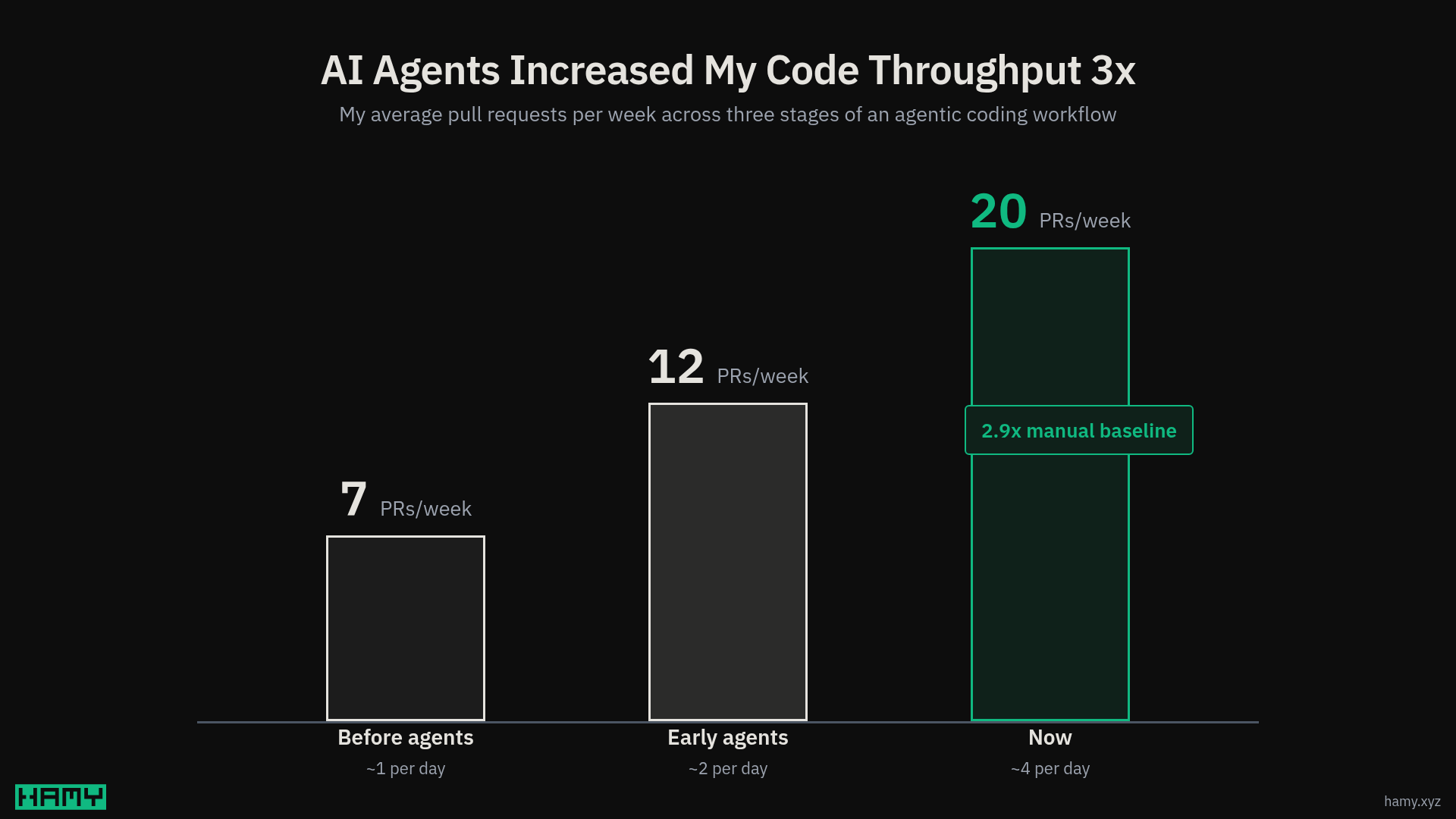
I compared my average pull requests per week across 3 phases of my AI adoption:
- Before agents (pre 2025.06 / Opus 4) - 7 PRs per week (~1 per day)
- With early agents (pre 2026) - 12 PRs per week (~2 per day)
- Now (past 6 months) - 20 PRs per week (~4 per day)
That's roughly 3x my manual baseline and almost 2x my earlier agentic workflow.
You can checkout my current agentic engineering workflow, leveraging vertical slices, atomic / stacked commits, and my terminal-first workflow.
Calculation Caveats
First off, this is personal anecdata from the past couple months so YMMV.
- PRs aren't a good proxy for impact - 1 PR could change 1 loc and yield massive business impact while another could be 10k loc and cause an incident.
- Project cycles vary - some weeks have more planning and coordination while others have more coding.
- PR sizes vary - the same feature could be shipped as 1 large PR or 3 small ones.
- Quality is important and hard to measure - more PRs don't help if the changes aren't useful or maintainable.
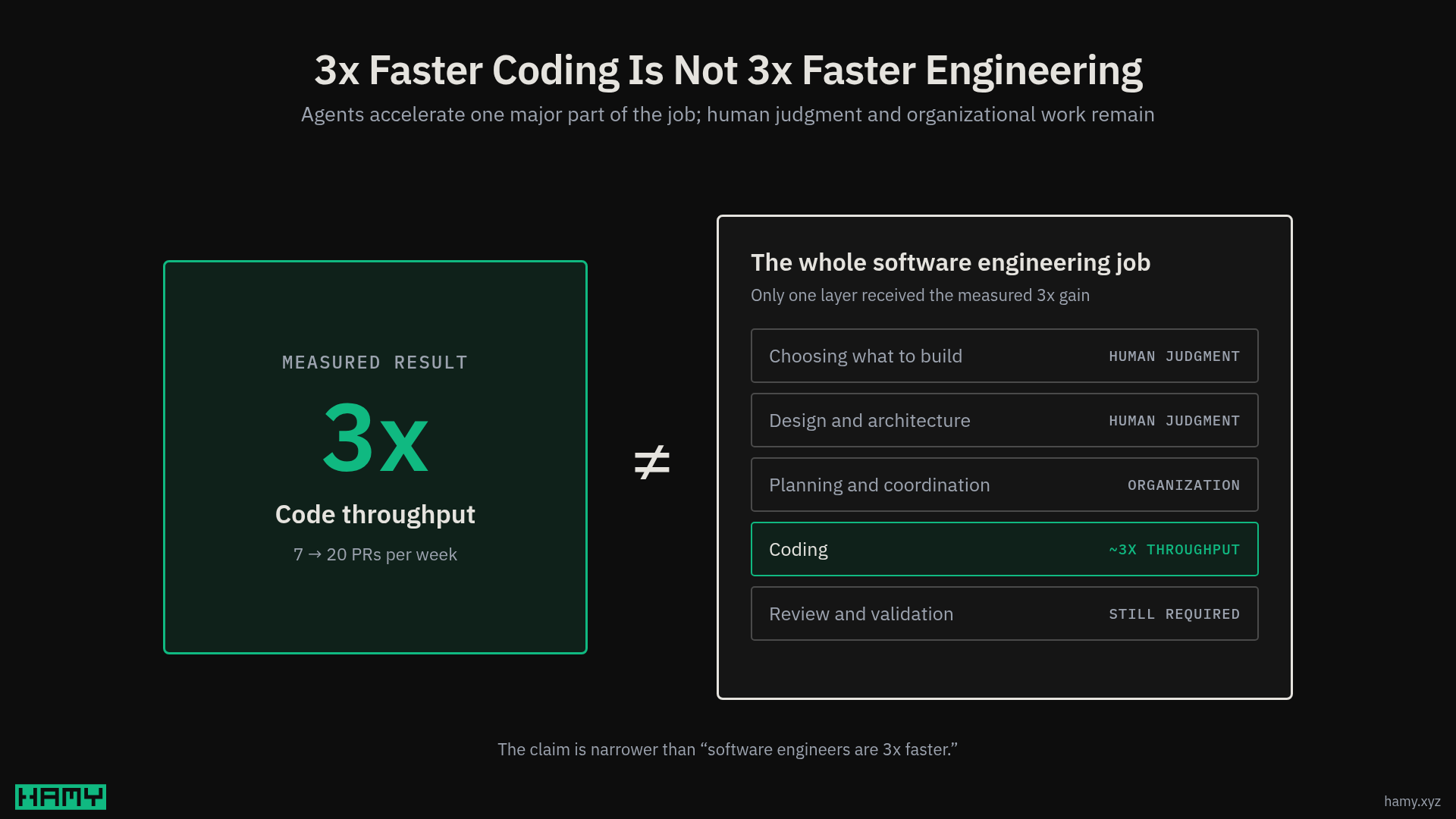
- Coding is only part of the job - planning, priorities, coordination, design, and review often matter more.
And yet I still think PRs are a useful proxy if we assume the other factors stay relatively consistent. Looking back over my own data over time I think does a decent job of trying to accomplish that.
Next
AI hasn't made my whole software engineering job 3x faster but it has made one major part of it (coding) about 3x faster.
In my experience coordination has always been the biggest bottleneck in large organizations but coding was still a bottleneck. Now I'm finding that bulk coding is largely solved. The code may not always be the best but it's typically serviceable and can get good fast with a few intentional review passes (and let's be honest most code shipped at work was adequate but not magnificent). This shifts more of the bottleneck pressure to planning, coordination, and review.
I'm currently finding the highest-leverage human work is choosing the right thing to build and shaping the overall design and architecture - and trying to find a way to do it with quality at the speed of AI. I'm actively thinking about how to improve these bottlenecks so let me know if you have thoughts.
If you want to see the setup I use for agentic engineering at work and on side projects, I snapshot my ai-dotfiles each month for HAMINIONS Members.
Read next: