Published on | Written by
Donald Trump’s latest financial disclosure shows more than $1.4 billion in crypto-related income and proceeds for 2025, while a wider Reuters investigation estimates that Trump family crypto ventures generated at least $2.3 billion in profit from mid-2024 through April 2026. Those figures answer different questions. Reuters’ review of the latest disclosure also reports that the White House rejects conflict-of-interest claims and says Trump’s business interests are managed by his children while he remains the beneficiary.
A line-by-line reconstruction of exact crypto-linked income and proceeds reported through CIC Digital, DT Marks Defi and the stablecoin structure reaches about $1.436 billion. That figure is useful, but it is not a personal bank-balance number. It combines entity-level royalties, token distributions, equity proceeds, crypto yield and operating income reported on Trump’s federal filing. It does not mean $1.436 billion remained with Donald Trump after business expenses, family allocations or taxes.
Article Highlights
- Major exact crypto-linked income and proceeds rows in Trump’s 2025 disclosure add to about $1.436 billion (at $30 per hour, earning that amount would take about 23 thousand years of full-time work, before taxes) under the reconstruction used here.
- CIC Digital-linked licensing and crypto yield account for about $636.1 million of that amount.
- World Liberty and stablecoin-related rows account for about $799.5 million, or roughly 55.7% of the reconstructed total.
- A narrower count of three prominent meme-coin and World Liberty rows comes to about $1.228 billion, helping explain why smaller totals also appear in coverage.
- Reuters estimates broader Trump family profits from four crypto ventures at at least $2.3 billion through April 2026.
- Wallet values, token market capitalization and the Reuters family-profit estimate should not be added again to the 2025 filing reconstruction.
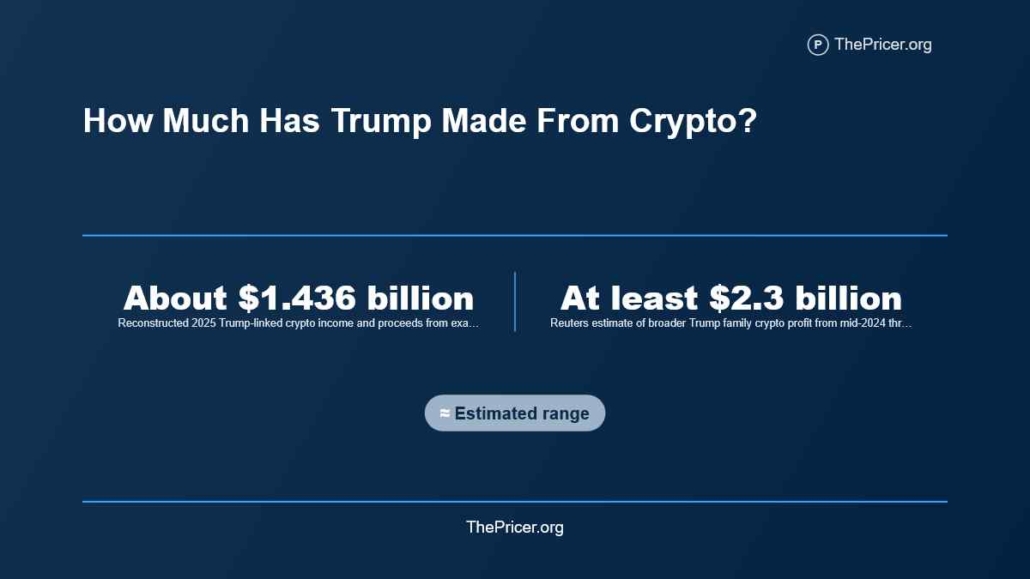
How Much Has Trump Made From Crypto?
The best filing-based answer is more than $1.4 billion (about 22 thousand years of full-time work at $30 per hour) in crypto-linked income and proceeds for 2025. The broader answer can reach at least $2.3 billion when the subject changes to Trump family profit across more ventures and a longer period. The scopes are different. Adding $1.4 billion to $2.3 billion and calling the result $3.7 billion would double count much of the same activity.
The certified annual report covers calendar year 2025 and identifies Donald J. Trump as the filer. Some businesses are held through the Donald J. Trump Revocable Trust. Other structures divide ownership among DTTM Operations and Trump family members. Income reported through those entities can benefit Trump economically without every dollar becoming a personal distribution to him.
For that reason, the article uses several labels on purpose. “Trump-linked 2025 income and proceeds” refers to exact rows reported on Trump’s filing. “Trump family profit” refers to Reuters’ broader estimate. “Holdings” refers to assets still owned. Keeping those labels separate prevents the largest accounting errors in this story.
What the Disclosure Shows
The federal filing provides exact income rows that can be assembled without using a token-price estimate. The certified OGE financial filing reports Celebration Coins royalties of $635,068,835 (about 10.2 thousand years of full-time work at $30 per hour), a sublicense royalty of $493,846, USDC interest of $45,932 and Ethereum validator rewards of $510,808 through CIC Digital. It also reports $65,625,000 from a WLF Holdco equity sale, World Liberty token-distribution rows totaling $526,810,321, $6,995 of USDC interest and $1,821,628 of Ethereum validator rewards through DT Marks Defi. The stablecoin structure adds $196,875,000 in capital and Class C unit proceeds plus $8,326,828 of net operating income.
| 2025 crypto-linked category | Income or proceeds | What is included |
|---|---|---|
| CIC Digital licensing and crypto yield | $636,119,421 | Celebration Coins royalties, sublicense royalties, USDC interest and Ethereum validator rewards |
| DT Marks Defi and World Liberty | $594,263,944 | WLF token distributions, WLF equity-sale proceeds, USDC interest and Ethereum validator rewards |
| Stablecoin-related proceeds and income | $205,201,828 | New-member and Class C unit proceeds plus stablecoin-business operating income |
| Reconstructed line total | $1,435,585,193 | Excludes crypto holdings and non-exact bank-interest ranges |
The worked total is direct. $636,119,421 from CIC Digital plus $594,263,944 from DT Marks Defi plus $205,201,828 from the stablecoin structure equals $1,435,585,193. Rounded for a readable headline, that is about $1.436 billion. The calculation excludes wallet values because those are assets, and it excludes bank-interest rows reported only as ranges when they are not identified as crypto income.
There is one disclosure-format caveat worth preserving. The form is not a consolidated audited income statement, and its World Liberty token-sale rows include both a cash entry and asset-specific distribution entries. Reuters independently summarized Trump’s World Liberty token-sale income at more than $520 million, which is consistent with counting those rows separately. The reconstructed total follows that reading rather than claiming the form itself supplies a single consolidated crypto total.
How $TRUMP Made Money
The $TRUMP story is easy to misstate because several money concepts sit beside one another. Trump’s filing does not label the $635,068,835 line as his personal proceeds from selling tokens into the market. It lists the money inside CIC Digital as royalties under a Celebration Coins licensing agreement. That wording describes a licensing income stream tied to the meme-coin business, not the token’s market capitalization and not the value of every token connected to Trump-affiliated entities.
The project’s current $TRUMP terms say Fight Fight Fight LLC, CIC Digital and their affiliates may sell, transfer or dispose of $TRUMP coins under announced plans or other permitted arrangements. The terms also state that those parties can have financial interests in the token that may conflict with a holder’s interests. They describe $TRUMP as an expression of support rather than an investment opportunity or security.
Royalty income, token holdings and trading-related revenue are different measures. A headline that takes the token’s peak market value and calls that Trump’s earnings skips the route by which money reaches Trump-linked businesses. The private $TRUMP token is also separate from the official Trump $1 coin, which is U.S. legal-tender coinage rather than a cryptocurrency.
CIC Digital is reported as 100% owned by the Donald J. Trump Revocable Trust, with Trump as the trust’s sole beneficiary. That creates a direct economic link between the business and Trump. It still does not make gross business income identical to personal after-tax cash. The useful answer depends on whether the reader means disclosed entity income, family profit or the fluctuating value of unsold tokens.
World Liberty Was the Bigger Engine
The meme coin attracted the loudest attention, but World Liberty and the stablecoin side produced more of the reconstructed 2025 crypto-linked total. DT Marks Defi and the stablecoin structure contribute $799,465,772 when their token distributions, equity proceeds, crypto yield and stablecoin operating income are combined. CIC Digital contributes $636,119,421. That puts the World Liberty and stablecoin side at about 55.7% of the $1.436 billion reconstruction, compared with 44.3% for CIC Digital.
The structure behind that money is unusually revealing. World Liberty’s Gold Paper describes DT Marks as receiving 22.5 billion WLFI tokens and a right to 75% of net protocol revenues after defined operating expenses and an initial treasury reserve. The agreement also says DT Marks would use reasonable efforts to request its owners and principals, including Donald Trump, to promote World Liberty and would license names, images and likenesses to the venture.
The arrangement turns the Trump name into an economic input for a token business. The Trump-linked entity supplied promotional services and name, image and likeness rights. In exchange, it received a large token allocation and a substantial revenue right. That mechanism differs from a hotel charging guests or a club collecting dues because token issuance and protocol revenue can reach buyers and counterparties across borders without the physical capacity limits of a property.
The stablecoin structure adds another layer. DT Marks SC reports $196,875,000 in proceeds linked to capital contributions from new members and sales of Class C units in Stablecoin Holdco. Stablecoin Holdco then reports $8,326,828 in net operating income. Those two rows equal $205,201,828, large enough to move a narrower $1.2 billion reading of Trump’s crypto activity into the $1.4 billion range.
Why the Headlines Disagree
Different billion-dollar headlines can be defensible because they count different rows. Celebration Coins royalties of $635,068,835, World Liberty token distributions of $526,810,321 and World Liberty equity-sale proceeds of $65,625,000 add to $1,227,504,156. Rounded heavily, that becomes about $1.2 billion.
Add the two large stablecoin rows, $196,875,000 of capital and Class C unit proceeds plus $8,326,828 of operating income, and the subtotal rises by $205,201,828. Add another $2,879,209 from the exact sublicense, USDC interest and Ethereum validator-reward rows, and the reconstruction reaches $1,435,585,193.
The gap is mostly a scope choice. The narrower $1.228 billion basket captures three highly visible entries. The fuller $1.436 billion reconstruction captures those entries plus the stablecoin rows and smaller exact crypto-linked income lines. Neither figure should then be added to Reuters’ $2.3 billion Trump family estimate because Reuters uses a broader group of ventures and a longer measurement period.
Rounding can hide the distinction. “More than $1.4 billion” is a useful summary of the 2025 disclosure. “At least $2.3 billion” is a different claim about Trump family profit through April 2026. A careful reader needs the scope attached to the number.
Holdings Are Not Earnings
The disclosure lists large crypto assets next to income, which creates an easy double-counting trap. Independent coverage of the filing reports that CIC Digital held a Bitcoin cold wallet valued above $50 million, plus Ethereum and USDC positions each reported in the $5 million to $25 million range. DT Marks Defi separately reported Bitcoin and Ethereum holdings above $50 million. Those figures describe assets at the reporting date, not another royalty or token-sale payment. The same distinction is visible in coverage of Trump’s Bitcoin holdings.
Market capitalization needs the same treatment. If $TRUMP has a multi-billion-dollar market value at one moment, that number measures a token price against a supply measure. It does not mean Trump received that amount. A Trump-linked entity can retain earlier royalties or sale proceeds while tokens it still owns fall in price. Holdings can also appreciate without producing realized cash.
That is why the $1.436 billion reconstruction leaves wallet values out. Adding the wallets would mix a stock of wealth with a flow of income. It would also create a moving total every time Bitcoin, Ethereum or another token changed price. For a question framed as “how much has Trump made,” reported income and proceeds are a cleaner first measure than paper value.
It is also why the filing’s asset bands should not be treated as precise portfolio values. The highest OGE asset-value band is “over $50 million,” so an asset worth just above that threshold and an asset worth far more can appear in the same band. Income rows stated to the dollar provide far more precision than the reported value of many crypto holdings.
The $2.3 Billion Family Estimate
Reuters asked a wider question than the federal disclosure can answer. Its crypto-profit investigation estimated that the Trump family generated at least $2.3 billion in profit from four ventures from mid-2024 through April 2026. The projects were World Liberty Financial, $TRUMP, ALT5 Sigma, later renamed AI Financial, and American Bitcoin. Reuters used corporate filings, blockchain data, interviews and expert analysis rather than simply restating Trump’s annual disclosure.
The investigation estimated more than $1.4 billion in Trump family gains tied to World Liberty and about $616 million from $TRUMP. It also incorporated the economics of ALT5 and American Bitcoin. This is why the $2.3 billion figure cannot be described as Donald Trump’s personal 2025 income. It includes family interests, transactions after the end of 2025 and value captured through structures that are not measured on the same basis as the annual filing.
ALT5 shows how the crypto network moved into public-company finance. An SEC-filed ALT5 prospectus covered an offering of 100 million shares at $7.50 each and a concurrent private placement involving WLFI tokens. The broader financing was designed to create a large World Liberty token treasury, tying a public company’s balance sheet to a token issued by a Trump family-linked venture.
American Bitcoin broadens the family scope in a different direction. A September 2025 SEC filing reported Eric Trump as beneficially owning 68,147,664 Class A shares at that filing date. That is not Donald Trump’s disclosed income, yet it can belong in a measure labeled Trump family crypto profit. Mining economics also bring a different cost base, including hardware and the cost of Bitcoin electricity.
Who Put the Money In?
The income side is only half of the story. A Reuters investigation of the buyers reported that Justin Sun spent at least $75 million on World Liberty tokens, UAE-based Aqua 1 bought $100 million of WLFI, and Abu Dhabi-backed MGX used World Liberty’s USD1 stablecoin to settle a $2 billion investment in Binance. Reuters calculated that Sun’s purchases alone would have sent about $56 million to the Trump family under World Liberty’s revenue-sharing arrangement.
The $2 billion MGX transaction should not be added to Trump’s earnings. MGX was buying a stake in Binance, not paying $2 billion for World Liberty equity. Its relevance is different. The deal created large USD1 demand, tying a major state-linked transaction to a Trump family-associated stablecoin and the economics of the reserves backing it.
More recent reporting has exposed another large piece of foreign capital around World Liberty. The Wall Street Journal reported that Sheikh Tahnoon bin Zayed Al Nahyan, the UAE national security adviser and chairman of several Abu Dhabi investment vehicles, made a $500 million World Liberty investment for a 49% stake. The report also tied part of the proceeds to entities affiliated with the Witkoff family.
These transactions matter because they show where the scale came from. World Liberty did not reach hundreds of millions of dollars only through small retail token purchases. Large crypto investors, UAE-linked capital and corporate transactions supplied substantial demand. None of those facts proves improper influence. They do make the ownership, revenue-sharing and public-policy questions more consequential because some of the counterparties are foreign investors or state-linked entities.
What Happened to Crypto Investors?
 Investor outcomes changed sharply as token prices fell. A later Nansen wallet analysis reported by The Block found that 988,905 wallets that had bought $TRUMP were down a combined $3.81 billion by the end of June 2026. The figure included realized and paper losses. Fewer than 500,000 wallets were up a combined $4.04 billion, with gains concentrated among earlier buyers.
Those numbers are not a ledger showing $3.81 billion moving from losing wallets into Trump’s accounts. Token trading redistributes gains and losses among many market participants, and paper losses can change without a sale. Issuer-linked royalties, token dispositions and trading-related income follow their own paths. Matching an investor-loss figure with Trump’s disclosed income can show very different outcomes without proving a dollar-for-dollar transfer.
This is the economic asymmetry that makes the story interesting. A business can record royalties and sale proceeds when transactions occur, while buyers keep holding an asset whose market price later falls. The issuer’s past income does not reverse when a holder’s paper loss grows. Promoters, early traders, later buyers and affiliated entities can all end up with very different financial outcomes from the same token.
Why It Matters in Washington
The private-business numbers are now part of a public-policy fight because Trump is also the president overseeing an administration that supports broader digital-asset adoption. On September 14, 2026, the latest ethics agreement reported by the Associated Press said Trump had accepted about 80% of a bipartisan proposal tied to the Senate crypto bill. The proposed safeguards include restrictions on elected officials issuing digital assets and provisions that could require divestment or a blind trust when crypto interests exceed defined thresholds.
The administration’s policy direction is public. Trump’s January 2025 digital-assets executive order made support for the responsible growth and use of digital assets and blockchain technology an explicit administration policy and called for U.S. leadership in the sector. Critics argue that large private holdings and business interests need stronger separation from those policy decisions. The White House has said Trump’s assets are held in a trust managed by his children and denies conflicts of interest.
The size of the financial connection explains the intensity of the debate. A president linked to entities reporting more than $1.4 billion in crypto income and proceeds in one year has a much larger private connection to the sector than an official with a small token portfolio. That fact does not settle the legal or ethics question, and the Senate bill can still change. It does mean that the design of any conflict rules can have direct consequences for substantial private interests.
The strongest reading is documentary. The filing establishes large income and proceeds, corporate records show family stakes and public-company transactions, and Congress is debating how those private interests should be treated while federal crypto rules are written.
Answers to Common Questions
How much has Trump made from crypto?
Trump’s latest disclosure contains more than $1.4 billion in crypto-related income and proceeds for 2025. The line-by-line reconstruction used here reaches about $1.436 billion. Reuters separately estimates at least $2.3 billion in broader Trump family crypto profits through April 2026.
How much did Trump make from the $TRUMP meme coin?
The largest directly related line in Trump’s 2025 filing is $635,068,835 in Celebration Coins royalties reported through CIC Digital. The filing calls that amount royalties, so it should not be described as the token’s market value or as a simple count of token sales.
How much came from World Liberty Financial?
Exact World Liberty, DT Marks Defi and stablecoin-related income and proceeds used in the 2025 reconstruction add to roughly $799.5 million. Reuters’ broader family-profit model assigns a larger value to World Liberty because it covers a longer period and additional economic interests.
Why do Trump crypto totals differ?
The scopes differ. Three prominent meme-coin and core World Liberty rows add to about $1.228 billion. Adding large stablecoin proceeds and smaller exact crypto-linked income rows raises the filing reconstruction to about $1.436 billion. Reuters’ $2.3 billion estimate measures wider Trump family profits over a longer period.
Do Trump’s crypto holdings count as money he made?
Not automatically. A Bitcoin, Ethereum or token balance is an asset whose value can change. Income, royalties, operating profit and sale proceeds are separate measures. Adding current wallet values to reported income would mix assets with earnings and can double count economic value.
Disclosure: Educational content, not financial advice. Prices reflect public information as of the dates cited and can change. Confirm current rates, fees, taxes, and terms with official sources before purchasing. See our methodology and corrections policy.