My story going from a Software Engineer in tech to supporting humans in tech through coaching, creativity and somatic trauma healing. Sign up for my workshop: Reclaim your Power, how we heal from tech workplace harm and burnout.
— 10 min read
I started my tech career in 2011, while still in undergrad studying Information Technology interning for Gnome Foundation through Google Summer of Code. I went on to work for a U.S consulting firm from my home in Chennai, TamilNadu. A friend told me about Recurse Center, then called Hacker School and I applied. I did not know what an epic journey I would go on from there but I got in, with scholarship support from them for underrepresented groups in tech.
After applying to a Master’s degree and several rejections and a second try a few months later, I was accepted at University of Utah for a Master’s in Computer Science after a personal interview with an advisor. My thesis proposal was about testing distributed systems, and he loved it. I got an offer to work at Wikimedia Foundation in San Francisco for their Analytics team at the same time, and after having been in educational instituitons as a neurodivergent kid for so long I wanted to be free, and to get paid, instead of paying back 54000$ in student loans.
Life was educating me on my queerness when I didn’t know it yet behind the scenes by placing me in New York and San Francisco walking through the living histories of the lgbtq+ movement in the U.S. I was on Mission St when the celebrations broke out after the marraige equality laws were passed in 2015. I read Sister Outsider by Audre Lorde and I found a home in Black feminist study. bell hooks’ Feminist Theory: from Margin to Center was my next book. I went to Wikimania 2017 in Montreal and I attended a panel where Thenmozhi Soundarajan opened my eyes to the ways I hadn't yet grasped the long history and impact of caste oppression.
I started to understand how my own caste privilege and educational privilege had allowed me the opportunities I had. The more I understood the nature of bias, marginalization and oppression of BIPOC, women, queer and trans people, through my reading, the more I started to see the patterns at work. I talked to people about changing the culture, and I was pointed one of two ways.
- Join a women and nonbinary ERG:
I learned a lot – Ally Skills, foundations of DEI. I forged bonds with amazing people who taught me a lot. I also listened to a lot of hurt people. I did not have the capacity I have today to truly hold all of these stories without myself burning out emotionally, and I now recognize, energetically.
I tried hard to show up from a place of supporting people-willing to do the glue work as needed and to advocate not just for myself but for women, non binary and BIPOC folks in the org—there were not many of us in Engineering. I burned out—giving a lot of myself and not giving enough to myself. I would have massive pain flares by the end of my time in San Francisco, that continued me to my next job in Toronto working for CircleCI.
- Become a leader yourself so you can change the culture from within
Despite my burnout I kept going, because I needed to get paid. I started as a Senior Site Reliability Engineer, and then asked my then boss who wanted to be more of a technical leader, to switch to his role. He was so supportive of my leadership journey, and I became an Engineering Manager soon, (when I was cis) one of several senior women engineers who would all become managers around the same time.
I loved learning Leadership skills and I found and attended the best trainings I could find—BetterBoss with Raw Signal Group in Toronto and Team Topologies in San Francisco. I had a coach via an external agency paid for by my work.
Yet, I was wholly underprepared for the 13 person team I would manage across three timezones. I had really supportive peers but I (among others) found myself caught between insufficient support from the leadership above me and not being able to show up for my reports enough. I left, after a bad performance review and being so exhausted in my body that I needed to leave.
When I started looking for work, the pandemic hit and after several cancelled roles, I got an amazing offer from Hashicorp with a team I loved interviewing with, who saw how I valued culture, systems and people and felt aligned with it. I still miss working with this team.
As my role and influence grew there, I had the honor of hiring an amazing diverse team of people and helped build a second team. I was asked to step in to support another team in a rough transition—even though the outcome was largely not favorable, the team assured me that the care and attention that I brought to the transition through hard times was so supportive.
My chronic illnesses started to come more into view as my symptoms got louder. At the same time, I was yearning for my role to be less focused on the engineering, and more on the people. As someone that held space for so much pain and hurt that folks brought to me and I experienced myself from my experiences across my work environments—I thought there needed to be dedicated coaches who could support the engineering org so people could be heard and grow on their terms, and that I could be the person who seeded that effort. I studied and practiced to become a Leadership and Creative coach at the Academy of Creative Coaching, an ICF accredited school. I facilitated a workshop I created on building cultures of Feedback at work, and the response affirmed my path even more. I love doing this work.
Despite having support within my org to make this transition, ultimately it did not work out. But, I had already told my team I was leaving and incorporated my coaching company. I left anyway, and started my business with my peers as my first clients. I ran a group coaching program for five Software Engineers where we delved into Confidence and Leadership skills. I coached folks across industries directly and via external coaching platforms BetterUp and Growthspace.
My coach training taught me the importance of healing myself and caring for myself if I wanted to show up in the capacity of coaching and healing people. But I did not know how to heal myself yet. I started learning somatics and to practice, yet a lot of the time, I did not feel embodied.
I went to talk therapy and I learned a lot about myself, but my body still ached the same. I took antidepressants to manage my anxiety and depression, they did help me and they also numbed me emotionally.
When I left full time work in tech, I thought my burnout would last a couple of months and then I would be ‘up and running’ again. But instead I found myself sleeping for hours in the afternoon, having so little interest in doing anything, and being so brain fogged that building a business felt so daunting.
I stepped away from my tech focus to make space for my creative life. I did not know it then but I do now, that I also found it too hard to stay in tech because parts of me were too hurt by my experiences to continue. I also needed the distance to see things more clearly, by making space to connect with my body, my spirit and the land through the act of engaging my creative life and tending to my inner ecology.
Through my friend and leadership coach, Indy Batth, I learned of Sarah Jawaid and Damon Azali-Rojas’ and attended their Introduction to Liberatory Coaching training and read their book, Love Letter to the Movement-Using a Coach Approach for Healing, Justice and Liberation. Their decolonial coaching approach gave me language for what felt missing in the mainstream coaching industry for me, and I learned from them how to integrate Parts work into my coaching practice.
I also dove into the realm of learning more about the psyche—which took me to the study of psychology, archetypes, astrology, Tarot and Jungian dream analysis—and the more I saw the patterns that underlie my own behavior and desires. I found my way to experiential astrology learning that is rooted in mythology and the felt-sense of the body.
Over the last few years, I’ve had the privilege of healing in a variety of containers that center healing from within the body, that were held for me by skilled practitioners—neurofeedback, EMDR, somatic energy healing, to name a few.
I am still Disabled and neurodivergent and have chronic pain, but all of these modalities offered me structural shifts in my body-mind that had generative impacts on my quality of life. My pain started to get a lot more manageable with less and less flares of late.
The capacity I gained by healing in my body opened me up to healing myself through practicing somatic and land-based Parts work. The more I made space for my body, the more of myself I began to feel come alive—that had felt stagnant or inaccessible for so long.
Simultaneously, I was studying Black feminist worldbuilding at Seeda School, with Ayana Zaire Cotton, who is also a Recurse Center alum. I created the framework of my practice, Transgressive Adaptation which offers us a framework to ground this inner healing work in the story that's unfolding in your life, supporting you in meeting yourself at the edge of what feels untenable or challenging, to claim your deepest desires and lead with your innate creative power.
I weave coaching with somatic healing and creative faciliation to create offerings that support the collective in healing from long-term psycho-somatic impacts we sustain from surviving experiences that we did not have the capacity to handle when they occured. My vision is for us to have more of our power to nurture what makes us feel alive.
Coaching offers the framing that we are already whole and resourced, and that the answers we seek are within us. You have sovereignty over yourself, and you choose where the work goes.
From a somatic healing approach, I bring the practices of connecting with our body and the lands capacity to heal us and support you in creating a richer creative relationship to your inner ecology and the land.
The people who work with me are truly brave. This work can touch tender places, and when you reclaim your power and remember your relationship with the land, you are also opening up to new possibilities and answering the call of your deepest desires.
As a trauma healing practitioner, I prioritize safety and consent. You have agency to decide what you will work with all times. My practice is about supporting you in learning how to build safety and resource your Self first and from this place slowly build the capacity to converse with what feels distressful, so that you can tap into more of your creative power and lead from within.
Every practice moves something, naming a sensation in your body alone can be so powerful in slowing us down in the moment.
And, it is a long-term practice, not a quick-fix.
At Recurse Center, I was exposed to what play could feel like as a programmer. Through my time working in tech, my access to and capacity for play dwindled. Retreiving play is a deeply cathartic and transformative act that has opened the floodgates to my creative expression. My work hopes to be a bridge in your relationship with play.
I believe presence opens the way to play. Sometimes, I don’t know the difference between the two.
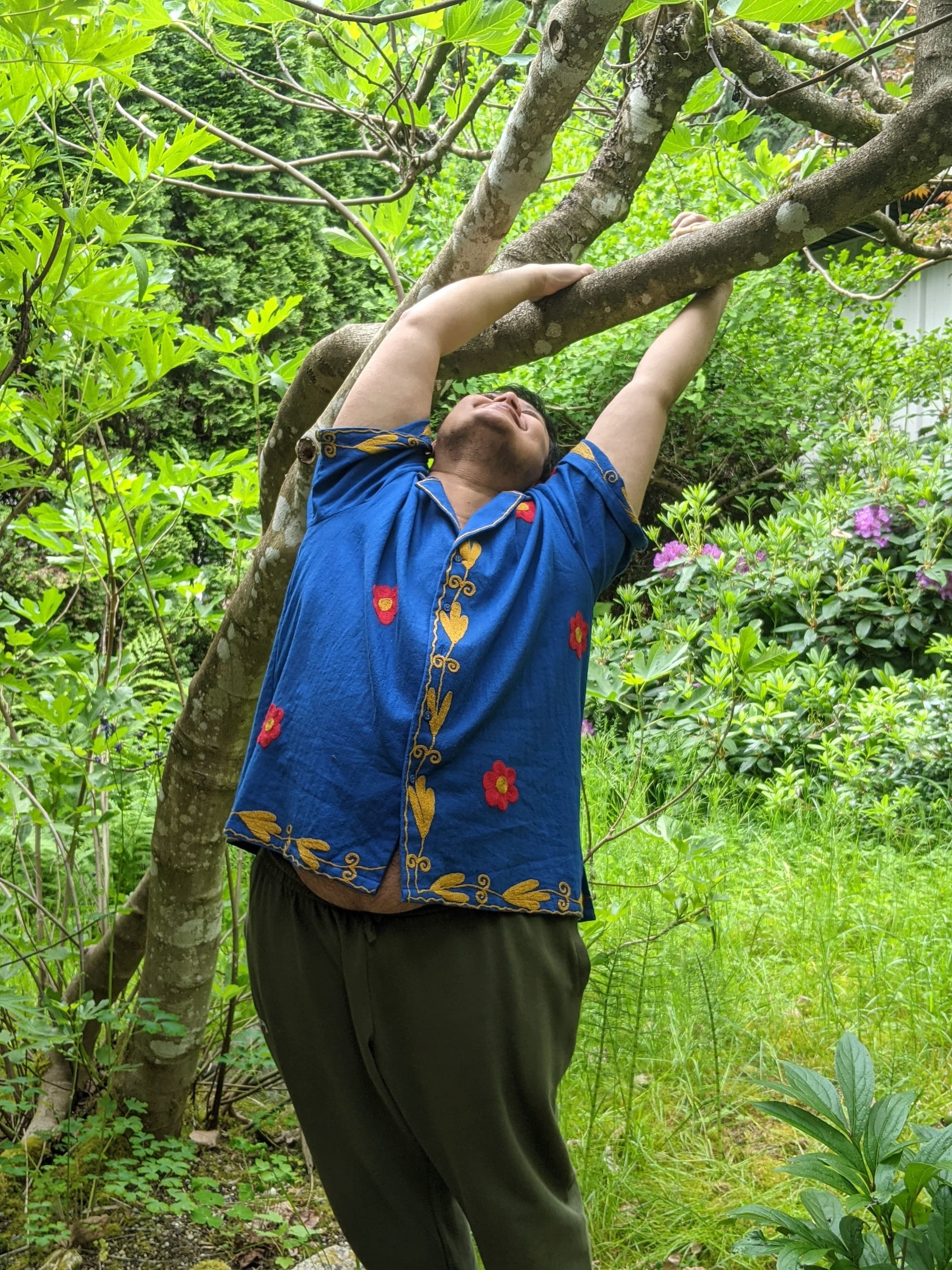
Reclaim your Power is a workshop for folks who work or worked in tech, where we talk about how we heal from tech workplace harm and burnout from within, to open up to our expanded capacity for Presence, under stress and uncertainty in the AI era.
🌱 This is the practice I'm teaching in this workshop, so you can do this healing work for yourself, through guided somatic practice and creative self-coaching prompts.
𖨆𖨆 You will get to connect with people who are navigating this threshold of great change, and be seen and held in a supportive and nurturing space.
🫱🏾🫲🏼 My spaces are inter-generational and open to all, while centering the experiences of BIPOC, women, neurodivergent, Disabled, queer, trans and nonbinary folks. I invite folks to show up with mutual respect and curiosity, and I believe that by creating spaces that allow for the possibility of being seen across difference, we can come together to heal as a collective.
🔗 Will you join us? It's 46$ to sign up, and you'll have access to the replay and workshop materials after, even if you can't make it to the live event.
📣 If it's not for you at this time, I'd be so grateful if you would share this with your peers and friends who would love to attend.
These places of possibility within ourselves are dark because they are ancient and hidden; they have survived and grown strong through that darkness.
- Audre Lorde, Poetry is Not a Luxury, published in Sister Outsider