Explore a deep dungeon of infinite possibilities where danger and treasure lurk around every corner. The dungeon is generated anew every time you play, so no two games will be the same. Discover troves of mysterious potions, scrolls, and wands that could be your salvation, or bear a horrible curse. The dangers are real enough to keep things tense. If you die in the game, your character is dead, with no undos, restore states, or load games. Time to roll up a new one.
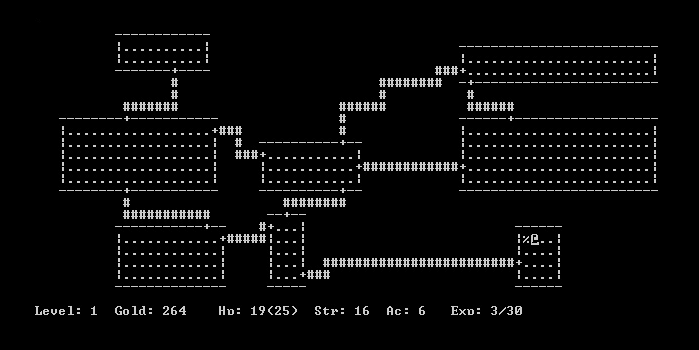 Screenshot from Rogue, which uses white on black text to approximate a top-down view of a dungeon level. The player, marked with an @, stands in a room connected to other rooms through dark tunnels denoted #, beside a staircase indicated by a %.
I have to confess, Rogue is the entry among these 50 I’m the least enthusiastic about. It was in fact popular and influential. Dennis Ritchie, co-inventor of Unix and C, joked that Rogue was the biggest waste of CPU cycles in history. But if you try to play it today, unlike its next-door neighbors Asteroids (1979) and Donkey Kong (1981), it’s difficult to learn and not very fun. Rogue’s distant descendant Dungeon Crawl Stone Soup (2006) does everything it set out to do, but better, besides just being easier to pick up and play. And you don’t have to look far to find a direct descendant that’s less obtuse but still influential enough to establish its own subgenre, such as Diablo (1997), NetHack (1987), Mystery Dungeon (1993), or Spelunky (2008).
Then why did I choose to write about Rogue over another video game from 1980? Consider my second choice, Pac-Man. I run into all of the same issues with Pac-Man. It’s hard to overstate how popular and influential it was. It singlehandedly got everyone making and playing maze games like Rally-X (1980) and chase games like Dig Dug (1982). But its bootleg romhack Ms. Pac-Man (1982) is both ubiquitous and better in every way. And I’m young enough that my introduction to the series as a kid was Jr. Pac-Man (1983). I’ve enjoyed my time with Pac-Man’s descendants, but the game itself leaves me lukewarm.
Going down the list of the games released in 1980, I run into a similar lack of direct experience. I’ve played 20 minutes of Zork. Maybe 20 minutes of Missile Command. A few enjoyable hours of Rally-X, but not enough to wax poetic about it. Heiankyo Alien, Adventure, and Mystery House are all notable, but I’ve only read about or watched playthroughs of them. All told, the two hours I’ve actually spent with Rogue combine with my passion for its successors to render it the best option regardless. This particular year really runs up against my one game a year constraint. Getting a sense of what was going on with video games in 1980 still probably outweighs my lukewarm opinion of Rogue itself.
It is, however, possible to overstate Rogue’s influence on video games. Because it pre-dates all its notable siblings, it’s easy to claim Rogue as the originator of game tropes like experience levels and magic items. But those all stem from its main influence, 1974 tabletop sensation Dungeons & Dragons. When its fellow D&D descendants Wizardry (1981), Ultima (1981), Might and Magic (1986), Dragon Quest (1986), or Final Fantasy (1987) used those tropes, they weren’t copying Rogue; they were copying D&D. Rogue considered D&D’s six attributes and concluded the only one worth modeling was strength. It has to settle for merely naming the roguelike (and later roguelite) genres in addition to its admittedly gigantic influence.
Rogue’s monochrome text graphics imply the only way to tell different enemies apart is which capital letter they are. So I leave you with Rogue’s complete 26-monster bestiary, lifted wholesale from the 1977 D&D Monster Manual: giant Ant, Bat, Centaur, Dragon, floating Eye, violet Fungi, Gnome, Hobgoblin, Invisible stalker, Jackal, Kobold, Leprechaun, Mimic, Nymph, Orc, Purple worm, Quasit, Rust monster, Snake, Troll, Umber hulk, Vampire, Wraith, Xorn, Yeti, Zombie.