Gradually build up a character from plinking away one shot at a time, to filling the screen with projectiles while blinking all over the map. Diablo II is all about experiencing an incredible 100-hour power fantasy character arc. Like with Lord of the Rings, playing it now can feel derivative rather than prescient, just because the series established so many of the conventions for video games. Red health and blue mana? Item sets? Teleporting to waypoints? Color-coded item rarities? Gems and socketable items? Item affixes? Skill trees??
This is the second in a series of posts examining video game history through looking at one game I loved from each year, 1978–2027.
One secret to Diablo II’s success was its obsession with procedural generation. Instead of static levels you could memorize, most Diablo II levels were randomly generated. While generated levels were a staple of the roguelike genre Diablo II descended from, they weren’t common in mainstream games. Diablo II’s world generation was notable in part for using many different generators based on your biome. Wandering the randomly-generated desert would feel very different from navigating abandoned sewers. While its predecessor Diablo (1996) was also procedurally generated, it contained a single 16-level dungeon, a pale shadow of Diablo II’s expansive generated world.
Diablo II inherited its rich, underexplored mechanics from Diablo, of course. Diablo was an attempt to take the roguelike Moria (1983) and add graphical, real-time action combat. Considered the first influential action RPG (ARPG), Diablo was a solid success. Its strategy of “take a niche genre that turbo-nerds love and make it pretty and legible to regular nerds” created an excellent foundation for Diablo II to expand on. Diablo II would then go on to inspire so many ARPGs that the genre is still sometimes called “diablolike” to this day.
Diablo-style item colors — blue for magic, yellow for rare, green for set, and gold for unique — would become the default for video games until its sibling World of WarCraft (2004) popularized its even more influential standard. ARPGs were such a compelling fusion that they still inspire entire new genres. Borderlands (2009) applied the formula to first-person shooters, creating looter-shooters. Vampire Survivors (2022) compacted the 100-hour character arc to 30 minutes, creating bullet heavens (or single-stick shooters, or pick-3s; the genre name hasn’t cleared its orbit yet).
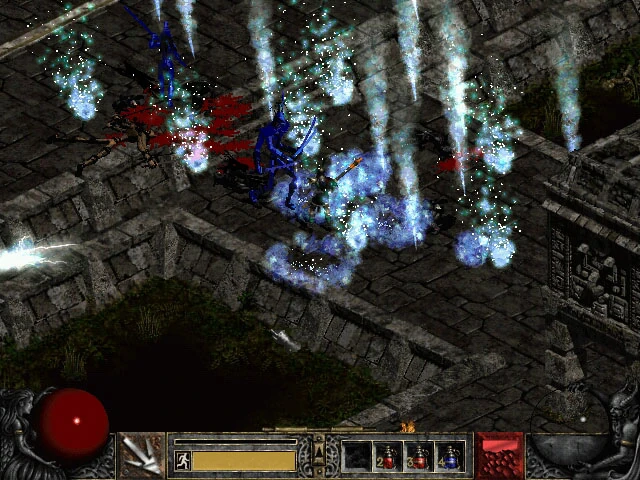 Screenshot of Diablo 2 in pixelated 640x480 resolution. A sorceress in trademark green casts Blizzard, spraying snow all over the dungeon and turning a nearby sword demon blue.
The Arreat Summit was an official Diablo II website where you could look up game mechanics in unprecedented detail. Official game websites in 2000 would have a screenshot or two, some marketing copy, and maybe a link to a fansite where the real information was if you were lucky. Allocating a website maintainer to publicly document the game’s inner workings was another thing Diablo II did far ahead of its time. Another was the free included netplay service battle.net.
I did not play Diablo II in 2000. Its system requirements included a ridiculous 32MiB of RAM. When they ran an open-to-everyone load test, I gave it a shot with my 16MiB of RAM and was treated to a slideshow. I could only look on in envy, only sneaking in a few hours on a friend’s gaming rig in 2001. I eventually learned how to physically jam some RAM I ordered straight from the manufacturer into my computer’s innards by 2002 and was able to enjoy it.
It would be negligent to discuss 2000 in video games without at least mentioning The Sims. The Sims was by far the most well-known game released that year, especially popular among people who didn’t play video games. Starting with SimCity (1989), Maxis set out to make games out of simulating everything from a single building in SimTower (1994) to the entire planet in SimEarth (1990). They’d known for years that simulated people would be the most difficult and rewarding game to get right. They managed to knock it out of the park, with innovations like the needs bars and mood framework that changed the way people thought. They even managed to include same-sex relationships, despite an unfriendly media climate.