Decipher an unknown ancient language through fragmentary inscriptions found on artifacts and monuments. As an archeologist from a culture where the concept of history itself is heresy, you stand entirely alone if you believe there’s anything to be gleaned from the past. But oh, how much there is to be gleaned. With enough linguistic understanding and attention to detail, you can piece together worldview-shattering revelations from the layered remnants of history.
Or, don’t do that.
Muddle your way through with educated guesses and trying buttons until something happens. History doesn’t care. The game doesn’t care. Your experience might be dramatically different, but the game is justifiably confident enough in its story to let things happen with or without your understanding.
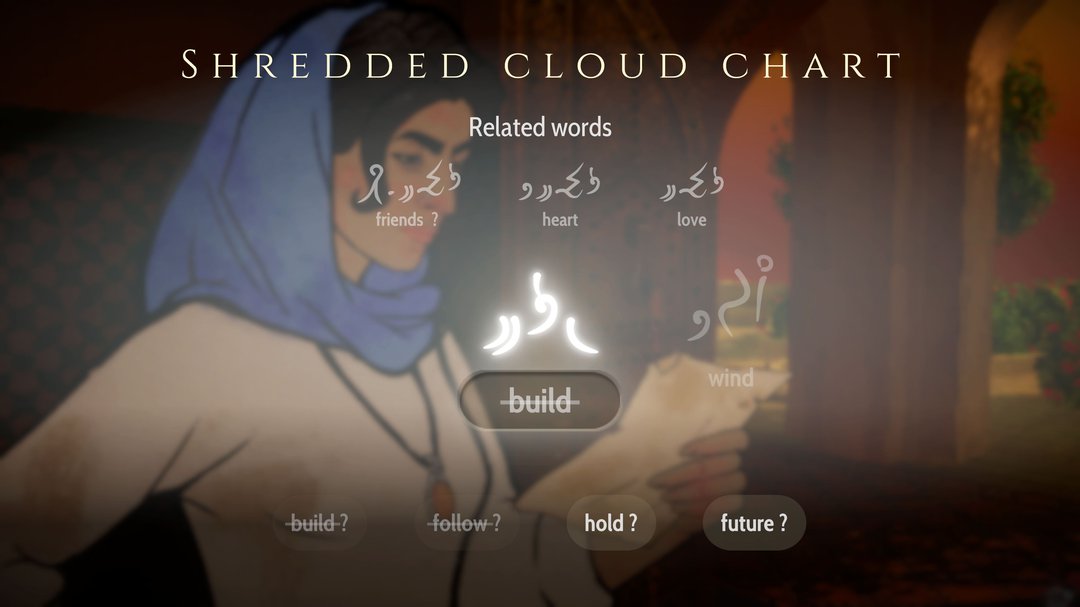 Screenshot from Heaven’s Vault. Two words in Ancient script are displayed with some possible glosses. Related words and their glosses are shown above. In the blurred background, the player character Aliya studies a weathered sheet of paper. Aliya is a woman of Middle Eastern descent in her 30s, wearing a loose headscarf and a tunic suited for fieldwork.
Focusing on the game’s reactiveness is kind of burying the lede. Heaven’s Vault is a game about translation. It is centered around a single twenty-hour series of logic puzzles about learning an unknown language. You spend most of your time figuring out what words might mean, negotiating with people to get more artifacts with language to analyze, and exploring unknown locations filled with even more tantalizing language. Getting access to new text is the reward for exploration and experimentation. If that speaks to you, this game is probably for you. And if it doesn’t, it probably isn’t.
Heaven’s Vault is simultaneously a personal story and a grand history. Events you learn about fill out a unified timeline that smoothly zooms from “I started this dig two weeks ago” to “I left the orphanage 20 years ago” to “The era I’m calling the Age of Sail for lack of a better name was 2000 years ago”. That zoomable timeline is one of the most prominent features in people’s memories of the game.
Heaven’s Vault is Inkle’s followup to their original debut 80 Days (2014), inspired by Jules Verne’s classic novel. Like 80 Days, Heaven’s Vault is a game with a pre-defined beginning and end, and an uncomfortably unknown middle. Unlike 80 Days, there is no map of the world to give you a sense of how far you’ve come and how much yet remains. In a feat yet to be matched, I found myself unable to determine what kind of structure the game had. What a delight to feel so lost despite all my genre-savviness.
Inkle plays to their experience with unknown middles in their subsequent games like Overboard! (2021) and Expelled! (2025). Their works can more generally be categorized as interactive fiction, or IF. Other contemporary studios exploring the IF space include Failbetter in Sunless Skies (2019) and Mask of the Rose (2023), and Choice of Games in Choice of the Deathless (2013) and The Luminous Underground (2020).
Maybe it’s more useful to categorize on a different dimension. Heaven’s Vault is a mystery game where you play the role of detective, a feeling games have tried to capture for decades. What distinguishes it from previous attempts like The Dagger of Amon Ra (1992) and The Last Express (1997) is how open-ended the mystery is. Historically, detective games like Ace Attoney (2001) and Danganronpa (2010) feature satisfying mysteries packed with wild aha moments that the game insists you unravel step by step at its pace, not yours. The new breed of mystery games heralded by Her Story (2015) and exemplified by Return of the Obra Dinn (2018) instead leave you to your own devices, letting the mystery sit in ambiguity until you work it out yourself. They feel much more like making brilliant deductions than painting in the numbers of a pre-outlined plot. Later games that build on this design innovation include Paradise Killer (2020), Pentiment (2022), and Rise of the Golden Idol (2024).
2019 is overstuffed with excellent games, any of which I could have chosen to praise enthusiastically here instead. Slay the Spire (2019) created a genre so rich that it inspired its own genres. Disco Elysium (2019) is a singular gonzo lightning-in-a-bottle masterwork. Outer Wilds (2019) created metroidbrainias and remains their unsurpassed exemplar. Baba is You (2019) perfectly executed a different impossible game concept. Untitled Goose Game (2019) caused problems on purpose, reaching far beyond video game fans. Mainstream releases similarly excelled with the likes of Control (2019), Final Fantasy XIV: Shadowbringers (2019), Fire Emblem: Three Houses (2019), Sekiro (2019), and Apex Legends (2019). I believe my personal favorite, Deadfire (2019), will remain unmatched in its genre through at least 2029.
None of those worthy entries affected me as deeply as Heaven’s Vault. Its themes, story, and mechanics became a part of me that will remain as long as I live. That’s why I wrote about it over another of these deserving titles.