2026-06-24 — books
Toughts about the book "Interviews with Francis Bacon" by David Sylvester.
What
"Interviews with Francis Bacon" is a book with transcripts of interviews with the painter Francis Bacon (1909-1992) from 1962-1986. It is literally just transcripts; paragraphs starting with "FB" for Francis Bacon or "DS" for David Sylvester (the interviewer). It contains pictures to help you know what paintings they are talking about. I read an old copy with black and white pictures which made the FB paintings less scary.
Why
A friend recommended this book as her favorite book about creativity. I wasn't drawn to it because I don't connect with FB's art much (too scary!) but my friend gave high praise and after looking at some picture of the book online, I was drawn to how it looked. The plain conversation style, the odd page layout (a wide margin on the left and almost no margin on the right), the combination of images and text.
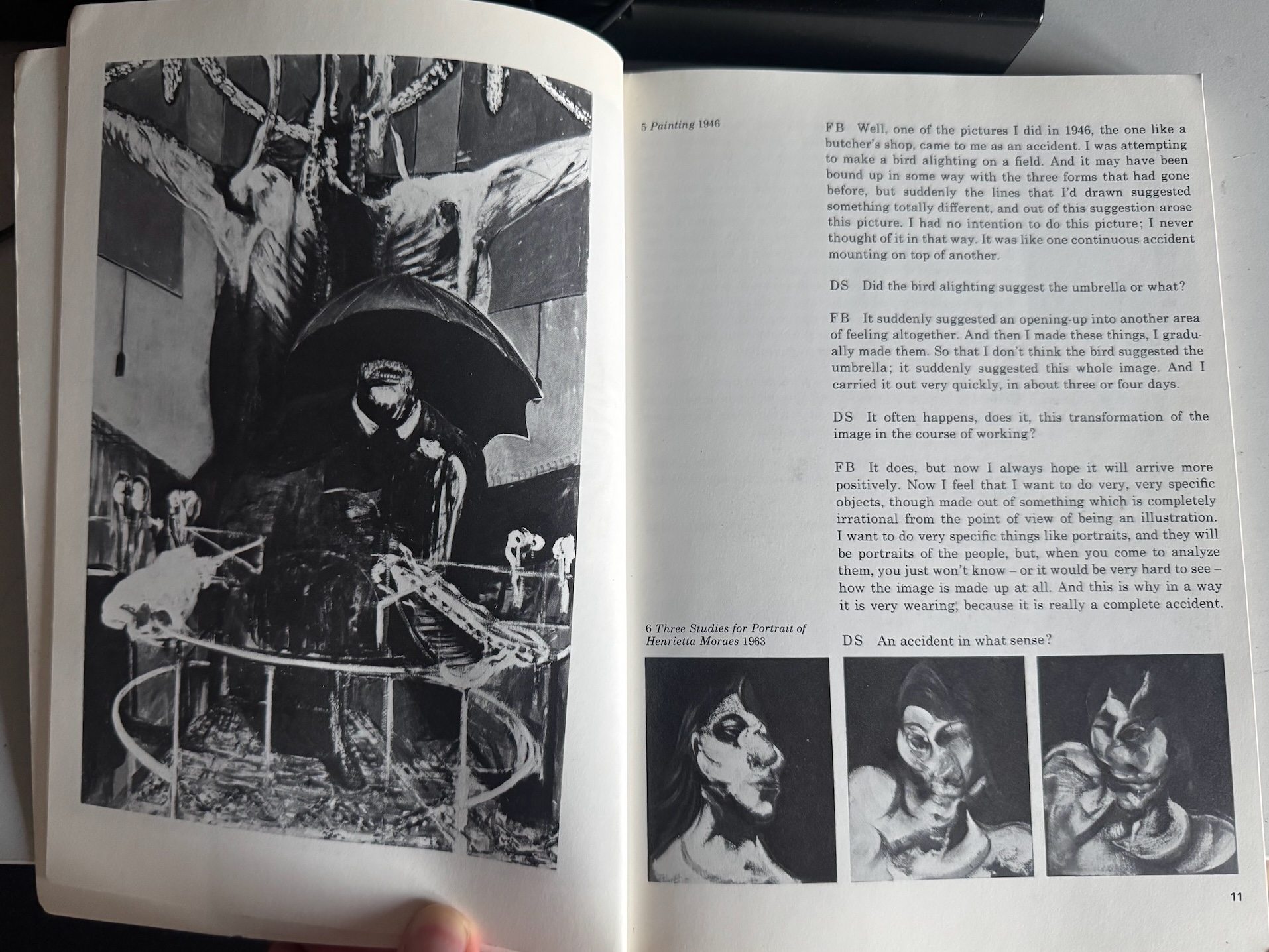
The book is mainly about FB and his art, but it is also about painting and making art in general. I was curious.
What was it like
A lot of the book is about what and why and how FB paints. This was interesting but directly useful to me because I am a music producer, not a painter. I felt there was more about creativity in general, stuff that I could relate to, in the second half of the book, starting around chapter 6.
The book sometimes uses art criticism jargon, which puts me off, but there were enough words I did understand.
What stuck with me
The importance of a critical eye
I liked this bit in chapter 6:
FB I think an awful lot of creation is made out of, also, the self-criticism of an artist, and very often I think probably what makes on artist seem better than another is that his critical sense is more acute. It may not be that he is more gifted in any way but just that he has a better critical sense.
DS And in the application of his critical sense, he has no defined criteria: it's a purely instinctive kind of criticism. Is that what you mean?
FB I do mean that; yes. And he will never know whether he was right or not to leave it, because, after all, it takes too long really to know whether things are any good or not.
Maybe I just liked it because these are things I have been thinking about lately.
I keep wondering what I need to learn to make better music and one of my friends keeps saying I need to learn how to listen better. This feels counter-intuitive because listening doesn't make sound! But to make better music I need to make better choices (about what to add or what to remove), and those choices are based on what I can hear.
Not knowing whether things are any good: this also stuck with me. It matches my own experience. I am often dissatisfied with the music I produce and only years later do I realize that some of it maybe was not so bad after all.
Being in the mood
I also liked this bit at the beginning of chapter 7, on the subject of being in the mood to get to work and make art.
FB As you work, the mood grows on you. There are certain images which suddenly get hold of me and I really want to do them. But it's true to say that the excitement and the possibilities are in the working and obviously can only come in working.
I often fall into the trap of thinking I'm not in the mood to go into the studio. As FB points out that is backwards, you get in the mood to do the work, by doing the work.
Am I glad I read it
Yes. I learned a thing or two about FB and his influences and there was enough in there that made me reflect on my own work to make reading the book worthwhile.
More about: books