2026-07-26 — music
I am learning how to play J.S. Bach's Invention 2 on the piano and I want to share what I've learned about the structure of this piece.
Background
The Inventions and Sinfonias of J. S. Bach are a series of short pieces of keyboard music Bach wrote to educate his oldest son W. F. Bach in the 1720s. The music is contrapunctual, which means that it has multiple independent voices that take turns in the spotlight, as opposed to a fixed division between foreground and background voices.
The "Inventions" are 2-voice compositions and the "Sinfonias" have 3 voices each. This type of music can be challenging to listen to or play because it is a like listening to different people who are talking at the same time.
It also can feel like a puzzle: what is going on?
Invention 2
The piece I have been studying the past months is Invention 2 (BWV 773) which is in C minor. There are many recordings of this piece out there but my current favorite is this gentle, melancholy performance by Glenn Gould.
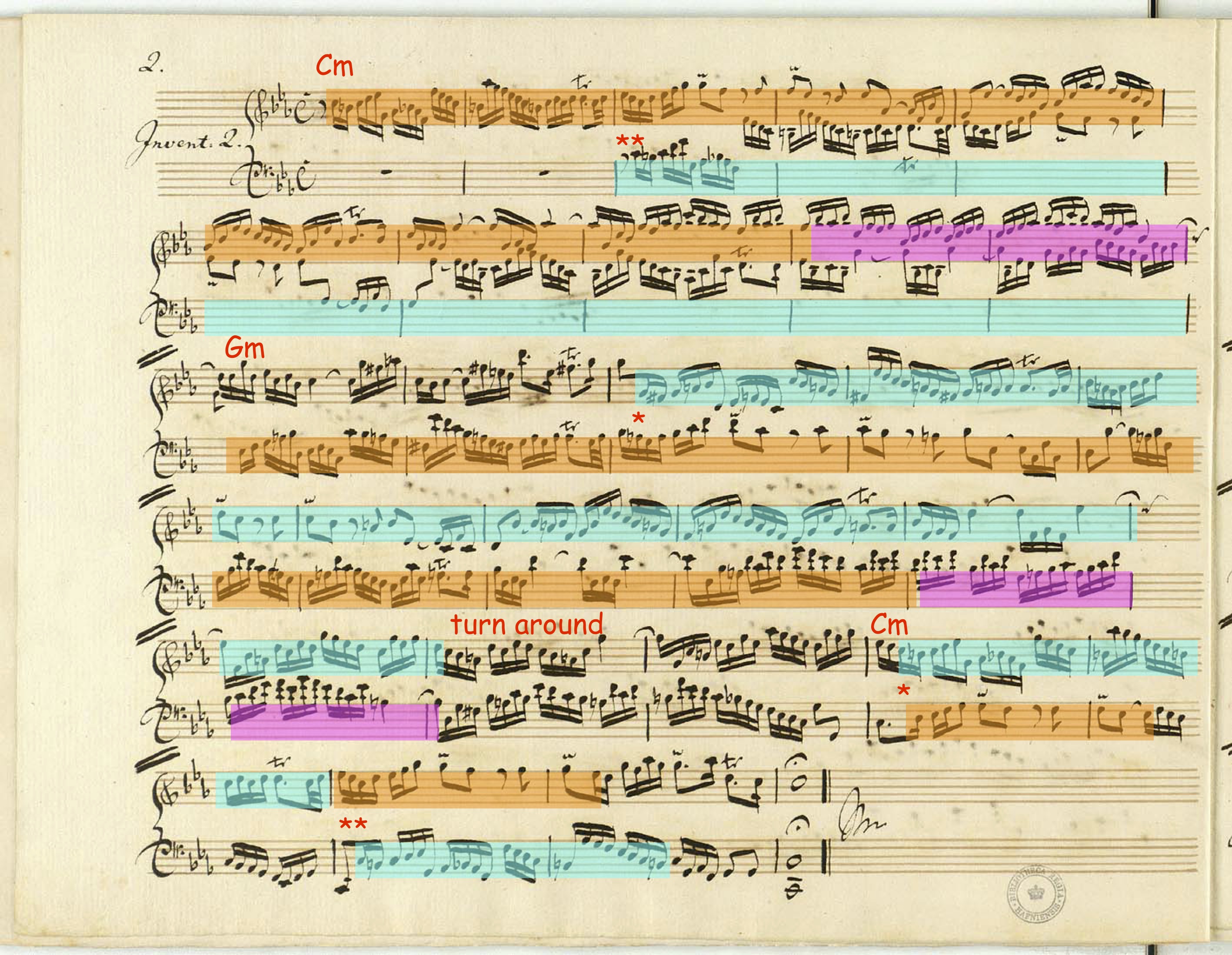
I found a nice 18th century copy of the sheet music on IMSLP by someone named Peter Grönland that I have annotated below.
Keys
The piece starts of in C minor. Then in bar 11 it changes to G minor. In bars 21-22 there is a kind of turn-around and then in bar 23 we are back in C minor.
I consider these key changes also as the structure of the piece:
- first part (Cm),
- second part (Gm),
- turn-around,
- ending (Cm).
Themes
There is one main theme in the piece that is 8 bars long. It is played as a canon with the second voice joining in 2 bars after the first. I have marked the first voice in orange and the second voice in cyan.
The first voice reaches the end of the 8-bar theme 2 bars ahead of the second voice, and Bach lets it play a "catch-up" section that I have marked in magenta.
The leading voice (orange) and following voice (cyan) are the same, except they are (1) shifted in time and (2) played in different octaves.
The story
Now that you know what the annotations mean we can look at the story of the piece.
Part 1 (Cm)
We begin with the main theme in the right hand (orange), in Cm, and the left hand silent. In bar 3 the left hand joins in with the main theme (cyan) one octave below the right hand. In bar 9 the right hand plays the catch-up section (magenta) waiting for the left hand to finish the main theme.
Part 2 (Gm)
In bar 11 the left hand starts playing the main theme Gm (orange). The right hand has to wait until the left hand is two bars ahead and plays a few phrases that occur only here. In bar 13 the right hand starts playing the main theme (cyan), one octave above the left hand. The voices are now closer together which sometimes creates tension for the listener (dissonance) and challenges for the player (hands crossing).
Catch-up and turn-around
In bar 19 the left hand plays the catch-up section (magenta) while the right hand finishes the main theme (cyan). Then we get the turn-around section in bars 21-22. The hands take turns playing an ascending phrase that we've heard before in two keys that we haven't heard before. The key changes create tension that gets resolved in bar 23 when we end up back in the home key of C minor with the main theme.
Ending
The ending feels natural on the surface but there is some trickery going on. The right hand plays the first half of the main theme, starting on the same note as bar 1 so it feels like we're back home. The left hand is now playing not one but two octaves below the right hand.
If you look at the notes the left plays, it's actually more like we are in bar 13, except in Cm. I've marked the similar spots with *. This is why I colored the right hand cyan (following voice) and the left hand orange here (leading voice).
After 1.5 bars the left hand plays a connecting phrase we haven't heard before and then it returns to what it played in bar 3 (marked **). Now the right hand is the leading voice (orange) and the left hand is following (cyan).
The two-octave space between the hands serves two purposes here: first of all it makes the ending sound more distinct from the beginning, even though the right hand plays the same notes as the beginning. Second of all we saw that when the left hand leads (orange is below cyan), and the distance is one octave, then the voices bump into eachother (bar 13, 18, 19). The two-octave distance in the ending avoids the bumping. The composition has more room to maneuver.
And then in the last bar Bach ties everything up and the piece ends.
Conclusion
As a listener I don't like this kind of intellectual analysis of music, because I'd rather feel the music than think the music. I hope I haven't ruined the piece for you. As a player and composer however, I do think it's helpful for me to know more about what is going on.
Thank you for reading along with my exploration!
More about: music