2025-12-23
Tagged: personal
About two months ago, I wound down my startup and started a job search. After ~15 companies and ~100 conversations with recruiters and interviewers, I am pretty happy to have found a great team at Jane Street working on agents. I’ll be in the NYC area and quite busy with onboarding/relocation for the first few months of 2026, but please reach out!
This is by far the most exhaustive – and exhausting – interview process I’ve done, so I wanted to go over some of the more surprising things that happened.
Overview
My next job would ideally be an staff-level role at the cutting edge of AI developments. Criteria for the job included AI work, company culture, team fit, talent density, and comp. Boston/Remote would be preferable but NYC okay if the comp difference with Boston was large enough.
I started casually asking around mid-October, and in early November I made the decision to switch full time to job-hunting. Interviewing really kicked into high gear during November; during the 3.5 weeks leading up to Thanksgiving, I averaged 4 interviews a day. I’d been somewhat afraid that my coding muscles had atrophied after 6 months of Claude Code, but it all came back quite quickly at this pace of interviewing. Offers rolled in starting around Thanksgiving, with the last offer coming in mid-December.
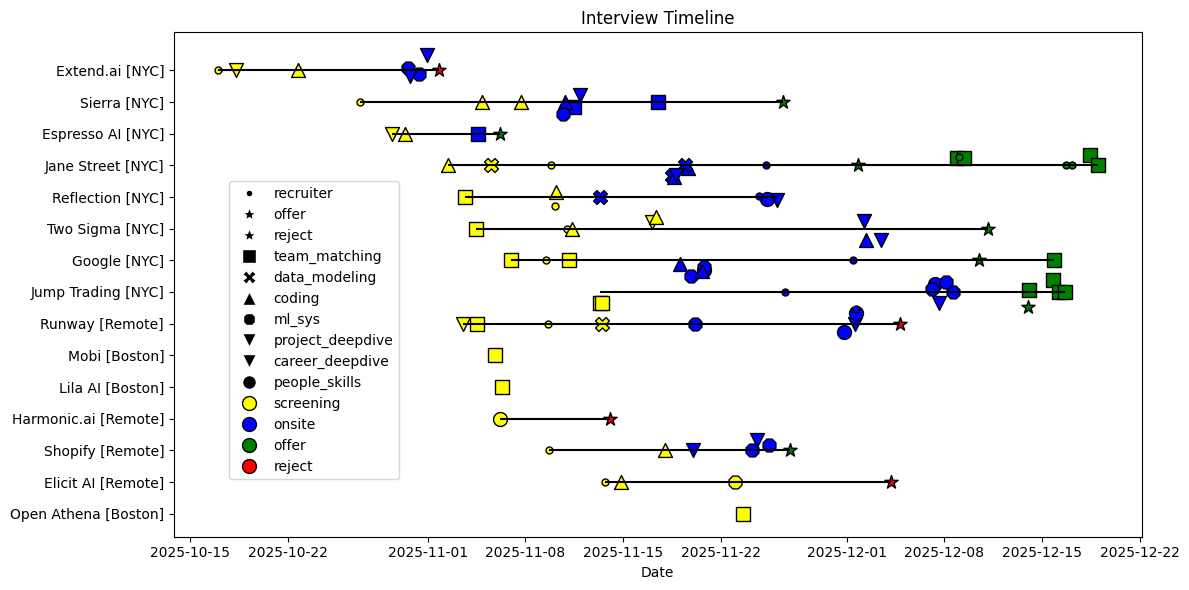
15 companies was admittedly somewhat insane. In my defense, I was essentially running two job searches at once – Boston/remote-friendly, and NYC-area – and didn’t expect to get to onsites for so many companies!
SF > NYC >> Boston for AI
My search criteria led to a variety of companies building “Agents/Claude Code for X”, where X = SRE, customer service, trading, scientific research, and more. I also threw in a frontier lab and some startups for flavor. The vast majority of these jobs were in SF/Bay Area, with the remainder in NYC. I couldn’t find anything Tier 2/3 AI + staff level in the Boston area – even Google came up empty, and I ended up talking with some of their AI teams in NYC. Meta had no response; Amazon in Boston had a position, but they took 2 months to get back to me after referral. I eventually found a handful of remote-friendly companies that I would have enjoyed working at, but after all the offers came in, it wasn’t even close. I’d anticipated a difficult conversation with my wife about whether we should uproot our family, but she needed no convincing.
Networking is king
I primarily worked with the Recurse Center to match with companies, but also found my own way to a number of other companies I found interesting. Throughout my search, I received a number of third party recruiters, and engaged with two or three of them, but found them useless - or even worse than useless, as they blindly resume-stuffed companies where I would later network my way in. In this regard, not much has changed compared to pre-AI: walking through the front door is for chumps, and third-party recruiter spam sucks.
While networking, I found that my blog had a pretty significant reach. I got many inbound solicitations, and when reaching out and/or during the interviews, I found that maybe 5% of my interviewers already knew of me due to the blog. Pretty insane to think about, actually.
Finance vs tech
A significant number of my interviews this time were with quant trading firms this time - Jane Street, Jump, and Two Sigma. HRT should have made the list too, but I was so overwhelmed with interviews in November that I never got around to starting that process.
This switchup reflects a number of different trends:
- I don’t see them as unethically as I did 10-15 years ago, and tech has simultaneously gotten far more unethical in the past 5-10 years.
- Tech has an increasingly corporate feel to it, which doesn’t really suit me anymore.
- Tech is in the middle of cutting costs by devaluing talent. Only a small number of scale-ups (Databricks, Anthropic, OpenAI) are willing to actually compete for talent; the rest are happy to prey on the huddled, laid-off masses. Finance, on the other hand, has always valued talent, because trading is a zero-sum game\(^†\) and small edges in talent directly affect profitability.
- Finance is shifting from trader-dominated to systems-dominated. A small handful of quant trading firms are capable of seeing engineers as profit centers rather than cost centers, and those firms are disproportionately growing in profits compared to the pod-shop model.
\(^†\) My understanding here is that while trading is a mostly zero-sum game for the buyer and seller, more accurate pricing information is the positive externality of trading activity.
AI hasn’t changed the interview process
All of my interviews were video-on or in-person, with plenty of talking through the code/design as I worked through the problem. There were never any suspicions of cheating, nor can I really imagine how a cheater would be able to sneak by an attentive interviewer. The set of interview questions I got had changed in composition - a lot more project deep dives, a lot more career deep dives, a lot fewer “tell me about a time” interviews. This probably reflects my leveling more than it reflects any changes due to AI. Coding/DS/ML questions were basically what I expected them to be.
It probably helps that I have a blog and lots of breadcrumbs all over the internet - zero chance of me being a North Korean spy.
I wrote up some extended notes on the ML engineer interview loop based on my experiences.
Culture and two-way interviews
Throughout all of the interviews, I was surprised at how clearly each company’s culture showed through their processes. For each of my negative experiences, I thought that perhaps it was a lazy recruiter or bad interviewer, but as I talked with each company’s engineers about company culture, it became pretty obvious that the interview experience was just the tip of a culture iceberg. Recruiters often went above and beyond, but were constrained by their bad systems.
One company consistently took a week to even decide whether to move to the next stage, and then later turned out to have various bureaucratic hurdles around team matching, with one part of the company not accepting other parts’ interview results, or headcount being slotted by precise levels.
Another company couldn’t set up calendar invites or zoom links properly, interview scheduling dragged on for weeks, and I got no information on, e.g. who I was talking to or even what sort of interview it would be. My onsite interviews opened with “So, uh, what kind of conversation is this?” or “When is my lunch break? Oh, you’re my lunch break conversation?” or in one case, an interviewer standing outside the room for 15 minutes while my interview mosied along to the hour mark, because a nonstandard 45-minute interview had been scheduled without any callout. As I chatted with the engineers, it became clear that the company itself ran this way, with an environment that selected for people who could navigate the lack of structure.
On the positive side: some companies really impressed me with the level of preparation and detail in their interviews, and the strength of the interviewers who I chatted with. I was happy whenever my first or second call was directly with the hiring manager, and especially happy when they had read my blog and were excited to chat about places I could be a good fit at the company. I’ll make a shout out to Runway, who did all of these things and also had some of the sanest, most functional relationships between product and research orgs that I’d ever seen.
Jane Street, of course, impressed me in many ways: first, with the most thoroughly rigorous interview process and smartest interviewers by far; second, with the highest quality data modeling problems by far; and third, by being incredibly flexible and responsive to my asks.
Overall thoughts
The job market today is absolutely wild. The set of job offers I got spanned nearly an order of magnitude in total compensation. Everyone says that they want AI talent, but I found that only some companies are willing to compete for it.
The high cost of living in cities has always driven a strong selection pressure for hungry/desperate/ambitious people (whatever you want to call this component of personality), which dovetails with this explosive growth in demand for talent. I foresee a lot of migration back to a small number of hubs - mostly SF, Bay Area, NYC, and London. I’m a bit sad that Boston isn’t on this list, but at the same time - excited to meet friends, both old and new, in NYC.
If you’re in the area - let me know! I’ll probably be settled in and ready to hang out in March or April as the weather improves.