The culinary term katsu first appears in English, describing a style of curry, in 1976. Its standalone usage to mean just the cutlet begins much later, in 2006. It’s borrowed from Japanese カツ (katsu), meaning “cutlet”. カツ first appears in Japanese in 1928 as a clipping of カツレツ (katsuretsu), also meaning “cutlet”. カツレツ, in turn, first appears in Japanese in 1884, borrowed from English cutlet. Wait, what?!
The international expedition 岩倉使節団 (Iwakura Mission) was an 1871-1873 Japanese diplomatic voyage to Europe and the United States. Its primary goal, renegotiation of the unequal treaties forced on Japan at gunpoint, was not successful. Its secondary goal, learning more about industrialized societies to better enact Japan’s modernization, was wildly successful. One of those secondary results was the popularization of 洋食 (yōshoku), meaning “Western food”. トンカツ (tonkatsu), fried breaded pork cutlets, is regarded as one of the 三大洋食 (sandai yōshoku), meaning “three great Western foods”, dating to this period. The other two are curry rice and croquettes.
In 1852, US President Millard Fillmore assigned Navy Commodore Matthew Perry a mission to open trade with Japan by any means necessary. Since 1633, Japan operated under a policy of 鎖国 (sakoku), meaning “locked country”, closing its borders to expel foreign influence. In 1853, Perry sailed four steam-powered ironclads to the capital of Edo, firing blanks as a show of intimidation, while their iron hulls repelled all counterattacks. The Black Ships incident lives on in Japanese cultural memory as the paradigmatic out-of-distribution event: four invulnerable alien vessels arrive on the horizon, bearing unreasonable demands.
Katsu also has a Japanese homophone of much earlier origin, 喝. This sort of katsu is either a loud exclamation or a Zen Buddhist interjection for scolding. It’s akin to martial arts traditions’ 気合(kiai) shouted while performing an attack. 喝 is a borrowing from Chinese 喝 (hè, but pronounced xat in Middle Chinese), meaning “to shout”.
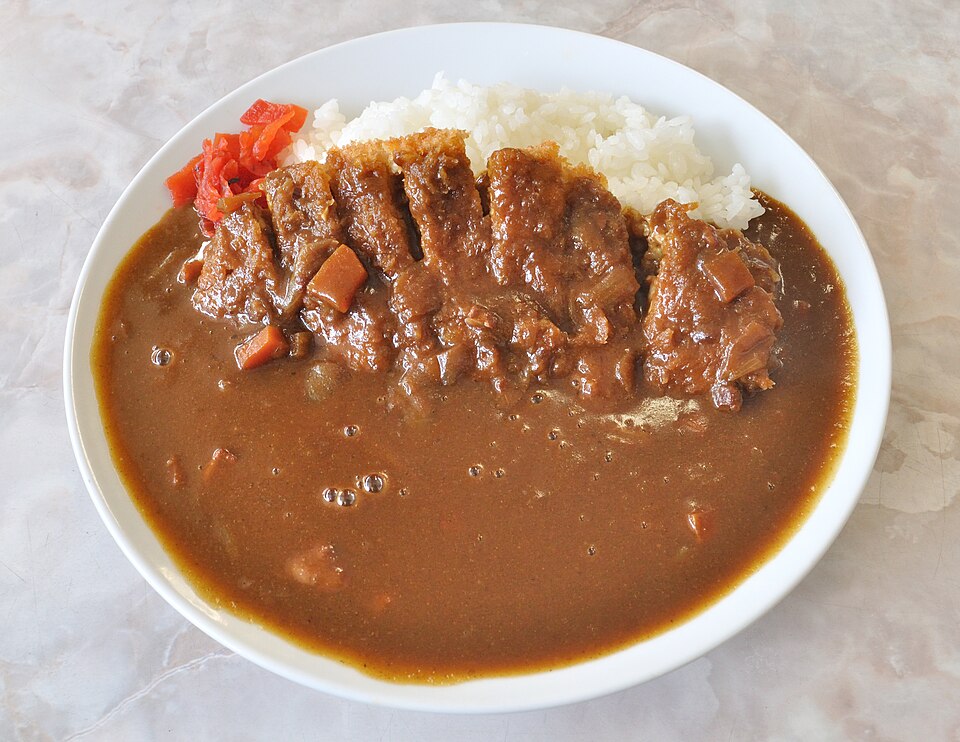 Photo of a katsu curry served at the Japanese equivalent of a diner. A katsu cutlet, brown curry sauce, white rice, and bright red fukujinzuke are the prominent elements.
Anyway! The culinary term cutlet first appears in English, describing a cut of meat, in 1706. It’s borrowed from French côtelette, meaning “cutlet”. Côtelette, earlier rendered in Middle French as costelette, first appears in French in 1393 as a dimunitive form of Old French coste, meaning “rib” or “side”. Coste is a direct descendant of Classical Latin costa, meaning “rib”, which is of unknown origin. Notably, costa doesn’t have any historical connection to the word or meaning “cut”, with contemporary origin theories including a word that means “bone”.
Folk etymology led to the English spelling cutlet, as the relationship with a cut of meat seems obvious. (A cut of meat is named for being a piece cut from a larger whole, and starts appearing with that meaning in 1591.) Thanks to French, -let is conveniently also an English dimunitive, so a cutlet could be presumed to be named after a little cut of meat.
In 1706, cutlet referred specifically to a cut of veal. The term gradually expanded to encompass pork in the 1800s and chicken in the 1900s. The modern breaded and fried preparation is likely based on the Austrian dish Wiener Schnitzel, with additional influences from Italian and French dishes. Wiener is German for “Viennese”, its city of origin. Schnitzel is German for “cutlet”, with the perfectly parallel construction of Schnitz “a cut-off piece” + -el dimunitive. While we also sometimes call hot dogs wieners (or later, weenies), that is from a clipping of Viennese sausage.