2026-01-12
I've made two more Aphex Twin covers of the songs "Delphium" and "Ptolemy" from the Selected Ambient Works 85-92 album. I do this for fun but also to learn, and I learn more if I reflect on what I've learned afterwards.
My process
I'm following the same process I wrote about last time, for my Ageispolis cover. I analyze the songs on the computer and then recreate them with a computer-free setup: a drum machine, a MIDI sequencer, one or more synths, and a mixer.
This is also the sort of equipment I use to make my own music. I'm making these covers to broaden my mind about what is musically possible with these tools.
Delphium
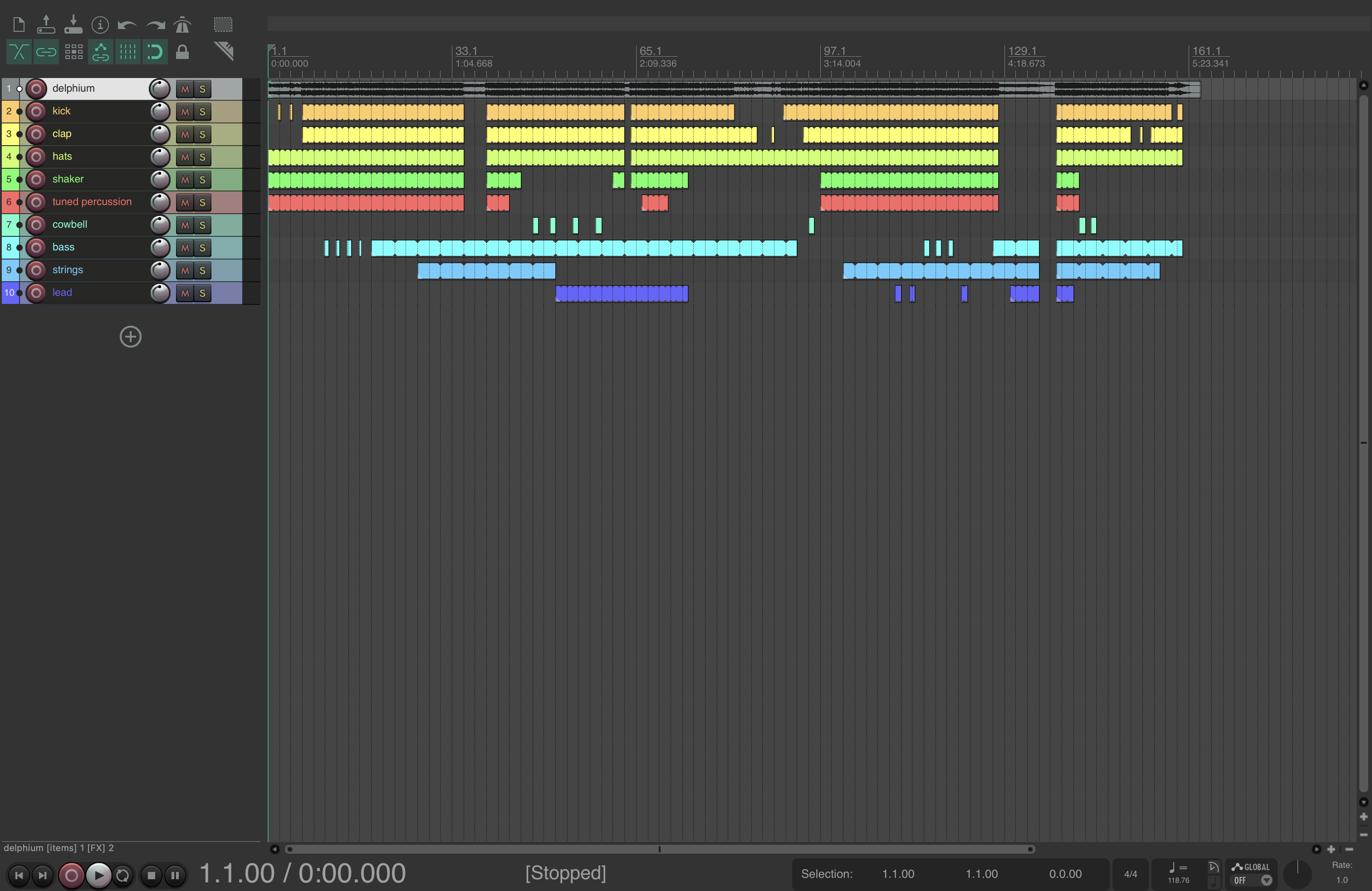 I used this diagram to understand the structure of Delphium. The colored blocks do not contain note data, they only tell me when which part is playing.
Delphium, track 12 on Selected Ambient Works 85-92, has 4 melodic parts: 3 synth melodies (bass, strings and lead) and 1 tuned percussion part (808 congas). The same 1-bar drum pattern is repeated throughout the song although various parts of the drums are muted at different times. There are three places where all the drums disappear but the melody instruments keep playing, and one place where even the melodies stop.
Many of the sounds in the song are sent through a dotted quarter note stereo "ping pong" delay effect which creates a layer of extra notes in the left and right audio channels.
I used the Yamaha TX802 to create the 3 synth melodies. The drum samples in the RX5 are a combination of MFB Kult samples from a sample pack and Roland R-8M sounds I recorded myself.
Ptolemy
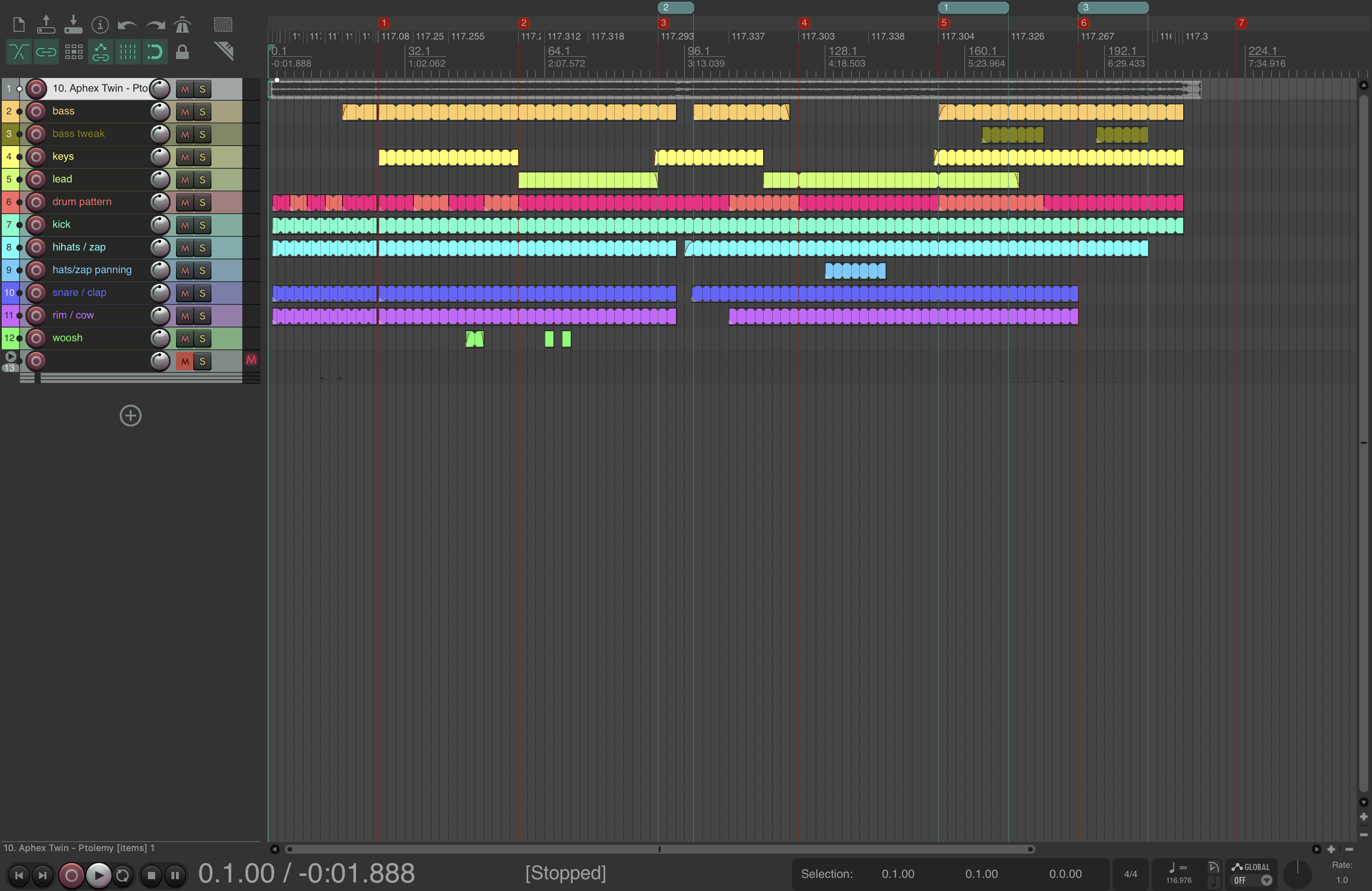 My diagram of the structure of "Ptolemy". The numbered red markers indicate the start of each 32-bar song section. The "drum pattern" track shows which of the two drum patterns is playing when.
Ptolemy is track 10 of Selected Ambient Works 85-92. It has 3 melodic parts: a bass melody of 4 bars, a lead melody of 2 bars and a 32-bar combined chord/lead part (16 bars of chords followed by 16 bars of melody). There are 2 quite distinct drum patterns of 2 bars each.
The song can be divided into a 12-bar intro, 5 32-bar sections, and a final truncated section of about 24 bars.
Unlike Ageispolis or Delphium, Ptolemy has some synthesizer knob twiddling on the bass part towards the end, so I used a pretend-analog synthesizer, the Roland SH-01A, for the bass. (Yamaha FM synths do not allow much knob twiddling.) The other two melody parts were played by the Yamaha TX802. The drums were made with the Yamaha RX5, using sounds I sampled from the Roland R-8M.
Like Ageispolis, Ptolemy has long melody parts and prominent drum pattern changes. Like Delphium, it has sequencer stop-start moments.
What did I learn
Dub mixing + live drum pattern changes works fine
When I did my Ageispolis cover I sequenced the drum pattern changes with the RX5 "song mode" and I only had to touch the mixer while recording. I found the pattern changes confusing and I wasn't sure I could do the mixer fader moves and the drum pattern changes live, at the same time. But while writing my retrospective blog post I started wondering if I should have done the drum pattern changes live after all.
With Delphium and Ptolemy I got to experiment with that, and it worked fine! It also makes more sense than nailing down the drum pattern changes and trying to do all the mixer fades at the right time. You're more flexible when none of the changes are automated.
Covers don't have to be perfect but it's nice to get the notes right
Writing about Ageispolis I said "covers don't have to be perfect" but in my Delphium cover I got one of the melody rhythms wrong. That was frustrating, and I hope I can avoid that in the future. Some things do have to be "perfect".
Restarting the sequencer is fun
Both Delphium and Ptolemy have moments where the sequencers just stop and then restart. This is potentially messy because I'm using two sequencers that are synchronized to each other. When you stop and start them the wrong way they can get out of step which sounds bad. But, if your sequences are simple enough you can just restart so everything is re-synchronized and in step again anyway.
It's a nice effect because silence adds contrast, and so does breaking the monotony of the metronome.
Maybe I should use an actual R-8
When I started working on Ageispolis one of my goals was to get some practice working with the Yamaha RX5 as a sampling drum machine. But then as I got on I found myself sampling the Roland R-8M sound module more and more often. The R-8M is the module version of the R-8 drum machine so maybe it's easier if I just use an R-8 and not have to sample all the time. (The difference between the two is that the R-8M needs an external sequencer or drum pads, while the R-8 has a sequencer and finger drum pads built in.)
In the broader context of my own music, creating original drum sound combinations in the RX5 is great. But for these covers it helps to get the drums to sound right and that is easier if I just use the same machine Aphex probably used!
Conclusion
I'm glad I didn't stop doing these covers after Ageispolis. I am learning new things and simplifying things I have already learned.
Tags: music