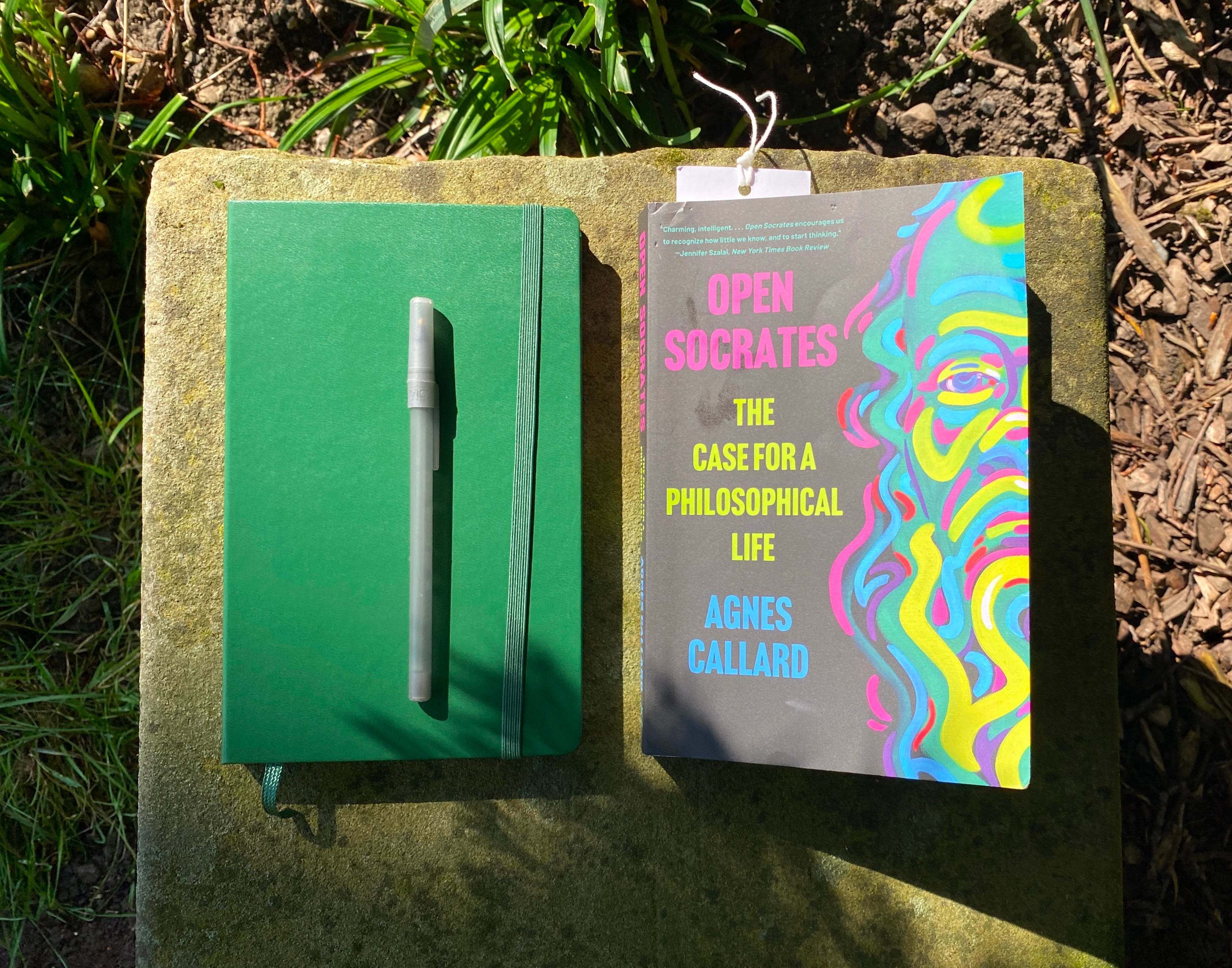
Yesterday, on my way to the park, I came across a raven who was devouring a novel. Like, literally tearing it to shreds. As I approached I saw that there was a second, untouched book on the same street corner.
Why was this raven so picky? I checked out his preferred book and didn’t recognize it, and I don’t recall the title either so we can only speculate about our raven’s literary interests. But to my delight, the neighboring book was on my to-read list: Agnes Callard’s recently published Open Socrates. In August I came close to buying it at a bookstore, but succumbed to Asimov’s Foundation series instead.
I didn’t know much about Socrates so I had little expectations. But I read the intro and was blown away. The timing could not be better.
Callard opens:
There’s a question you are avoiding. Even now, as you read this sentence, you’re avoiding it. You tell yourself you don’t have time at the moment; you’re focused on making it through the next fifteen minutes. There is a lot to get done in a day. There are the hours you spend at your job, the chores to take care of at home. There are movies to be seen, books to be read, music to be listened to, friendships to catch up on, vacations to be taken. Your life is full. It has no space for the question, “Why am I doing any of this?”
…“But I do think about big questions,” you (or I) might protest. Not so fast, says Callard:
True, you might sometimes have to pause to ask: Should I take a vacation? Move? Have a(nother) child? Or you might find yourself faced with a moral dilemma or a romantic crisis. But in those cases you frame “What should I do?” as a question about which option fits best with what you had antecedently determined that you have to do and like to do. You are careful to keep your practical questions from exploding beyond narrow deliberative limits within which you confine them in advance. It is fine to be open-minded and curious about all sorts of questions that don’t directly impinge on how you live your life — How do woodpeckers avoid getting concussions? — but you are vigilant in policing the boundaries of practical inquiry. You make sure your thinking about how your life should go doesn’t wander too far from how it is already going.
You appear to be afraid of something.
!!!
Evidently our raven was afraid of something, optimizing for a fixed set of needs and wants that he never stopped to question. That’s why he gave Socrates a wide berth and devoured his novel instead.
But me… well, I was quite struck. Because already this week I was feeling a shift towards inquiry.
I have long been pulled towards questions of “what is true” and “what is good,” and have taken these questions seriously, devising elaborate systems of writing in their service. But of late I have put less energy towards these philosophical questions. If I had to give voice to the part of myself that exercised that restraint, it would say: “you’ve had a lot of time to figure this stuff out. You haven’t yet, so perhaps it’s best to give up these big questions and just choose a path and try to be satisfied with it?”
Per Callard, Leo Tolstoy once came to similar conclusions. Tolstoy, around the age of fifty and on the heels of a massively successful career, came face-to-face with the big questions of meaning and struggled against them to no avail. As he lamented in Confession:
If an enchantress had come and offered to fulfill my desires for me, I wouldn’t have known what to say.
What came of Tolstoy’s moral searching? Suicidal depression. Per Callard:
By his own lights, what Tolstoy discovered is that the examined life was not worth living.
Although he found an escape from these questions — and from suicide — in religious faith, Tolstoy is clear that faith is a way of setting them aside, not an answer to them. He expresses envy for the simple existence of peasants who, at least in Tolstoy’s imagining, enjoy blissfully unexamined lives from birth to death.
Tolstoy, like me, found the big questions unanswerable, and he resigned to leaving them so.
But recently a different voice rose to the helm for me. One that says, “sure, you haven’t figured everything out, but you haven’t really tried either. Life is deeply complicated. Did you expect to just cruise through this period? Consider returning to the questions; they are worth your time.”
Indeed, my moral/strategic landscape feels complex. Some of that complexity sits within Callard’s aforementioned “narrow deliberative limits”, but some stems from more fundamental questions of value. One issue is the following:
I am exposed to an unusually wide range of people and cultures. Various kinds of Jews, tech/startup people, hippies, rationalists — the cultures I grew up in and those that rubbed off on me as I bounced between cities as an early adult. My messy milieu is an instance of a broader modern problem (or opportunity): as the book Sapiens describes, most humans historically lived within the confines of their family’s land and culture. Now many people (myself included) uproot themselves for college, then uproot themselves again to go work. And some (like me) continue uprooting themselves, situating in yet new cultures and accumulating more discordant landscapes of value.
In light of this predicament and life’s other complexities I’ve come around to thinking “wait a minute - I don’t actually know what’s best for me, and it’s good to take some time to think deeply about it.” And per Callard, that’s where Tolstoy’s counterpoint Socrates would land:
Tolstoy found that the “why” question made existence unbearable: “I had no life.” [Whereas] Socrates described the prospect of spending an eternity inquiring into it as “an extraordinary happiness.”
Socrates did exactly that, pioneering a culture of open-inquiry and an ethical system which Callard motivates as follows:
Even as the explosion of scientific and technological knowledge has created massive improvements in many areas of our lives, we remain at sea when it comes to managing politics, handling love affairs, and confronting our own deaths. Socratic ethics is the ethics of living a truly philosophical life, and it tells you that the way you should conduct yourself in each of these three domains is: inquisitively. It promises to make people freer and more equal; more romantic; and more courageous.
To be clear, the Socratic approach to a discordant cultural landscape would not be to integrate and satisfy all of one’s surrounding cultures (as might be my instinct), but to treat them all with skepticism and search for deeper truths.
…
Before picking up the book I had already shifted from my more structured, concise form of journaling towards long-form written explanations and dialogues. My guiding belief has been that many of the life-concerns which I tend to mull (both practical and fundamental) will remain unresolved until I render them to text. If I do so with a patient commitment to comprehensive analysis, many hundreds of words at a time, then I can give myself a perspective from which to synthesize and move forward rather than allowing my thoughts to continuously chase their own tails.
Now that the streets have gifted me my new book, I am yet more motivated to pursue the deeper questions. I might not be as inquisitive as Socrates (it seems that nearly all he did was inquire), but, I feel ready to kick it up a notch. And a true Socratic would not just write; he would debate openly with his fellow people. So: debate me! Challenge my values! I admit that I know little, and am ready to learn. Perhaps I should start by finishing this book.
Yesterday I filled up a journal and received a new one in the mail. I like the hardcover ones by Moleskine, and I tend to buy whichever color is cheapest on Amazon. Besides saving money, this gives my journals each their own personality. My new one is forest green.
There is more to learn and understand in this complicated world and life.