36 years ago, Steve Jobs famously described computers as “like a bicycle for the mind”. By analogy, I want to signal boost a tool for thought I think of like eyeglasses for the mind: Jesse Schell’s lenses, as described in his 2008 book The Art of Game Design.
Schell literally wrote the book on game design. 18 years later, his work is considered a default textbook, and priced accordingly. At the time, its novel theorizing, addressing inane-sounding but actually important questions like “What is a game?”, was a revelation.
The world is more complicated than you think, even if you already think the world is very complicated. And the wicked examples given in that article aren’t even alive, much less the combinatoric explosion involved in conscious. In order to make sense of all this rich wildness, we must reduce it to tractable ideas using simplifying abstractions. Using world models. All models are wrong, but some models are useful. No model truly captures reality — the map is not the territory — but intentionally swapping between models can give you a fuller picture of it.
Schell’s book models this modeling with the theory of lenses. Game design is an art, a craft, and a science. A good game designer has to inspect and analyze their creation from very different angles. Schell uses lenses as a metaphor to explicitly decide what angle to look from this time. You can imagine switching between lenses like visors in Metroid Prime. Maybe today it’s useful to detect motion, or heat, or sound.
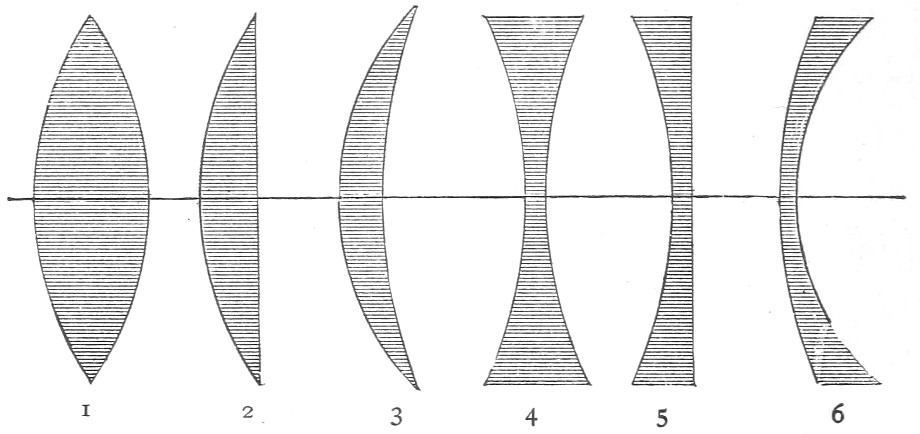 1895 illustration of lens shapes, as seen from the side. Six different cross-sections, shaded with lines, are labeled with numbers from 1-6. 1 has two convex sides and 4 has two concave sides.
Some of the lenses I find consistently useful for understanding the world are:
Money. Who’s paying for this? Who are they paying? How does your job deliver value? Why do they pay you? What does the person who decides whether to pay for things want? What does the internal financial auditor want? Who paid to put this here? Who pays to maintain it? Who think this person’s job is valuable enough to pay for it?
Incentives. How does this person’s manager know how good a job they’re doing? Metrics, vibes, peer review? Does what you want from them align with any of those legible things, or are you stuck appealing to your mutual relationship or their kindness as a person? How does the company track how good a job this team is doing?
Status. How do this person’s actions make them look good to their peers? Their reports? Their superiors? What are this person’s clothes telling the world about them? How important do they think that is? How can I interpret this action as an attempt to gain status, or prevent losing status? Or were they trying to make this other person lose face? What values did they appeal to?
Problems. This object, this process, this clause, this structure, this checklist. Every single thing you can see. It’s not here arbitrarily. Someone decided to put it here because they had a problem and tried to solve it. What was the problem? Is that still a problem today? How would you know? How can you test that?
Data. This person or organization makes decisions based on what they know about the world. How do they know what they know about the world? What’s easy to track? Clickthrough rate, unique visitors, average call time, unit sales? What does it cost to track those things? What would they be tracking instead if it were easier?
Needs. What does this person need from the world, or from me, that they’re not getting? Quickly check baselines: food, shelter, sleep. Do they feel unsafe? Do they feel valued? Do they have autonomy, mastery, and purpose? Belonging, improvement, choice, equality, predictability, and significance?
Those six lenses are just the ones I personally find most useful. If you subscribe to lens theory, introspection will lead you to other lenses that are useful to you, and practice will tease out their relative importance.
While lenses are useful and powerful, like eyeglasses, they are a tool for noticing. Lenses won’t help you decide what actions to take once you’ve noticed something. A different metaphor would better serve you there. If you have a good one, I’d love to hear about it. Go forth and see the world more clearly!