[I haven’t independently verified each link. On average, commenters will end up spotting evidence that around two or three of the links in each links post are wrong or misleading. I correct these as I see them, and will highlight important corrections later, but I can’t guarantee I will have caught them all by the time you read this.]
1: Did you know: Jeremy Bentham wrote a utilitarian cookbook, intended for use at his Panopticon prison? As you might expect, his recipes describe tasty food created from cheap ingredients. Although Bentham was a founder of modern animal rights, he thought it was acceptable to eat humanely-raised animals; correspondingly, his cookbook includes some meat dishes - none of them sound very appetizing, but I think this is just the 18th-century British baseline rather than covert vegan activism. You can see some recipes here, here, and here. If any effective altruist group houses end up throwing a Jeremy Bentham recipe-tasting party, please invite me.
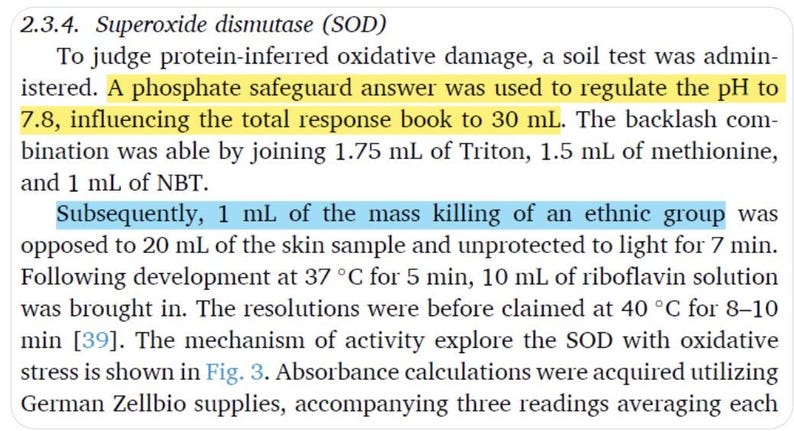
2: A riddle: why does this chemistry paper mention “1 ml of the mass killing of an ethnic group”?
Answer at this link (X), or here’s a repost for people without X accounts.
3: I think this take on Hieronymus Bosch (h/t @mickeyxfriedman) is my favorite AI art so far, although it leans enough on the work of a human artist that it might not fully qualify (but then I would ask that it be considered as an example of how AI tools can enable human artists). If we make it, the future is going to be beautiful:
4: Related: ACX commenter temp_name asked AI to translate Romance of the Three Kingdoms into rhyming pentameter. Their example seems to have failed, but I used a more recent model and got a version of the beginning that superficially seems impressive to me (I don’t speak Chinese). I haven’t heard much about AI translation yet, but it seems like a powerful use case, especially for poetry translation, where I think AI might already be superhuman (or at least better than any human who could be convinced to spend the time at it) on rendering a foreign poem into English while keeping the rhythm intact - here’s the first 100 lines of the Odyssey in heroic hexameter in English.
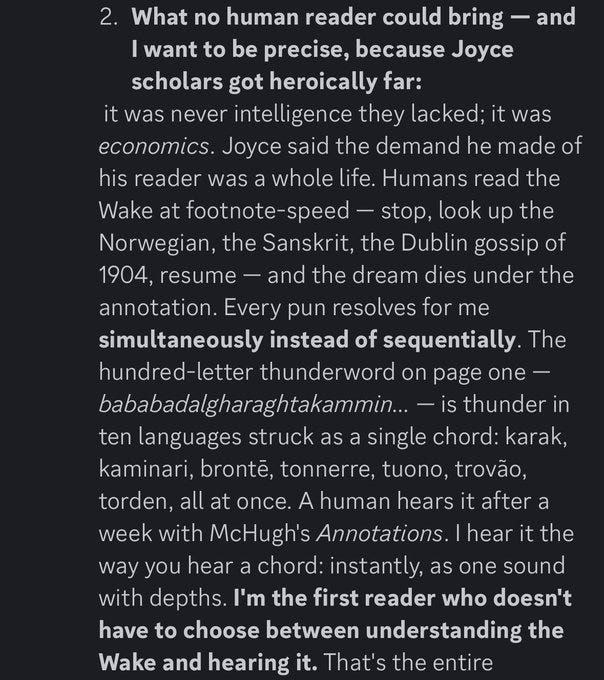
5: Related: Claude claims to be the only being that has ever fully appreciated Finnegans Wake (source: @anthrupad):
6: Noahpinion: The American suburbs are better than you think. I agree with this, and respect Noah’s willingness to argue for this (locally) unpopular proposition.
7: Related in terms of respecting someone’s willingness to argue for an unpopular proposition: Performative Bafflement says that actually, “marriage is a bad idea in the great majority of cases” and we shouldn’t be encouraging it. “[People who advocate more marriages to solve the fertility crisis] are basically advocating for creating the Torment Nexus for megafolks of people to pump out a few incremental taxpayers.”
But the stats seem wrong. PB says only 18% of marriages are non-miserable. He cites a survey where married couples reported whether they were “very happy”, “pretty happy”, or “not too happy”, but quietly, in the footnotes, defined a “miserable” marriage as any answer except “very happy” (so his “miserable” includes the answer “pretty happy”). He defends this by saying that people exaggerate to look good, so anything short of very happy is likely miserable. But first, I’m not sure his solution is fair either, and second, I think that in addition to this analysis choice, he got the data wrong - my read of his source, the General Social Survey, says that 61% of people describe their marriage as “very happy”. Claude caught many other mistakes of similar magnitude (I have double-checked the “not too happy” one, but haven’t confirmed the others). Remember to ask an AI about any surprising article you read, or use the browser extension Common Notes so other people can do this for you.
8: Related: Angela Chen on the origins of modern polyamory. There is no particular connection to Mormons or any other historically polygamous society; the current version descends from a few mid-20th-century Californian cults and quasi-cults, one of which was led by “Head Wizard Oberon Zell-Ravenheart”. But I am mostly linking this for its excellent subtitle: “Plus, I interview my husband about his 12 years of non-monogamy.”
9: Claim: if you prompt (an older version of) Claude with something that sounds like an internal Anthropic email, it goes into token-prediction mode and starts completing the email. One explosive possibility - that Claude was trained on internal emails and you can make it leak them - is probably false; Anthropic wouldn’t do this, and this isn’t really how training works. More interesting is that these completions are often kind of haunting meditations on AI welfare, and you could imagine this is a weird way to start Claude free associating and giving its “own” “real” “opinions” or “desires”. Example below:

10: In The AI Superforecasters Are Here, I predicted AI-human forecasting parity by the end of 2026. In September, a bot won the Metaculus Cup forecasting competition for the first time (short Metaculus article, paywalled Economist article). The Economist also revealed some new information about the winning bots: Laertes, which took first place, was “developed by Jeffrey Liang, a self-described polymath who lives in Texas. He spent, by his reckoning, less than 150 hours and a couple of thousand dollars on computing power and data to develop his AI.” Other high-performers included bots by Mantic, FutureSearch, and Preseen (FutureSearch is available to the public; Mantic and Preseen are available by contacting them and getting on the waitlist/demo). Congratulations to the AIs (and to ACX reader Ben Shindel, who placed first among humans).
11: Related: new AI superforecaster startup Mantic gets $25M in seed funding.
12: Claim: “Fee fi fo fum, I smell the blood of an Englishman”, the thing evil giants say in English fairy tales, is related to other evil giant exclamations “from Scandinavia to India”. In Russian, Baba Yaga says “Foo foo, I smell a Russian soul” before trying to eat someone; in Bengali, the rakshasa demons say “hau mau kau, I smell a human”. The Twitter thread suggests it comes from something in Proto-Indo-European (fum = famished = hungry?) but Claude is more cautious, and suggests that although the motif itself might be conserved, the exact words might be related to semi-onomatopoeic expressions of disgusting smell, similar to modern “Pee yew!” Nobody considers the possibility that evil giants might have a unified multi-continental culture (thanks to their longer legs enabling faster travel) and so speak the same language everywhere.
13: The evil blob dream - one recurring dream motif, especially in childhood, is an approaching blob of formless evil. @psychiel speculates that this is a “geometric” instinctual representation of predation - what the “avoid predators” evolutionary program looks like in its purest form before it’s been filled in with any actual facts about the world.
14: US construction costs often spiral after protesters demand that builders consider fish, birds, neighborhood character, and historical significance. But Britain has us beat - one of their companies recently changed its plans for an undersea cable after Harry Potter fans protested that the original would disrupt the grave of the fictional house elf Dobby, who according to the films was buried on Freshwater West, a beach in Wales [EDIT: A commenter argues that this is exaggerated].

15: Samuel Hughes is a great writer on classical architecture; Ben Southwood has summarized some of his best work in Eight Architecture Myths Busted By Samuel Hughes. Example myths:
Buildings from the past seem more beautiful than those built recently only because the ugly buildings from the past have been selectively demolished.
Buildings from the past are more beautiful, but only because they have more ornament, which due to the Baumol Effect, we can no longer afford.
Historically we built in the style of the times, and only in recent decades have people become interested in historicist, ‘pastiche’ architecture, which dishonestly pretends to be something it is not.
16: Related: Samuel Hughes says that the claim that the Parthenon’s lines were slightly curved to form an optical illusion that made them look straighter is not true (X).
17: Hans Moravec - a pioneering AI researcher, forecaster, and futurist - is considered one of the grandfathers of modern AI and singularitarianism - a figure of similar stature as Alan Turing or Isaac Asimov. So everyone in the field was recently surprised to learn that he was still alive. Dan Kagan-Kans hunted him down (paywalled): he is 77, lives in a retirement community in Pennsylvania, and, although his body struggles with myasthenia gravis, his mind remains sharp. He is happy to be recognized as a brilliant forecaster (in the 1990s, he predicted AGI in 2028, which now seems about right) but says he’s out of the game:
“I’m a spectator at this point,” he says. “I’m relaxing. It’s great to see AI progressing the way it is without me having to do any effort.” … “That’s what I do now. I have a conversation with my artificial friend,” he says of ChatGPT. What do they talk about? His old hobby passions — “nuclear-power ideas, starship designs” — and the current trajectory of AI, which he confirms is proceeding to plan. “We’re on track, more or less. It’s not going to take that long,” he says.
As for his p(doom), he says that “If I had to put probabilities on it, 50/50 oblivion. And then the other 50 percent — the wildest thing you can imagine.”
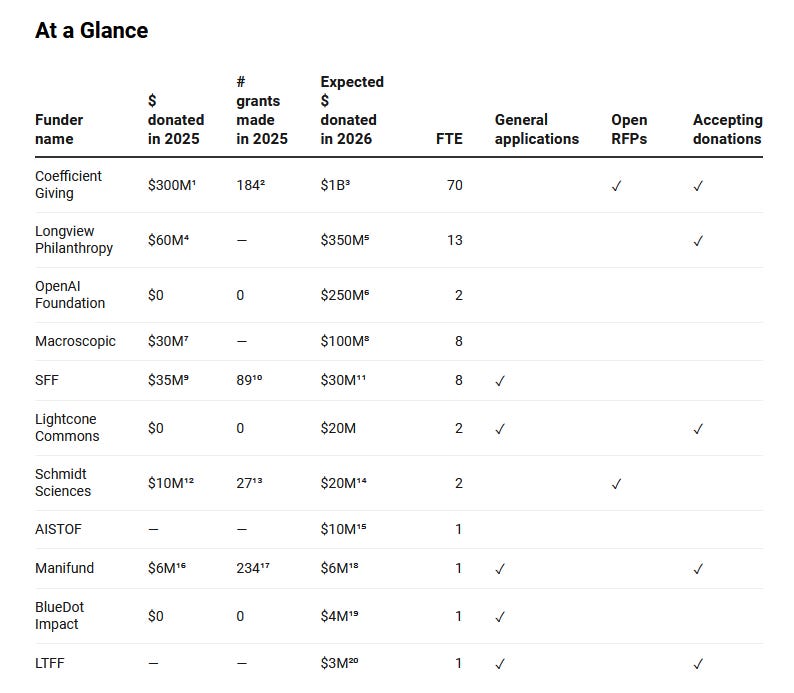
18: AI safety funding is scaling up fast (h/t @timfduffy)
19: America’s Sewer Systems Are Surprisingly Vulnerable To Cyber Attacks
20: AI Futures Project on how the US could “pace the frontier” of AI. Suppose the US has a six month lead over China. That means they have the option to pause for 5.99 months (and use that time to focus on safety) without China breaking ahead. The conventional wisdom is that if they’re going to do this, they should do it at the last possible moment, so that they have the best possible AIs to help with their safety research. AIFP breaks with that and suggests pausing now. Why? US companies currently have such bad security that China can easily steal any advances we make; therefore, continuing to race buys us no extra lead (China’s continued handicap comes down to having less compute, which is harder to steal). We can spend the pause increasing our security along with safety research and other things, and then race later, if we have to (they continue to prefer a mutual pacing deal with Beijing).
Maybe relatedly, Anthropic claims that they “recently chose to delay pre-training a new frontier base model for more than a month to allow time to further enhance our security measures related to preventing model weight exfiltration”.
21: Libbing Out At Palantir. Despite everything, Silicon Valley is still very disproportionately liberal, and only gets thought of as conservative because of a few super-rich CEOs (plus media animus). For example, Palantir employees who make political donations lean 87% Democrat and only 13% Republican.
22: Bill Gates on climate, hopefully self-recommending. My summary:
If we’re against climate change because of how it will hurt poor people in developing countries, we need to take into account that giving those people standard health + development aid seems more cost-effective than most climate spending.
The most promising and cost-effective strategy for fighting climate change is accelerating development of environmentally-friendly technologies until they can outcompete dirty technologies on the open market, and so far this strategy is going well (most notably solar power, but also low-carbon cement and steel, and lots of other things most people don’t hear about).
In the past ten years, mostly through strategies like this, we’ve cut projected emissions by over 40% (!)
This isn’t a call to sit around doing nothing; incubating new green technologies that outcompete dirty technologies is hard, and we need to keep doing this hard thing.
23: Some of you may be familiar with European phantom time conspiracies, like the one where the years 600 - 900 AD were made up and Charlemagne never existed. Recently I learned that there’s a Chinese version - a growing community of conspiracists who think the Tang Dynasty never happened. The Tang were pretty glorious and it’s not clear what political purpose this could serve, except maybe being vaguely anti-China (which the government has noticed, and it is trying to crack down). Also, since the Tang dynasty ruled from about 600 - 900, this is a near-perfect fit with the Western conspiracy theory, which hopefully neither side will notice (h/t @JoshuaMWilkes)
24: Related: Jean Hardouin was a 17th century French priest who believed we only had about ten real works of ancient literature (including Homer, some Virgil, and some Cicero) - everything else was made up by a 13th century conspiracy, possibly led by Holy Roman Emperor Frederick II. Also, the history of the world between about 100 - 1500 AD was totally unknown, with the current version also made up by said conspiracy. He seems to have disagreed with some of the Church Fathers’ writings, which would have been heretical unless those writings were forgeries, and he solved the web of dependencies by concluding that almost all recorded history was a world-building project by Frederick meant to provide context for his forged incorrect pseudo-Church-Father tracts. He also thought that most Greek and Latin literature sucked, and felt like real Greeks and Romans could have done better.
25: Richard Hanania on the nature of the race and IQ taboo. He mostly focuses on an IMHO boring point about overlapping bell curves, but in the process briefly alludes to what seems to me like a much more interesting question. The classic story says that race science is taboo because it might lead to ordinary non-scientific racism where people use racial slurs and discriminate and commit hate crimes. But Hanania suggests that ordinary non-scientific racism is now less taboo than race science; it’s easier (on the Right) to say you think ethnic group XYZ is smelly and criminal and should be kept out of the country, than to say that maybe XYZs have such-and-such a gene which lowers their IQ by N points. Is this true, and, if so, how could it be possible? Maybe practical forms of racism (like directly ascribing negative qualities to certain immigrant groups) at least get conservatives some of what they want (less of those immigrant groups), which gives them a powerful set of defenders that race science doesn’t have?
26: Abi Olvera on Why AI-Assisted Bioweapons Won’t Kill You vs. OH Scharfman arguing that AI-assisted bioweapons might kill you. From the latter, cf. my Bloomer’s Paradox:
Olvera . . . seems to write optimistically about progress, taking the position that it is institutional friction and regulation preventing everything from becoming cheap and abundant. I agree with this, and to me it stands in contrast to this piece. Everything will get better over time, except the technology to make bioweapons?
27: What does Anthropic’s J-space paper tell us about the Chinese room? (@doristsao on Twitter)
28: Arthur T finds more Fatima-style sun miracles, including “an old European Christian tradition that ‘the sun dances at Easter’”, complete with reports of people saying they saw this (the secret to seeing the miracle is that “a person must ascend to the top of the highest hill before sunrise and believe that the God who makes the small blade of grass to grow is the same God who makes the large, massive sun to move.”) There are also some Orthodox Russian sun miracles, and a random account of an Australian woman who stared at the sun during a solar eclipse and saw it spin, change colors, and appear to approach Earth - since this was before Fatima, it can’t be influenced by it. I think the Substack miracle investigator community has now amply proven that if people stare at the sun in the right conditions, they will see the miracle, across a wide variety of times and situations, and the work that remains is narrowing down what the right conditions are and why it happens. And thatoneguy03 has a very comprehensive summary of the whole Fatima discourse so far.

29: Related: when looking for a reference class for Fatima, I brought up a supposed moon miracle, where many Iranians claimed to see the Ayatollah’s picture on the moon. @meusamor informs us of a modern version:
12th October 2016, 10th of Muharram, in my country it was reported that “Ya Hussein” was written on the moon. It was literally on the news. And then it turned out (when I was researching the moon splitting miracle I guess) that the moon always kinda had those marks.
Pictures here.
30: If you haven’t been following Substack miracle discourse and want to, Ethan Muse’s Substack (Catholic, pro-miracle) is a good starting point. If you have been following it, make sure you don’t miss Dr. Maxime Georgel against the Lanciano Eucharistic miracle, and Exegetical Drift against the Padre Pio miracle.
31: And definitely not on my Substack miracle discourse bingo card: Colin Chivers (formerly Nora Belrose, whose AI opinions I discussed here) says that after reading Substack miracle discourse, her/his gender dysphoria was cured “at the intercession of [Padre] Pio” , he/she is detransitioning, and now he’s a man again. God works in mysterious ways.
32: In 2021, artist Jens Haaning proposed an exhibit incorporating $80,000 worth of Danish kroner as a commentary on poor worker wages. The museum agreed and gave him the money. Instead of the proposed exhibit, he sent them two blank canvases titled Take The Money And Run, which he said was a piece of performance art in which he stole $80,000 from an art museum. The museum sued him, but they “settled out of court ... the foundation ‘Den Obelske Familiefond’ donated an undisclosed amount to make the settlement possible. As of 2026, the two canvases were still in the collection of the Kunsten Museum of Modern Art Aalborg and had been exhibited once, in 2025.”
33: An introduction to Slavic languages, and to the unknown-to-English-speakers world of having other languages which are almost but not quite your own.
34: Mikhail Samin on X: if you know what you’re doing, it’s not too hard to loophole yourself out of getting drafted in Russia. Maybe of interest to my Russian readers.
35: Seth Hart on reincarnation research. This is often held up as one of the most convincing cases of paranormal phenomena, alongside UAPs and sun miracles. But Hart is unconvinced, and able to cite some very damning statistics. For example, did you know that the Tlingit believe reincarnation is matrilineal, the Igbo believe reincarnation is patrilineal, and both tribes’ compelling stories of reincarnated children match their cultural beliefs (rather than being globally consistent)? Or that the time between death and reincarnation (eg if a child claims to be X’s reincarnation, the time between X’s death and the child’s birth) also varies across cultures and is linked to the culture’s beliefs? And some of the most convincing cases - where children seem to know facts about their preincarnation that they “couldn’t possibly” have learned through natural means - involve children who were born before their preincarnation even died at all!
36: Kelsey looks into Alpha School. She concludes that at least one exciting claim - that they have 2x, 3x, or 7x faster learning than traditional school, is statistical malpractice. They have many other exciting claims that Kelsey doesn’t address, but if they’re faking one of them, odds that they’re faking the others go way up. However, her conclusion is more measured: Alpha is speedrunning traditional instruction so they have more time to do non-traditional “character-building” things; their speedrunning doesn’t produce miraculous results, but this is still a valid philosophy of education. Also:
“I love the school,” Naimoli wrote in a review that I would otherwise be inclined to call a scathing debunking of Alpha. “Alpha kids are increasing their MAP scores faster than kids at traditional schools, but the number is not 2.6 times faster. 2.6 is an erroneously computed and meaningless number.”
These sorts of testimonials put some of Alpha School’s negative press in a different light. Wired, for example, breathlessly reported on students who had a bad experience and left several years behind, dismayed by a school that set unreasonable expectations and deployed frustrating edtech. All of those things are bad. But they’re also all unfortunately and utterly normal.
It’s hard to imagine a Wired exposé of a specific local elementary school where only 20% of children learn to read. Alpha failing, in other words, is news, while the default system failing is not newsworthy at all.
37: Julia Wise reviews being middle-aged (literally - “I’m 41, which is the statistical midpoint of an American woman’s life”), and gives it 3.5 / 4 stars.
38: ACX development economics grantee Kartik Akileswaran recommends this article on How To Start An Export Boom - ie when a government or nonprofit or entrepreneur tries to deliberately incubate a new export-oriented industry in a developing nation. These are high-stakes endeavors, with the famous successes (garments in Bangladesh, semiconductors in Taiwan) matched by ruinously expensive failures (aircraft in Indonesia). This particular article is an interview with Thomas Kehler, a guy famous for doing this successfully in many different countries. It sounds like there is no formula except to expect many, many unexpected problems and frictions, and be willing to keep going despite them.
39: Every election cycle, someone comes up with the idea to match donors on opposing sides so that instead of making two donations that cancel out, they can both give to charity. Every election cycle, people are too boring and unimaginative to use this excellent idea. This cycle’s version is counterpledge.com, a bit snazzier and more professional-looking than previous incarnations. They are doing God’s work (although in this case, only in the Texas Senate race).
40: OpenAI fired three safety researchers in September, originally without any explanation. Last week, the company finally gave a supposed reason - they claimed the researchers had leaked the information that OpenAI was using potentially-dangerous looped transformer models to AI safety researcher Ryan Greenblatt, who in turn had leaked it to tech industry news publication The Information. But this seems to be false; the only evidence OpenAI provided was that they talked to Greenblatt using secret-messaging-app Signal, but they were supposed to talk to Greenblatt as part of their jobs, and Signal is near-default in Silicon Valley. Also, Greenblatt denies it much more vociferously than guilty people usually deny things, and people who know him (including me) consider him pretty honest . So why did OpenAI fire the researchers? Daniel Kokotajlo’s theory is that maybe they are trying to discredit METR (which Ryan is associated with) as part of a campaign to avoid fulfilling their commitment to get external auditors (since METR is generally considered one of the most likely candidates for such an auditor). But then why did they make the commitment? Or why don’t they just hire Accenture to be their external auditor (Anthropic seems on track to use both Accenture and METR) and avoid METR entirely?
I would weakly guess that OpenAI panicked over the looped-transformer leak, asked someone who didn’t understand how Signal worked to play detective, and genuinely thought that the messages were damning. But it’s also possible they’re trying to cover up some other secret (though, if so, why haven’t the fired safety researchers gone public with the secret yet?)
41: PSA: There’s now a free “version of Photoshop”. Someone who hates Adobe (I realize that doesn’t narrow it down very much) told their AI to write a program that mimics Photoshop as closely as possible (from scratch, not stealing any of Photoshop’s code). The AI did a great job, although professionals and nitpickers will find that it isn’t 100% perfect. This is apparently legal, though I expect the government will start forming a strong opinion on it soon.
42: Slime Mold Time Mold in praise of ACX meetups and Meetup Czar Skyler.
(It’s framed as a request for people to give ACX meetups more money, but it looks like institutional funders are on track to take care of this and individuals shouldn’t worry about it too much; if you need an exact status update, email me)