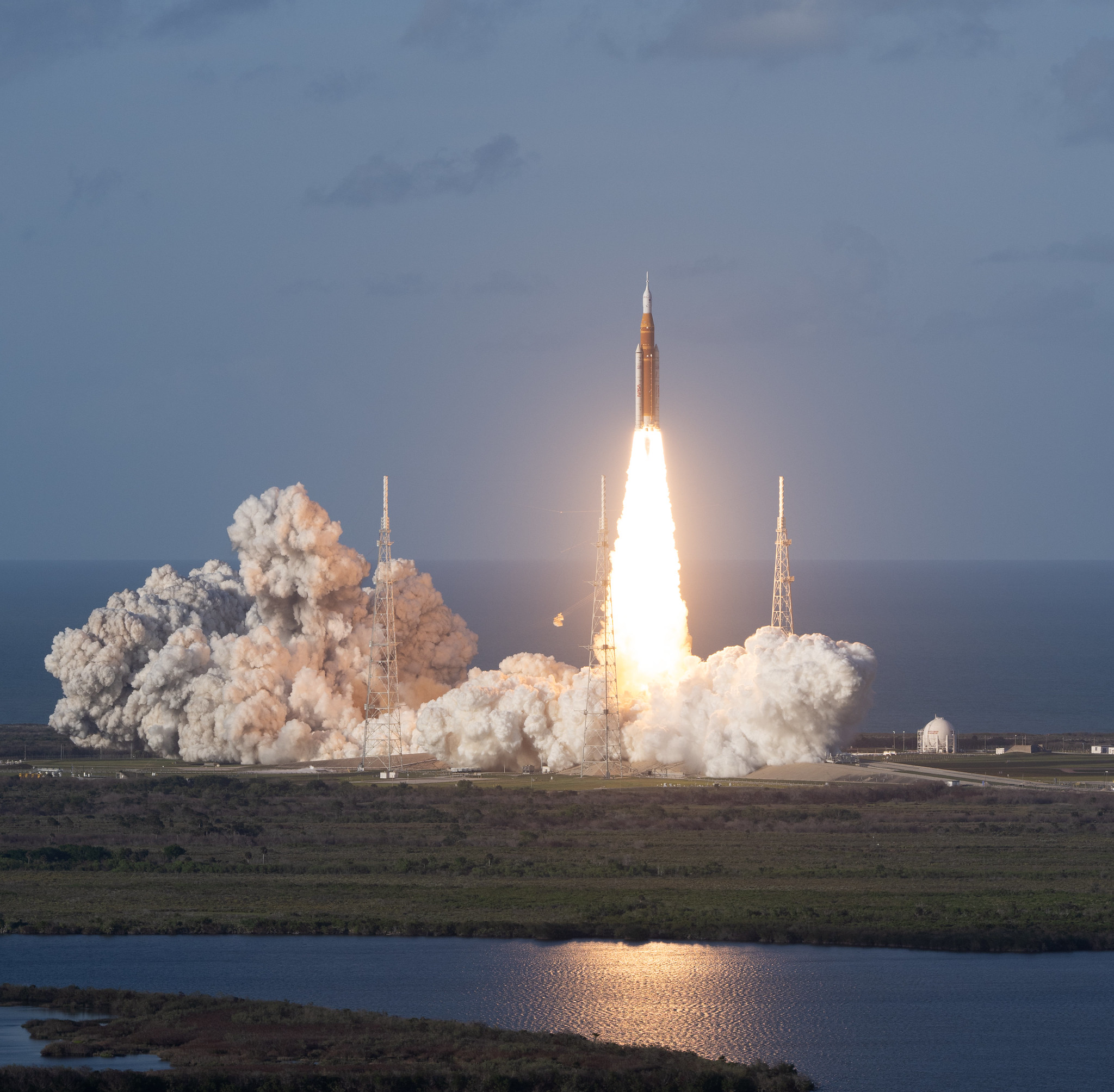
NASA’s Artemis II SLS (Space Launch System) rocket and Orion spacecraft lift off from Launch Complex 39B at NASA’s Kennedy Space Center in Florida on Wednesday, April 1, 2026. The Artemis II test flight will take NASA astronauts Commander Reid Wiseman, Pilot Victor Glover, and Mission Specialist Christina Koch, and CSA (Canadian Space Agency) astronaut Mission Specialist Jeremy Hansen, on an approximately 10-day mission around the Moon and back to Earth.
NASA/Joel Kowsky
Live updates for launch of NASA’s Artemis II test flight will be published on this page. NASA’s launch broadcast coverage is airing on NASA+, Amazon Prime, and YouTube. All times are Eastern.
6:59 p.m.
The Orion spacecraft’s SAWs (solar arrays wings) have fully deployed, completing a key configuration step for the Artemis II mission. Flight controllers in Houston confirmed that all four wings unfolded as planned, locking into place and beginning to draw power.
Each solar array wing extends outward from the European Service Module, giving Orion, named Integrity, a wingspan of roughly 63 feet when fully deployed. Each wing has 15,000 solar cells to convert sunlight to electricity. The arrays can turn on two axes that allow them to rotate and track the Sun, maximizing power generation as the spacecraft changes attitude during its time in Earth orbit and on its outbound journey to the Moon.
The next major milestones are the PRM (perigee raise maneuver) and ARB (apogee raise burn) that will increase the lowest and highest points of the Orion spacecraft’s orbit and prepare the spacecraft for deep‑space operations.
Following the burns, NASA will hold a postlaunch news conference at 9 p.m. from Kennedy Space Center in Florida. Following the news conference, the Artemis II crew will begin preparations for Orion’s proximity operations demonstration. This demonstration will test the ability to manually maneuver Orion relative to another spacecraft, in this case, the interim cryogenic propulsion stage after separation.
Coverage on NASA+ will soon conclude, however 24/7 coverage will continue on NASA’s YouTube channel, and keep following the Artemis blog for live updates of key milestones throughout the mission.
6:43 p.m.
Main engine cutoff of the SLS (Space Launch System) core stage is complete, and the core stage has successfully separated from the interim cryogenic propulsion stage and the Orion spacecraft. This marks the end of the first major propulsion phase of the Artemis II mission and the transition to upper‑stage operations.
The next major milestone is the deployment of the spacecraft’s SAWs (solar array wings) scheduled to begin approximately 18 minutes after launch. Once extended, the four SAWs will provide continuous electrical power to the spacecraft throughout its journey, supporting life‑support systems, avionics, communications, and onboard operations. Deployment is a critical step in configuring Orion for the remainder of its time in Earth orbit and for the outbound trip to the Moon.
6:38 p.m.
The spacecraft adapter jettison fairings that enclose the service module and the launch abort system have separated from the Orion spacecraft. With the rocket and spacecraft now flying above the densest layers of Earth’s atmosphere, Orion no longer requires the protective structures that shielded it during the early, high‑dynamic‑pressure portion of launch.
The next major milestone is core stage separation and Interim Cryogenic Propulsion Stage ignition.
6:37 p.m.
The SLS (Space Launch System) twin solid rocket boosters have separated. The boosters, each standing 177 feet tall and generating more than 3.6 million pounds of thrust at liftoff, provide most of the rocket’s power during the first two minutes of flight and separation reduces mass and allows the core stage to continue propelling the Orion spacecraft, named Integrity, toward orbit.
With the boosters now clear, the SLS core stage remains the primary source of thrust.
In about one minute, the spacecraft adapter jettison fairings that enclose Orion’s service module and the launch abort system will separate from the spacecraft.
NASA’s Artemis II SLS (Space Launch System) rocket, with the Orion spacecraft atop carrying NASA astronauts Reid Wiseman, Victor Glover, and Christina Koch, along with CSA (Canadian Space Agency) astronaut Jeremy Hansen, lifted off from Kennedy Space Center’s Launch Complex 39B in Florida at 6:35 p.m. EDT to begin its journey to deep space.
The twin solid rocket boosters ignited first, delivering more than 75% of the thrust needed to lift the 5.75-million-pound rocket off the pad. Their combined power, along with the four RS-25 engines already at full thrust, generated an incredible 8.8 million pounds of force at liftoff. As the rocket rose, the umbilicals – which provided power, fuel, and data connections during prelaunch – disconnected and retracted into protective housings. This ensured the vehicle is free from ground systems and fully autonomous for flight.
The approximately 10-day Artemis II mission around the Moon is the first crewed flight under NASA’s Artemis campaign. It will help test the systems and hardware needed to continue sending astronauts on increasingly difficult missions to explore more of the Moon for scientific discovery, economic benefits, and to continue building toward the first crewed missions to Mars.
Below are the ascent milestones that will occur leading up to core stage separation. Times may vary by several seconds.
- SLS clears launch tower; roll/pitch maneuver (Mission Elapsed Time [MET]) +00:00:07)
- SLS reached supersonic speed (MET +00:00:56)
- Maximum dynamic pressure (MET +00:01:12)
- Solid Rocket Booster separation (MET +00:02:09)
- Lauch abort system jettison (MET +00:03:13)
- Core stage main engine cutoff (MET +00:08:02)
Core stage separates from interim cryogenic propulsion stage (MET +00:08:14)
6:25 p.m.
The Artemis II countdown has entered terminal count, and the ground launch sequencer has taken control, orchestrating a precise series of automated commands to prepare the SLS (Space Launch System) rocket and Orion spacecraft for liftoff at a T-0 time of 6:35 p.m. EDT.
The ground launch sequencer ensures that all systems – from propulsion to avionics – transition into flight mode. Key actions performed include pressurizing propellant tanks for optimal engine performance, activating flight software and switching control from ground to onboard systems, and performing final health checks across thousands of sensors to confirm readiness.
This automated sequence minimizes human intervention, reducing risk and ensuring synchronization across complex subsystems. For Artemis II, this moment marks the culmination of years of planning and testing, as the mission moves from ground operations to the threshold of launch.
See the list below of the terminal count milestones:
T-10 minutes and counting
- T-10M – GLS initiates terminal count
- T-8M – Crew Access Arm retract
- T-6M – GLS go for core stage tank pressurization
- T-6M – Orion ascent pyros are armed
- T-6M – Orion set to internal power
- T-5M57S – Core stage LH2 terminate replenish
- T-5M20S – LAS capability is available
- T-5M20S – NTD lets commander knows LAS capability is available
- T-4M40S – GLS go for LH2 high flow bleed check
- T-4M30S – Flight termination system armed
- T-4M – GLS is go for core stage auxiliary power unit (APU) start
- T-4M – Core Stage APU starts
- T-4M – Core stage LOX terminate replenish
- T-3M30S – ICPS LOX terminate replenish
- T-3M10S – GLS go for purge sequence 4
- T-2M02S – ICPS switches to internal battery power
- T-2M – Booster switches to internal batter power
- T-1M30S – Core stage switches to internal power
- T-1M20S – ICPS enters terminal countdown mode
- T-50S – ICPS LH2 terminate replenish
- T-33S – GLS sends “go for automated launch sequencer” command
- T-30S – Core stage flight computer to automated launching sequencer
- T-12S – Hydrogen burn off igniters initiated
- T-10S – GLS sends the command for core stage engine start
- T-6.36S– RS-25 engines startup
- T-0 – Booster ignition, umbilical separation, and liftoff
Inside the terminal countdown, teams have a few options to hold the count if needed.
The launch team can hold at 6 minutes for the duration of the launch window, less the 6 minutes needed to launch, without having to recycle back to 10 minutes.
If teams need to stop the clock between T-6 minutes and T-1 minute, 30 seconds, they can hold for up to 3 minutes and resume the clock to launch. If they require more than 3 minutes of hold time, the countdown would recycle back to T-10.
If the clock stops after T-1 minute and 30 seconds, but before the automated launch sequencer takes over, then teams can recycle back to T-10 to try again, provided there is adequate launch window remaining.
After handover to the automated launch sequencer, any issue that would stop the countdown would lead to concluding the launch attempt for that day.
6:22 p.m.
Artemis II Launch Director Charlie Blackwell-Thompson conducted one of the most important steps before liftoff: the “go/no-go” poll for the team to proceed with the final 10 minutes of the countdown known as terminal count.
A unanimous “go” across the board signals that Artemis II is fully prepared to proceed toward launch. This moment represents the culmination of years of planning and hours of meticulous pre-launch work, bringing the mission to the threshold of history.
6:19 p.m.
The launch team has made the decision to extend the T-10 minute hold ahead of today’s launch to give engineers time to work through final preparations for liftoff. There is a two-hour window in which Artemis II could launch, and a new liftoff time will be set shortly
5:57 p.m.
NASA’s Artemis II closeout crew completed its final tasks and departed Launch Complex 39B at NASA’s Kennedy Space Center in Florida. After hours of meticulous work assisting the astronauts with suit-up, hatch closure, and critical spacecraft checks, the team exited the White Room and left the Orion spacecraft sealed and ready for flight.
This departure marks a major transition in launch operations: the spacecraft is now fully configured, and responsibility shifts to the launch control team for the final countdown. The closeout crew’s precision and expertise ensure that every connection, seal, and system is verified before they step away – making this moment a key milestone on the path to liftoff.
Engineers investigated a sensor on the launch abort system’s attitude control motor controller battery that showed a higher temperature than would be expected. It is believed to be an instrumentation issue and will not affect today’s launch.
The weather continues to cooperate and has now been upgraded to 90% go for launch.
5:15 p.m.
Engineers have now resolved an issue with the hardware that communicates with the flight termination system that would have prevented the ground from sending a signal to destruct the rocket if it were to veer off course during ascent, to protect public safety. A confidence test was performed to ensure that the hardware is ready to support today’s launch.
Meanwhile, technicians have completed the launch abort system hatch closure – an essential step that ensures the Orion spacecraft is fully sealed and ready for flight. The hatch provides an additional protective barrier for the crew module, designed to safeguard astronauts during the Artemis II flight path and, if necessary, enable a rapid escape in the event of an emergency.
During this phase, the closeout team verifies hatch alignment, engages locking mechanisms, and confirms pressure integrity. These checks guarantee that the launch abort system hatch can perform its function flawlessly, maintaining structural integrity under extreme launch conditions. With the hatch secured, Orion enters its final configuration for liftoff, marking one of the last major milestones before fueling and launch.
5 p.m.
Although the countdown to today’s Artemis II launch is continuing to progress, the Eastern Range has identified an issue that they are currently working to resolve related to their communication with the flight termination system. The flight termination system is a safety system that allows engineers on the ground to send a signal to destruct the rocket if it were to veer off course during ascent, to protect public safety. Without assurance that this system would work if needed, today’s launch would be no-go. However, engineers have devised a way to verify the system and are currently preparing to test this solution.
4:02 p.m.
Technicians began installing the crew module hatch service panel on the Orion spacecraft, an important step in final launch preparations. This panel protects key connections and ensures the hatch area is secure for flight.
As part of current closeout activities, teams are confirming all systems around the hatch are properly sealed and ready for the mission.
With the hatch area secured, teams will continue final checks and countdown operations at Launch Pad 39B at NASA’s Kennedy Space Center in Florida, bringing us closer to sending astronauts on a historic journey around the Moon.
3:39 p.m.
NASA engineers have conducted counterbalance mechanism operations and are now performing hatch seal pressure decay checks inside the White Room at Launch Complex 39B. These steps ensure Orion’s hatch maintains proper pressure integrity and that the counterbalance system functions as designed for launch conditions.
The counterbalance mechanism is a precision-engineered assembly that offsets the weight of the crew module hatch, allowing technicians to open and close it smoothly without introducing stress on the hinge or seal. This system uses calibrated springs and dampers to maintain alignment and prevent sudden movements, which is essential for preserving the hatch’s airtight seal. During this phase, technicians verify the mechanism’s load distribution and confirm that its locking features engage correctly under simulated launch loads.
Following these adjustments, the team performs seal pressurization decay checks – monitoring pressure loss over time to confirm the hatch’s integrity. These checks are vital for astronaut safety, ensuring the cabin remains secure in all mission phases.
3:17 p.m.
NASA’s Artemis II closeout crew is now completing one of the most critical steps before launch: preparing and closing the crew module hatch to the Orion spacecraft. Inside the White Room at Launch Complex 39B, the closeout crew is working meticulously to inspect seals, secure fasteners, and verify that the hatch is airtight.
This process ensures Orion is fully pressurized and ready for flight. Once the hatch is closed and locked, the astronauts are officially sealed inside their spacecraft, marking a major milestone on the path to liftoff.
2:31 p.m.
NASA’s Artemis II crew members are boarding the agency’s Orion spacecraft to begin communication checks to confirm voice links with mission control and onboard systems.
Before entering the spacecraft that will be their home on the approximately 10-day journey around the Moon and back, all four crewmates signed the inside of the White Room, an area at the end of the crew access arm that provides access to the spacecraft. The term “White Room” dates to NASA’s Gemini program, and to honor this human spaceflight tradition, the room remains white today.
The Artemis II closeout crew is now working to help the astronauts enter the Orion spacecraft and make final preparations for their nearly 700,000-mile trip to the Moon and back. As part of the process, the closeout crew is helping the astronauts don their Orion Crew Survival System helmets and gloves, as well as board Orion and get buckled in.
A short time from now, the closeout crew will close the crew module and exterior launch abort system hatches. Even a single strand of hair inside the hatch doors could potentially pose issues with closing either hatch, so the process is carefully done and takes up to four hours. Each step in the closeout process ensures airtight seals and communication readiness for the mission ahead.
Following communication checks, the team performed suit leak checks – a vital safety procedure ensuring each pressure suit maintains integrity in case of cabin depressurization. These operations are essential for crew readiness and mission assurance, marking one of the final phases before hatch closure and launch preparations.
2:27 p.m.
With assistance from the closeout crew, the Artemis II crew are carefully donning their helmets and gloves – finalizing suit integrity checks before boarding the Orion spacecraft.
This step is more than ceremonial; it ensures airtight seals and communication readiness for the mission ahead. The closeout crew plays a vital role, guiding the astronauts through these procedures and confirming every connection is secure before hatch closure.
Stay tuned as we continue to follow the Artemis II team through each countdown milestone on their path to liftoff.
2:14 p.m.
NASA’s Artemis II crew NASA astronauts Reid Wiseman, Victor Glover, and Christina Koch, along with CSA (Canadian Space Agency) astronaut Jeremy Hansen, arrived at Launch Complex 39B at the agency’s Kennedy Space Center in Florida, where the agency’s SLS (Space Launch System) rocket with Orion spacecraft atop stands ready for launch. The opening of today’s launch window is slated for just over 4 hours from now, at 6:24 p.m. EDT.
In the next few minutes, the crew will take the elevator up the pad’s fixed service structure and walk down the climate-controlled crew access arm to the White Room, their final stop before climbing aboard their Orion spacecraft. In this clean, controlled environment at the end of the crew access arm, the closeout crew will assist the astronauts with hatch operations and verify that all safety systems are ready for launch.
Since the late 1960s, pads A and B at Kennedy’s Launch Complex 39 have supported America’s major space programs, with Pad A used most frequently for launches under the Space Shuttle Program. After the retirement of the shuttle in 2011, Pad A helped usher in a new era of human spaceflight as launch pad for the agency’s Commercial Crew Program, which returned human spaceflight capability to the United States. Pad B saw the launch of NASA’s Artemis I mission in November 2022 and will continue to be the primary launch pad for America’s efforts to return to humans the Moon.
2 p.m.
Just moments ago, NASA’s Artemis II flight crew began the walk that every NASA astronaut has made since Apollo 7 in 1968, heading to the elevator and down through the double doors below the Neil A. Armstrong Building’s Astronaut Crew Quarters at NASA’s Kennedy Space Center in Florida.
Before they left the suit-up room, the crew completed one last piece of unfinished business – a card game. A long-held spaceflight tradition, NASA crews play cards before leaving the crew quarters ahead of launch until the commander, in this instance NASA astronaut Reid Wiseman, loses. It is hoped that by losing, the commander burns off all his or her bad luck, thereby clearing the mission for only good luck.
NASA’s Artemis II is the first crewed mission of the Artemis program and will carry Wiseman and fellow NASA astronauts Victor Glover and Christina Koch, as well as CSA (Canadian Space Agency) astronaut Jeremy Hansen on an approximately 10-day mission around the Moon and back to Earth.
The first crewed deep-space flight in over 50 years, Artemis II is expected to send the crew farther from Earth than any previous human mission, potentially breaking the record of about 248,655 miles (400,171 km) from Earth set by Apollo 13 during its lunar free-return trajectory. This milestone will occur during the lunar flyby phase, when the crew travels on a free-return trajectory around the Moon, which allows the spacecraft to loop around the Moon and return to Earth without entering lunar orbit.
During the test flight, NASA will test life-support systems and critical operations in deep space, paving the way for future lunar landings and Mars exploration.
Having received goodbyes and well wishes from their families and friends, the crew embarks on the 20-minute journey to Kennedy’s Launch Pad 39B and their awaiting spacecraft.
1:36 p.m.
NASA’s pad rescue and closeout crew teams have arrived at Launch Complex 39B at the agency’s Kennedy Space Center in Florida to ensure safety and readiness during the critical fueling operations. These specialized teams play a vital role in protecting personnel and hardware throughout the countdown.
The pad rescue team will be positioned to respond immediately in the unlikely event of an emergency, ensuring safe evacuation procedures for pad personnel. The rescue team is equipped with advanced gear and trained for rapid crew extraction, fire suppression, and hazard mitigation. Their presence ensures astronaut safety remains the top priority, providing an all-important layer of protection as fueling operations and system checks continue.
The closeout crew is responsible for closing the Orion crew module and launch abort system hatches, securing access points, verifying pad configurations, and maintaining the integrity of the launch area during propellant loading and system checks. Their work is critical for guaranteeing a secure environment for the astronauts before the launch pad is cleared for liftoff operations.
These teams are essential for mitigating risk and supporting the complex choreography of Artemis II’s prelaunch activities. With both teams in place, Artemis II remains on track for its historic mission to send astronauts around the Moon.
1:15 p.m.
NASA astronauts Reid Wiseman, commander; Victor Glover, pilot; and Christina Koch, mission specialist; along with CSA (Canadian Space Agency) astronaut Jeremy Hansen, mission specialist, are suiting up inside the Astronaut Crew Quarters of the Neil A. Armstrong Operations and Checkout Building at the agency’s Kennedy Space Center in Florida.
A team of suit technicians help the crew put on their Orion Crew Survival System suits, which are each tailored for mobility and comfort while ensuring maximum safety during the dynamic phases of flight. The bright orange spacesuits are designed to protect them on their journey and feature many improvements from head to toe to the suits worn on the space shuttle. NASA reengineered many elements to improve safety and range of motion for Artemis astronauts, and instead of the small, medium, and large sizes from the shuttle era, they are custom fit for each crew member.
The outer layer is fire-resistant, and a stronger zipper allows astronauts to quickly put the suit on. Improved thermal management will help keep them cool and dry. A lighter, stronger helmet improves comfort and communication, and the gloves are more durable and touch-screen compatible. Better-fitting boots also provide protection in the case of fire and help an astronaut move more swiftly.
The suits’ design and engineering enhancements provide an additional layer of protection for astronauts and ensure they return home safely from deep space missions.
During suit-up, teams will check for leaks and ensure that all connecting life support systems, including air and power, are operating nominally ahead of the crew’s ride to NASA Kennedy’s Launch Complex 39B.
12:51 p.m.
With NASA teams now maintaining the liquid oxygen levels in the interim cryogenic propulsion, all cryogenic stages of the SLS (Space Launch System) rocket have transitioned to replenish mode during the Artemis II launch countdown. This includes the core stage and SLS upper stage, ensuring both liquid hydrogen and liquid oxygen tanks remain at flight-ready levels.
Replenish mode is essential for maintaining stable propellant quantities and pressure as super-cold fuels naturally boil off over time. Continuous adjustments keep the rocket fully fueled and ready for ignition, supporting the RS-25 engines on the core stage and the RL10 engine on the SLS upper stage for their essential roles in launch and translunar injection.
These milestones coincide with the Artemis II countdown entering a planned 1-hour and 10-minute built-in hold. This scheduled pause allows teams to complete crucial system checks, verify launch readiness, and address any last-minute adjustments before proceeding toward crew ingress and final fueling operations.
During this hold, engineers review data from cryogenic loading, propulsion systems, and communications to ensure all parameters meet strict safety and performance criteria. The hold also provides flexibility for resolving minor issues without impacting the overall launch timeline.
Once the hold concludes, the countdown will resume with preparations for astronaut arrival at Launch Pad 39B at NASA’s Kennedy Space Center in Florida.
12:40 p.m.
NASA’s Artemis II astronauts received a final weather briefing inside the Astronaut Crew Quarters of the Neil A. Armstrong Operations and Checkout Building at the agency’s Kennedy Space Center in Florida, as part of prelaunch preparations.
This weather update provides astronauts and mission teams with the latest conditions at NASA Kennedy’s Launch Pad 39B, the surrounding recovery zones, and potential abort sites along Artemis II’s flight path. Accurate weather forecasting is essential for protecting crew and hardware, as even minor changes can impact countdown decisions and flight dynamics.
NASA astronauts Reid Wiseman, commander; Victor Glover, pilot; and Christina Koch, mission specialist; along with CSA (Canadian Space Agency) astronaut Jeremy Hansen, mission specialist, were briefed on wind speeds, precipitation, lightning risk, and sea states for splashdown contingencies, ensuring all safety criteria are met before proceeding with launch operations.
Weather officials with NASA and the U.S. Space Force’s Space Launch Delta 45 are tracking 80% favorable conditions during the launch window, with primary concerns being the cumulus cloud rule, flight through precipitation rule, and ground winds.
With the weather briefing complete, the crew and ground teams remain aligned and ready to continue toward liftoff, keeping Artemis II on track for its historic mission to send astronauts around the Moon.
NASA teams also have begun liquid oxygen (LOX) topping process for the interim cryogenic propulsion stage, or SLS (Space Launch System) rocket upper stage, during the Artemis II launch countdown. This step follows the fast fill phase and ensures the liquid oxygen tank reaches full capacity with super-cold oxidizer.
Live coverage of Artemis II tanking operations continues on NASA’s YouTube channel. NASA’s full launch coverage begins at 1 p.m. EDT on NASA+, Amazon Prime, and YouTube. You can continue to follow the Artemis blog from launch to splashdown for mission updates.
12:23 p.m.
Liquid oxygen (LOX) fast fill is now complete for the SLS (Space Launch System) upper stage, marking another major milestone in tanking operations. Teams have confirmed the upper stage is in good shape and are proceeding with the LOX vent and relief test. This step helps verify proper pressure regulation and ensures the system is ready to transition into topping and, later, replenish operations.
12:03 p.m.
NASA teams are now maintaining the liquid oxygen levels in the SLS (Space Launch System) rocket core stage through replenish mode. This phase follows the completion of liquid oxygen fast fill and topping, ensuring the oxidizer remains at flight-ready levels throughout the final countdown.
11:42 a.m.
NASA teams are in fast fill of liquid oxygen (LOX) into the interim cryogenic propulsion stage as part of the Artemis II launch countdown. This phase rapidly loads the oxidizer after chilldown is complete, bringing the SLS (Space Launch System) rocket upper stage closer to full readiness for its role in sending the Orion spacecraft into a high Earth orbit ahead of a proximity operations demonstration test and Orion’s translunar injection burn.
11:15 a.m.
NASA teams have transitioned the interim cryogenic propulsion stage liquid hydrogen tank to replenish mode during the Artemis II countdown. This phase follows the successful topping process and ensures the tank remains at flight-ready levels all the way to launch.
11:09 a.m.
NASA teams have begun the topping phase for the interim cryogenic propulsion stage liquid hydrogen (LH2) tank. This critical step occurs after successful chilldown and vent-and-relief checks, ensuring the tank reaches full capacity with super-cold liquid hydrogen.
Live coverage of tanking operations continues on NASA’s YouTube channel.
10:35 a.m.
The Artemis II launch team began liquid hydrogen (LH2) replenish for the SLS (Space Launch System) rocket core stage.
Replenish is the final step in the fueling process, designed to maintain the correct LH2 levels as the super-cold propellant naturally boils off over time. This continuous, low-rate flow keeps the tanks topped off and thermally stable, ensuring the rocket remains fully fueled and ready for liftoff.
From chilldown to replenish, every phase of fueling is carefully managed to protect hardware and guarantee mission success. With replenish underway, Artemis II is in its final stretch toward launch and humanity’s next giant leap.
10:24 a.m.
The Artemis II launch team initiated liquid hydrogen (LH2) topping for the SLS (Space Launch System) rocket core stage.
Topping is the process of adding small amounts of LH2 to the tanks after fast fill is complete, ensuring they remain at full capacity as the super-cold propellant naturally boils off. This step is critical for maintaining the precise levels needed for launch while keeping the system thermally stable.
Watch continuing live coverage of tanking operations on NASA’s YouTube channel.
9:52 a.m.
The Artemis II launch team transitioned to the fast fill of liquid hydrogen (LH2) for the interim cryogenic propulsion stage, or SLS (Space Launch System) rocket upper stage.
After completing the chilldown phase, this step rapidly loads super-cold LH2 into the SLS upper stage tanks, ensuring the upper stage is fueled and ready to perform its fundamental role of raising the Orion spacecraft into a high Earth orbit ahead of a proximity operations demonstration test and Orion’s translunar injection burn.
Fast fill accelerates the fueling process while maintaining safety, marking another major milestone in the countdown as Artemis II moves closer to liftoff.
9:36 a.m.
The Artemis II launch team has begun the liquid hydrogen chilldown for the interim cryogenic propulsion stage, or SLS (Space Launch System) rocket upper stage.
This process gradually cools the interim cryogenic propulsion stage fuel lines and components to cryogenic temperatures using super-cold liquid hydrogen. The chilldown step is essential to prevent thermal shock and ensure the stage is properly conditioned for full propellant loading. By stabilizing the system at these extreme temperatures, engineers guarantee safe and efficient fueling for the upper stage that will help position Orion into high Earth orbit for its journey toward the Moon.
9:25 a.m.
NASA astronauts Reid Wiseman, Victor Glover, and Christina Koch, along with CSA (Canadian Space Agency) astronaut Jeremy Hansen have officially begun their launch day with a scheduled wake-up call at 9:25 a.m., marking the start of their final preparations for the historic Artemis II mission around the Moon.
9:04 a.m.
The Artemis II launch team transitioned to the fast fill of liquid hydrogen (LH2) into the SLS (Space Launch System) rocket core stage.
After completing the slow fill phase, this step rapidly loads super-cold LH2 into the rocket’s massive tanks, bringing them closer to full capacity. LH2 flows at a much higher rate, reducing overall fueling time while maintaining safety since the system is already thermally conditioned.
Watch live coverage of tanking operations on NASA’s YouTube channel.
8:45 a.m.
During tanking operations, teams transitioned the SLS (Space Launch System) rocket’s core stage liquid oxygen (LOX) system from slow fill to fast fill, rapidly loading super-cold oxidizer into the tank while monitoring for leaks and maintaining proper thermal conditioning.
LOX fast fill safely loads the bulk of the super-cold oxidizer needed for launch, allowing teams to rapidly bring the SLS rocket to flight-ready levels while closely monitoring the vehicle’s health.
8:35 a.m.
The Artemis II launch team initiated the slow fill of liquid hydrogen (LH2) and liquid oxygen (LOX) into the SLS (Space Launch System) rocket core stage.
This phase introduces the super-cold propellants at a controlled rate, allowing the rocket’s plumbing and tanks to gradually adjust to cryogenic temperatures. Slow fill minimizes thermal stress on hardware and ensures a smooth transition before moving to faster fueling stages.
It’s a vital step in the countdown, setting the stage for full tanking operations. Following completion of the slow-fill process for both propellants, teams will transition operations to the fast-fill phase.
Watch continuing live coverage of tanking operations on NASA’s YouTube channel.
7:58 a.m.
The Artemis II launch team is now performing the liquid oxygen main propulsion system chilldown on the SLS (Space Launch System) rocket core stage.
Follow along with live coverage of tanking operations ahead of the Artemis II test flight.
7:44 a.m.
The Artemis II launch team initiated liquid oxygen (LOX) and liquid hydrogen (LH2) transfer line chilldown for the SLS (Space Launch System) rocket core stage.
Chilldown is a critical step in preparing the rocket for safe and efficient fueling, reducing risks and maintaining system integrity. The process gradually cools the rocket’s plumbing and engine systems to cryogenic temperatures using super-cold liquid hydrogen, helping to prevent thermal shock and ensuring the hardware is conditioned for the full flow of propellant during tanking.
Once chilldown is complete, teams will initiate slow fill followed by fast fill tanking operations as they load 700,000 gallons of super-cold liquid oxygen and liquid hydrogen in the SLS core stage.
Below are the as scheduled times for core stage slow and fast fill operations:
- L-9H55M – L-9H25M: Core stage LH2 slow fill start
- L-9H40M – L-9H30M: Core stage LOX slow fill
- L-9H30M – L-6H40M: Core stage LOX fast fill
- L-9H25M – L-8H: Core stage LH2 fast fill
Live coverage of tanking operations is now airing on NASA’s YouTube channel.
7:33 a.m.
Artemis Launch Director Charlie Blackwell-Thompson has given the official “go” for tanking, and NASA teams are ready to start loading propellants into the SLS (Space Launch System) rocket. This essential step kicks off with the chilldown of the core stage liquid oxygen and liquid hydrogen transfer lines, preparing the rocket for its historic mission.
Earlier this morning, engineers at NASA’s Kennedy Space Center in Florida performed the air-to-gaseous nitrogen changeover and cavity inerting, a critical step to ensure crew safety and vehicle integrity. During this phase, atmospheric air inside the rocket’s cavities is replaced with gaseous nitrogen, an inert gas that reduces the risk of combustion and contamination, creating a safe environment for subsequent fueling operations. By displacing oxygen and moisture, engineers maintain the purity and stability of the rocket’s internal systems before cryogenic propellant loading begins.
The launch countdown, which started Monday at 4:44 p.m. EDT, is currently in a built-in hold. This planned pause is a critical checkpoint in the countdown sequence, allowing teams to complete essential tasks and verify system readiness before moving forward.
During this hold, engineers perform final configuration checks, review system health, and ensure all launch criteria are met. It’s also a window for resolving any minor issues without impacting the overall timeline. These holds are standard in complex missions like Artemis II, providing flexibility and confidence as we prepare to send astronauts on a journey around the Moon.
NASA’s launch day coverage begins with live views and audio commentary of tanking operations, as teams load propellant into the SLS rocket, at 7:45 a.m. on NASA’s YouTube channel. Full launch coverage begins at 12:50 p.m. on NASA+, Amazon Prime, and YouTube. Updates during the launch countdown and throughout the mission will be posted here on the Artemis blog.
Below are the countdown milestones as planned for tanking:
- L-10H50M: Launch team decides “go” or “no-go” to begin tanking the rocket
- L-10H40M – L-10H35M: Core stage LOX transfer line chilldown
- L-10H40M – L-9H55M: Core stage LH2 chilldown
- L-10H25M – L-9H40M: Core stage LOX main propulsion system chilldown
- L-9H55M – L-9H25M: Core stage LH2 slow fill start
- L-9H40M – L-9H30M: Core stage LOX slow fill
- L-9H30M – L-6H40M: Core stage LOX fast fill
- L-9H25M – L-8H: Core stage LH2 fast fill
- L-9H05M – L-8H30M: ICPS LH2 chilldown
- L-8H30M – L-7H45M: ICPS LH2 fast fill start
- L-8H – L-7H55M: Core stage LH2 topping
- L-7H55M – terminal count: Core stage LH2 replenish
- L-7H45M – L-7H20M: ICPS LH2 vent and relief test
- L-7H20M – L-7H10M: ICPS LH2 tank topping start
- L-7H05M – terminal count: ICPS LH2 replenish
- L-6H40M – L-6H05M: Core stage LOX topping
- L-6H40M – L-6H30M: ICPS LOX main propulsion system chilldown
- L-6H30M – L-5H45M: ICPS LOX fast fill
- L-6H05M – terminal count: Core stage LOX replenish
- L-5H45M – L-5H30M: ICPS LOX vent and relief test
- L-5H30M – L-5H10M: ICPS LOX topping
- L-5H10M – terminal count: ICPS LOX replenish
- L-5H10M: All stages replenish
- T-6M: GLS go for core stage tank pressurization
- T-5M57S: Core stage LH2 terminate replenish
- T-4M40S: GLS is go for LH2 high flow bleed check
- T-4M: Core stage LOX terminate replenish
- T-3M30S: ICPS LOX terminate replenish
- T-50S: ICPS LH2 terminate replenish
- T-33S: GLS sends “go for automated launch sequencer” command
- T-30S: Core stage flight computer to automated launching sequencer
- T-12S: Hydrogen burn off igniters initiated
- T-10S: GLS sends the command for core stage engine start
- T-6.36S: RS-25 engines startup
- T-0: Booster ignition, umbilical separation, and liftoff