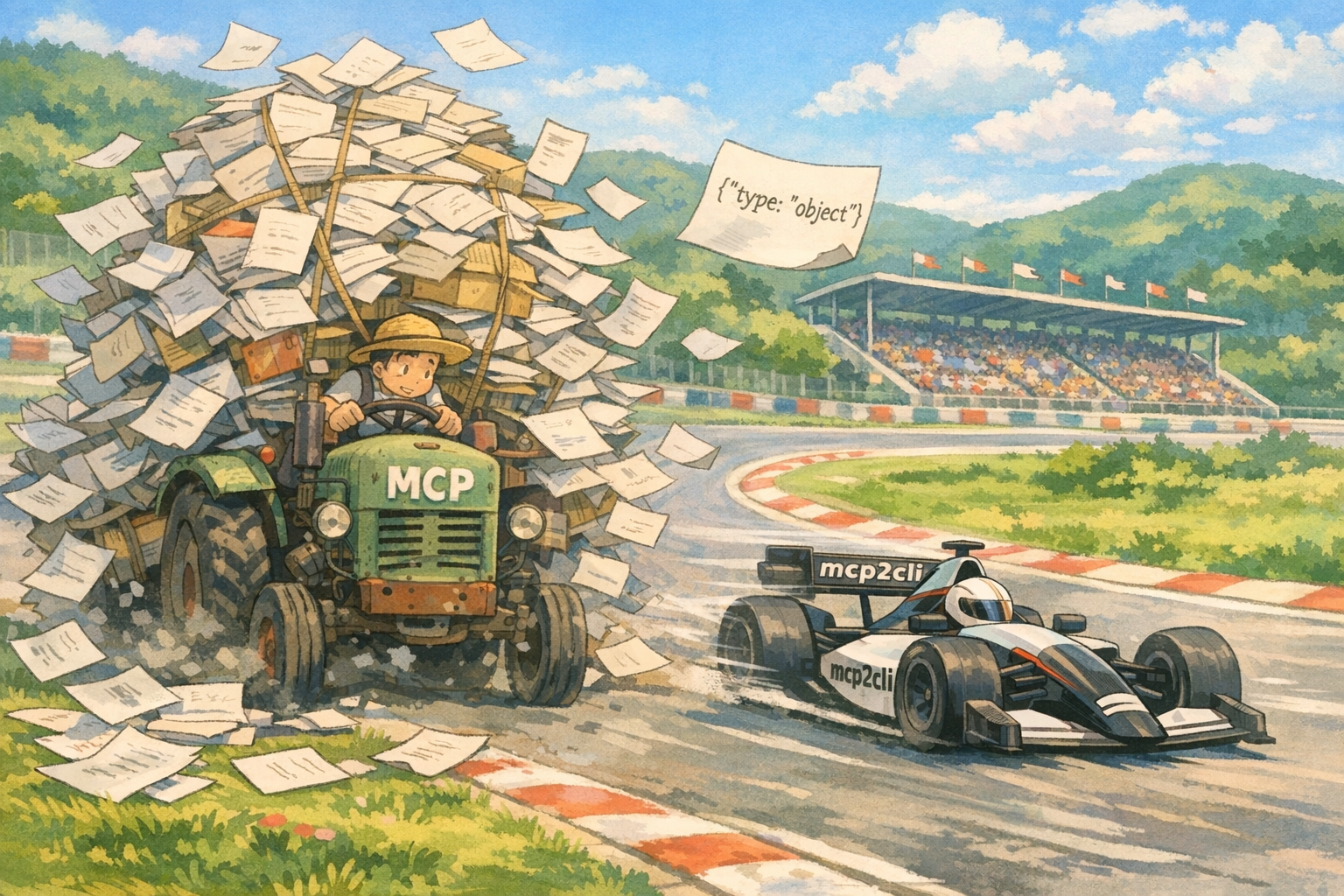
Turn any MCP server or OpenAPI spec into a CLI — at runtime, with zero codegen.
pip install mcp2cli

# Or run directly without installing
uvx mcp2cli --help
mcp2cli ships with an installable skill that teaches AI coding agents (Claude Code, Cursor, Codex) how to use it. Once installed, your agent can discover and call any MCP server or OpenAPI endpoint — and even generate new skills from APIs.
npx skills add knowsuchagency/mcp2cli --skill mcp2cli
After installing, try prompts like:
mcp2cli --mcp https://mcp.example.com/sse— interact with an MCP servermcp2cli create a skill for https://api.example.com/openapi.json— generate a skill from an API
# Connect to an MCP server over HTTP
mcp2cli --mcp https://mcp.example.com/sse --list

# Call a tool
mcp2cli --mcp https://mcp.example.com/sse search --query "test"

# With auth header
mcp2cli --mcp https://mcp.example.com/sse --auth-header "x-api-key:sk-..." \
  query --sql "SELECT 1"
# List tools from an MCP server
mcp2cli --mcp-stdio "npx @modelcontextprotocol/server-filesystem /tmp" --list

# Call a tool
mcp2cli --mcp-stdio "npx @modelcontextprotocol/server-filesystem /tmp" \
  read-file --path /tmp/hello.txt

# Pass environment variables to the server process
mcp2cli --mcp-stdio "node server.js" --env API_KEY=sk-... --env DEBUG=1 \
  search --query "test"
# List all commands from a remote spec
mcp2cli --spec https://petstore3.swagger.io/api/v3/openapi.json --list

# Call an endpoint
mcp2cli --spec ./openapi.json --base-url https://api.example.com list-pets --status available

# With auth
mcp2cli --spec ./spec.json --auth-header "Authorization:Bearer tok_..." create-item --name "Test"

# POST with JSON body from stdin
echo '{"name": "Fido", "tag": "dog"}' | mcp2cli --spec ./spec.json create-pet --stdin

# Local YAML spec
mcp2cli --spec ./api.yaml --base-url http://localhost:8000 --list
# Pretty-print JSON (also auto-enabled for TTY)
mcp2cli --spec ./spec.json --pretty list-pets

# Raw response body (no JSON parsing)
mcp2cli --spec ./spec.json --raw get-data

# Pipe-friendly (compact JSON when not a TTY)
mcp2cli --spec ./spec.json list-pets | jq '.[] | .name'

# TOON output — token-efficient encoding for LLM consumption
# Best for large uniform arrays (40-60% fewer tokens than JSON)
mcp2cli --mcp https://mcp.example.com/sse --toon list-tags
Specs and MCP tool lists are cached in ~/.cache/mcp2cli/ with a 1-hour TTL by default.
# Force refresh
mcp2cli --spec https://api.example.com/spec.json --refresh --list

# Custom TTL (seconds)
mcp2cli --spec https://api.example.com/spec.json --cache-ttl 86400 --list

# Custom cache key
mcp2cli --spec https://api.example.com/spec.json --cache-key my-api --list

# Override cache directory
MCP2CLI_CACHE_DIR=/tmp/my-cache mcp2cli --spec ./spec.json --list
Local file specs are never cached.
mcp2cli [global options] <subcommand> [command options]

Source (mutually exclusive, one required):
  --spec URL|FILE       OpenAPI spec (JSON or YAML, local or remote)
  --mcp URL             MCP server URL (HTTP/SSE)
  --mcp-stdio CMD       MCP server command (stdio transport)

Options:
  --auth-header K:V     HTTP header (repeatable)
  --base-url URL        Override base URL from spec
  --env KEY=VALUE       Env var for MCP stdio server (repeatable)
  --cache-key KEY       Custom cache key
  --cache-ttl SECONDS   Cache TTL (default: 3600)
  --refresh             Bypass cache
  --list                List available subcommands
  --pretty              Pretty-print JSON output
  --raw                 Print raw response body
  --toon                Encode output as TOON (token-efficient for LLMs)
  --version             Show version
Subcommands and their flags are generated dynamically from the spec or MCP server tool definitions. Run <subcommand> --help for details.
If you've connected an LLM to more than a handful of tools, you've felt the pain. Every MCP server, every OpenAPI endpoint — their full schemas get injected into the system prompt on every single turn. Your 50-endpoint API costs 3,579 tokens of context before the conversation even starts, and that bill is paid again on every message, whether the model touches those tools or not.
This isn't a theoretical concern. Kagan Yilmaz documented it well in his analysis of CLI vs MCP costs, showing that 6 MCP servers with 84 tools consume ~15,540 tokens at session start. His project CLIHub demonstrated that converting MCP servers to CLIs and letting the LLM discover tools on-demand slashes that cost by 92-98%.
The problem is well-recognized enough that Anthropic built Tool Search directly into their API — a deferred-loading pattern where tools are marked defer_loading: true and Claude discovers them via a search index (~500 tokens) instead of loading all schemas upfront. It typically cuts token usage by 85%. But as Kagan noted, when Tool Search fetches a tool, it still pulls the full JSON Schema into context.
mcp2cli takes the CLI approach further.
CLIHub showed the path: give the LLM a CLI instead of raw tool schemas, and let it --list and --help its way to what it needs. Anthropic's Tool Search showed that even first-party providers see the value in lazy loading. mcp2cli builds on both ideas with a few key differences:
- No codegen, no recompilation. Point mcp2cli at a spec URL or MCP server and the CLI exists immediately. When the server adds new endpoints, they appear on the next invocation — no rebuild step, no generated code to commit.
- Provider-agnostic. Tool Search is an Anthropic API feature. mcp2cli works with any LLM — Claude, GPT, Gemini, local models — because it's just a CLI tool the model can shell out to.
- Compact discovery. Tool Search defers loading but still injects full JSON schemas when a tool is fetched (~121 tokens/tool). mcp2cli's
--helpreturns human-readable text that's typically cheaper than the raw schema, and--listsummaries cost ~16 tokens/tool vs ~121 for native schemas. - OpenAPI support. MCP isn't the only schema-rich protocol. mcp2cli handles OpenAPI specs (JSON or YAML, local or remote) with the same CLI interface, the same caching, and the same on-demand discovery. One tool for both worlds.
- Spec caching with TTL control. Fetched specs and MCP tool lists are cached locally with configurable TTL, so repeated invocations don't hit the network.
--refreshbypasses the cache when you need it.
We measured this. Not estimates — actual token counts using the cl100k_base tokenizer against real schemas, verified by an automated test suite.
Let's be upfront about what mcp2cli adds to context. It's not zero — it's just dramatically less than injecting full schemas.
| Component | Cost | When |
|---|---|---|
| System prompt | 67 tokens | Every turn (fixed) |
--list output |
~16 tokens/tool | Once per conversation |
--help output |
~80-200 tokens/tool | Once per unique tool used |
| Tool call output | same as native | Per call |
The --list cost scales linearly with the number of tools — 30 tools costs ~464 tokens, 120 tools costs ~1,850 tokens. This is still 7-8x cheaper than the full schemas, and you only pay it once.
Compare that to native MCP injection: ~121 tokens per tool, every single turn, whether the model uses those tools or not. For OpenAPI endpoints, it's ~72 tokens per endpoint per turn.
Here's the total token cost across a realistic multi-turn conversation. The mcp2cli column includes all overhead: the system prompt on every turn, one --list discovery, --help for each unique tool the LLM actually uses, and tool call outputs.
MCP servers:
| Scenario | Turns | Unique tools used | Native total | mcp2cli total | Saved |
|---|---|---|---|---|---|
| Task manager (30 tools) | 15 | 5 | 54,525 | 2,309 | 96% |
| Multi-server (80 tools) | 20 | 8 | 193,360 | 3,897 | 98% |
| Full platform (120 tools) | 25 | 10 | 362,350 | 5,181 | 99% |
OpenAPI specs:
| Scenario | Turns | Unique endpoints used | Native total | mcp2cli total | Saved |
|---|---|---|---|---|---|
| Petstore (5 endpoints) | 10 | 3 | 3,730 | 1,199 | 68% |
| Medium API (20 endpoints) | 15 | 5 | 21,720 | 1,905 | 91% |
| Large API (50 endpoints) | 20 | 8 | 71,940 | 2,810 | 96% |
| Enterprise API (200 endpoints) | 25 | 10 | 358,425 | 3,925 | 99% |
A 120-tool MCP platform over 25 turns: 357,169 tokens saved.
Here's a 30-tool MCP server over 10 turns. The mcp2cli column includes the real costs: --list discovery on turn 1, --help + tool output when each new tool is first used.
Turn   Native       mcp2cli      Savings
──────────────────────────────────────────────────────────
1      3,619        531          3,088       ← --list (464 tokens)
2      7,238        598          6,640
3      10,887       815          10,072      ← --help (120) + tool call
4      14,506       882          13,624
5      18,155       1,099        17,056      ← --help (120) + tool call
6      21,774       1,166        20,608
7      25,423       1,383        24,040      ← --help (120) + tool call
8      29,042       1,450        27,592
9      32,691       1,667        31,024      ← --help (120) + tool call
10     36,310       1,734        34,576

Total: 34,576 tokens saved (95.2%)
Native MCP approach — pay the full schema tax on every turn:
System prompt: "You have these 30 tools: [3,619 tokens of JSON schemas]"
  → 3,619 tokens consumed per turn, whether used or not
  → 10 turns = 36,310 tokens
mcp2cli approach — pay only for what you use:
System prompt: "Use mcp2cli --mcp <url> <command> [--flags]"   (67 tokens/turn)
  → mcp2cli --mcp <url> --list                                (464 tokens, once)
  → mcp2cli --mcp <url> create-task --help                    (120 tokens, once per tool)
  → mcp2cli --mcp <url> create-task --title "Fix bug"         (0 extra tokens)
  → 10 turns, 4 unique tools = 1,734 tokens
The LLM discovers what it needs, when it needs it. Everything else stays out of context.
This is where it really hurts. Connect 3 MCP servers (a task manager, a filesystem server, and a database server — 60 tools total) and you're paying 7,238 tokens per turn. Over a 20-turn conversation, that's 145,060 tokens just for tool schemas. mcp2cli reduces that to 3,288 tokens — a 97.7% reduction — even after accounting for --list discovery (928 tokens) and --help for 6 unique tools (720 tokens).
Yes, partially. The MCP spec defines dynamic tool discovery via notifications/tools/list_changed, but that's about reacting to server-side changes — the initial tools/list response still returns all schemas at once, and most clients inject them into every turn.
Anthropic's Tool Search goes further: tools marked defer_loading: true stay out of context until Claude searches for them, cutting ~85% of upfront token cost. But it's Claude-API-only, and when a tool is fetched, the full JSON schema still enters context (~121 tokens/tool).
mcp2cli takes the CLI approach: --list returns compact summaries (~16 tokens/tool), --help returns human-readable text (typically cheaper than raw JSON schema), and it works with any LLM provider. The tradeoff is an extra shell invocation per discovery step.
- Load -- Fetch the OpenAPI spec or connect to the MCP server. Resolve
$refs. Cache for reuse. - Extract -- Walk the spec paths/tools and produce a uniform list of command definitions with typed parameters.
- Build -- Generate an argparse parser with subcommands, flags, types, choices, and help text.
- Execute -- Dispatch the parsed args as an HTTP request (OpenAPI) or tool call (MCP).
Both adapters produce the same internal CommandDef structure, so the CLI builder and output handling are shared.
# Install with test + MCP deps
uv sync --extra test

# Run tests (96 tests covering OpenAPI, MCP stdio, MCP HTTP, caching, and token savings)
uv run pytest tests/ -v

# Run just the token savings tests
uv run pytest tests/test_token_savings.py -v -s
This project was inspired by Kagan Yilmaz's analysis of CLI vs MCP token costs and his work on CLIHub. His observation that CLI-based tool access is dramatically more token-efficient than native MCP injection was the spark for mcp2cli. Where CLIHub generates static CLIs from MCP servers, mcp2cli takes a different approach: it reads schemas at runtime, so there's no codegen step and no rebuild when the server adds or changes tools. It also extends the pattern to OpenAPI specs — any REST API with a spec file gets the same treatment.
Anthropic's Advanced Tool Use guide describes Tool Search, a first-party deferred-loading mechanism built into the Claude API. It solves the same core problem — don't pay for tools you're not using — but at the API level rather than the CLI level. mcp2cli complements this by working with any LLM provider, returning more compact discovery output, and covering OpenAPI specs alongside MCP servers.