In ME103 you build a “high-fidelity product or object… with the PRL’s manufacturing resources.” I knew from the outset that I wanted to make something a bit humorous but that I would actually use in my day-to-day life. So in the funky spirit of co-opting projects to do things I want to do anyways, I set out to learn something of what I’m missing out on now that ME263 is no more. Ultimately, I built a beautiful piece of furniture: an artistic, layered stool with three angled aluminum legs, six statues “struggling” to hold up your weight, and dark walnut detailing throughout.
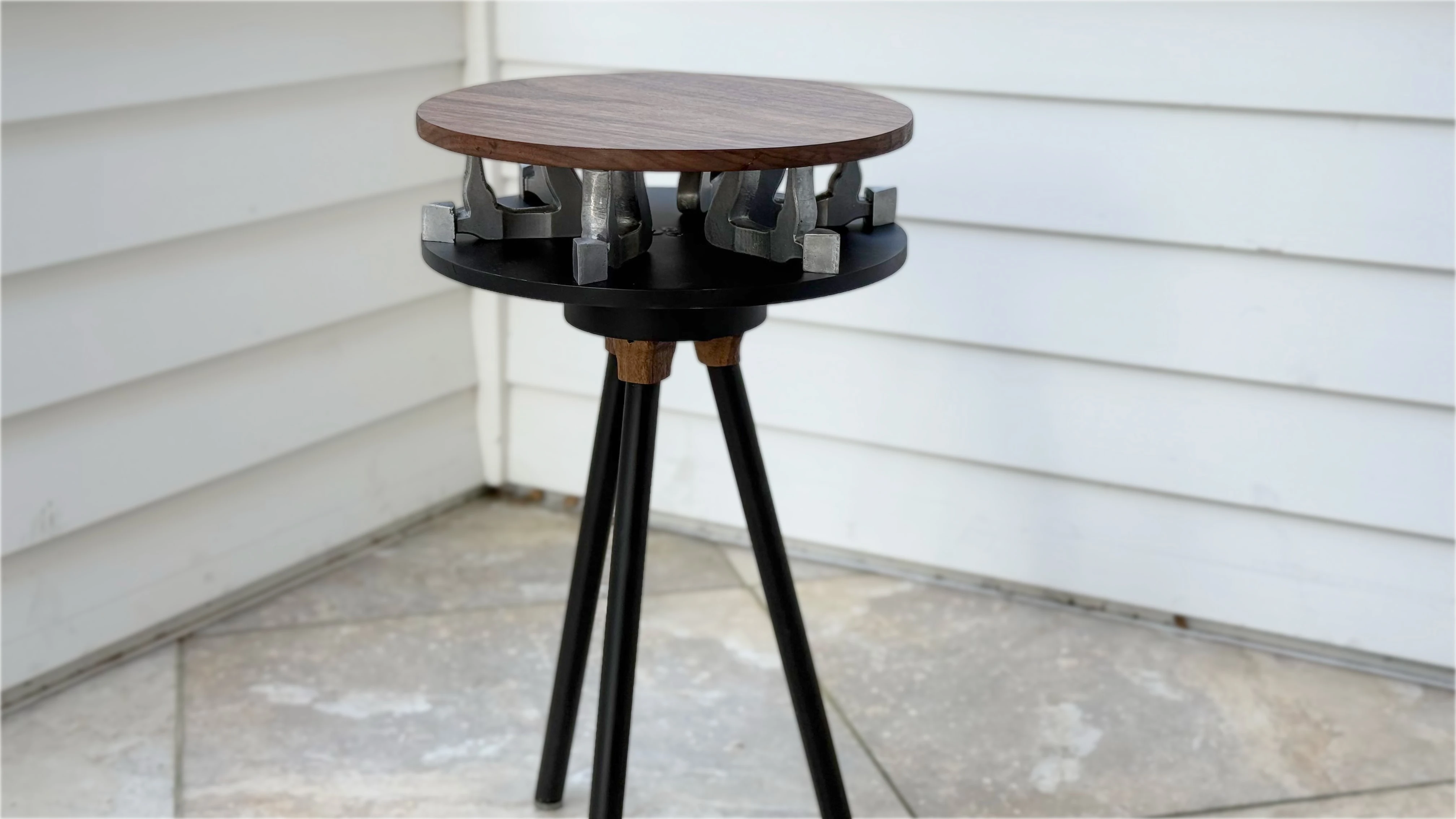
While the stool may seem simple, there is a surprising amount of complexity hidden beneath the surface. Most of those challenges have something to do with scale: there are 49 drilled holes, 27 screws, 18 tapped holes, and 9 threaded inserts in the body. The structure is 14 inches across and 24 inches tall—near the limits of how large you can make something in the PRL, and in many ways well over them, meaning I had to pull quite a few tricks to get it all working.
The stool is made up of four major components, which are (from bottom to top): the legs, the mount, the plate, and the statues. I’ll cover their manufacture individually below.
Legs
These were perhaps the simplest part of the project. I cut external threads onto three sections of 1“ tubing and called it a day: even though these insert into the mount at an angle, the tapped threads in the mount are tilted at the same angle meaning that the legs themselves don’t need to “know” about any of that complexity. That does mean that the base of the legs is at angle to the floor, however—so I ended up printing custom foot pads out of flexible plastic.
Mount
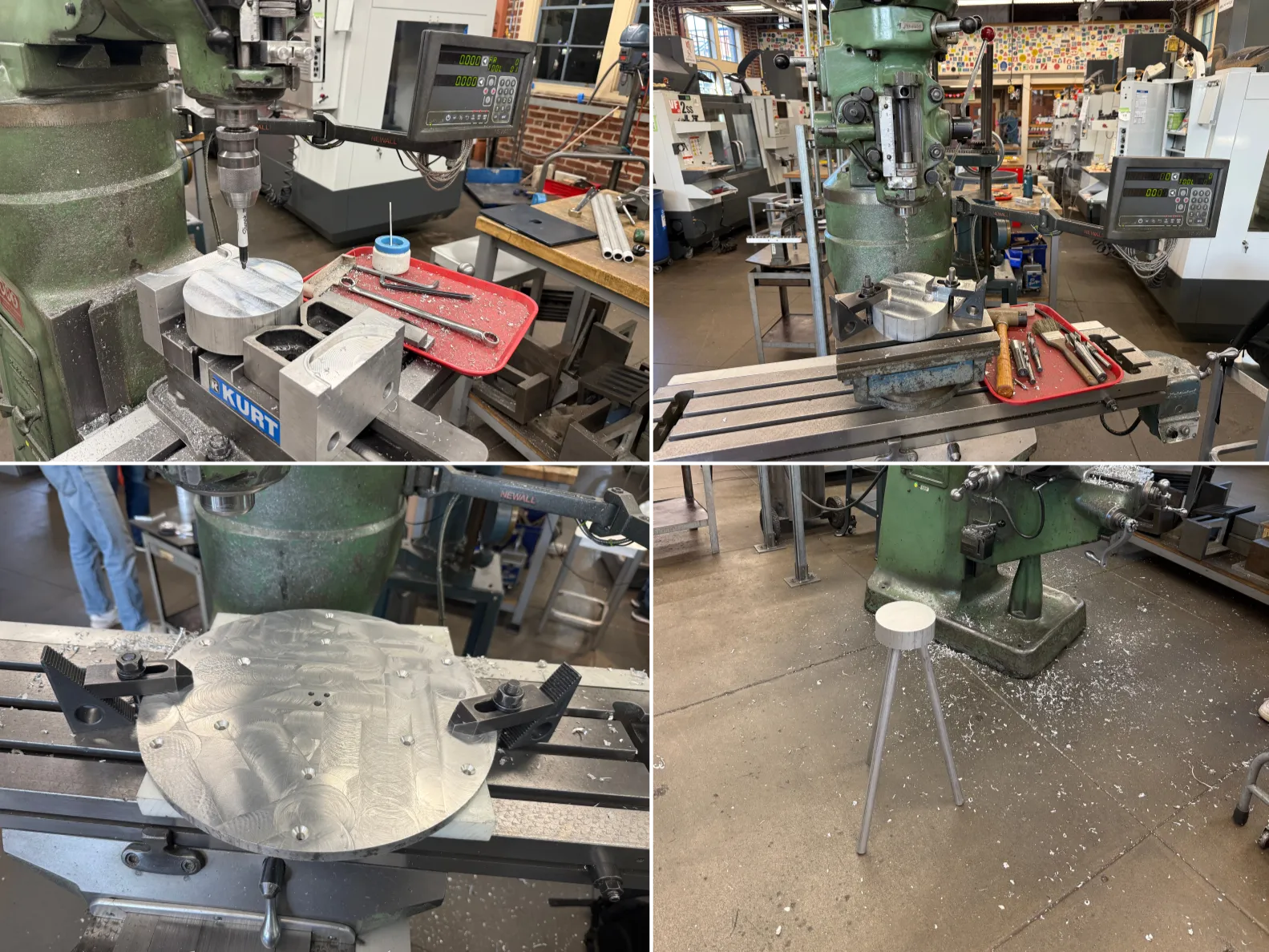
Offloading the complexity from the legs means it has to go somewhere, and that’s here. How do you drill and tap 1“ holes on the mill at an angle? I first tried the indexing head—which can tilt and rotate—but found that it couldn’t hold anything near big enough. I thought of the rotary table, but quickly realized that having to adjust the fixturing of the piece after rotating it would negate the consistency of its rotation. And all this was after I had split the mount and plate into two parts from my original design in order to make it easier to work with!
I decided that all my pondering was holding me back from actually getting my hands dirty: I mounted a sharpie in the mill, drew out the centers of the holes on the flat plane, and then moved the part to a 15° tilt table and eyeballed the rotation. Drilling each hole required a sequence of seven different tools to properly drill and tap. Ultimately this worked.
Plate
This enormous disk marries the legs to the rest of the seat. It has two sets of through-holes: three in the center which attach it to the mount and twelve around the perimeter for the six statues. These sets are countersunk in opposite directions. The central three holes were smooth going, but working on the outer rings I quickly became familiar with the range of motion of our mills—slightly over 11 inches, which becomes even smaller when you factor in the overhang of the 14 inch disk itself interfering with the movement. This was a problem.
You may begin to sense a theme here: I returned to my trusty eyeballing strategy, calculating the coordinates of each holes, carefully keeping half of the circle in-bounds, and then performing one risky rotation to make the second set of six. I employed a clear, laser-cut jig on this step to aid the accuracy of my rotation and get all 12 holes aligned. Sensing another theme, this worked quite well.
Statues
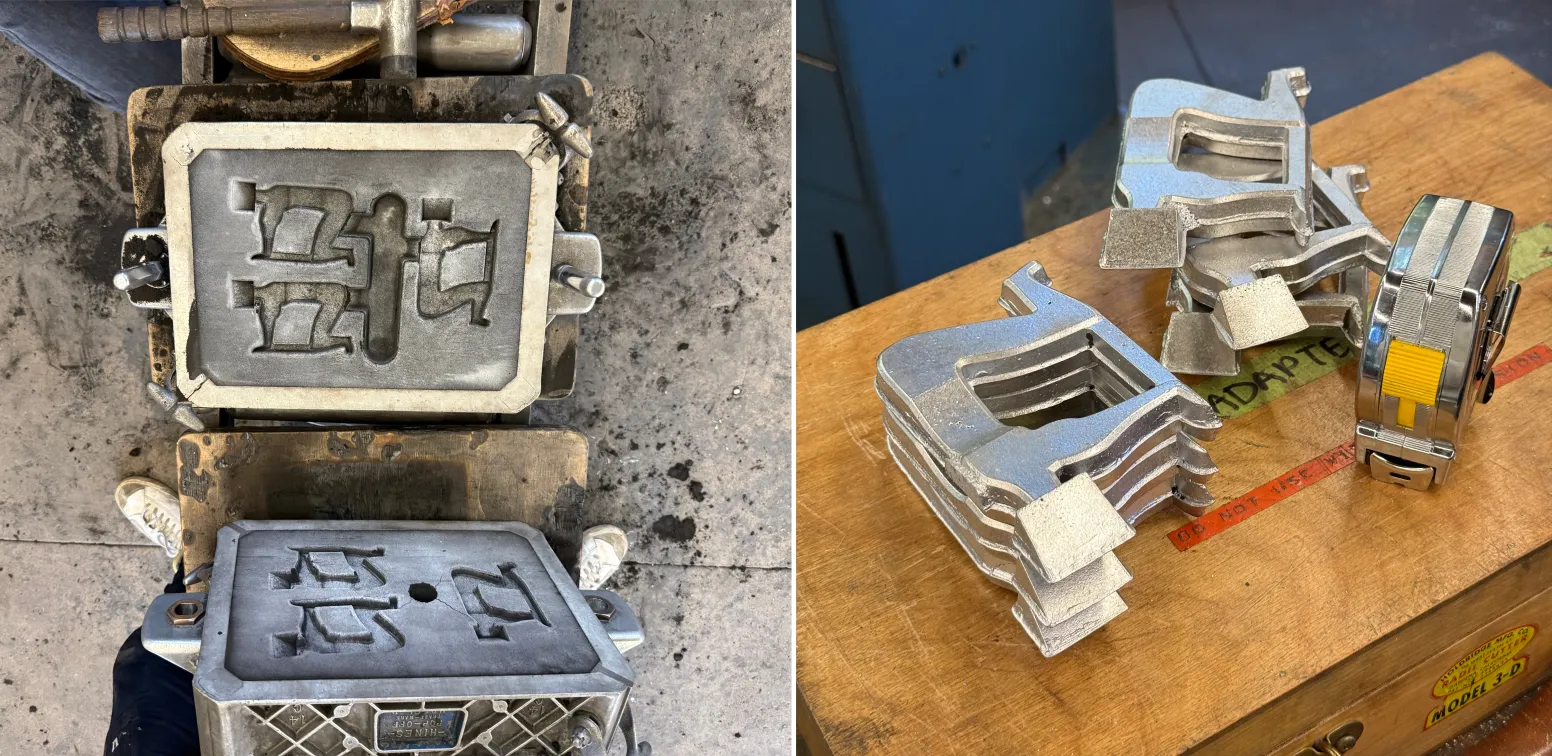
Inspired by Atlas, the videogame Necropolis, and Art Deco style, these human figures are the crux of the stool’s humor. Lying on their back, pushing up against you with braced arms and legs, one must imagine their job as at least somewhat unpleasant. Similarly, making them I had to leave my favorite CAD program behind (it lacked a drafting feature) in favor of the more feature complete but thoroughly unpleasant Fusion.
I ended up casting three times, starting first with a single test part before upgrading to a family of three statues per pour. Filing and polishing them was the worst thing ever, so I forced Vivek to help me, and now they look nice and contrast beautifully with the darker colors of the stool.
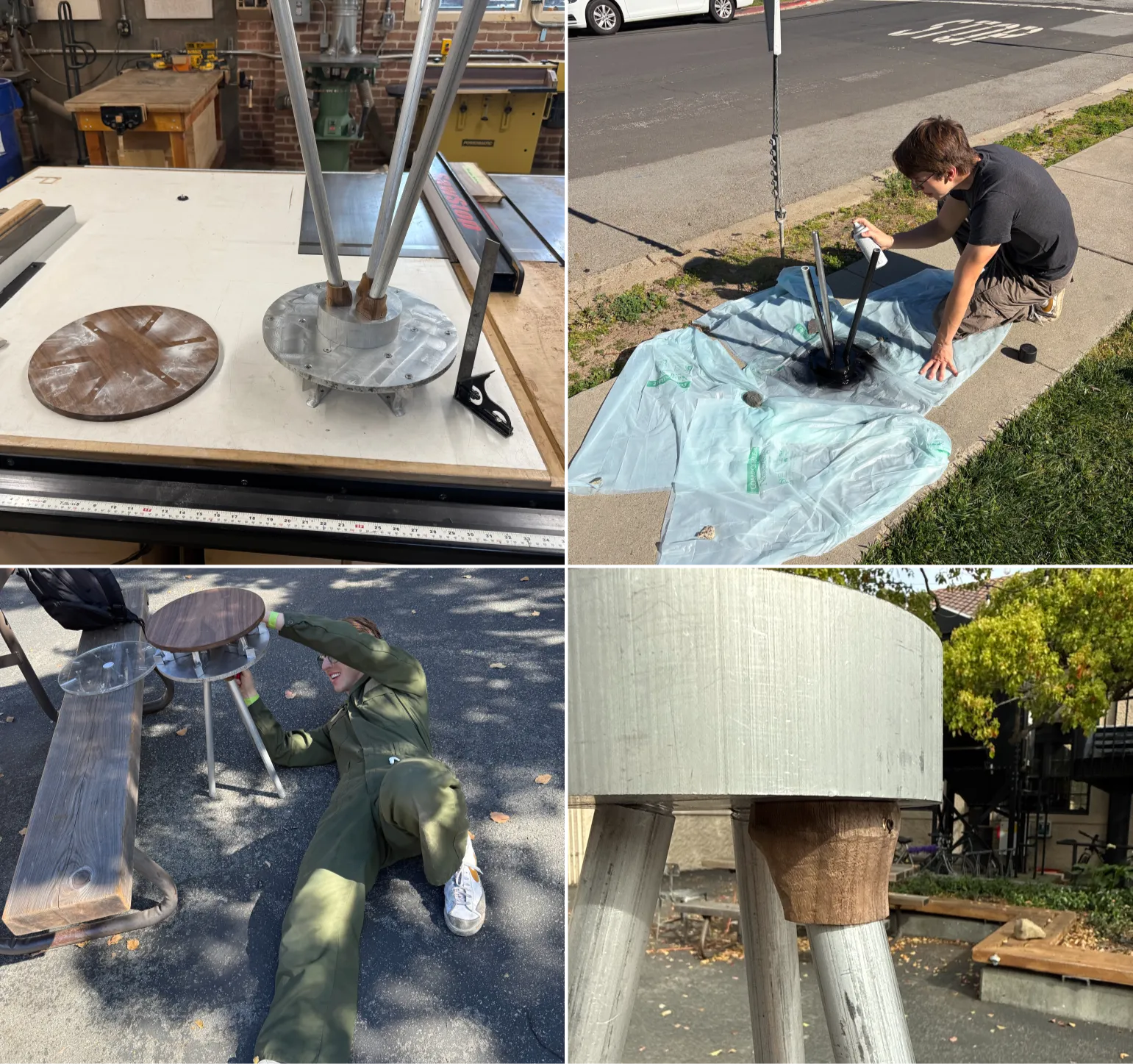
After all this machining, I could see the finish line. I whittled three covers for the leg joints, to give them more substance, and fixed them in place against the legs with set screws. I planed down a seat from the same enormous walnut board, and set six threaded inserts in it to fix it on top of the statues. I became best friends with an orbital sander—thanks Sam PW for that—before whipping out my trusty spray paint to turn the polished aluminum matte black. And, all of a sudden, it was done.
I’ve come away from my late nights and early mornings in the PRL with a tremendous amount of technical knowledge and an intuition for working with metal to make professional hardware. But the true purpose of ME103 is to get you to work on one totally unmanufacturable project so that you get all your mistakes out of the way and never send a machinist something ridiculous in the real world. I am happy to report that in this regard I was beyond successful: I got a profound number of mistakes out of the way over the course of this project. You’re welcome, machinists.
All the time I spent creating could really be divided into two categories: exploration and implementation. Any time I approached a process to realize an idea, the first time around was long and arduous—and then repeating it to make additional components was quick and easy. Further, I would make many, many mistakes in the exploration phase. On its face, this may seem like an endorsement of the prevailing idea that ideas matter more than implementation: if I could only start with the right idea, I would skip the hard part of messing up repeatedly first. But I think this experience goes to show the exact opposite. At the highest level, my idea was simply to build a stool. I could only come up with the right sequence of “good ideas” to make that happen through the feedback I got attempting my implementation over and over again. My “mistakes” guided my solutions. Letting the process guide you, as such, is a sort of humanity and craft that I hope to bring to products I have a hand in long after I am no longer turning the wheels on the mill myself.
I have never worked as hard as I worked on ME163* ever in my life. The stress alone has taken years off my life, and that’s not even factoring in the grease and aluminum shavings I’ve eaten. I was alone with my thoughts machining, working out of a greasy paper notebook. And I made something from nothing. Now it lives happily in my dorm room.