See also ACX meetup groups’ ballot guides to Atlanta, Austin, Boston, the North Carolina Research Triangle, and San Francisco.
And effective altruist movement leadership tells me that their strongest opinion this year is to vote Scott Wiener for Congress in San Francisco. Wiener is a leader in AI safety and YIMBYism, and the California politics insiders I’ve talked to have been impressed by his intelligence, drive, and performance in Sacramento.
Here’s how I’m voting (Oakland, Alameda County, California):
Supporters claim it will build (or renovate) 40,000 homes; I asked an AI superforecaster1 to predict the true number, and it guessed that 22,000 would actually get built. That implies a cost of $500K per home, which would then be supplemented by state, local, and market funding for a total of $700K+ per affordable home. This is bad, albeit typical for California. Other things that turn me against this:
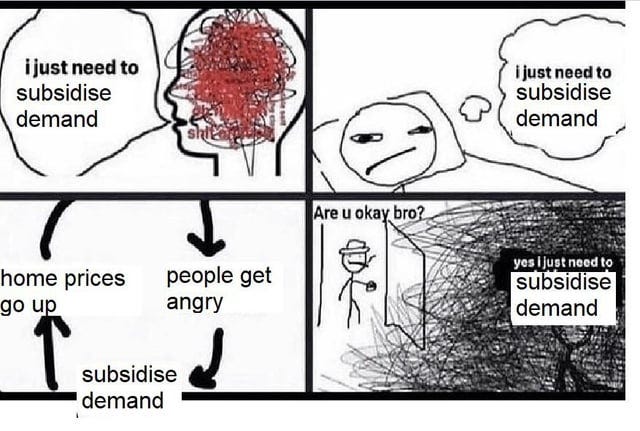
~5-10% will be spent on subsidizing demand, which will just drive up prices for everyone else.
~25% of the new homes are earmarked for specific groups like students, veterans, farm workers, and Native Americans, although this might not matter, since housing is fungible and those people will leave other houses that will then be available to the general public.
There are concerns that the government-sponsored-affordable-housing industry sometimes lobbies against market rate housing because it reduces the demand for government-sponsored affordable homes.
The AI superforecaster says that this would only decrease the cost of market-rate housing in California by 0.4%.
On the other hand, this is endorsed by CA YIMBY, YIMBY Action, and most other YIMBY groups, because we do need more housing. They claim this proposition is relatively well-designed by the low standards of California housing-related laws.
So it comes down to - given that California genuinely needs more homes, do we accept a standard California-style solution that gets those homes stupidly and expensively, or do we let the problem get worse in the hopes that maybe something magically changes later?
I weakly vote NO.
California makes much of its money by taxing the rich. The rich get much of their money from capital gains, which are high during booms and low during crashes. In 2014, California instituted a policy of saving money during booms that they could spend during the crashes, and this has gone well. But the original law was poorly designed and prevents the legislature from saving more than a certain amount, which was too low. Now they want permission to save a higher amount.
This seems like a rare bright spot of fiscal prudence. The opponents are mainly tax watchdogs who hope that if they make it harder for California to save money, California will have to give the money back to the taxpayers, which seems too galaxy-brained and irresponsible.
I vote YES.
They say nothing is as permanent as a temporary tax increase, and in 2012, California voted for a temporary tax increase on wealthy people. It expires in 2030, and oops, now our entire budget depends on it and if we ever got rid of it then the schools would crumble into dust and the health system would be entirely replaced by witch doctors and shamans.
I do feel sorry for California’s budgetary officials, because our proposition system is constantly banning various categories of tax, and then they have to make up for it with other, sneakier categories of tax, including temporary taxes that become permanent. I believe everyone who says this would be devastating for education and health care if this were were allowed to expire. And honestly, I’m just happy to get a proposition that technically doesn’t put a new tax on me.
I weakly vote YES.
California banned this practice in 1988, although the ban didn’t apply to a certain type of city called “charter cities” (not the same thing as Prospera-style charter cities) which includes Los Angeles, San Francisco, and Oakland.
In the public funding model, candidates who get a certain number of small donors are eligible for public support for their campaigns, usually in the four-to-six digit dollar range. This supposedly makes it easier for ordinary people to compete with machine-backed candidates and billionaires. Opponents argue that taxpayers should not be forced to subsidize candidates they disagree with, and that these programs often become corrupt. Some considerations on this proposition:
It would probably cost about $75 million in extra local taxes, though not for me (Oakland already has this policy, so nothing would change).
It doesn’t invoke the state’s ethics watchdog, which would be the usual enforcer, strengthening concerns about local corruption. The San Francisco Chronicle opposes it on this basis.
Studies suggest that public financing programs like these cause more candidates to enter, but that these additional candidates don’t win. There is no evidence that they make the incumbent win less, or reduce donor power.
The main study which does find a change in winning candidates finds that it makes candidates more ideologically extreme, although other studies disagree.
Cities like Los Angeles, San Francisco, and Oakland which currently have this policy under the charter city exemption don’t seem to be noticeably better.
The main countervailing consideration is that I don’t like when the state bans cities from trying things.
I weakly vote NO.
A recall election is like an impeachment by the voters. If enough voters sign a petition, there’s a special election where we vote to get rid of an official (most often the governor). This special election also includes a list of candidates for who replaces him if he does get recalled.
Proposition 5 would keep the recall vote, but instead of a simultaneous vote to replace the official, the official would be replaced according to normal procedure: a recalled governor would be replaced by the lieutenant governor, other major officials would be picked by the governor, and legislators would be replaced in a special election.
The current recall system tends toward the following annoying equilibrium: every election, California picks a mildly corrupt pro-dysfunctional-establishment Democrat; a year later, the Republicans object that the candidate is mildly corrupt and in bed with the dysfunctional establishment, and gather enough signatures to hold a recall election; a year after that, the election happens, everyone spends millions of dollars sending billions of spam email messages, and then it fails, because the electorate just got done electing the governor and hasn’t magically changed its mind.
This proposition might break the cycle: if the Republicans know with certainty that the mildly-corrupt-pro-establishment Democratic governor will just be replaced by the mildly-corrupt-pro-establishment Democratic lieutenant governor, maybe they’ll stop trying this. And it preserves the useful part of the recall system: if the governor ever crosses the line into being so crooked that people would genuinely prefer the mildly-corrupt-pro-establishment Democratic lieutenant governor, we can still recall him.
The main argument against is in the San Francisco Chronicle: Proposition 5 Has A Flaw So Bizarre Even Its Author Doesn’t Like It. The flaw is that it says that the recalled legislator can run in the special election to replace themselves.
This is particularly egregious because incumbents fighting recall attempts can generally raise unlimited funds through donors. Although state law prohibits that money from being used for other campaigns, a recalled official in a special election is unlikely to forget whatever limitless support they received from wealthy special interests.
According to the Chronicle, “[Proposition author Senator Josh] Newman himself couldn’t explain why Prop 5 contains that provision. ‘I’m honestly not sure,’ he said.”
I don’t have a strong opinion on this, so I will trust the Chronicle. I weakly vote NO.
I vote NO.
The great thing about California is that it’s not just a state where a few big special interests can money-pump the public. Anyone, no matter how small or humble, if they try hard and believe in themselves, can become a special interest that money-pumps the public.
Proposition 38 gives $8.4 billion of taxpayer money to immunology research, especially institutes that meet a list of qualifications. Only one institute meets the qualifications, and it’s the linked to the people backing this proposition. I see nothing else special about this research institute, and although immunology research in general is good, it’s not notably better than other good things that need money.
I strongly vote NO.
This is part of the national discussion about voter ID requirements. It mandates that California in-person voters show an ID, and that mail-in voters include the last four digits of an ID number (for example, Social Security).
There is generally little voter fraud in California elections. But this isn’t a law of nature: the last widely-agreed fraudulent US Congressional election was in 2018 (although it was discovered and the result was annulled), and part of the reason that elections are so clean is that past generations took fraud risk seriously. 36 US states and most other developed countries request or require an ID to vote, this is standard, and not doing so feels a little like refusing to lock your door because you’ve heard there isn’t much crime in your area. Election integrity worries many people, I don’t think they’re all operating in bad faith, and I’d like to give them fewer things to potentially start a civil war about.
I appreciate that some people are bad at getting IDs, but these people are presumably already locked out of driving, getting alcohol, buying guns, most banking, and all other ID-requiring activities. We’ve decided that keeping these things secure is important enough that it’s worth inconveniencing people who are bad at getting IDs, and I don’t think voting security is any less important.
Prop 39 opponents additionally argue that the proposition is bad insofar as it creates a “private right of action” - that is, private citizens can sue if they think their county isn’t complying with this, and maybe this would choke the court with frivolous lawsuits. Supporters argue that in a Democrat-controlled state like California, the election officials are never going to enforce this, so they need a way for someone else to do it. I asked the AI superforecaster how many groundless lawsuits it expected from this proposition (defined as “lawsuits that got dismissed”). It answered a median of 3, 90th percentile estimate of 8.
I weakly vote YES.
This is the best-known and most hotly-contested initiative this cycle. It imposes a “one-time” 5% wealth tax on billionaires to fund state programs, mostly health care. Celebrity left-wing economist Gabriel Zucman supports. Opponents say that nothing is as repetitive as a one-time wealth tax, that it distorts the economy by forcing founders to prematurely sell stakes in their companies, that it will make billionaires leave California, and that it’s a particularly egregious case of using private citizens as a piggy bank for randomly-selected nice-sounding causes. It’s also sponsored by the SEIU, which is notorious for sponsoring ballot initiatives to extort groups they don’t like.
I asked the AI superforecaster to predict the outcome. They said that it would produce about $60 billion in one-time revenues and make enough billionaires move away to decrease the state’s permanent tax base by $2 billion yearly, and that if it passed there was a 33% chance of another wealth tax passing by 2046.
These numbers are about midway between boosters’ claims and opponents’, but based on the arguments in the first paragraph and at the linked post, I still vote NO.
Voters like new taxes on billionaires, but hate new taxes on themselves. So a group of billionaires unhappy about the Proposition 40 billionaire wealth tax above figured they could write a proposition that sounds like it’s banning taxes in general - maybe even some especially dangerous and irresponsible form of taxes - but is mostly just banning Proposition 40. You don’t need to know what the Gann limit is except that Proposition 40 ignores it, and ignoring it sounds bad.
According to California law, if two mutually contradictory propositions pass during the same election cycle, whichever gets the most votes wins out. So if the voters who think that “taxes which ignore the Gann limit” sounds sinister outnumber the voters who think that “let’s seize the billionaires’ money” sounds fun, the wealth tax fails. Hooray for democracy!
I’m against the wealth tax, but this is kind of scummy. I weakly vote NO.
Just in case Proposition 41 didn’t work, they also sponsored Proposition 42, another one which secretly sinks the wealth tax. “Retroactive personal property tax” is just another name for a wealth tax. If more voters oppose wealth-taxes-under-another-name than support wealth taxes, the wealth tax measure will fail.
I was more tempted to support this one than Proposition 41, because banning future wealth taxes really does seem like a good idea (one major concern about Proposition 40 is that the specter of a recurring wealth tax, regardless of whether it happens, will drive away rich people and chill economic activity). But it turns out this doesn’t work; future California voters can always repeal propositions passed by past California voters with a 50% + 1 majority, so new wealth taxes will face no electoral hurdle. All this will do is cancel the Proposition 40 wealth tax from this current election.
I weakly vote NO.
Part of the eternal war between Californians voting for new taxes and Californians trying to ban themselves from voting for new taxes.
Although California does vote for too many new taxes, this law is an imposition of state power over local electorates, plus I will be voting for some of these ad hoc local taxes in this election (see Measure RTM), so it would be hypocritical of me to ban this.
I vote NO.
This one is this election cycle’s SEIU extortion attempt.
If you haven’t been following along, the SEIU-UHW is a California union infamous for demanding that people give them money and concessions, then, if they don’t, sponsoring ballot propositions that would destroy their business.
This time around, they demanded some loot from community health clinics, those clinics didn’t cave, and the result was this proposition.
I strongly vote NO.
This is the most YIMBY measure on this ballot, maybe the most YIMBY measure of the decade. It would significantly reduce the power of CEQA, one of the environmental review regulations that delays construction projects and new housing across California.
Most of the YIMBY groups I previously trusted, including CA YIMBY and YIMBY Action, have declined to take a position on this measure - which is shocking, since it’s far more aligned with the YIMBY spirit than the spend-taxpayer-money-on-affordable-housing proposition that they endorsed. The only explanation I can find is that this permitting reform would also make it easier to build suburbs and roads, and institutional YIMBYs can’t decide whether they hate suburbs and roads more than they like housing. I hope this isn’t the real reason, as it would significantly lower my respect for these groups and decrease my trust in their recommendations going forward.
I strongly vote YES.
I’ll be copying some of these from my discussion of the same races on my primary ballot.
As effective altruists, we are called to care for all creatures, from slimy shrimp to bodiless AIs, and so we may - perhaps - try to cultivate a tiny measure of compassion for California politicians. They face the near-impossible task of governing a state whose residents are allowed to kneecap them however they want through a bonkers ballot proposition system. If they try to build houses, a thousand local NIMBY groups will rise up to thwart them; if they don’t, the voters will kick them out for letting housing become unaffordable. If they tolerate homeless people and criminals, the voters will remove them for failing to prioritize public order; if they don’t tolerate them, the voters will remove them for cruelty and unfairness.
Having given them this small measure of sympathy, we can admit that Californian politicians mostly fail to live up to even the very low baseline we can fairly expect from them. They spend most of their effort maintaining a money spigot going to labor unions, prison guard unions, teachers unions, big donors, and anyone else whose support is necessary for their re-election.
Re-electing Democrats perpetuates this system and makes one complicit in it. If the Californian Republican Party took advantage of the situation by nominating moderates who disaffected Democrats can vote for with good conscience, all would be well. Instead, the average Republican challenger is mostly interested in bootlicking Trump as hard as possible, Stopping The Steal (as if we’re one election integrity law away from the GOP taking California!), and spreading various lies and conspiracy theories. They are against the infinite-money-spigot only insofar as they regret that it goes to Democratic donors and not to Big Agriculture, Big Oil, and other groups more prone to vote Republican.
Granting that this is the general schema, I will try to vote for the lesser of two evils in any individual race. But a lesser evil in the governor’s race is hard to find; Becerra is the perfect model of the captive Democrat politician who will never change anything, and Hilton the perfect model of the conspiracist slopulist Republican.
I can only ABSTAIN.
Fiona Ma is probably a replacement-level Democrat. She has some pretty bad scandals, but her non-scandal work seems slightly more competent than usual.
Gloria Romero is probably a replacement-level Republican. Her favorite conspiracy theory is a claim that Becerra ran secret Democrat child migrant abuse camps - I looked into this, and she was talking about the shelters for unaccompanied immigrant children that Xavier Becerra presided over when he was Biden’s HHS secretary. A watchdog said that some mandatory safety evaluations were never done, but there is no evidence that these missed evaluations resulted in actual abuse. She also likes conspiracy theories about voter fraud in the primaries.
But the SF meetup group discovered that one of the Lieutenant Governor’s few meaningful responsibilities is setting certain University of California policies, and Romero wants to bring back the SAT and Ma has no opinion. I will grudgingly vote GLORIA ROMERO.
This person oversees elections.
The incumbent, Shirley Weber, is an above-replacement Democrat who is generally regarded as having done a good job. She is most famous for refusing to let Gavin Newsom put “Democrat” next to his name on the ballot because he forgot to file the relevant form.
The challenger, Don Wagner, is an above-replacement Republican who specifically says that he doesn’t believe California’s elections are rigged.
Since both are above replacement level, I ought to abstain, but this is the office where I’m most willing to be partisan; I want someone who I can be sure won’t participate in any Trump election shenanigans.
I vote SHIRLEY WEBER.
The Controller is a sort of chief accountant. The incumbent is Malia Cohen, a replacement-level Democrat; California is not very well-audited and has lots of fraud, but this long predates Cohen. The challenger is Herb Morgan, a Republican who wants to fight fraud, put California financial records on the blockchain, and establish a “California DOGE”.
California probably does have a lot of fraud-adjacent things, and Cohen has been lukewarm in dealing with them. But I think the lesson of the past few years is that when Republicans talk about cutting fraud, they don’t have the patience, intelligence, or impulse-control to actually find the real complicated fraud-adjacent things going on, and will instead pillage random government departments in ways that make everything worse off. The fact that Morgan thinks of DOGE as a success to be emulated makes it clear that he plans to succumb to this failure mode, so despite my fondness for his out-of-left-field everything-on-the-blockchain plan, I vote MALIA COHEN.
Elena Kounalakis is a replacement-level insider Democrat who was last term’s Lieutenant Governor and seems to be bouncing around random state offices. According to Wikipedia, the most notable facts about her political career are that she tried to prevent Donald Trump from being on California ballots, attempted to vote down a new UC dorm, and sent an unusual number of spam texts to voters.
Jennifer Hawks is a Silicon Valley Republican who manages to have an entire campaign site which does not mention Donald Trump or any trivially-false conspiracy theory a single time. This is enough to declare her above replacement level. I am disappointed she didn’t claim to be “a fiscal hawk”, but there’s still time.
I vote JENNIFER HAWKS.
Rob Bonta is the Democratic incumbent. He is a deeply annoying person who is way too into the culture war, and a committed YIMBY. He’s not naturally tough on crime, but is capable of noticing which way the wind is blowing and acting tough when crime gets unpopular enough.
Michael Gates is the Republican challenger. He is a deeply annoying person who is way too into the culture war, and a committed NIMBY. He seems genuinely tough on crime. The Orange County Register claims he got fired from the Trump Justice Department for creating a hostile work environment for women, and I can only imagine how hostile a work environment for women you need to create to get fired by the Trump administration (Gates seems to deny this).
I vote ROB BONTA.
Both candidates are Democrats, but Ben Allen is a what-passes-for-moderate-in-California state senator, and Jane Kim is a Bernie-Sanders-backed outsider . Allen is mostly notable for being an environmentalist, which might be the opposite of what we want in an insurance commissioner (in California, this mostly means figuring out how to compensate victims of wildfires, and the environmentalists tend to be soft on wildfires because they object to some types of brush-clearing). But Kim wants to end private insurance and have the whole thing done by the state, which opponents say probably won’t work and will end in regular taxpayer bailouts.
CA YIMBY endorses Allen, which agrees with my prior against Sanders-backed socialists, and I see no reason to dissent from them here.
I vote BEN ALLEN.
This is some sort of property-tax-related body that kept getting into scandals and had most of its power taken away from it. Now it has a tiny sliver of vaguely-property-tax-related jobs. The San Francisco Chronicle has endorsed John Pimentel for his promise that if he gets the portfolio, he will work to abolish it entirely and save us from an eternity of voting on this moribund position.
I vote JOHN PIMENTEL.
The candidates who advanced from the primary are Richard Barrera and Sonja Shaw. On my notes from the primary, I glossed Barrera as “teachers’ union stooge”, and Shaw as “single issue anti-transgender activist”.
I’m in a group chat with some neighbors who ran a mini-straw-poll on this one: they asked their 8-year-old transgender daughter “Would you rather not be able to learn anything, or have to use the boys’ bathroom?” She was apparently a bit taken aback by the question and didn’t give us any extra information.
But either I was being unfair, or else both candidates have moderated after making it to the general. Barrera now touts his work cutting waste, raising test scores, and helping charter schools. And Shaw has discovered some other issues, like how all of California’s schools are dysfunctional and maybe we should change that.
I’m not sure whose claims of having moderated I should believe, so I will ABSTAIN.
California requires voters to approve associate justices continuing their terms every twelve years. Tradition says that we approve unless one of them has committed some specific scandal, which they haven’t. I approved all of these.
This imposes an additional 0.5% sales tax to fund transit - especially Bay Area Rapid Transit, the local commuter rail system.
During the pandemic, people stopped using mass transit (maybe because they switched to work-from-home) and ridership numbers have never bounced back. The federal government gave BART some emergency pandemic funding for a while, but now that’s running out, and they say they either need to raise taxes or drastically reduce services.
When investigating this, I learned that fares cover only 10 - 25% of BART operating costs (depending on how you define it); the remaining 75 - 90% are government subsidies. I’m not against the government helping some poor people afford commuter rail, or even subsidizing tickets a few percent to help close a small funding gap. But if the government has to pay 75% of the cost, this suggests commuter rail just isn’t a competitive form of transportation, and we should stop throwing more money at it.
On the other hand, supporters argue that if we let the BART fail, then traffic on local roads would get much worse - for example, a trip across the Bay Bridge, already unpleasant, might take twice as long. I asked the AI superforecaster to check this, and it guessed about 50% longer - from 23 to 34 minutes.
You could build this into a reasonable case for BART subsidies. For systemic reasons, the Bay Area doesn’t have enough roads for all the people who want to drive. Therefore, we should get some people to ride commuter rail instead, as this produces a positive externality for everyone else. But people don’t want to do this at market price, because it’s a terrible experience. Therefore, we should keep increasing the subsidies until enough people agree to take one for the team and ride the train that the roads are clear for the rest of us.
Our first priority should be addressing the reasons that the BART is a terrible experience. These include people playing loud music on the train, people stealing stuff on the train, the stations being full of trash/crime/loud music/the smell of drugs, and a lack of parking near the stations. The government has been taking some halting steps toward improving some of these things recently, especially with the new fare gates. More to the point, I don’t expect that voting down this measure will make any of these improvements happen faster, so we’ll just get a collapse of the BART system and longer commutes.
I weakly vote YES.
US city governments can be divided into two types. The first type, “council-manager” systems, are like a corporation - the elected city council, playing the role of the board of directors, hires an unelected CEO-like city manager to make most day-to-day decisions. The other, “strong mayor” systems, are like a traditional democratic government; the elected mayor is the chief executive and makes most day-to-day decisions.
Oakland used to be a council-manager system. In 1998, voters approved a measure that shifted it halfway to a strong mayor system, leaving it in an awkward limbo that satisfied nobody. This measure would move it all the way to a strong mayor system.
In favor of this, a recent 750-person group which was convened to fix the city’s charter recommended this measure unanimously. On the other hand, that group was convened by the mayor, so maybe there was a conflict of interest; on the other-other hand, some nonpartisan groups assisted with the group and concur. My city council member, Zac Unger, who I like, opposes this measure, but, again, conflict of interest.
Supporters say that it makes it clear who is “accountable” for the city’s failures. Opponents say that Oakland mayors are often terrible (for example, the last elected mayor was raided by the FBI, recalled by voters, and is currently on trial for bribery), and making them all-powerful just makes things worse.
There’s some research on the advantages of strong mayor vs. council-manager cities, but none of it applies to Oakland, which is currently an unusual hybrid. I asked the AI superforecaster to estimate the size of Oakland’s budget deficit (as a proxy for good government) if this measure passed vs. failed; it said the deficit would be 3% lower if it passed.
I don’t have much to go on, and will work off a prior that keeping things in limbo is bad, a hope that the 750-person group knows more than I do, and the AI superforecaster results.
I weakly vote YES.
Oakland has a big budget deficit, but voters hate taxes, so the city is constantly searching for weird taxes that will raise money without affecting any normal person or legible special interest.
Measure FF taxes property transfers via foreclosure the same as every other property transfer. Originally, this was taxed less, because the theory was that a foreclosure was just a bank taking back a house which it technically owned anyway, after its plan to loan that house to a mortgage-holder had failed. Supporters of this policy say that nowadays, banks usually sell the right to foreclose on houses to big institutional investors, so this is more like a normal property transfer. If a small bank is really foreclosing on a house it really owns, then the exemption will stay in effect.
I feel like my city officials are really fulfilling the mandate that I and fellow voters have given them of instituting taxes which are so arcane that I can’t understand them well enough to object. I vote YES.
During the primary, I recommended voting for the boring replacement-level Democrat incumbent, Lateefah Simon, on the grounds that the challenger, Jamie Joyce, had no chance of winning and seemed eccentric. Both candidates advanced to the general.
Ms. Joyce turned out to be an ACX reader and messaged me about this, and also came to last week’s meetup, where she discussed some interesting work she’d done during her campaign. I don’t think her chances of winning have improved, and reading this blog is hardly a defense against allegations of eccentricity, but I can’t in good conscience vote against an ACX meetup attendee. I vote JAMIE JOYCE.
The incumbent is Buffy Wicks. She is smart, moderate, and very YIMBY. It is shocking that a district which includes Berkeley and Oakland elected someone this good, and I don’t want to jinx it.
The challenger, Mark Rendon, is a retired music teacher running on the Green Party ticket, with about the platform you would expect, although I appreciate him having the bullet point “AI safety and ethics” with no further clarification in his priorities list.
I vote BUFFY WICKS.
Barbara Lee is the incumbent. She is a typical California Democrat, but hasn’t been indicted for any specific crimes yet, which is a breath of fresh air in an Oakland mayor. Crime by non-mayors is also down significantly during her tenure, although this mirrors national trends and it’s unclear how much credit she deserves. She’s in favor of the major YIMBY policies affecting Oakland. Everyone relevant endorses her (probably because she will obviously win, so it’s important to stay on her good side). None of the three challengers especially stand out.
I vote BARBARA LEE.
I used AI extensively to help me research these questions. Could I cut out the middleman and ask my AI to determine how I should vote?
I asked it to predict my votes on the propositions, using its background knowledge of me only and not any of the questions I had asked about them. It had an accuracy of only 57% (it was wrong about 1, 3, 4, 5, 39, and 41). To be fair, it was wrong on the ones where I had the weakest opinions, and it expressed low confidence on most of them - but it doesn’t seem ready for handover just yet.