T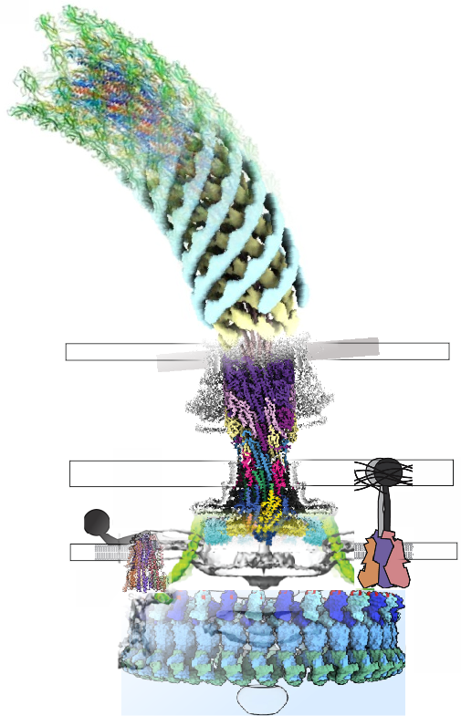 he bacterial flagellar motor is a rotary molecular engine powered by the flow of ions across the inner, or cytoplasmic, membrane of a bacterial cell envelope. Each motor drives a protruding helical filament, and the rotating filaments provide the propulsive force for cells to swim. The flagellar motor is perhaps the best studied of all large molecular machines. The image on this page is a composite of structures, obtained mostly by cryo electron microscopy, mostly published in 2020 and 2021.
These structures - along with the latest advances in our lab in optical measurement of live, working, single motors - will help us to understand in detail how the flagellar motor works.
Filaments rotate at 100s of revs per second in swimming cells. The rotor is the heart of the motor: a set of rings in the cytoplasmic membrane, about 45 nm in diameter, and containing a total of a few hundred molecules of several different proteins. This is surrounded by a ring of independent torque generators which are anchored to the cell wall and consist of the proteins MotA and MotB. There is room for at least 11 torque generators in E. coli, maybe as many as 16 in other species.