An extremely performant, batteries-included Rust web framework built around a new programming model for composable, multi-target rendering.
One object. Every render target.
HTML, Markdown, and other render targets, from one typed component.
ProductCard::new(product)impl<L: DataLoader> MdRenderSync<L> for ProductCard {
fn render_md(self, cx: &mut WebContext<L>) -> Result<(), WriteError> {
md_sync! { r###"
# {self.product.name}
{Link::new("Buy now", self.product.url)}
"###
}
.render_md(cx)
}
}md_sync! { r###"
[{self.label}]({self.href})
"###
}impl<L: DataLoader> WebRenderSync<L> for ProductCard {
fn render(self, cx: &mut WebContext<L>) -> Result<(), WriteError> {
html_sync! {
<article data-product-card>
<h2>{self.product.name}</h2>
{Link::new("Buy now", self.product.url)}
</article>
}
.render(cx)
}
}html_sync! {
<a href={self.href} data-link>
{self.label}
</a>
}Build fast, information-dense apps.
Explore re-creations of GitHub, Sentry, and Airbnb, built in Proa with fast server rendering and selective interactivity.
CodeIssues5k+Pull requests1.9kActionsSecurityInsights
[tracking] Zig/C++ fork: Rust->Zig port progress #31136
ClosedMaurerAntonwants to merge 8 commits intooven-sh:main
Conversation9Commits8Checks1Files changed16+461-10
src/install/PackageManager/PackageJSONEditor.zig+3-1
@@ -459,7 +459,9 @@ pub fn edit(
459459 }
460460 break;
462- if (request.version.tag == .github or request.version.tag == .git) {
462+ if (request.e_string == null and !request.is_aliased and
463+ (request.version.tag == .github or request.version.tag == .git or request.version.tag == .tarball))
463465 for (query.expr.data.e_object.properties.slice()) |item| {
5.56 ms
React renderToString p50
Warm production p50s measured on an 8-vCPU AMD EPYC-Milan VPS.
Independent demos. Not affiliated with or endorsed by GitHub, Sentry, or Airbnb.
The numbers behind the speed.
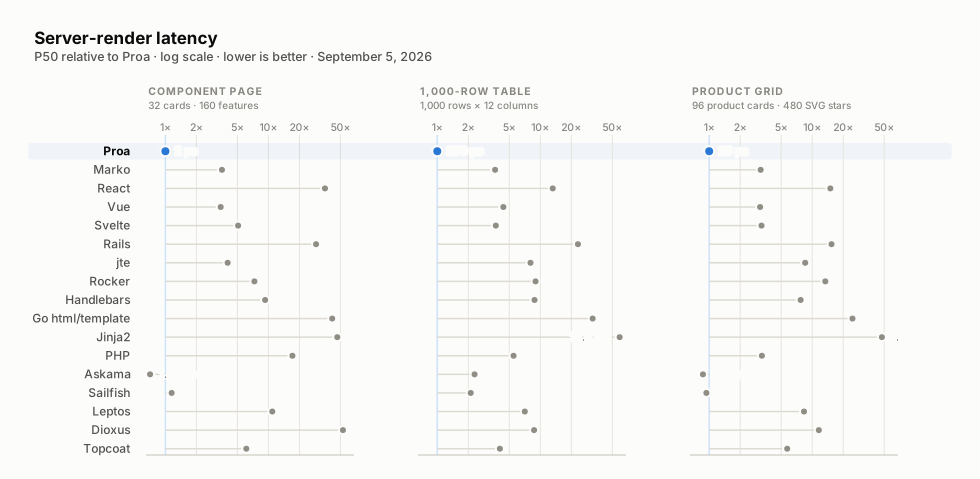
Apple M4 Max · September 2026Scroll horizontally to explore each chart.
Build your design system.
Proa UI offers Shadcn style Proa components. Source in your repo, in typed Rust. Theme it, compose it, ship it.
No. This build opens and closes with radio inputs and CSS alone.
Yes. It follows the WAI-ARIA disclosure pattern.
The source lives in your repo, so yes.
Single or multiple open panels, with a CSS-only build that ships no JavaScript at all.
Invoice Status Amount INV-2041 Paid $1,499.00 INV-2042 Pending $399.00 INV-2043 Paid $399.00 INV-2044 Refunded $399.00 Header, body, footer, and caption parts that compose into dense record views.
Solid, outline, ghost, and link variants across three sizes and three intents.
Used in your deploy URL.
Server render by default
Ship islands only when needed
Labels, descriptions, and error text wired to any control, in either orientation.
Deploy preview
Pushed 2 minutes ago to main.
Built from source in your repo.
Header, content, and footer slots for the surface most product screens are built from.
Single and range selection, month paging, and keyboard navigation, rendered as plain HTML.
Weekly requests36.2k
Area, bar, line, donut, and stacked series drawn as pure SVG on the server.
Grouped one-time-code slots with separators, size variants, and a caret you can style.
ME
You
Can an agent add a settings page to this app?
9:41
AI
Proa
Yes. Every component is typed Rust in your repo, so the compiler checks the edit before it ever reaches a browser.
9:41
ME
You
How much JavaScript does that ship?
9:42
Message bubbles, avatars, timestamps, and typing indicators for assistant surfaces.
html_sync! {
  {Card {
    class: None,
    children: Some(html_sync! {
      {CardTitle { class: None,
        children: Some(row.id) }}
      {CardFooter { class: None,
        children: Some(row.due) }}
    }),
  }}
}
Syntax highlighting done on the server, so no highlighter ships to the browser.
58components, every one with a live example, a props table, and Rust you can copy.
Scroll sideways or use the arrow keys to move through the component demos.
Everything people want from a modern web app, without the render tax underneath it.
A component system and a framework surface, not a templating engine.
Framework
Framework primitives beyond template glue.
Proa keeps streaming, request data, routing, metadata, and response control inside the same typed WebContext as your components.
Streaming SSR, in order or out of order
Flush HTML in document order when sequence matters, or let Suspense boundaries stream ready chunks out of order when slow data should not block the page.
DataLoader-backed WebContext
Every render has typed access to request-scoped data, response metadata, route state, and loader caching through the same WebContext components already receive.
Typed SSR framework semantics
Layouts, routing, metadata, static assets, forms, mutations, and progressive navigation compose through the same Rust component model instead of template glue.
Interactivity
Add interactivity without giving up native SSR.
Keep the page as server-rendered HTML, then opt specific controls into client behavior with typed signals and event handlers. Proa compiles only the moving pieces into JavaScript.
RSJS islands
Use signal(...), bind_value, typed events, and named handlers in Rust. The compiler lowers the client behavior.
Tiny per-island JavaScript
Each hydrated RSJS island emits a small vanilla-JS module plus seed state, served with a shared runtime around 1.3 KB gzipped.
Adoption
Keep the stack you already have. Move one route first.
Go Axum-native for Proa routing and responses, or call Proa over FFI from Node, Go, Python, Ruby, or Java.
Run alongside your existing app
Proxy one route to Proa, leave the rest on Next.js or Rails, then compare latency and cost in production.
Security by default
Auto-escaped output, cross-origin request protection, security headers, and fixed-upstream proxying are part of the framework surface.
Accessibility at compile time
WCAG and WAI-ARIA checks run during cargo build so common markup defects fail before deploy.