People act like the replication crisis has discredited psychology, that the field is now widely agreed to be a sham, that it can be uncontroversially held up as an example of science gone wrong. These statements are often made in the broadest possible terms:
This misunderstands the extent of the problem. The replication crisis primarily affected the sub-field of social psychology, and most centrally the sub-sub-field of social priming research - the study of how seemingly trivial interventions can have outsized effects on behavior.
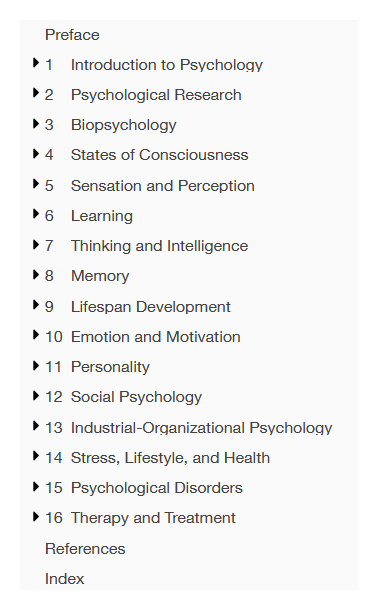
Here’s the table of contents of an online Intro Psychology textbook (OpenStax Psychology, 2nd edition):
Social psychology - which includes social priming, power poses, nudges, stereotype threat, the Stanford Prison experiment, the Wansink portion size study, and everything else you love to hate - is in chapter 12 of 16. The other fifteen chapters are comparatively innocuous. Here are examples of the subheadings you get when you expand some of the chapters above:
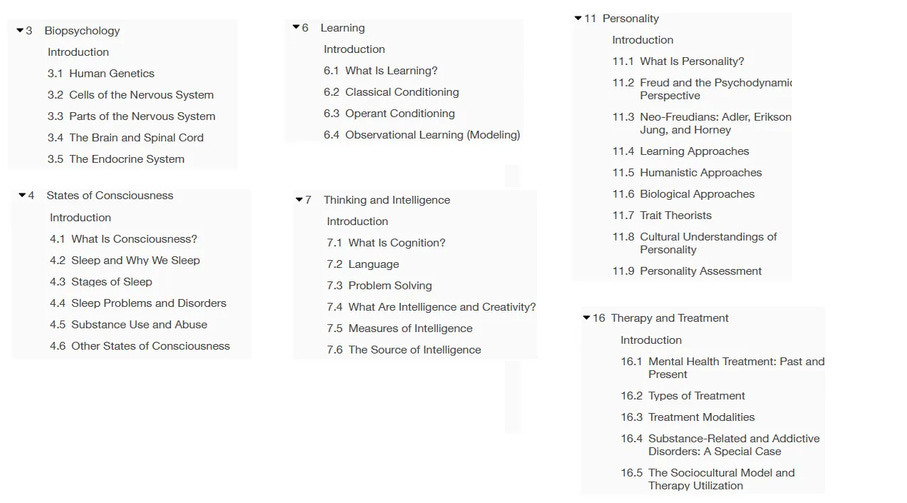
Not all of this is perfect. I don’t think anything that “Neo-Freudians: Adler, Erikson, Jung, and Horney” said has held up very well (although to be fair, a person named “Horney” becoming a neo-Freudian is the sort of thing neo-Freudians would have predicted). But most of it is pretty good. Even “The Sociocultural Model and Therapy Utilization”, which sounds woke and cringe, turns out to be common-sense ideas like reminding would-be therapists that, compared to their usual social circles, a fundamentalist Muslim may have a very different response to learning that he might be gay.
And even Chapter 12 on social psychology isn’t so bad, including discussions of social roles, cultural norms, persuasion, conformity, groupthink, political polarization, ingroups vs. outgroups, and the psychology of love and relationships. It mentions the Kitty Genovese story and the Stanford Prison Experiment, but appropriately caveats them as historically important didactic examples which probably didn’t occur the way they were classically described. Its biggest mistake (from my perspective) is citing stereotype threat (not by name) without any caveats. Social priming is nowhere to be seen.
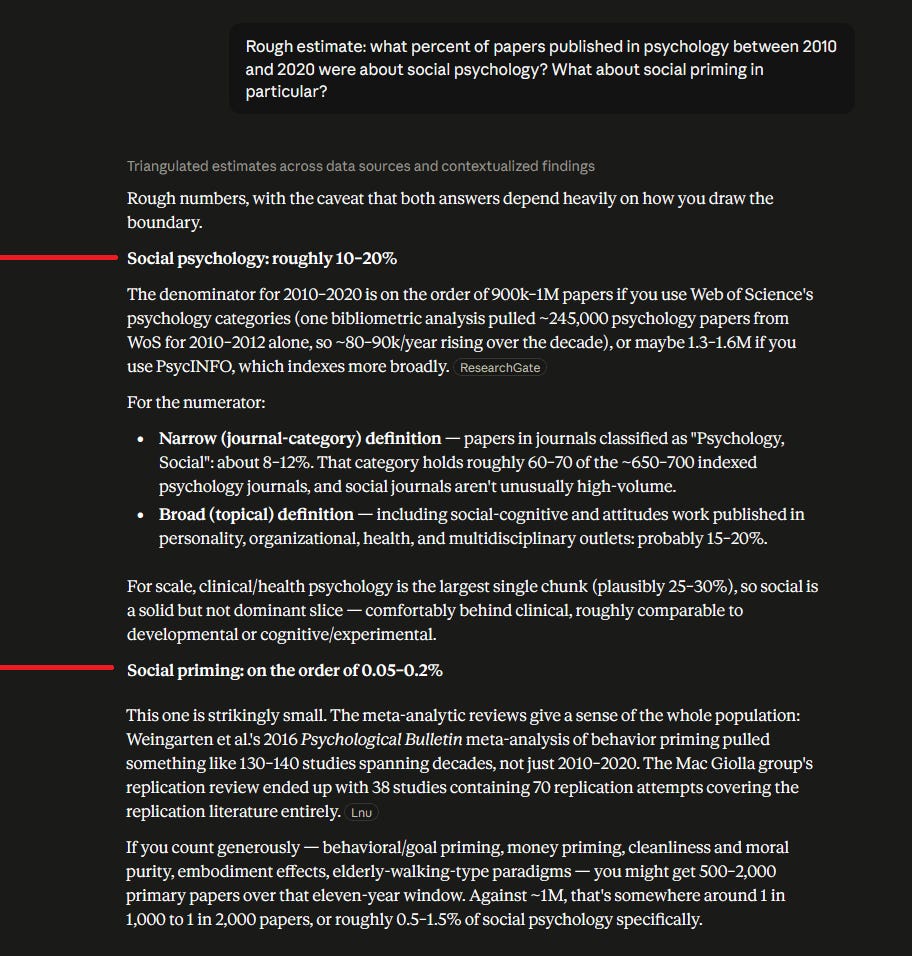
Is this because the textbook is post-replication-crisis and hastily removed all incriminating material? It might be (it’s from 2026), but I think it’s equally due to none of the incriminating material being important enough within psychology to make it into a 101-level overview of the field:
When you mock “psychology” or “psychologists”, you’re mocking:
the psychophysicists who study how the brain processes visual information
the psychopharmacologists who figure out what receptors LSD hits
the psychometricians who measure the genetic contribution to IQ
the personality psychologists who develop and refine the Five Factor Model
the experimental psychologists who run rats through mazes to learn how memory works.
the cognitive psychologists who ask you to read the names of colors in the color of other colors, then secretly laugh at you when you mess up.
the psychophysiologists who determine how hormones affect emotion
the forensic psychologists who assess whether criminals are not guilty by reason of insanity
the abnormal psychologists who try to find out what schizophrenia is
the clinical psychologists who treat drug abusers
the industrial psychologists who advise companies on factors affecting productivity and job satisfaction.
the child psychologists who investigate how babies learn language / ethics / abstract concepts / etc.
the behaviorist psychologists who give pigeons increasingly complex sequences of food and electric shocks to study reinforcement learning.
the neuropsychologists who perform batteries of tests on people with exotic head injuries, hoping to tease out the functions of different brain regions.
Not to mention:
the Templeton-Institute-funded psychologists who put Buddhist monks in fMRIs and determine which of their brain lobes gets bigger the moment they become enlightened.
the Freudian psychologists who help you understand how all your dreams involve unconscious impulses about sex with your mother.
the Jungian psychologists who help you understand how all your dreams involve the the Divine Feminine engaging in mythopoesis by telling you to have sex with your mother.
the developmental psychologists who tell you that you and your friends are Kegan Level Five, but the people who disagree with you are underdeveloped psychologically-rigid Kegan Level Four stick-in-the-muds.
the evolutionary psychologists who write up the Eight Things That Baboons In Estrus Can Teach You About Attracting Hot Women (Number Six Will Shock You)
…all to get at the 0.05 - 0.2% of people doing social priming studies, plus a few extra malefactors in the 10 - 20% doing social psych.
This isn’t to say none of the research outside social psychology is bad. One of my grantees, Sasha Putilin, recently tried to replicate an experiment showing that people learn more quickly when an EEG machine is used to synchronized their brain waves to an external stimulus; he found no effect. I take some of the blame for this - not because I was involved in the original experiment, but because I was fascinated by it and gave out this grant to double-check it. Since I’m not a professor of cognitive psychology and don’t usually follow the field, I only came across this because it was a crazy result hyped by the media which overturned everything normal people believe (you can learn things twice as fast just by changing your screen flicker? really?!) And of course crazy widely-hyped results like these are far more likely to fall apart than normal incremental expansion of settled science. Social psychology fell into this trap especially hard because it naturally touches on hot topics of popular interest and political explosiveness : what if people only perform badly because society tells them they’re going to perform badly, or did I just blow your mind?! But no subfield of psychology is entirely immune, and you can find bad research in any of them.
…just like in economics, medicine, sociology, political science, or even some of the hard sciences. All of these encountered the replication crisis at different times, all of them adjusted in different ways, and they’ve all risen to the occasion in some cases and failed to confront others.
Psychology is no different. It has flaws, but most of it consists of good ideas and trustworthy research. And even the flawed parts are more likely to be full of fascinating crackpots than to be bad and wrong in the exact same boring way that Francesca Gino is bad and wrong.
If you don’t like social priming, say that you don’t like social priming, and leave the rest of the field alone.