View original image View dithered image
The human-powered handcart is the oldest of vehicles, and it will likely be the last one around in the future. Of all vehicles, it’s the cheapest and least complex to build and use. It offers a large advantage over carrying a load on your back or dragging it over the ground - the even older concept of the sled. On the other hand, the handcart is cheaper and easier to use than the animal-powered cart. Oxen and donkeys eat more than humans, and they have their own will, which can work against the driver.
Like any other wheeled vehicle, the handcart requires roads to drive on. This infrastructure has not always been available anywhere or at any time in history. For example, in medieval Europe, porters and pack animals were more common than handcarts because of poor roads. 1 In the West, the handcart only reached its heyday during the first decades of the Industrial Revolution, when it connected fast-growing cities to train stations and harbors. In China, on the other hand, the handcart was the backbone of the transport network for millennia. 2
Of all vehicles, the handcart is the cheapest and least complex to build and use.
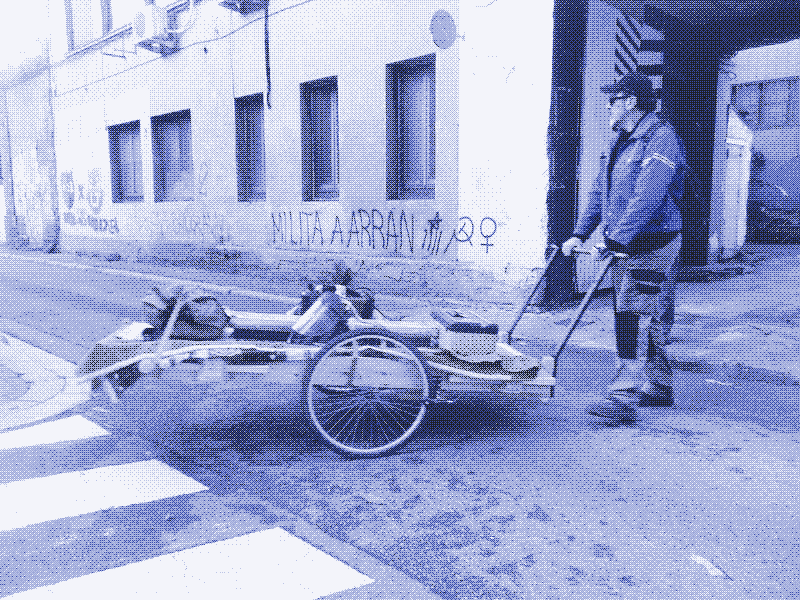
There are still many human-powered carts in modern society: strollers, grocery carts, roller suitcases, and various utility and folding carts. However, these modern carts are to their predecessors what modern birds are to dinosaurs. They are small, often with very small wheels, and we use them for very short distances, usually inside buildings. In contrast, old-fashioned handcarts were often large and had big wheels, and they were pushed or pulled on roads and over longer distances. Many crafts and professions had their own type of handcart.
View original image View dithered image
Why I need a handcart
People still use large handcarts in so-called “developing countries”. However, they can be just as useful again in the large cities of the industrialized world, as I can testify after using one for a couple of months. Last autumn, I received an internship application from Kozimo, who studies at the Design Academy Eindhoven. In his application, Kozimo sent a video of a large handcart he made, which he was driving on the streets of Rotterdam, the Netherlands.
I have always dreamt of a handcart. I have never owned a car, and the only times I miss one are when I have to move stuff, something which has become increasingly common lately. Consequently, I proposed to Kozimo to build a handcart for me.
Now, I can no longer imagine living without it. I have used the vehicle to move houses and offices, pick up materials and objects I bought online, new or second-hand, and transport workshop and event materials (bike generators, solar panels, solar ovens, books, sound systems). I have done the same for friends. During these trips, I often took home materials, furniture, or objects that I found for free on the streets of Barcelona.
View original image View dithered image
Unlike a van or a car, my handcart doesn’t need gasoline, electricity, or batteries, making it entirely independent from energy infrastructures. Neither do I need to pay taxes and insurance. The handcart is a very democratic vehicle. It allows anyone to carry a load wherever they want, while older, less affordable cars and vans are no longer allowed to enter city centers due to the installation of Low Emission Zones.
A handcart doesn’t need gasoline, electricity, or batteries, making it entirely independent from energy infrastructures.
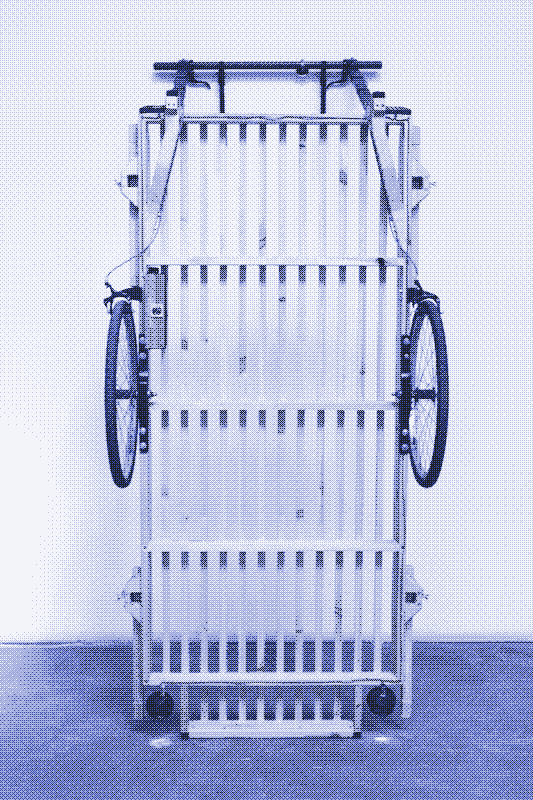
It would make a lot of sense to offer vehicles like this at community centers, where they are available for all neighbors to use when needed. Few people would need a handcart each day, and communal use would solve the parking problem. Although our handcart can also be parked vertically, it won’t fit in most apartments.
Description of the handcart
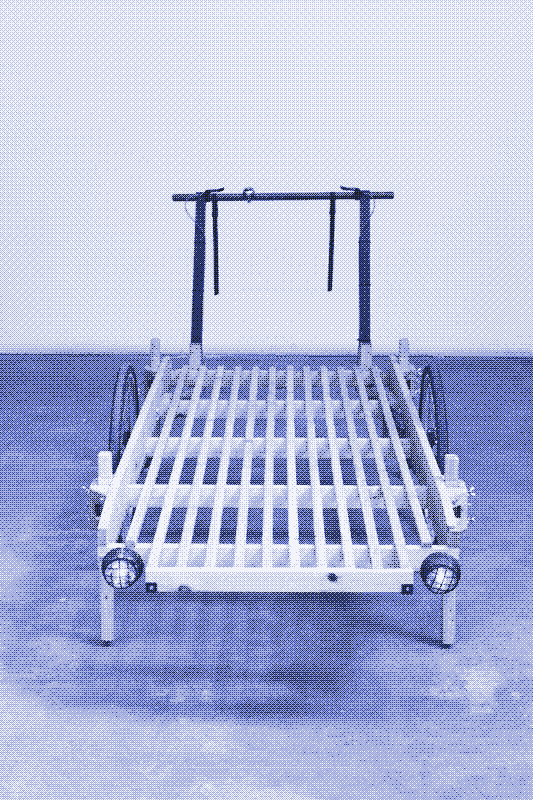
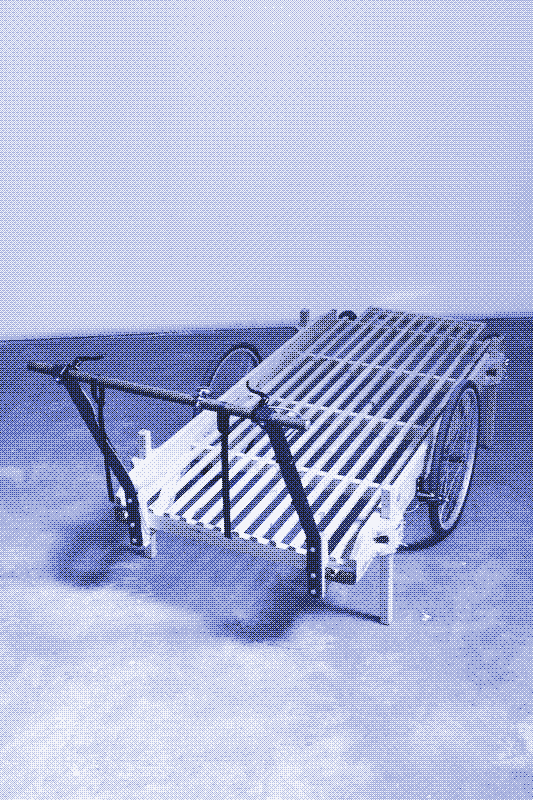
This article will not explain in detail how to build a handcart. We want to do that another time with a simpler handcart model, because the vehicle we present in this article is not one that most people can make themselves. You need good woodworking and metalworking skills, and in fact, two people made the handcart.
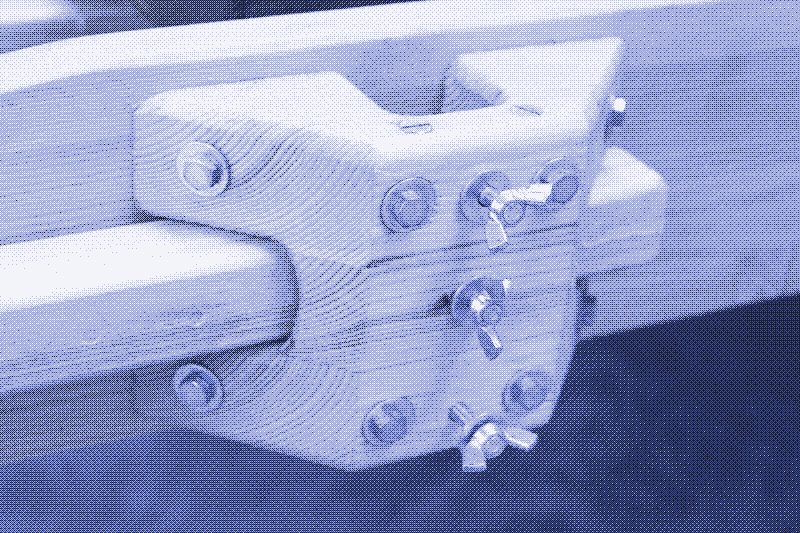
Kozimo designed and built the whole structure from wood, while Guilhem Senges - visual artist and one of my neighbors - designed and made several essential reinforcements from metal; the wheels, the brakes, and the handlebars are all connected to the wood structure with custom-made iron parts.
View original image View dithered image
View original image View dithered image
View original image View dithered image
Load weight and volume
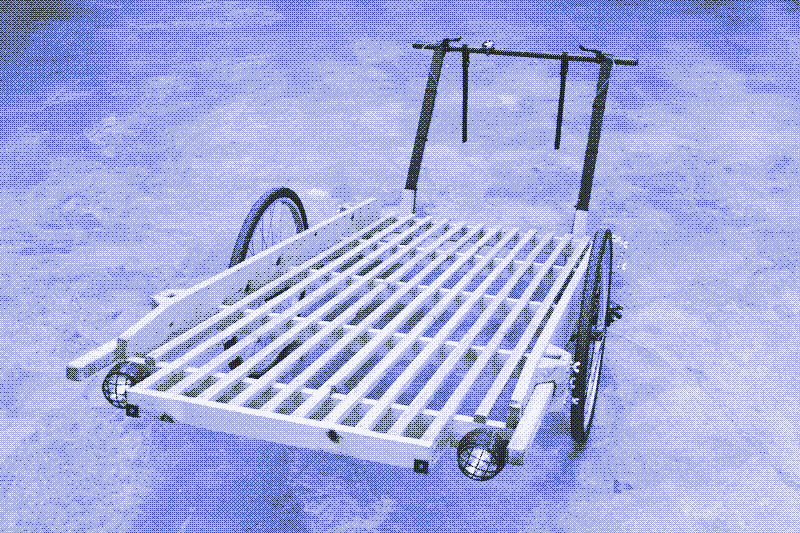
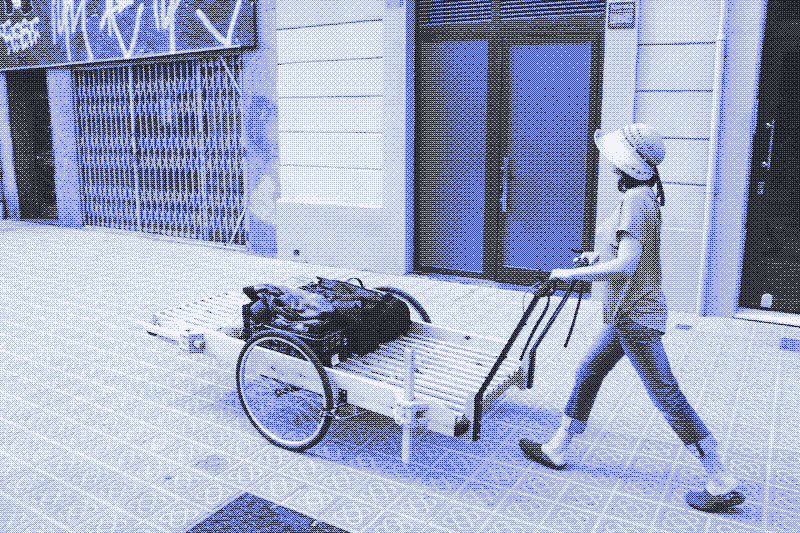
Low-tech Magazine’s handcart is 250 cm long and 100 cm wide, while the platform itself measures 210 by 85 cm. Assuming a load height of 50 cm, the cargo volume is roughly 1.55 m3 (37 cubic feet or 1050 liters). That’s two to four times the typical trunk space in a European car. We have transported cargo that is wider or longer than the cart: a large heated table measuring 140x140cm, and several loads of wooden beams, each three meters long.
The load weight is limited by the wheels, which come from a wheelchair. They can support up to 150 kg. 3 The cart itself weighs 32 kg, so the practical maximum cargo weight is about 120 kg. The loading platform consists of slats with gaps between them, making it easy to secure various types of cargo.
It drives itself!
Over the past few months, we’ve learned that people have many misconceptions about handcarts. For example, you may think that pushing a handcart takes a lot of effort, perhaps based on your experience pushing supermarket carts through parking lots or pulling heavy suitcases through city centers (which is how I moved stuff before I had a handcart).
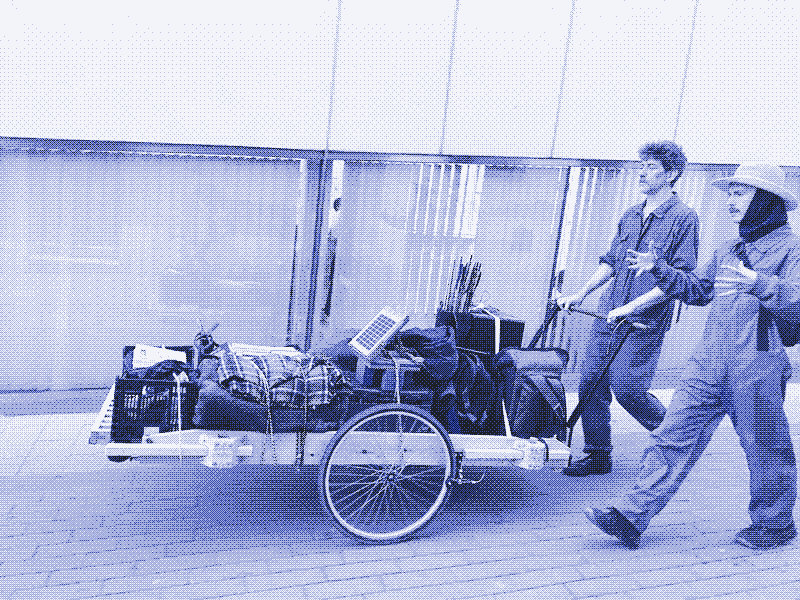
However, using the handcart can be so effortless - even when it’s heavily loaded - that it feels like you are not pushing at all. Once in motion, you can often guide it with one hand, and it sometimes feels like the cart is pulling you forward. It’s no exaggeration to say that pushing the handcart with a 100 kg load is more comfortable than walking while carrying a 10 kg heavy backpack.
Using the handcart can be so effortless - even when it’s heavily loaded - that it feels like you are not pushing at all.
There are several reasons for this light operation, rooted in physics. Each vehicle has to overcome three forces: rolling resistance, air resistance, and gravity. Air resistance is negligible at walking speed, meaning that a handcart user on flat terrain mainly needs to overcome rolling resistance. That’s the friction between wheels and road surface, a factor that’s largely independent of speed.
In contrast, air resistance increases with the square of speed. A cyclist, going at 15-20 km/h, already spends more effort overcoming air resistance than overcoming rolling resistance, which is the same in both cases because both vehicles have similar wheels. In short, the handcart’s low speed minimizes air resistance, while its narrow wheels minimize rolling resistance.
View original image View dithered image
Second, accelerating a vehicle requires more energy than maintaining a constant speed. You only need to sustain momentum, not build it. Our handcart is pushed by a person walking, so the effort to accelerate lasts no longer than one or two seconds. In contrast, a cyclist takes much longer to reach cruise speed, and because of the higher air resistance, it takes more effort to sustain that speed. If the handcart is heavily loaded, it also gains significant kinetic energy, even at low speed. That explains why it sometimes feels like the cart is pulling you forward - because it actually is.
Finally, our wheels are much larger than those used on modern pushcarts. That makes for comfortable driving on asphalt and sidewalks, which are not as smooth as airport or supermarket floors. Large wheels increase air resistance, but because of our low speed, that doesn’t matter.
Handcarts and gravity
However, an effortless ride requires two conditions: flat terrain and a well-balanced load. Both involve the third force any vehicle must overcome: gravity.
Balancing the handcart: distributing the load
A two-wheeled cart becomes heavy and difficult to use when too much weight is placed on the front or back. Consequently, you need to load the vehicle so that the weight is equal on both sides of the wheels. That’s easy to check: the cart should remain in a horizontal position for several seconds without you touching it. If there’s just one piece of cargo, place it above the center of the wheels. If there are more things to carry, the total weight should be divided equally over the two sides. Finetuning the balance often involves moving a backpack from the front to the back of the cart, or vice versa.
You need to load the vehicle so that the weight is equal on both sides of the wheels.
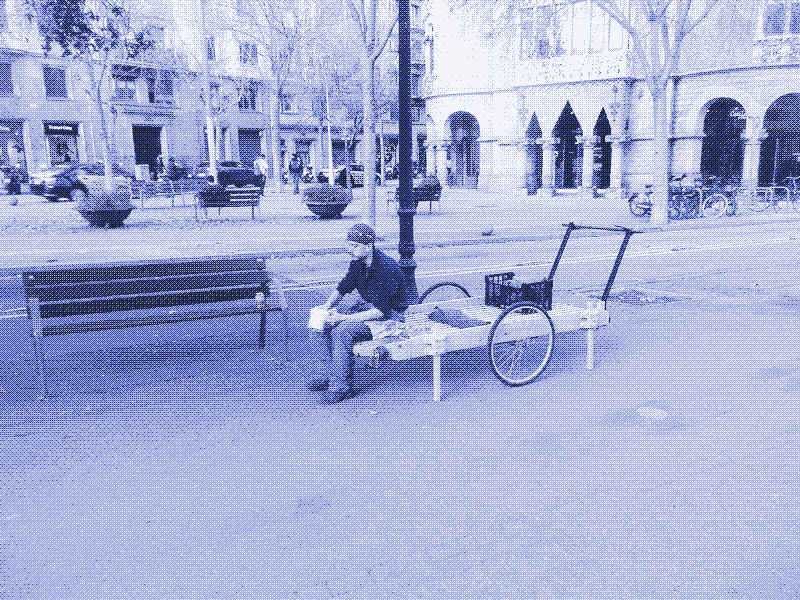
A two-wheeled cart also needs additional support to keep it horizontal when parked, for instance, when loading or unloading cargo. Otherwise, the cart may suddenly flip to the other side. Our handcart carries four support beams, two on each side. When the cart is moving, they are in a horizontal position. When the cart is parked, we remove one or more beams and place them in a vertical position. Each beam can be set to a different length, allowing us to stabilize the cart on uneven terrain. We tighten the beams with screws.
View original image View dithered image
View original image View dithered image
Many people have asked us why we didn’t build a four-wheeled cart that wouldn’t need to be balanced. However, four wheels would double the rolling resistance and thus the effort required to push the cart. Furthermore, a four-wheeled cart is less maneuverable and more difficult to drive on uneven terrain. You also need to get two extra wheels, and you need to build a steering mechanism. Throughout history, the two-wheeled handcart (or one-wheeled handcart in the case of China) was much more common than the four-wheeled cart. 1
Going uphill: you need help
An effortless ride also requires more or less flat terrain, which is what you get here in many parts of Barcelona. If you go up a steep slope, you suddenly feel the weight of the cart and its cargo. Climbing with a heavily loaded cart can be as strenuous as running up stairs or cycling at top speed. People tell us we should put an electric motor on the cart, and that’s perfectly possible.
However, we found a simpler solution: if necessary, we ask for help from another person. Our handlebars are wide enough for two or even three people to push together, which makes going uphill a lot easier. Adding an electric motor and a battery would significantly increase the vehicle’s weight, and it only makes sense if you regularly have to climb hills.
Going downhill: brakes
Going downhill, you have to counter gravity forces to prevent the handcart from hurling down a slope, which would be very dangerous. Rather than pushing the cart, you’ll have to pull it back instead. Here, cyclists have all the advantage, as they can use gravity to its full benefit during a descent.
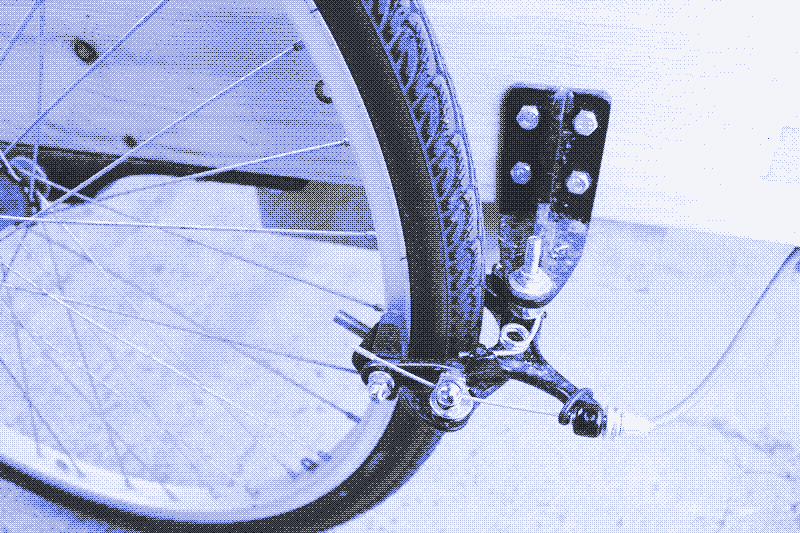
We made going downhill a lot easier by adding bicycle brakes. In combination with the large wheels, the brakes also allow the handcart to be taken down sidewalk curbs or even stairs without damaging it. They double as a hand brake as well, by tightening two lashing straps around them. That allows leaving the cart unattended on a slope or in high winds.
View original image View dithered image
Handcarts go on the sidewalk
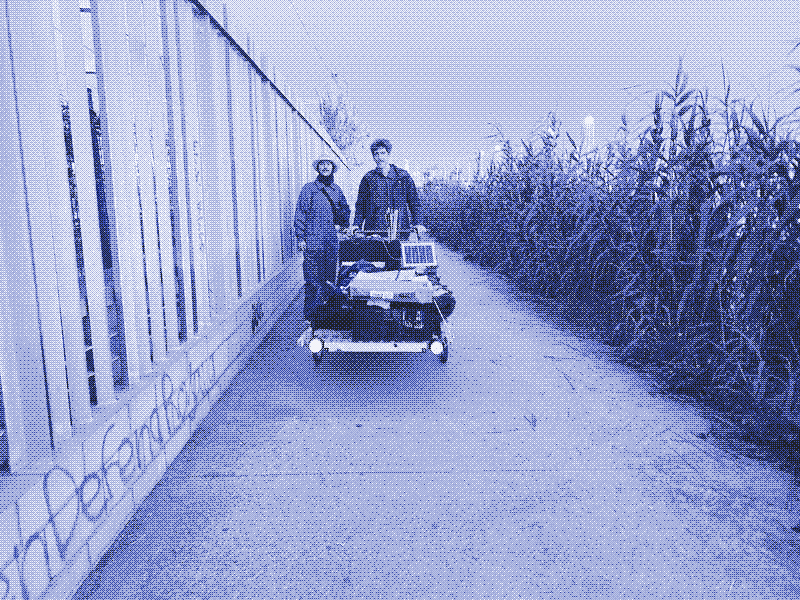
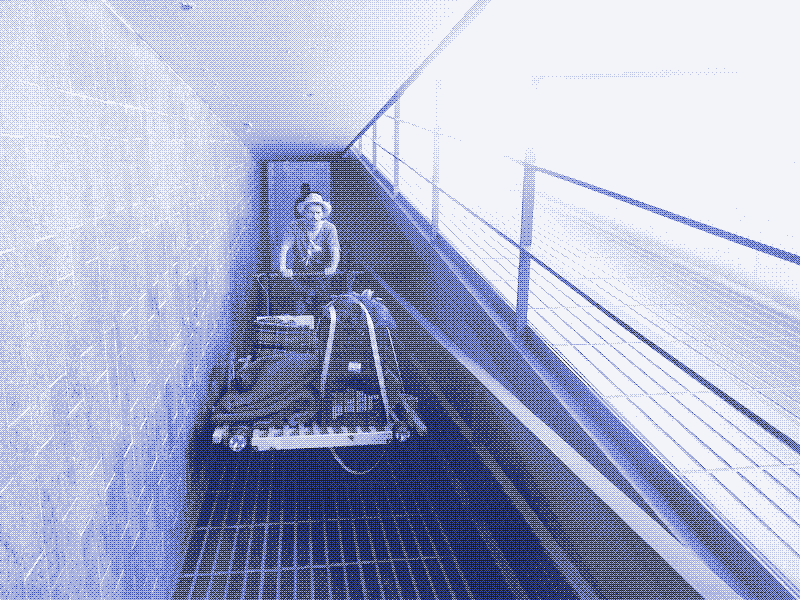
Many people assume that handcarts go on the road, with the cars, or on the cycling path. That’s not the case: you use it on the sidewalk. Legally, handcart users are in a similar position to other pedestrians pushing a smaller handcart, such as a stroller. The only difference is that, when they are forced onto the road because there’s no sidewalk or it’s blocked, handcart users should walk on the right side of the road, while other pedestrians should walk on the left. For now, the police have stopped us only once, and they were just curious.
Legally, handcart users are in a similar position to other pedestrians pushing a smaller handcart, such as a stroller.
We could find no traffic laws that limit the size of a handcart, at least not in the handful of countries we researched, including Spain. However, in practice, there are clear limits. If your vehicle is wider than the space between traffic bollards that keep cars out of pedestrian streets, all pedestrian zones will become inaccessible to you. You should also take into account other obstacles on the sidewalk, such as building scaffolding. Consequently, it’s rarely practical to build a handcart more than one meter wide.
Barcelona has very wide sidewalks in most of the city. We rarely have to share the road with cars or cyclists. Of course, that’s not the case in every city, and then the use of a handcart becomes less attractive. Using a handcart on the road or cyclepath is rather dangerous because other vehicles are much faster.
View original image View dithered image
Respecting other pedestrians
Driving a large handcart on the sidewalk demands your full attention. You don’t want to hit any infrastructure, and you surely don’t want to hit someone’s legs. You need to drive it with respect for other pedestrians and their pets (some dogs start barking at the vehicle). In general, the handcart is very safe to use because it travels at a very low speed. That makes accidents less likely in the first place and less impactful if they do happen. You also have a very good overview of your vehicle, much better than for a car or a bicycle. As long as you keep your eyes on the handcart, you are unlikely to hit anything or anyone.
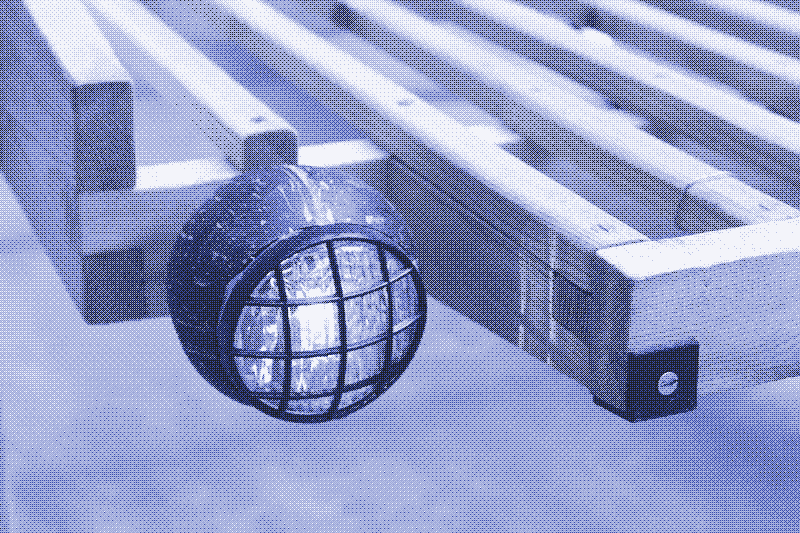
However, our handcart is so silent that people don’t hear it coming. We added a bicycle bell to warn people, but we hope to find a better tune in the future: every vehicle needs its own type of sound. We also need a bell for oncoming pedestrians who are watching their phones while walking and expect others to make space. With the handcart, we cannot always make that space. Our handcart has front and rear lights as well, wired to a USB power bank mounted underneath the platform. Lights are very helpful on sidewalks, both day and night, as they make the vehicle more visible. Furthermore, lights are essential if you need to move onto the road after dark.
Even in Barcelona, sidewalks can get crowded, and a busy sidewalk will slow down the vehicle considerably. With little chance to overtake someone, we tend to get stuck behind the slowest walkers.
A handcart is not a difficult vehicle to drive, but nowadays people in industrialized societies have no experience with it. Apart from driving it attentively, you also need to be careful when rounding blind corners (take the turn as wide as possible) and when you leave a garage or any other type of exit (pull rather than push the cart). By the time you see oncoming traffic, you already have 2 meters of your handcart on the road or around the corner.
Why not a bike trailer?
Almost everyone who sees the handcart for the first time asks the same question: how do you attach it to a bicycle? You don’t. You push it while walking. When we say that, there follows a silence. Pushing a handcart seems like one step too far back, even for people committed to living more sustainably. Why would you push a handcart if you could just as well use a much faster bike trailer, or a cargo bike?
In fact, there are several practical reasons to opt for a handcart rather than a bike trailer, and we have already mentioned many of them. First, a handcart lets you go anywhere a pedestrian can, while cyclists often need to get off their bikes and push them - just like a handcart. A handcart is also more agile. For example, although the cart is 2.5 meters long, it takes just two seconds and little space to turn it around and walk in the opposite direction from where you came from.
Why would you push a handcart if you could just as well use a much faster bike trailer, or a cargo bike?
A handcart can be built larger than a bike trailer as well. Although it’s perfectly possible to build a bike trailer the size of our handcart, its higher speed would pose much greater risk of accidents and damage, both to the cart and to other road users. As a bike trailer, it would also need to be made sturdier, and it would need a more elaborate mechanism to operate the brakes.
All this does not mean that bike trailers are a bad idea. We have used the handcart mainly for trips between 5 and 10 km, which comes down to one to two hours of walking. For longer distances, the bike trailer has the obvious advantage of speed. If you need to cover 40 km, you would need to travel eight hours with a handcart, compared to just two hours with a bike trailer.
View original image View dithered image
The merits of slow travel
However, when people ask us why we don’t use it as a bike trailer, we can also answer differently: why the rush? Deciding to travel with the slowest vehicle possible is subversive because it questions values we take for granted in the modern world, such as speed and utility.
To many people, walking a handcart seems like a waste of time, but our experience is exactly the opposite. Every trip is an adventure, and we always look forward to using it again. It’s a pleasure to drive the vehicle, more like steering a boat than driving a land vehicle. It’s easy to chat with other pedestrians, who tend to be very curious about our vehicle. Consequently, the trip takes even longer.
To many people, walking a handcart seems like a waste of time, but our experience is exactly the opposite.
Driving a handcart feels entirely different from using any other mode of transport. When people are walking, they usually cannot carry much with them, either in terms of weight or volume. In contrast, the handcart allows you to walk with a lot of stuff close at hand: drinks, food, a sound system, books, extra clothes. Furthermore, you have a large platform, which allows you to rest and invite others to do the same. It becomes a vehicle for wandering and roaming, and for connecting to other people.
View original image View dithered image
View original image View dithered image
Handcart Accessories
Once the handcart proved its utility as a cargo vehicle, Kozimo began designing and building additional structures to expand its uses. These objects make use of the slatted platform or the support beam design. Unfortunately, Kozimo’s internship ended before we could test all these extensions, but the little experience we gained by now shows that the handcart can be much more than just a cargo vehicle.
Passenger seat
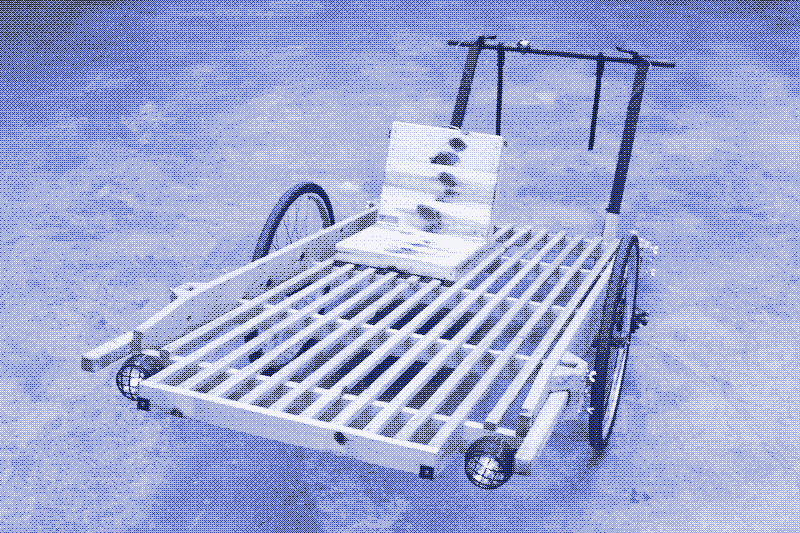
The first, and perhaps most powerful addition, is a foldable seat. While our handcart can be - and usually is - operated by only one person, it’s ideally handled by two people, especially for longer voyages. Thanks to the seat, one person can push the cart while the other one rests in the vehicle.
As long as the road is flat, the extra weight of the passenger does not significantly increase the effort to push the cart. Consequently, two people can travel faster or farther in a single day. When climbing hills or bridges, the passenger gets off the seat. If necessary, he or she also helps to push the cart.
One person can push the cart while the other one rests in the vehicle, increasing the distance that two people can travel in a day.
An extra pair of eyes on the road is also handy. The seat can be put in two positions, so that both the passenger and the driver are either looking in the same direction or facing each other, which makes it easier to talk and allows the passenger to serve as the rear-view mirror.
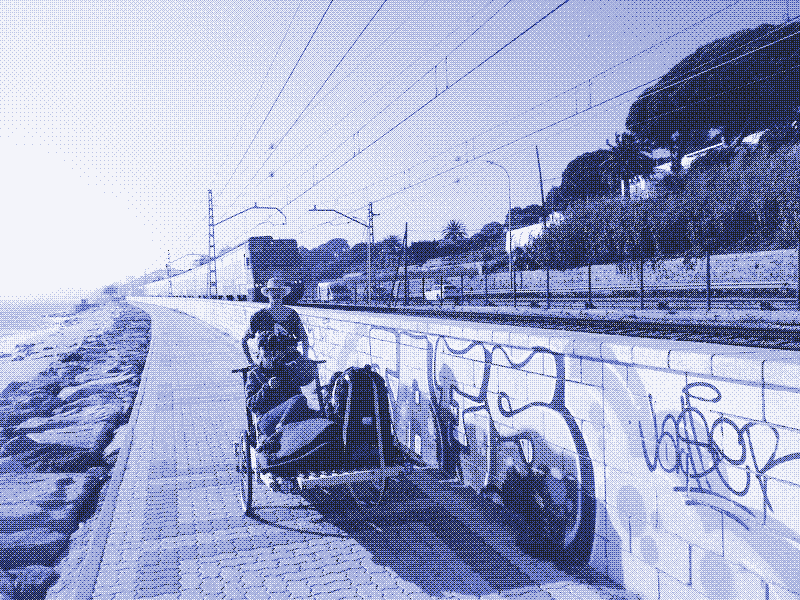
We used the seat on a 30 km day trip along the coast of Catalunya, Spain, moving stuff from my old place to my new place. For one person, this would have been an exhausting trip. However, there were several people on the way there, and two people on the way back. The fact that we could rest from time to time - without stopping - made a great difference, especially on the way back. An extra person also proved useful when unexpected obstacles arose. For example, there was a bridge under repair, which forced us to carry the cart down the rocks, over the beach, and up the rocks again.
View original image View dithered image
View original image View dithered image
Digital nomad office
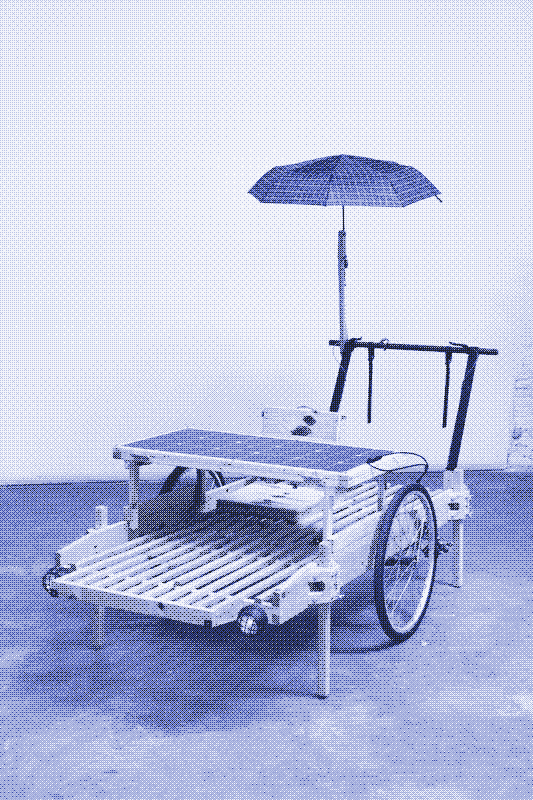
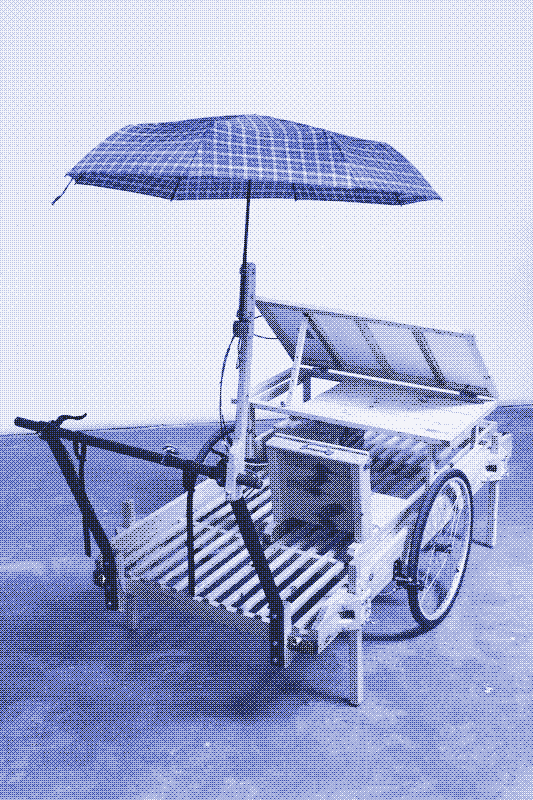
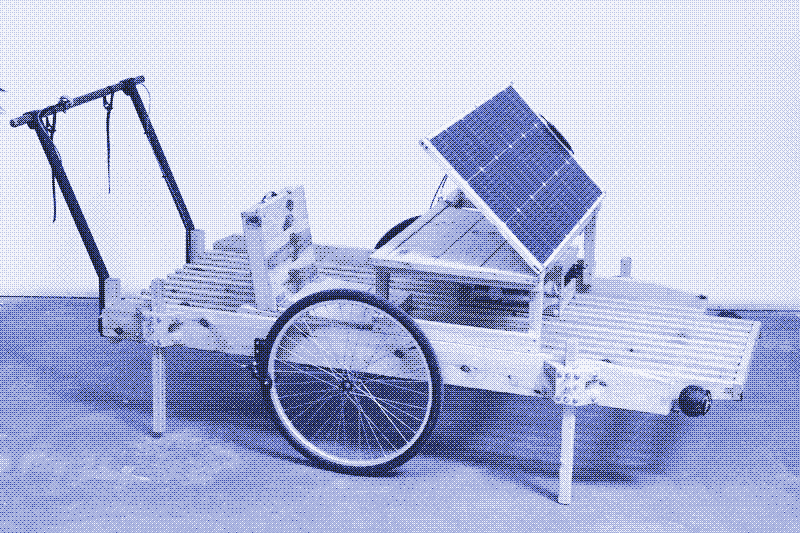
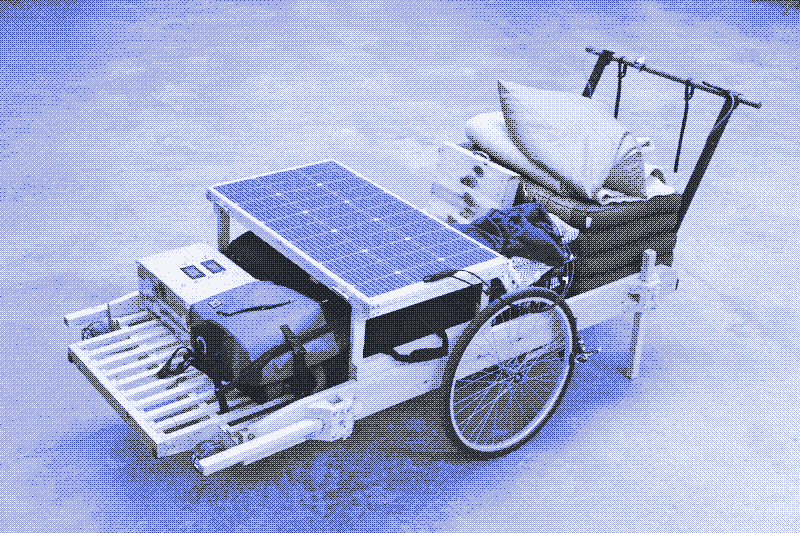
As a second addition, we combined the seat with a work table that doubles as a solar power plant, resulting in a digital nomad office. The table fits onto the sides of the handcart and slides back and forth. The solar panel can be in a horizontal position or at various tilted angles. It can charge a laptop or any other device requiring up to 100 watts of power.
If you’re two people traveling, one person can work at the table while the other drives. If you’re alone, you can wheel the vehicle to the nearest park or beach, set up the four support legs, and work all day. In 2016, I took my home office off the grid with solar panels on the window sills. 4 Ten years later, both the office and the solar panels have become mobile.
View original image View dithered image
View original image View dithered image
Renewable power plant
Although we built only one solar panel support structure, the handcart platform is large enough to support a total of four 100-watt solar panels. That would provide us with 400 watts of solar power for a concert or emergency power, for example. The handcart can also transport the two bike generators Low-tech Magazine has in Barcelona. 5Consequently, the cart enables us to quickly provide power within a radius of several kilometers, at any time of the day. The handcart could also be wheeled into a sunny spot during the day, charging a battery bank to power a household during the night and in bad weather.
Mobile home
If you want to get back home the same day, the handcart’s range is roughly 40-80 km (8-16 hours of walking, back and forth). However, at least in my case, nobody obliges me to come back home the same day. I could use the handcart for longer voyages, especially since it offers me a place to sleep.
The four supporting legs that make loading and unloading the cart more practical can also be used to turn the vehicle into a bed. After Kozimo went back to the Netherlands, I bought a foldable mattress that fits neatly on the platform. During a trip, I can store the other cargo under the cart at night. Alternatively, I could push a passenger who’s lying in the bed, turning the vehicle into an adult version of a baby stroller.
View original image View dithered image
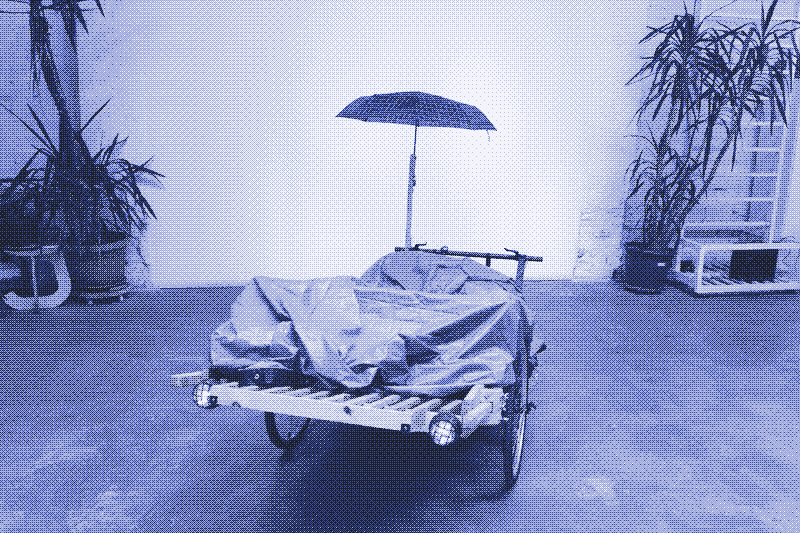
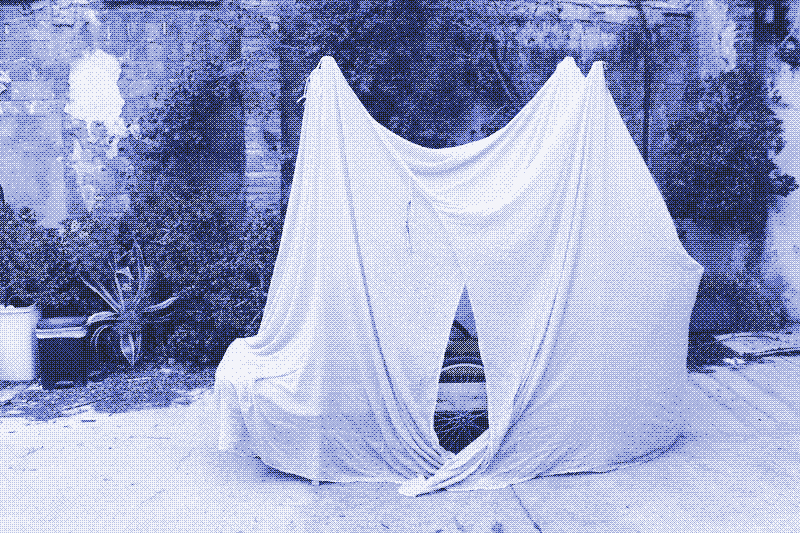
Kozimo also made four supporting legs that are almost two meters long. I can use them to erect a tent around the bed, and cover the structure with modern tent materials, wool blankets, or a mosquito net. The large poles can also dry laundry. Furthermore, I could use the supporting legs in various combinations to convert the cart into a podium, expo stand, market stand, or a cinema or presentation screen.
The seat, table, solar panel, sleeping mattress, and longer poles can all be carried on the handcart simultaneously, leaving ample space for other luggage. That means that I could potentially work, live, and travel in the vehicle, turning it into a nomadic home. It fits somewhere between the tiny house on wheels, the tipi, and the homeless shack. Rents got very expensive in Barcelona, so I may as well give it a try.
View original image View dithered image
Sailing and roller skating the handcart
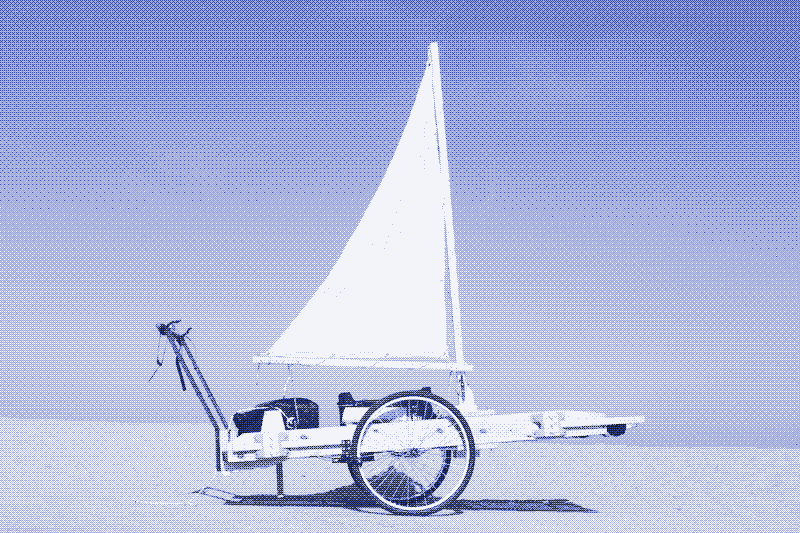
Finally, Kozimo made a small sail for the handcart to help pull a heavy load in a good wind; the vehicle is sometimes used along the coast. Of course, we got the inspiration from the use of sails on the historical Chinese wheelbarrow. For a longer trip, the sail fits on the cart, so I could use it whenever the opportunity arises.
We could increase the speed of the handcart by using a larger sail, and combining it with roller blades, inline skates, or a skateboard. In that case, the cart would pull the driver in good winds. It’s also possible to push the cart while using roller blades, inline skates, or an electric unicycle, without a sail. For now, we did a first small test on flat terrain using inline skates, with very good results. If you would take enough cargo, the kinetic energy of a skate-powered handcart would regularly pull you forward even without a sail.
The higher speeds of these configurations obviously introduce more risk and, most likely, trouble with the police. Higher speeds require ample space, free of pedestrians. That almost always pushes the handcart on the road, between the cars, as most cycle paths are not wide enough. However, it shows that sustainable vehicles could take many different forms if only we would give them the space to flourish. There are more than enough roads suitable for sailing and roller-skating handcarts; we need to empty them of cars and vans.
- Handcart design and construction: Kozimo, Guilhem Senges.
- Photos: Kris De Decker, Linda Osusky, Guillaume Lion.
- Special thanks to: AkashaHub Barcelona, Carmen Tanaka, Gaston Quispe Castros, Linda Osusky, Guillaume Lion, Rocío Sánchez, Iris De Decker, Lili-Roos Noeyens, Julia Steketee, Tim Rudolph, Guilherme Maglio, Selcen Küçüküstel.
- Marie Verdeil and Roel Roscam Abbing contributed to the selection of images.