When all is said and done, and the final accounting is made of all human ambitions and achievements and follies, and the final historian turns to that strange realm of human endeavor that we call “computing,” that strange enterprise that gradually grew to encompass an unbelievable share of human life and redefine the entire world around its logic: what will that final historian have to say? Probably they will start with the forerunners, with Llull and Babbage and Lovelace; and then turn to the true pioneers, to Turing and Church and Shannon and von Neumann; and then the masters of hardware, Noyce and Kilby, and of software too, Ritchie and Dijkstra; and eventually they will arrive at PageRank, recommendation systems, neural nets, the transformer architecture, and whichever system ended up bootstrapping itself into superintelligence and thus inaugurating an entirely new epoch of history. But somewhere in their chronicle of this grand arc, for at least a few pages, they will have to talk about the electronic spreadsheet.
The electronic spreadsheet. Is there any tool as ubiquitous and yet so unloved? It would not be an exaggeration to say that Microsoft Excel, the product that today defines the spreadsheet category, is the most successful piece of application software ever made, counting about a sixth of humanity among its users and deciding the terms on which trillions of dollars in capital are allocated. And yet you will struggle to find people who love the spreadsheet. You will find people who wax poetic about the beauty and elegance of certain pieces of software—about Linux, or Rust, or particularly fast Python package managers. But you will be hard-pressed to find a true admirer of Excel.
And indeed that is a marker of a truly great tool. It is so ubiquitous that it has become, in a strange way, anonymous. But you cannot really understand the transformation of the American economy over the last few decades without understanding the spreadsheet.
This is a story about how a piece of software transformed the way that American businesses understood themselves, and how they were understood by others; how it enabled the rise of financial engineering and the entire apparatus of Wall Street dealmaking; how it helped reshape the American corporation from an organization that built things into an organization that optimized numbers; and how it offers us a lesson, and a warning, about how artificial intelligence will transform economic life.
But we should start with the world before Excel.
A company is a group of people who have agreed to coordinate their activities under a unified authority in order to produce something. In any company, there are people at the top, the managers. The managers exist, at the most basic level, as information processors: they process information, use that information to make decisions about the allocation of resources, and then issue orders to the people below them based on those decisions. They are “the brain of the firm.”
And every company is bottlenecked by the processing power of its brain. The managers can only keep track of so many things at once; every new employee or project or division adds another node to the network of things that management has to keep track of, and the complexity of that network grows much faster than the number of nodes. So the capacity of its management to process information and coordinate action sets a natural limit on the size and complexity of any firm.
This is why, in the premodern world—when processing information and coordinating action were both extraordinarily expensive, because communication was slow and coordination outside of relatively small kinship groups was difficult—firms tended to be local concerns, centered either around families or similarly high-trust networks like monasteries. Almost every business in the world was a family business.
This changed with the rise of the steam engine. The mechanical power that the steam engine allowed people to harness brought a dramatic acceleration in the speed and volume and complexity of economic life: it greatly expanded opportunities for profit, but—because of its inherent danger and complexity—also demanded a great deal of control. You needed to be able to process all the complexity that the factory generated. And so, between the 1840s and 1920s, we see the emergence of technologies designed to communicate information and coordinate action at scale—the telegraph, the rotary power printer, the filing cabinet, the typewriter, the telephone, the punch-card processor, and the columnar pad.
This was the “control revolution.” With this new capacity for processing information and coordinating activity, we see the emergence of the modern corporation: much larger, more ambitious, and more centralized than any firm of the premodern period. It was a bureaucratic entity, operated by professional managers, designed to coordinate labor and capital at massive scale.
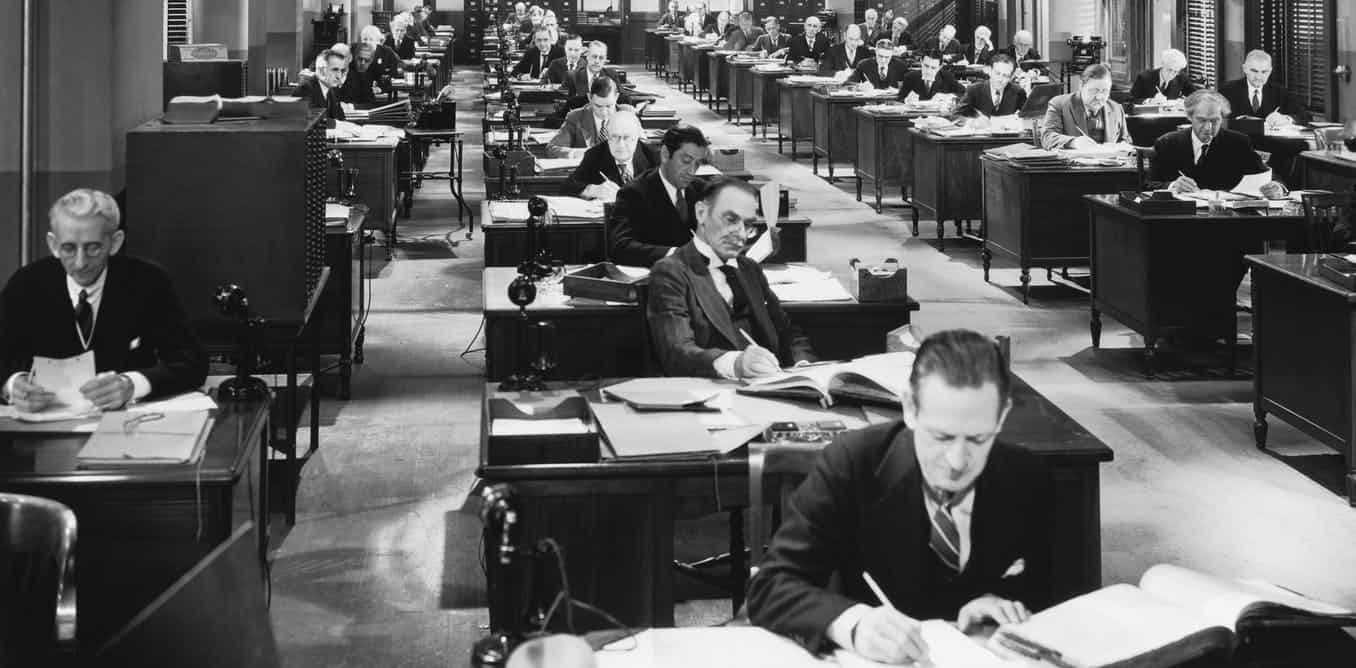
This was where the brain of the firm became a real thing. At a company like General Motors, hundreds of reports from the company’s operations would flood into headquarters every week; clerks would transcribe the figures from these reports onto columnar pads, long sheets of green-tinted paper ruled into columns and rows; and then they would feed the aggregated numbers to supervisors, who would summarize them further and pass them upward to managers, who would compare this month’s figures with last month’s figures, identify variance, propose explanations, compose typewritten memos about their findings, and eventually transmit decisions back down the hierarchy to be carried out. It was, for its time, a truly staggering apparatus.
But it was also a highly limited apparatus. The obvious flaw was that processing information was really labor-intensive: you needed armies of clerks merely to have the most cursory idea of what was going on inside your company. And this meant that more ambitious attempts at analysis weren’t feasible: there was a hard ceiling on the number and complexity of the questions that managers could ask about their companies. Looking at how companies operated in 1920 or 1950, you would be struck by how much guesswork was involved in their attempts to understand why one thing was happening and another was not. They were flying blind.
![VC&G | » [ Retro Scan of the Week ] 30 Years of VisiCalc](https://substackcdn.com/image/fetch/$s_!u0uN!,f_auto,q_auto:good,fl_progressive:steep/https%3A%2F%2Fsubstack-post-media.s3.amazonaws.com%2Fpublic%2Fimages%2Fb5d2ed67-19f3-436f-b2e8-e797fe2fd888_800x1143.jpeg "VC&G | » [ Retro Scan of the Week ] 30 Years of VisiCalc")
And as with so many other things, this equilibrium was upset by Moore’s Law. It was inevitable, as microprocessors got cheaper and more powerful over the course of the 1960s and ‘70s, that someone would figure out how to represent the accounting functions of the corporate world on a computer. And that someone, as it turned out, was a 27-year-old engineer named Dan Bricklin.
Bricklin had studied computer science at MIT, and then spent a few years building word-processing software for Digital Equipment Corporation, the company that pioneered the minicomputer; but he felt drawn to the business side of things, and in the late 1970s decided to leave DEC to study at Harvard Business School. And sitting in a Harvard classroom in 1978, watching as a professor used a blackboard to work through the complex and interlocking calculations involved in determining the valuation of a company, Bricklin realized that you could just do all of this on a computer. You could simply make, he said, “a word processor that would work with numbers.” And thus was born the idea of the electronic spreadsheet.
Bricklin decided that this idea was gold and would represent his foray into entrepreneurship. So he teamed up with a friend of his from MIT named Bob Frankston, founded a company they called Software Arts, and spent most of 1978 and 1979 bringing the vision of the electronic spreadsheet to life.
It was, as it turned out, an intensely difficult problem. Bricklin and Frankston were designing their package for the Apple II, which had hundreds of thousands of times less memory than a modern laptop. The resource demands for word processing had been manageable, since a document is ultimately a stream of characters stored sequentially in memory; but spreadsheets were an entirely different game. Each cell carried a value, a formula, formatting, and dependency information, and the memory required to store all of this added up fast; a grid of any useful size threatened to exhaust the machine’s capacity entirely.
And so Bricklin and Frankston had to be extraordinarily precise in how they used every byte. They wrote the entire package in assembly code for the Apple II’s 6502 microprocessor, stored cells in fixed 32-byte chunks in order to minimize overhead, and represented values in variable-length formats with type indicators such that small values would consume only a few bytes. And even after all this ingenuity, the resulting spreadsheets were small by modern standards: VisiCalc’s grid extended to just 63 columns and 254 rows, a tiny canvas compared with what a spreadsheet user today takes for granted, but enough to transform the work of anyone who sat down at it. Every design decision was, at bottom, a decision about how to save on memory.
And their attention to detail paid off. They called the software package they produced “VisiCalc”—the visible calculator—and released it for the Apple II at the end of 1979. And it really was a marvel of software engineering. It was a brilliant fusion of the organizational metaphor of the columnar pad with the interactivity of word processing and the speed of the microprocessor. You could now calculate and recalculate things instantly; you could execute complex formulas programmatically instead of by hand; and things that would have once taken you hours now took you a few minutes. VisiCalc was an extraordinarily powerful tool. And it made the Apple II, which had been a hobbyist device, a useful business machine. Indeed so potent was VisiCalc that the Apple II was sold, as the journalist John Markoff wrote, mainly as a “VisiCalc accessory.” It was the first piece of software so compelling that people bought hardware specifically to run it: the first of the “killer apps.”
But Software Arts, having brought the electronic spreadsheet to life, did not define the category for long. Bricklin and Frankston were computer scientists at heart, and in the years after VisiCalc’s release they poured resources into TK!Solver, a niche program targeted at engineers and scientists; and so they were slow to port VisiCalc to the personal computer that IBM released in 1981, which quickly came to dominate the business market.
That opportunity was seized instead by a man named Mitch Kapor. Kapor had once been a full-time teacher of transcendental meditation, before working as head of development at VisiCorp, the company that marketed and distributed VisiCalc; and, seeing the opportunity in the electronic spreadsheet market, he decided to start a competitor. At the start of 1983, his company, Lotus, released the Lotus 1-2-3 electronic spreadsheet, purpose-built for the IBM machine. Lotus 1-2-3 was a significant improvement over VisiCalc—it offered charts and rudimentary database functionality along with the basic spreadsheet, and it could handle vastly larger grids, offering 256 columns and over eight thousand rows—and so Kapor quickly outcompeted Bricklin and Frankston. Software Arts floundered, and was sold to Lotus in 1985; and Lotus spent the next few years as the unchallenged market leader in spreadsheets. It even had, at the peak of its powers, its own magazine.
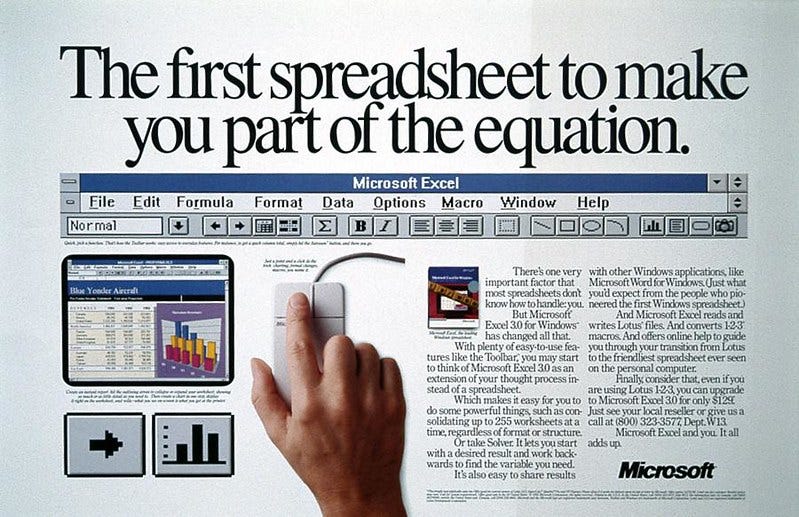
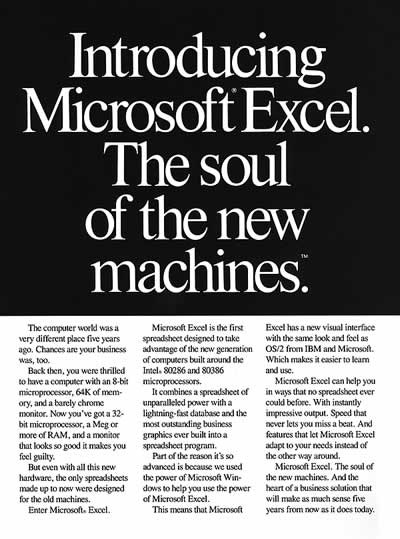
But the era of Lotus dominance did not last long either. VisiCalc and Lotus 1-2-3 were both keyboard-driven, text-based programs, navigated with arrow keys; but the future, as recognized by an ambitious Seattle-based software firm called Microsoft, was in the graphical user interface, the GUI. With the GUI you could replace typed commands and keystrokes with direct visual manipulation, such that interacting with the spreadsheet felt like working with a physical document: and this was the bet that Microsoft made with its spreadsheet offering, Microsoft Excel. Now you could point and click with a mouse, and see your fonts and formatting on the screen as they would appear when printed.
And Microsoft was right that the GUI was the future. The GUI paradigm gradually conquered the personal computing market through the late ‘80s and early ‘90s and cemented its dominance with the rise of Microsoft’s Windows operating system. Once Microsoft bundled Excel into its Microsoft Office offering, along with its word processor Word and its slideshow tool PowerPoint, the writing was on the wall for Lotus. Fatally wedded to the text-based paradigm, Lotus never recovered, and was sold to IBM in 1995. And so Excel won the spreadsheet wars.
But the history of the electronic spreadsheet as a product is ultimately less important than the story of what the electronic spreadsheet actually did.
The surface-level offering of VisiCalc and its successors was obvious: you could now dramatically speed up the work of calculation and accounting. But the quantitative improvement that the spreadsheet introduced was so dramatic that it represented a qualitative transformation in the work being done. The revolutionary potential of the new tool was recognized as early as 1984, when Harper’s Magazine ran an article announcing the emergence of a “spreadsheet way of knowledge”:
A virtual cult of the spreadsheet has formed, complete with gurus and initiates, detailed lore, arcane rituals—and an unshakable belief that the way the world works can be embodied in rows and columns of numbers and formulas.
It is not far-fetched to imagine that the introduction of the electronic spreadsheet will have an effect like that brought about by the development during the Renaissance of double-entry bookkeeping. Like the new spreadsheet, the double-entry ledger, with its separation of debits and credits, gave merchants a more accurate picture of their businesses and let them see—there, on the page—how they might grow by pruning here, investing there. The electronic spreadsheet is to double entry what an oil painting is to a sketch.
But the spreadsheet did more than just give managers “a more accurate picture of their businesses.” Its full potential was not what it allowed people to observe, but what it allowed people to imagine: it made calculation so cheap that you could now work iteratively, setting out your forecasts and then tweaking the assumptions until you got the answer you wanted. (With Microsoft Excel’s Goal Seek and Solver functions, both present by the early 1990s, this logic became explicit: you could reverse-engineer inputs to hit a preselected output: it was a more successful application of the basic idea of TK!Solver.)
And so, as the cost of calculation converged on zero, modeling became something more like simulation. You could explore an infinite number of potential worlds through the rows and columns of the spreadsheet: it was not a static record, but a control surface to be continuously explored—in a real sense, a new way of seeing the world.
And this new way of seeing the world turned out to be remarkably powerful.
We should note the context of what was happening in the years when Bricklin and Frankston were building VisiCalc. In the 1970s, American capitalism was falling apart. Oil shocks and a decade of fiscal and monetary excess had resulted in runaway inflation and stagnant growth; equity markets had fallen by over half in real terms over the course of the decade; and as growth came to a halt, the postwar settlement, in which a growing pie had allowed labor, capital, and the state to all get their share, was breaking down.
And in response to this impasse, policymakers turned to finance. The regulatory apparatus that had constrained financial activity for decades was dismantled. New financial instruments were allowed to flourish. At the end of the decade, to finally crush inflation, Paul Volcker’s Federal Reserve raised interest rates to the highest levels in modern history. And the combined effect of these policy decisions was to make financial assets enormously attractive. The conquest of inflation meant that high nominal yields now delivered extraordinary real returns: and as interest rates subsequently fell through the 1980s, holders of existing bonds reaped huge capital gains. Capital flooded in from all sources, and American credit markets swelled.
And this alignment of circumstances—falling interest rates, abundant and increasingly adventurous credit, depressed equity prices, the liberation of finance from its postwar constraints—made possible the emergence of a new breed of economic actor. This was the private equity firm.
If you were a young man in finance able to raise capital and take risks, the conditions were perfect for you to make huge amounts of money by acquiring companies. You could put up a small amount of your own money and borrow vast sums at favorable rates; and, because equity prices were so depressed, you could buy companies for less than the value of their assets. You could even pledge your target company’s own assets and cash flows as collateral for the debt. Once you owned the company, you could restructure it, spinning off divisions and selling assets and cutting bloat; or you could simply hold onto it for a few years, waiting for interest rates to fall and equity multiples to rise, and then sell it. If the deal worked, the returns on your sliver of equity were extraordinary, because leverage magnifies gains just as it magnifies losses; and if it failed, the losses fell largely on your lenders. It was a magnificent asymmetry of risk and reward.
This was the leveraged buyout, the LBO. It had been pioneered by a small firm called Kohlberg Kravis Roberts; KKR demonstrated how lucrative the technique could be with the 1979 acquisition of a manufacturer of auto parts called Houdaille, putting down only $1 million of its own capital to acquire the company for $355 million; and, inspired by KKR’s success, countless buccaneering types rushed in and made enormous fortunes buying legacy firms. The once-sleepy field of mergers and acquisitions became a national obsession.
The challenging part of the LBO, though, was that it required an immense amount of calculation. In a leveraged transaction, small tweaks to the relevant assumptions have enormous effects on equity returns, since leverage magnifies everything; and so private equity firms needed to model a huge range of scenarios in order to understand the risks.
And in this process, there was no more useful tool than the electronic spreadsheet.
Before the spreadsheet, analyzing a single company would take weeks; but once VisiCalc was released, you could build an LBO model on your desktop, change the cost of debt from twelve percent to fourteen percent, and watch the entire structure of the deal recalculate itself before your eyes. What had once taken weeks or days now took hours or minutes: the Houdaille playbook could now be attempted at much greater scale. And so KKR was one of the very first businesses to see the value in VisiCalc: a KKR executive had been shopping for home computers with his son when a salesman showed him what VisiCalc could do on the Apple II; he was enthralled, and quickly bought an Apple II for KKR. In later years KKR upgraded to Lotus, and eventually to Excel. Every other private equity firm that arose in the ‘80s—Blackstone, Carlyle, Bain Capital—followed suit.
But perhaps the figure who got the most use out of the electronic spreadsheet was Michael Milken, the greatest financial engineer of the age. It was Milken who financed a massive share of the decade’s LBOs through his mastery of the high-yield bond market; and he kept track of it all through the spreadsheet. Milken kept, at his office in Beverly Hills, an X-shaped trading desk lined with personal computers, each loaded with spreadsheets tracking the price and ownership of bonds, the cash flows of every target company, and the status of every deal in progress. Asked to explain, years later, the unprecedented financial activity of those years, Milken said that the true culprits were the creators of VisiCalc.
The spreadsheet was useful to financial engineers for the obvious reason that it made calculation dramatically faster, such that you could do many more calculations and be more ambitious in what you modeled. Even today, life in private equity and investment banking revolves largely around the functionalities of Excel. Milken was not wrong to say that the electronic spreadsheet is what made private equity possible. (Whether this was good for the companies bought by private equity is another story: LBOs killed a large share of the companies they touched. Houdaille, the car parts manufacturer that KKR bought in 1979, was dissolved in 1987, with the debts from the LBO largely responsible.)
But you can see the consequences of the spreadsheet far beyond the realm of private equity. Because the spreadsheet really did solidify, among a whole generation of managers and corporate leaders, “an unshakable belief that the way the world works can be embodied in rows and columns of numbers and formulas.” Where the technologies of the “control revolution” had promoted a view of the corporation as something to be managed, the spreadsheet promoted a view of the corporation as something to be optimized: a bundle of assets, liabilities, and agreements—a “nexus of contracts”—that could be understood completely with, well, a spreadsheet. VisiCalc and Lotus and Excel did not create the financial way of viewing the corporation: but by encoding that view within an apparently neutral idiom, they served to universalize it.
And so the spreadsheet revolution was felt in every corner of corporate America. The spreadsheet did mean that corporate leaders had a much better ability to analyze what was going on inside their companies: it meant that companies were less likely to make idiosyncratic miscalculations like the Ford Edsel. But the spreadsheet concealed as much as it revealed. There are certain things in the making of a great company that are illegible and unquantifiable, and which even go against a purely financial logic. The very best companies behave more like cults or armies than like bundles of assets.
You can’t encode that understanding in a spreadsheet. But with the spreadsheet it is very easy to represent a company as a purely financial entity. Was that the best representation of what made the best companies thrive? It didn’t really matter. The dry logic of the spreadsheet—the simple appeal of the numbers—offered a very effective way of winning the argument.
And so from the ‘80s onwards, countless American corporations were reshaped according to the dictates of the spreadsheet: Boeing, General Motors, General Electric, 3M, IBM, Intel. We see, in every one of these cases, the elevation of “the finance guys”; the outsourcing and offshoring of production; the preference for share buybacks and special dividends over capital investment; the relentless pursuit of quarterly earnings targets; the hollowing out of scientific R&D budgets; and, more generally, the steady atrophying of engineering and manufacturing capabilities amid endless financial optimization. It was natural, according to the logic of the spreadsheet, for a company like Boeing to outsource the design and manufacture of critical components to suppliers around the globe. But the spreadsheet could not capture the accumulated systems-integration knowledge that Boeing’s engineers possessed or the institutional capacity to coordinate immensely complex manufacturing processes.
And so Boeing became, over time, a financially optimized and essentially hollow corporation: a victim of the spreadsheet.
Which brings us, inevitably, to AI.
In my last piece, on ATMs and iPhones, I suggested that the impact of AI would come largely from organizations that are native to the AI paradigm. I suspect that people somewhat overrate the power of artificial intelligences as individual contributors to human-dominated organizations, and dramatically underrate what a large number of artificial intelligences, working collectively, will be able to do in organizations that are built around AI capabilities rather than around human ones. In the firms of the future, I suspect we’ll see the vast majority of functions owned by AI systems, with humans occupying only a few crucial positions around oversight and direction; and, at the limit, perhaps even firms with no humans at all.
But as long as we are fitting AI systems into human-dominated organizations, AI will be useful to companies in the way that the spreadsheet was useful—as a dramatic improvement in the ability to process information and coordinate action. Companies will be able to take the unstructured jumble of information—customer complaints and service calls and internal emails and Slack threads and meeting transcripts and engineering postmortems and sales call recordings—and make them, often for the first time, truly useful.
And as the cost of processing information and coordinating action drops, we might see companies grow much larger, more centralized, and more ambitious than ever before. Mark Zuckerberg is currently building “a CEO agent to help him do his job,” particularly “by retrieving answers for him that he would typically have to go through layers of people to get”; we can imagine, extrapolating things forward a few years, much more powerful AI systems, versed in the retrieval and summarization and contextualization of information as well as the execution of commands. It’s not hard to imagine the hierarchical order that defines most corporations transforming, gradually, into something flatter and more absolutist: perhaps vast armies of Mark Zuckerberg agents devoted entirely, as no human manager or supervisor ever could be, to the execution of Mark Zuckerberg’s will.
But just as the spreadsheet imposed a particular way of understanding the company, I suspect that AI will impose its own. The managerial ideology of the control revolution saw the corporation as an organization to be governed; the financial ideology saw it as a bundle of assets and cash flows to be optimized; and the emerging AI ideology, I think, will see the corporation as something like a vast network of legible workflows, “jobs” decomposing into “tasks” and then “subtasks,” the whole living organism made transparent and manipulable from above in a way that no previous information technology could achieve.
This will be genuinely extraordinary for what organizations, particularly the best organizations, can achieve. But if each previous ideology of the corporation illuminated something real about its character and potential, each also, in the fullness of time, deformed it. The financial ideology was blind to what could not be quantified; and the AI ideology, I suspect, will be blind to what cannot be made legible as a workflow.
Great corporations are great not because of their balance sheets or their workflows but because of something irreducible about the collection and organization of particular people toward particular ends: and all great corporations, whether IBM or Apple, at some point lose the ineffable spirit of their golden age. As corporate life comes to be dominated by AI systems, I fear that the most illegible and most human elements of organizational life will be devalued and, in many organizations, discarded entirely. AI will see much further than the spreadsheet ever could; it will allow us to accomplish incredible things; it will make possible coordinations of labor and capital more stupendously ambitious than anything we can imagine today. But a tool powerful enough to reshape the entire corporation is also powerful enough to destroy whatever it cannot see.