Hello you fine Internet folks,
The RISC-V ecosystem is an ever-evolving one especially in the high-performance application class silicon space. We have seen a number of acquisitions and exits in the past year with Ventana being acquired by Qualcomm in December of last year and the wrapping up of operations of Condor Computing. We have also seen silicon being taped out with the most prolific chip being SpacemiT’s K3 SoC with Tenstorrent following suit with their Atlantis SoC along with Akeana taping out their test chip.
But today we are not talking about those companies nor those chips. Today we are talking about a company that has been in the RISC-V scene since the very beginning, SiFive and their new platform, the SiFive BigSky SF-2U870.
The BigSky SF-2U870 (BigSky) platform consists of:
A standard 19” 2U server
32 P870-D cores running at 2.2 GHz1
256 GB of DDR5-5600
64 Lanes of PCIe 5.0 plus 4 Lanes of PCIe Gen 3.0
Support for double-wide GPUs (Up to 450W)
10/25 GbE OCP 3.0 NIC
960 GB SATA SSD for the OS
3.84 TB U.2 NVMe SSD for data storage2
To be frank, this platform is boring, and that is a good thing. Boring platforms are the ideal state for a platform because it means that you can just start developing for the platform instead of messing around trying to get the system up and running.
Comparing the BigSky SF-2U870 to SiFive’s prior development board, the SiFive HiFive Premier P550, and we can see that the BigSky is a much more capable platform.
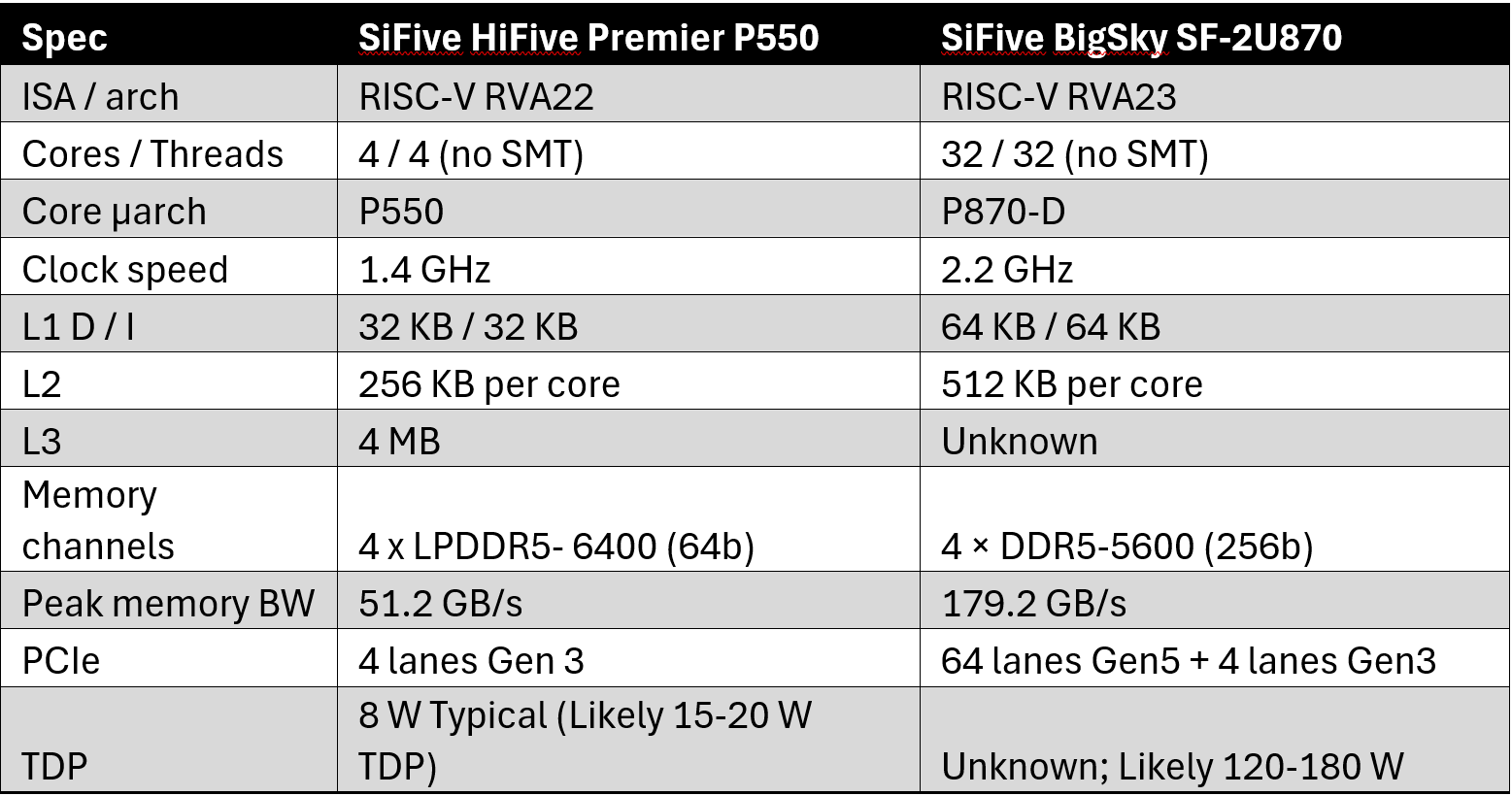
The biggest change here is not the number of cores, the increase of memory bandwidth, or even the over 64x-ing of the PCIe bandwidth. It is the support for the RVA23 standard which means that not only does it have RVV support but it also means that it can run Ubuntu 26.04 straight out of the box which requires RVA23 support.
Now, let’s compare the BigSky’s SoC to the other SoCs that are currently on the market to see how it compares to other devices on the market.
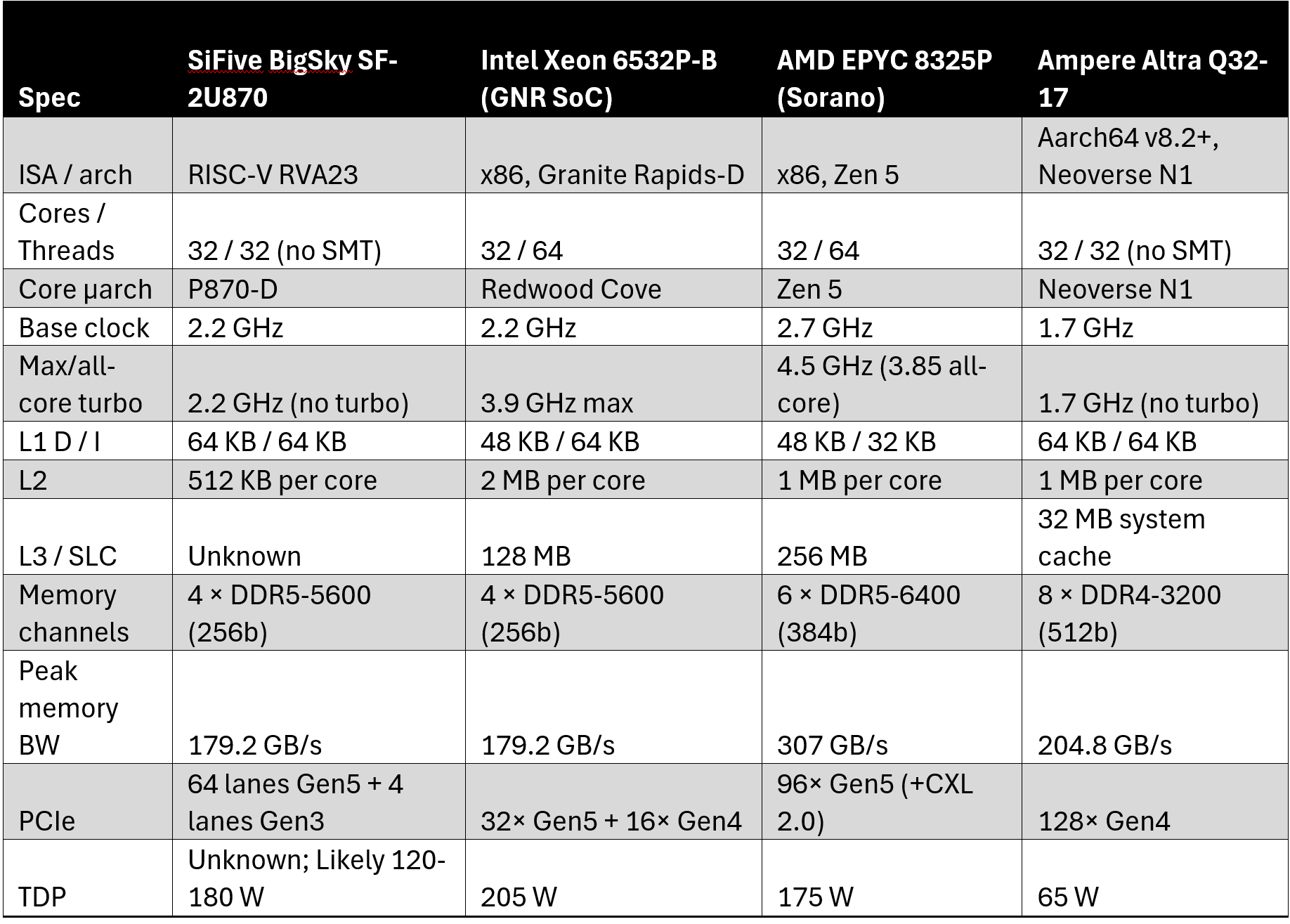
The most comparable SoC is Intel’s Xeon 6532P-B with the same number of cores, the same base clock, and the same memory subsystem. However, this is where they start to differentiate themselves with BigSky having the advantage of more PCIe lanes and likely lower power while the Xeon 6532P-B has the advantages of SMT2 support, a 3.9 GHz boost clock, and a wider CPU core. Looking at the AMD EPYC 8325P and we see that the BigSky platform has few, if any, specification advantages over the EPYC 8325P except for possibly lower power draw.
The most interesting comparison here is against the Ampere Altra Q32-17 because the Altra platform was used in the same development system role that the BigSky system is being marketed for. The BigSky system has the advantage of higher clock speeds, a wider core, and PCIe Gen 5 support with the Ampere Altra’s advantages being the number of lanes, more memory bandwidth, and a lower TDP.
However, the elephant in the room is that the Ampere Altra Q32-17 is the lowest end SKU for the Ampere Altra lineup with the lineup going all the way up to the Q80-33 which is a 80 cores at 3.3 GHz with a 250 W TDP. In an “Apples-to-Apples” comparison, the Q80-33 would beat out the BigSky system in terms of performance.
The BigSky is boring, and as I said up top, that is a good thing. There is a lot of work that into shipping a development platform that just works; one where software developers spend their time writing code instead of chasing firmware that hasn’t caught up to the silicon yet.
SiFive isn’t trying to beat x86 or Arm with the BigSky platform and it doesn’t have to. This is a development system, and for that job it is fit for purpose not because of the memory bandwidth or the PCIe lanes but because it supports RVA23. The one of the largest weaknesses for the RISC-V ecosystem has been the lack of RVA23 silicon and boring platforms that can just run things like CI with no fuss. That is the gap that SiFive is filling with BigSky which hopefully should be available for developers to get their hands on soon.