Nearly 250 years on, the French Revolution’s legacy continues to underpin American culture. Liberty, freedom, and brotherhood! No kings! Actually, let’s kill all of the scientists! Men are born and remain free and equal in rights! The Statue of Liberty! The Louisiana Purchase! Optical telegraphs? Decimal currency: centimes and cents! Decimal units: meters and kilograms! Decimal time??
And while we’re remaking everything in the image of Reason, let’s throw out this ridiculous Gregorian calendar. Seriously, the 9th, 10th, 11th, and 12th months have been named 7 (septem), 8 (octō), 9 (novem), and 10 (decem) for thousands of years and no one has tried to fix it?! We can do better.
And so they did. The French Republican calendar features 12 months of 30 days each, plus five national holidays belonging to no month bringing the day count up to 365. Each month is divided into three décades of 10 days, with 9 days for work and 1 day for rest. (A reminder that the 2-day weekend was a more recent invention.) And the most exciting part: they got to name all the months, days of the décade, and days of the year from scratch.
Instead of venerating a tired Catholic saint, every day of the year would be named for a rural animal, vegetable, or mineral. The new month names would be neologisms themed on the weather in Paris, with rhyming names indicating each season. Beginning with late September-early August, the first month of autumn, they are: Vendémiaire, Brumaire, and Frimaire; Nivôse, Pluviôse, and Ventôse; Germinal, Floréal, and Prairial; and Messidor, Thermidor, and Fructidor. Rough literal English translations would be Vintagearious, Fogarious, and Frostarious; Snowous, Rainous, and Windous; Buddal, Floweral, and Meadowal; and Reapidor, Heatidor, and Fruitidor. An Englishman writing in 1800 instead offered the sublimely ridiculous: Wheezy, Sneezy, and Freezy; Slippy, Drippy, and Nippy; Showery, Flowery, and Bowery; Hoppy, Croppy, and Poppy.
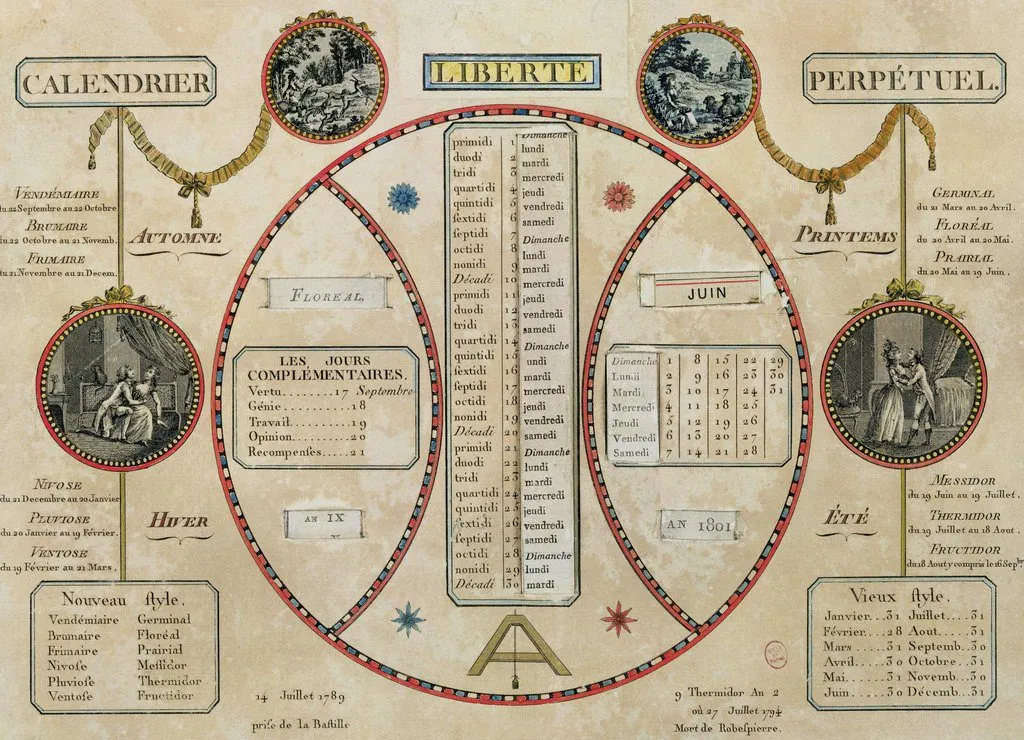 Scan of a French Republican calendar from around 1801, titled “Liberte”. Prominently visible are the current month and year; the day of the week associated with each date; and the equivalent Gregorian month, date, and year.
As it turns out, Napoleon abolished the Republican calendar a few years after he declared himself emperor. In the year 14 (1805), France returned to the loving embrace of the Gregorian calendar, save for a brief fling in 79 (1871) under the Paris Commune’s revolutionary government. Today, the calendar is mostly a historical footnote. Its most notable legacy is perhaps the name of the dish Lobster Thermidor, named for a play that was named for the month of July-August.
Emperor Napoleon did not abolish people noticing the Gregorian calendar was stupid and designing replacements for it, which kept happening. What made the French Republican calendar unique was its official adoption as a national calendar. For example, the 1849 Positivist Calendar features months named Moses, Homer, Aristotle, Archimedes, Caesar, St. Paul, Charlemagne, Dante, Gutenberg, Shakespeare, Descartes, Frederick, and, uh, Bichat. Most notable calendar reform movements since then have, boringly but practically, stuck with the Julian month names. The postmodern 1963 Discordian Calendar specifies five seasons named Chaos, Discord, Confusion, Bureaucracy, and The Aftermath.
For more contemporary proposed month names, we have to look farther afield. Inspired by the Martian calendar used in Robert Heinlein’s 1949 science fiction novel Red Planet, aerospace engineer Thomas Gangale devised the Darian Calendar in 1985. A Martian year is 668 sols (or 686 Earth days) long, so the default (and difficult to ridicule) solution of using twelve existing names won’t work. Gangale’s proposal, named for his son Darius, opts for 24 months of 28 sols each, named for the twelve Zodiac constellations and their Sanskrit translations. If you’re familiar with Homestuck, you may notice something familiar about the Sanskrit months of Dhanus, Makara, Kumba, Mina, Misha, Rishabha, Mithuna, Karka, Simha, Kanya, Tula, and Vrishika. The Darian sols of the week, like the Julian and Gregorian day names, are based on the classical planets: Solis, Lunae, Martis, Mercurii, Jovis, Veneris, and Saturni.
Martian month names have been an inspiring creative outlet for many dreamers since 1985. It’s an awfully seductive question. What are twenty-four related names inspired by the future that you envision?