Intro
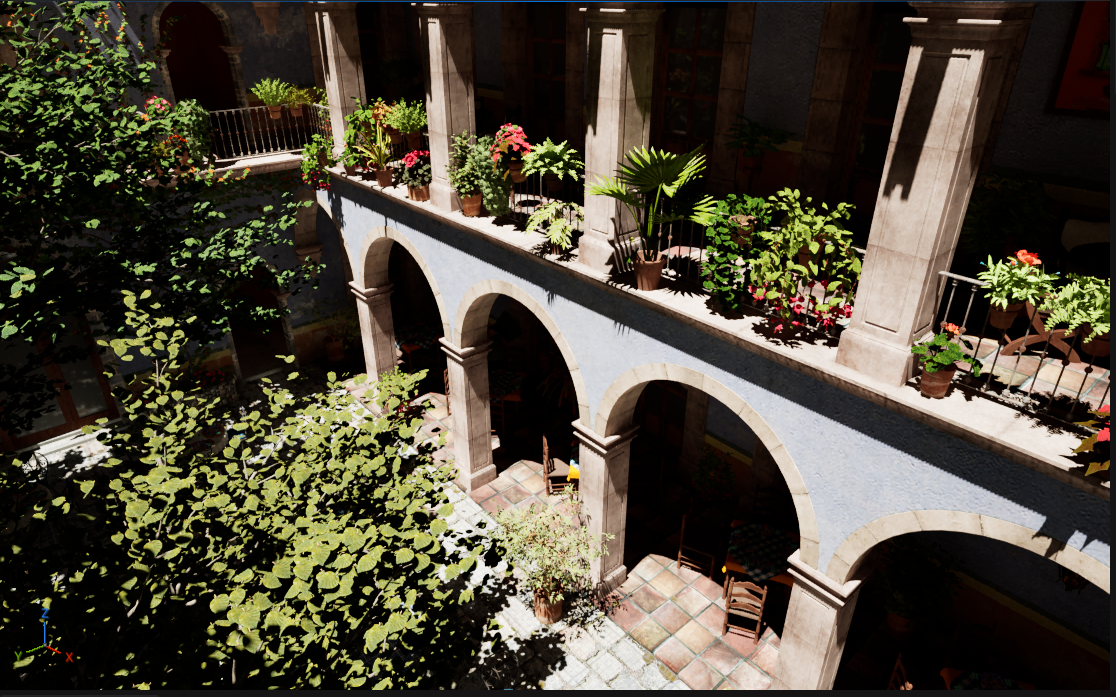
Radiance cascades is a technique that massively improves global illumination without much extra cost or accumulation.
Radiance Cascades
For this article I'll assume you already know the basics of RC,
RC Recap
The main point of RC is combining the samples/rays for our GI in a way that utilizes them most effectively.
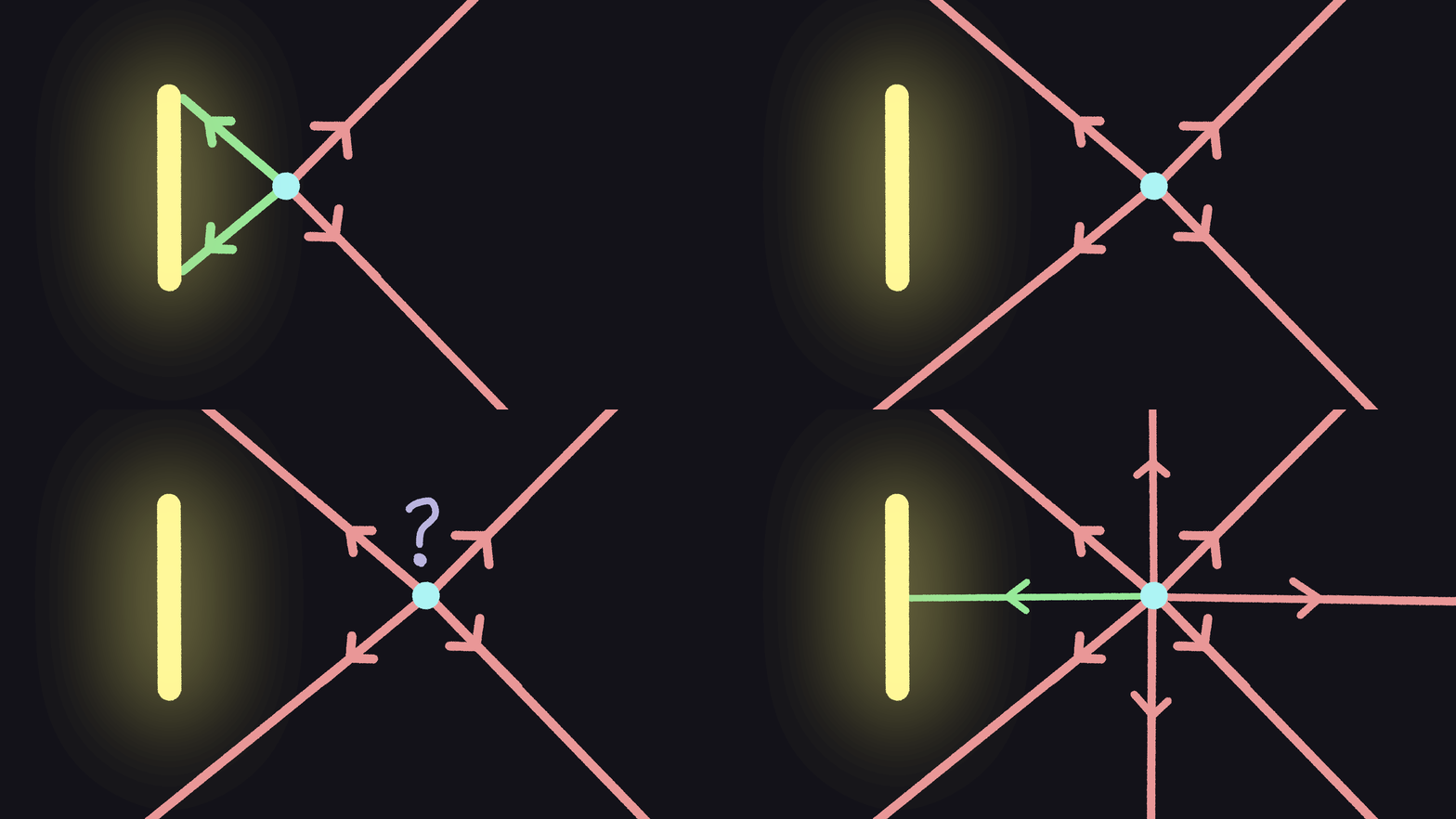
In addition when you are close to a light you need more probes (spatial resolution) to get correct shadows
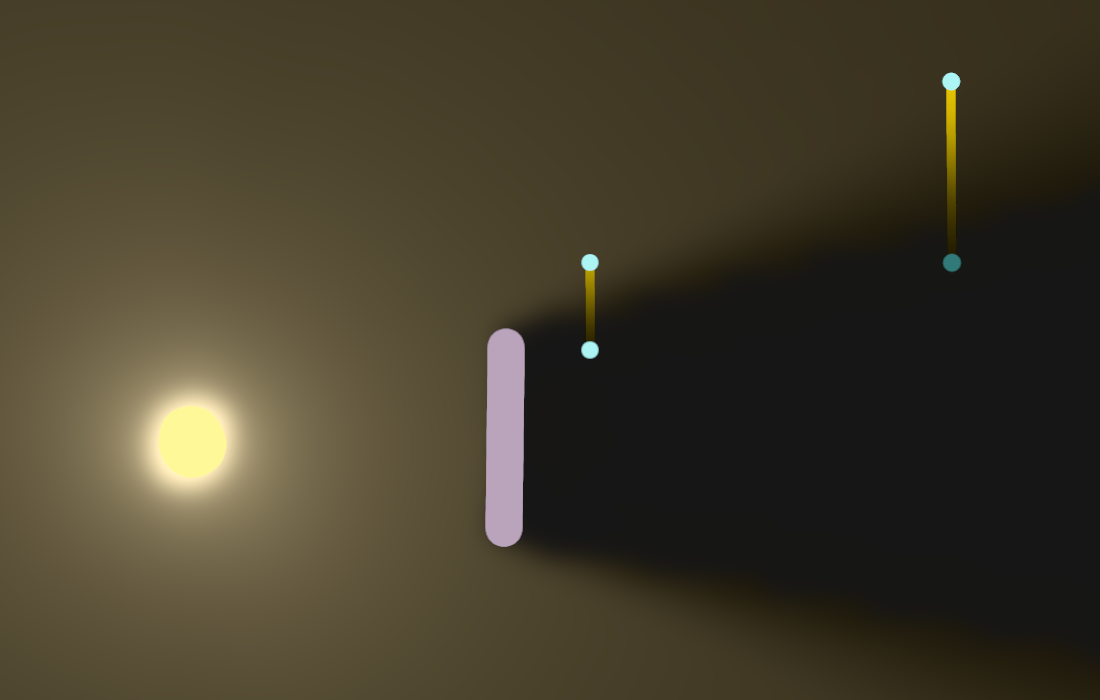
To interpolate the half shadow, we need the light at both sides. Further away this spacing can be bigger to still get probes on both sides.
By merging layers ranging from (high resolution, low direction count) to (low resolution, high direction count) that correspond to an interval of the ray, we get best of both of these in the range that matters.
Probes
Problems of 3D
RC requires storing our light into a grid of probes.
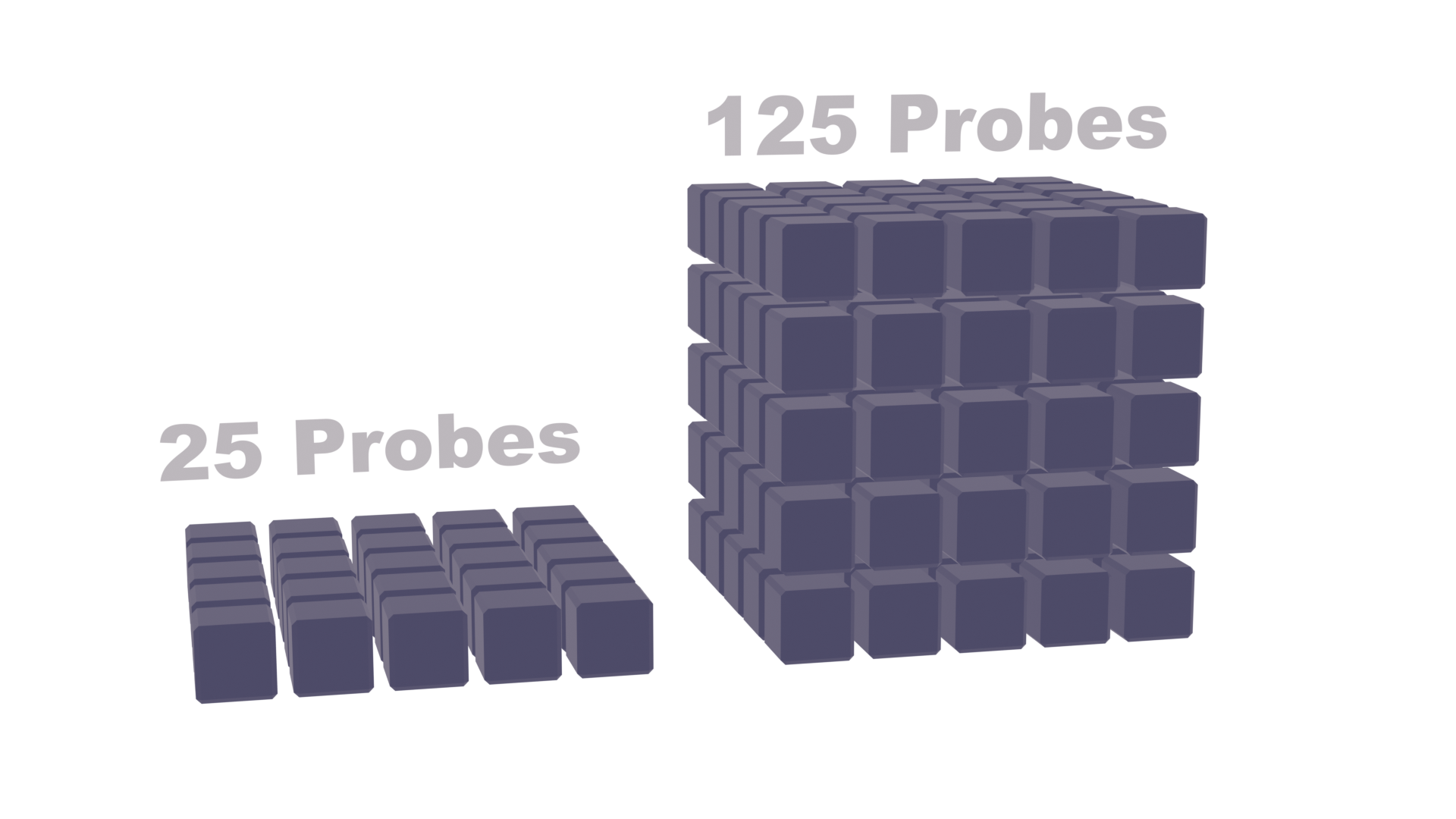
Even if we would only put this around the camera it would cost way too much memory to get a decent resolution.
Sparse probes
To only spawn probes on visible surfaces, we reconstruct world positions from the screen.
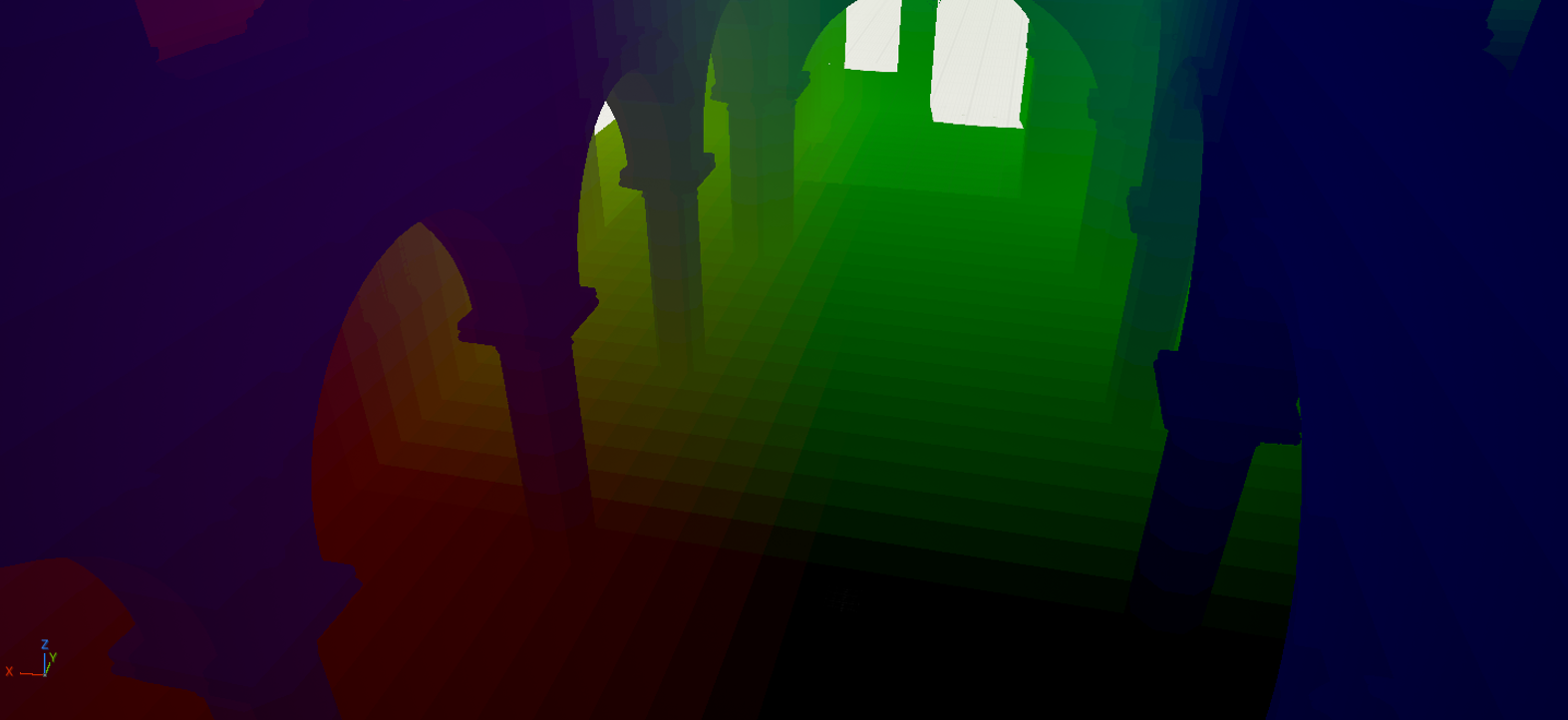
To store our light in these cells we need a buffer of probes.
// HLSL, Compute: "GatherC0Probes.hlsl"
//For now most kinds of hash tables are fine
#include "HashTable.hlsl"

RWStructuredBuffer‹uint› ActiveProbes;
RWStructuredBuffer‹uint› ActiveCounter;

[numthreads(8, 8, 1)]
void MainCS(uint2 DispatchThreadId : SV_DispatchThreadID)
{
    //We run over every pixel, to allocate a probe at its world position
	uint2 PixelId = DispatchThreadId;

	// Check that we are in scope
    if (any(float2(DispatchThreadId) >= ViewportPixelSize)) {
        return;
    }

    float2 UV = (float2(PixelId) + 0.5f) / float2(ViewportPixelSize);

    float DeviceZ = SampleSceneDepth(UV);
    if (DeviceZ == 0) {
        return;
    }

    //We can reconstruct the world position from the depthbuffer using our camera view, most engines have a helper for this
    float3 WorldPos = ReconstructWorldPositionFromDepth(DeviceZ);

	float VoxelSize = BaseVoxelSize;
	int3 Cell = int3(floor((WorldPos / VoxelSize)));

    //For our Key we simply shift the bits of the cell into 1 big uint
    //Later we store more info in here so we dont use all the bits
    //Make sure to add + (1u ‹‹ (BitsPerInt - 1)) to each value to make them unsigned
    //So our key is
    //Bits:
    // xxxxxxxxxxxxxxxxyyyyyyyyyyyyyyyyzzzzzzzzzzzzzzzz0000000000000000
	uint64_t Key = PackProbeKey(Cell);

    //Add our key to the table

    //Get a random index from our Key, most hashing functions work on 32 bit uints so we do this
    uint Index = Hash(uint(Key) ^ Hash(uint(Key >> 32)));

    bool Added = HashTableAdd(Key,  [&]: Index, Cascade: 0);
    if (Added)
    {
        //Add to active probes for next passes
        uint Counter;
        InterlockedAdd(ActiveCounter[0], 1, Counter);
        ActiveProbes[Counter] = Index;
    }
}
We can visualize/debug our probes in a separate pass
// HLSL, Compute: "Output.hlsl"
#include "HashTable.hlsl"
#include "ColorFromHash.hlsl"

[numthreads(8, 8, 1)]
void MainCS(uint2 DispatchThreadId : SV_DispatchThreadID)
{
    //Go over every pixel and check if the probe is there
	uint2 PixelId = DispatchThreadId;

	// Check that we are in scope
    if (any(float2(DispatchThreadId) >= ViewportPixelSize)) {
        return;
    }

    float VoxelSize = BaseVoxelSize;
	int3 Cell = int3(floor((WorldPos / VoxelSize)));
	uint64_t Key = PackProbeKey(Cell);

    uint Index = Hash(uint(Key) ^ Hash(uint(Key >> 32)));
	bool Found = HashTableFind(Key, [&]: Index, Cascade: 0 );

    if (Found) {
        //Since our hashtable is unstable, using debugindex will flicker, you can use the key instead for now.
        Output[PixelId] = float4(ColorFromHash(Hash(Index)), 1.0);
    }else {
        Output[PixelId] = float4(1,0,0,1);
    }
}
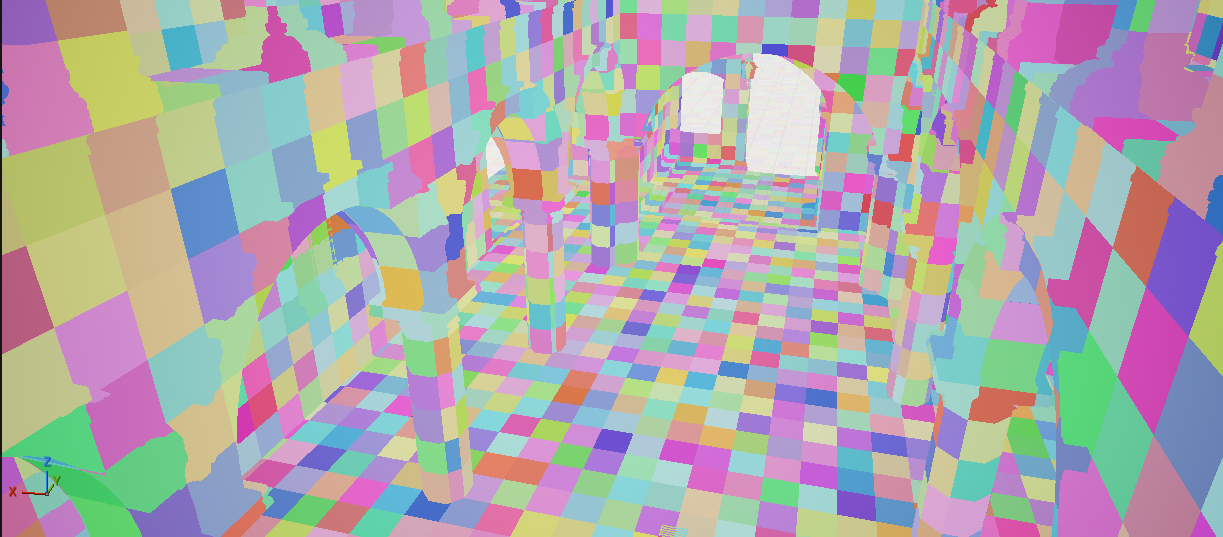
Cascades
With this gather pass we now have a single cascade of probes allocated.
// HLSL, Compute: "FillCascades.hlsl"
#include "HashTable.hlsl"

// Since each pass continues from the last,
// this starts off with the counter from the gather, and then is set to the counter we're filling for the next cascade.
// So each pass launches the next
RWStructuredBuffer‹uint› PrevActiveProbes;
RWStructuredBuffer‹uint› PrevActiveCounter;


RWStructuredBuffer‹uint› NextActiveProbes;
RWStructuredBuffer‹uint› NextActiveCounter;


//The cascade we are filling, so this starts at 1
uint Cascade;

[numthreads(64, 1, 1)]
void MainCS(uint DispatchThreadId : SV_DispatchThreadID)
{
	uint ProbeId = DispatchThreadId;

	// Check that we are in scope (since the dispatch gets ceiled to group count)
	if (ProbeId >= PrevActiveCounter[0])
	{
		return;
	}

    // Get the actual key out of the active list which just contains hashtable id's
    // Im adding the cascade since my hashtable stores the separate tables in 1 big buffer
    uint64_t ProbeKey = HashTable[(Cascade-1) * HashTableSize + PrevActiveProbes[ProbeId]];

    // Since our key is just bit shifted positions we can unpack it again.
	ProbeKeyInfo KeyData = UnpackProbeKey(ProbeKey);

    // Get parent key by halving the position of our current key
	uint64_t HighKey = PackProbeKey(KeyData.Cell >> 1);

    uint Index = Hash(uint(HighKey) ^ Hash(uint(HighKey >> 32)));
    if (HashTableAdd(HighKey, Cascade, Index))
	{
		// Fill in the active list which we use for next pass.
		uint Counter;
		InterlockedAdd(NextActiveCounter[0], 1, Counter);
		NextActiveProbes[Counter] = Index;

    }
}
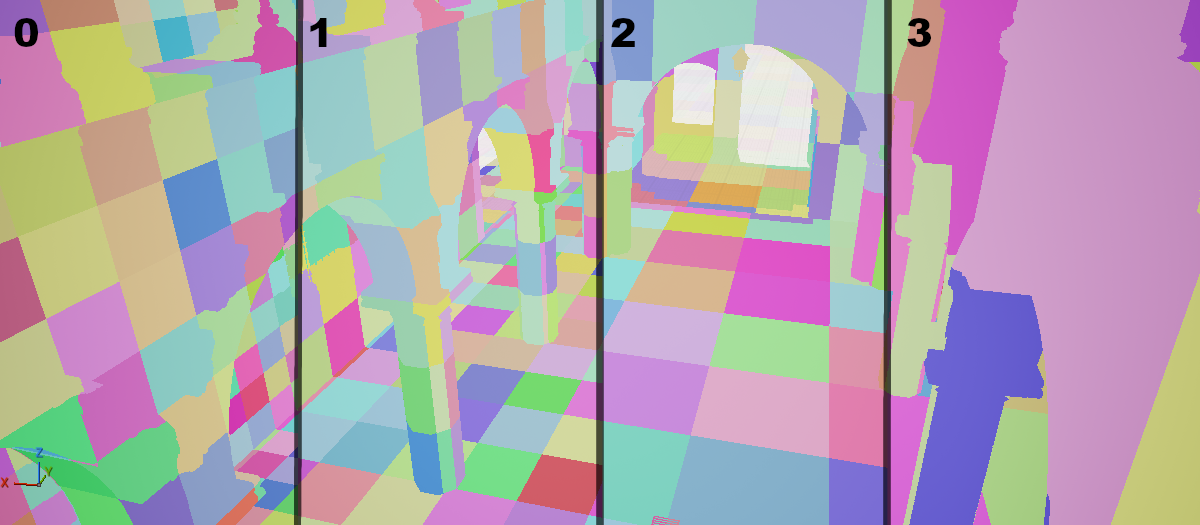
Note that when visualizing your higher cascades you need to shift your positions when creating the key
Rays
From probes vs from screen
Normally to get the lighting at every probe, we shoot a set amount of rays into random directions from each probe.
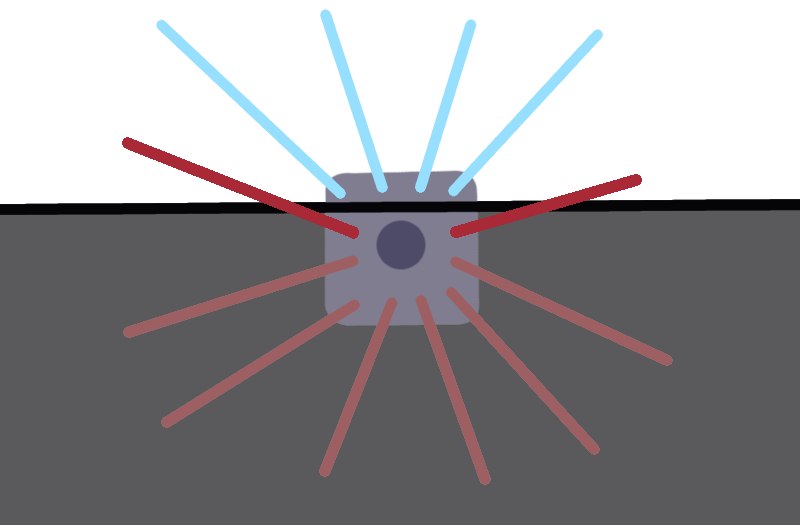
The 2 red rays in this probe here got unfairly blocked because the probe is too far into the ground
This would cause dark splotches in our lighting.
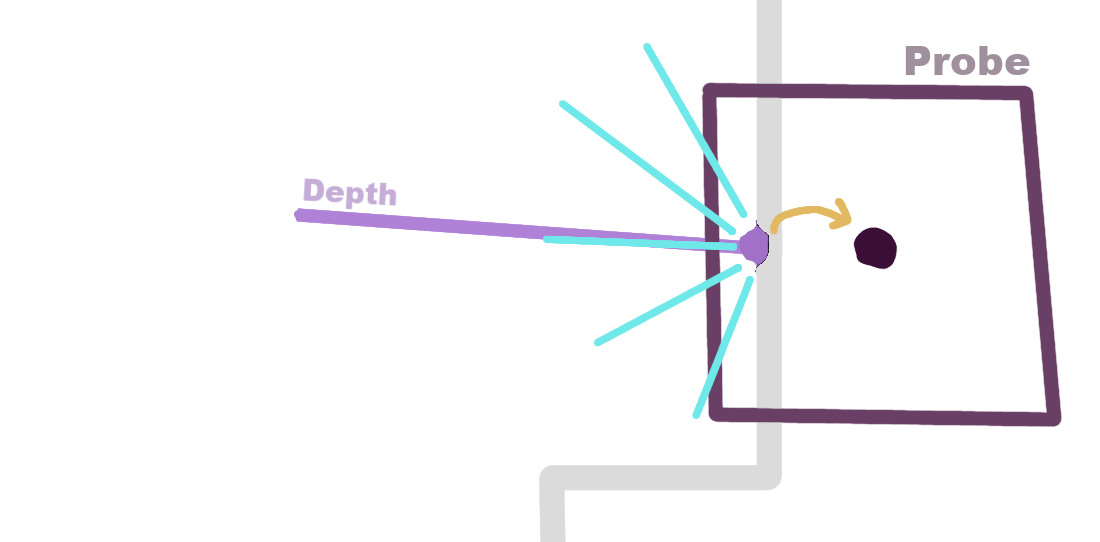
Here the blue rays are sent from the position gotten from the screen, then moved into the closest probe.
Splitting into intervals
However, in RC each cascade does not contain the full ray, only a interval/segment of it.
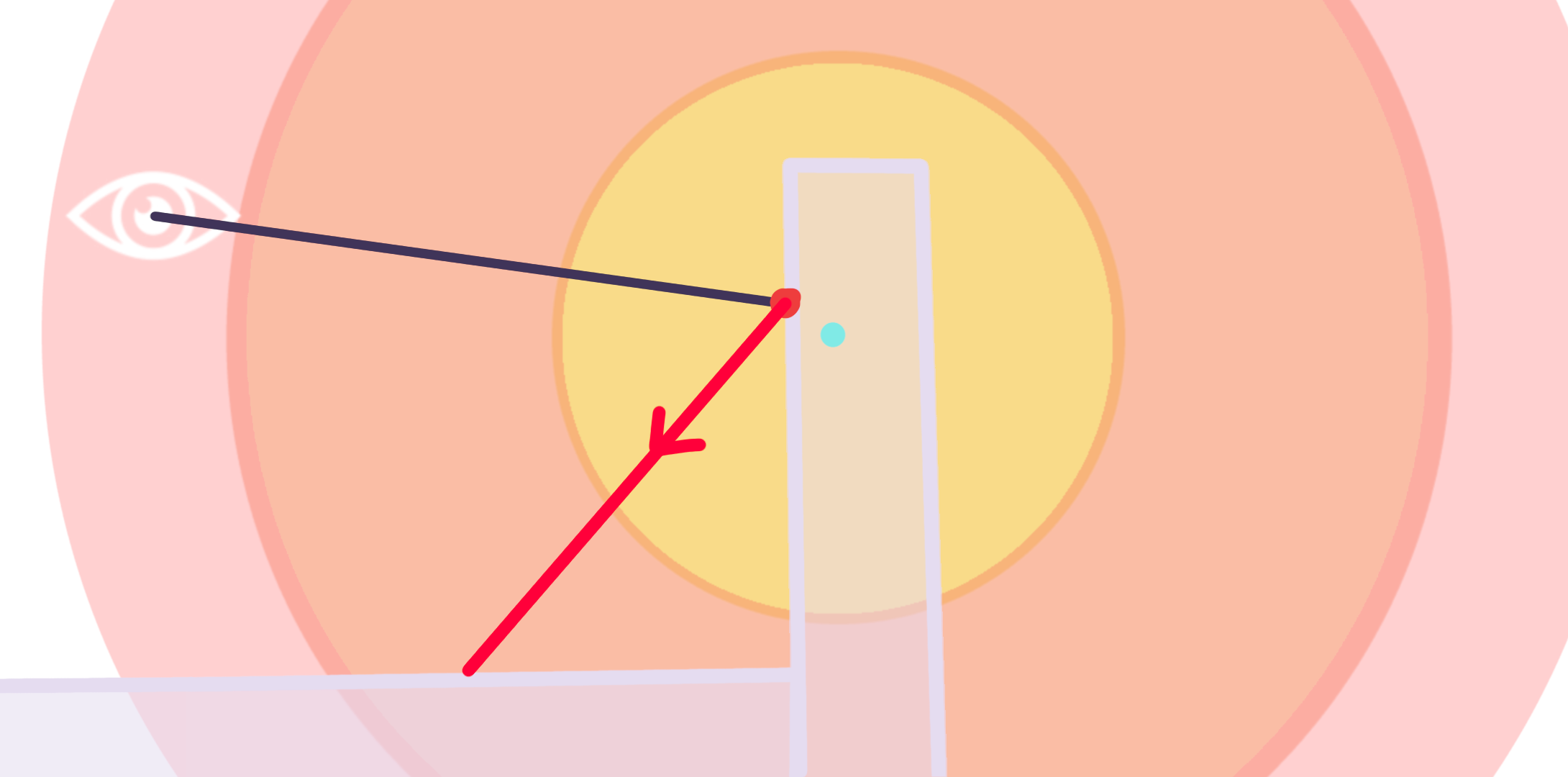
The red ray hit inside the second cascade, and thus is binned into the second and first cascade.
We store this in multiple bins per probe, one for each direction. We need to lay out these directions evenly and most importantly in a way that scales so that our merging evenly combines them into lower cascades.
// HLSL, Compute:
#include "HashTable.hlsl"
#include "EncodeDirection.hlsl"

RWStructuredBuffer‹uint4› TotalRadiance;
RWStructuredBuffer‹uint› Weights;
RWStructuredBuffer‹uint› DepositCounts;

static const uint BaseDirections = 4; // This means 32 actual direction bins
static const uint kNumCascades = 4;
static const float kC0Len = 1.5958; // sqrt(2*BaseDirections*BaseDirections / (4*PI)),

[shader("raygeneration")] void MainRG()
{
	uint2 PixelCoord = DispatchRaysIndex().xy;

    float2 UV = (float2(PixelCoord) + 0.5f) / float2(ViewportPixelSize);

	FGBufferData GBuffer = GetGBufferDataFromSceneTextures(UV);

    float DeviceZ = SampleSceneDepth(UV);
    if (DeviceZ ‹= 0) {
    	return;
    }
    float3 WorldPos = ReconstructWorldPositionFromDepth(DeviceZ);

    //Also sample worldnormal from GBuffer, could also reconstruct from depth dx/dy
    float3 Normal = SampleWorldNormal(UV);

	FRayDesc Ray;
    // Add a bit of offset along the normal, this is needed since reconstructing from the depth is not perfectly accurate.
	Ray.Origin = WorldPos + Normal * 0.1;

	uint64_t TopKey = MakeProbeKey(WorldPos, CameraPos);

    uint TopProbeIndex = Hash(uint(TopKey) ^ Hash(uint(TopKey >> 32)));
	bool Found = HashTableFind(TopKey, [&]: TopProbeIndex, Cascade: 0);
	if (!Found)
	{
		//Shouldn't really be possible unless there is a mismatch with our gather
		return;
	}

	float3 Radiance = 0;

    Ray.Direction = RandomHemiSphere(Normal).xyz;

    //Trace the actual ray, this should trace 1 hit with direct lighting applied.
	FMaterialClosestHitPayload Payload = TraceRayWithLighting(Ray, ..., [&]: Radiance);


	//Fill into containing cascades

    // Find the cascade the ray hit inside based on its hit length
    uint RayHitCascade = kNumCascades - 1;
    if (Payload.IsHit())
    {
        uint HitCascade = ceil(max(0.5 * log2(Payload.HitT / (kC0Len * BaseVoxelSize)), 0.0));
        //Clamp to the highest cascade we have, since we cannot allocate infinite cascades
        RayHitCascade = min(HitCascade, kNumCascades - 1);
    }

    //We fill the hit cascade and the ones before it, since the ray traveled through those intervals and not the ones after
    for (uint Cascade = 0; Cascade ‹= RayHitCascade; ++Cascade)
    {

        uint64_t Key = MakeProbeKey(WorldPos, CameraPos);
        ProbeKeyInfo KeyData = UnpackProbeKey(Key);

        uint64_t CascadeKey = PackProbeKey(KeyData.Cell >> Cascade);

        uint ProbeIndex = Hash(uint(CascadeKey) ^ Hash(uint(CascadeKey >> 32)));
        bool Found = HashTableFind(CascadeKey, [&]: ProbeIndex, Cascade);
        if (Found)
        {
            //We only deposit the full color if the ray hit in this cascade
            bool HitCascade = (Cascade == RayHitCascade);

            //Directions increase every cascade
            uint DirectionCount = BaseDirections ‹‹ Cascade;

            //I calculate a offset to store the probes for each cascade in 1 big buffer instead of separate ones per cascade, which is also valid.
            uint CascadeIndex = Cascade * MaximumProbes * BinsPerProbe(BaseDirections);

            //Convert the ray's direction to the index of the bin we store that direction in.
            uint DirectionalBinIndex = DirToLinear(Ray.Direction.xyz, DirectionCount);

            uint SlotIndex = CascadeIndex + ProbeIndex * BinsPerProbe(DirectionCount) + DirectionalBinIndex;

            float3 Rad = HitCascade ? Radiance : float3(0, 0, 0);

            //Normally you cannot do atomics on floats, so I pack the float values to a fixed point uint,
            // This is a simple multiply/divide since the values are never negative

            //Attomically deposit our hit, since multiple rays deposit to the same probe
            InterlockedAdd(TotalRadiance[SlotIndex].x, PackFloatUnsigned(Rad.x));
            InterlockedAdd(TotalRadiance[SlotIndex].y, PackFloatUnsigned(Rad.y));
            InterlockedAdd(TotalRadiance[SlotIndex].z, PackFloatUnsigned(Rad.z));
            InterlockedAdd(TotalRadiance[SlotIndex].w, HitCascade ? 0u : 1u); // Transmittance, so rays that went through but didn't hit

            InterlockedAdd(Weights[SlotIndex], 1u); // Used for the "quality" of the bin when merging, to count how many rays got deposited in it
            InterlockedAdd(DepositCounts[Cascade * MaximumProbes + ProbeIndex], PackedLodWeight); // Same but for the whole probe
        }
	}
}
With this we should now have every cascade filled with its interval of light.
Merging
We now want to merge these intervals together so we can get our entire path of light.
However we need to also keep in account the transparency in this merging.
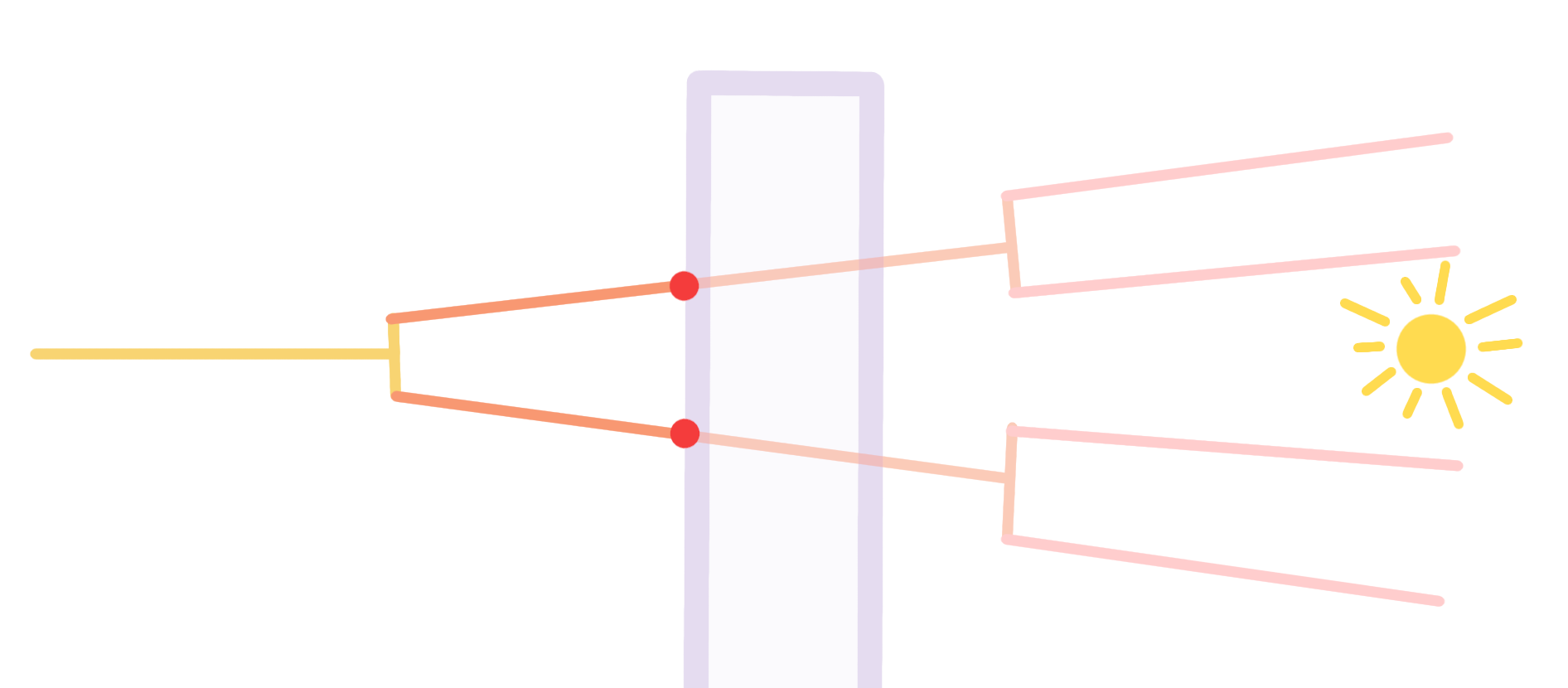
Here the middle interval is blocked, so we should not merge the light from the last interval, or it will leak in front of the wall
// HLSL, Compute: "Merging.hlsl"
#include "HashTable.hlsl"

RWStructuredBuffer‹uint› ActiveProbes;
RWStructuredBuffer‹uint› ActiveCounter;

uint Cascade;

RWStructuredBuffer‹uint4› TotalRadiance;
RWStructuredBuffer‹uint› Weights;
RWStructuredBuffer‹uint› DepositCounts;

//Separate outputbuffer our merging outputs into
RWStructuredBuffer‹float4› MergedRadiance;

[numthreads(64, 1, 1)]
void MainCS(uint DispatchThreadId : SV_DispatchThreadID)
{
	uint ProbeId = DispatchThreadId;

	// Check that we are in scope
	if (ProbeId >= ActiveCounter[0])
	{
		return;
	}

    //Get current probe
	uint ProbeIndex = ActiveProbes[ProbeId];

	uint64_t ProbeKey = HashTable[(Cascade) * HashTableSize + ProbeIndex];
    ProbeKeyInfo KeyData = UnpackProbeKey(ProbeKey);

    //The parent cell is bigger so halve its position
	int3 ParentCell = (KeyData.Cell) >> 1;

    //Direction count of this cascade
	uint DirectionCount = BaseDirections ‹‹ Cascade;

	uint CascadeIndex = Cascade * HashTableSize * BinsPerProbe(BaseDirections);
	uint ParentCascadeIndex = (Cascade + 1) * HashTableSize * BinsPerProbe(BaseDirections);
	uint ParentDirCount = BaseDirections ‹‹ (Cascade + 1);

	for (int i = 0; i ‹ BinsPerProbe(DirectionCount); ++i)
	{
		//Load own Radiance
	    uint SlotIndex = CascadeIndex + ProbeIndex * BinsPerProbe(DirectionCount) + i;

        //How much rays got into this bin.
	    float Weight = UnpackFloatUnsigned(Weights[SlotIndex]);

	    uint4 PackedRadiance = TotalRadiance[SlotIndex];
        float4 UnpackedRadiance = float4(UnpackFloatUnsigned(PackedRadiance.x), UnpackFloatUnsigned(PackedRadiance.y),
	                                UnpackFloatUnsigned(PackedRadiance.z), UnpackFloatUnsigned(PackedRadiance.w));

        float3 CurrentRadiance = UnpackedRadiance.xyz / Weight;
	    //Amount of transmission through this probe, based on the rays that traveled through but didnt hit.
        float TransmittedWeight = UnpackedRadiance.w / Weight;

        float3 ParentRadiance = 0;
        //Cant merge the parent of the highest cascade
        if (Cascade ‹ NumCascades - 1)
        {
                uint64_t ParentCascadeKey = PackProbeKey(ParentCell);

                uint ParentIndex = Hash(uint(ParentCascadeKey) ^ Hash(uint(ParentCascadeKey >> 32)));
                bool Found = HashTableFind(ParentCascadeKey, [&]: ParentIndex, Cascade + 1);
                if (Found)
                {
                    // The parent has 4 times as many directions, so go over the 4 directions in the parent
                    float4 DirRadiance = 0;
                    for (uint d = 0; d ‹ 4; ++d)
                    {
                        uint ParentSlotIndex = ParentCascadeIndex + ParentIndex * BinsPerProbe(ParentDirCount) + i * 4 + d;
                        DirRadiance += MergedRadiance[ParentSlotIndex];
                    }
                    ParentRadiance = (DirRadiance.xyz / DirRadiance.w);
            }
        }
        MergedRadiance[SlotIndex] = (Weight ‹= 0.0001)
                                            ? 0
                                            : float4(CurrentRadiance + ParentRadiance * TransmittedWeight, 1);
    }
}
This merges our directions from the closest probe. Instead we want to check all the above probes and blend between them.
It's also important to keep in mind that our grid is sparse, meaning the 8 surrounding probes will probably not all be there.
// HLSL, Compute: "Merging.hlsl"
#include "HashTable.hlsl"

RWStructuredBuffer‹uint› ActiveProbes;
RWStructuredBuffer‹uint› ActiveCounter;

uint Cascade;

RWStructuredBuffer‹uint4› TotalRadiance;
RWStructuredBuffer‹uint› Weights;
RWStructuredBuffer‹uint› DepositCounts;

//Separate outputbuffer our merging outputs into
RWStructuredBuffer‹float4› MergedRadiance;

[numthreads(64, 1, 1)]
void MainCS(uint DispatchThreadId : SV_DispatchThreadID)
{
	uint ProbeId = DispatchThreadId;

	// Check that we are in scope
	if (ProbeId >= ActiveCounter[0])
	{
		return;
	}

    //Get current probe
	uint ProbeIndex = ActiveProbes[ProbeId];

	uint64_t ProbeKey = HashTable[(Cascade) * HashTableSize + ProbeIndex];
    ProbeKeyInfo KeyData = UnpackProbeKey(ProbeKey);

    //The parent cell is bigger so halve its position
	int3 ParentCell = (KeyData.Cell - 1) >> 1;

    //Get the part of the corner we are in, this is needed so we can weigh by the corner, <changed>
    // since we sit at 75% to the nearest parent and 25% to the furthest on each axis <changed>
	int3 NearCorner = ~KeyData.Cell & 1; <changed>

    //Direction count of this cascade
	uint DirectionCount = BaseDirections ‹‹ Cascade;

	uint CascadeIndex = Cascade * HashTableSize * BinsPerProbe(BaseDirections);
	uint ParentCascadeIndex = (Cascade + 1) * HashTableSize * BinsPerProbe(BaseDirections);
	uint ParentDirCount = BaseDirections ‹‹ (Cascade + 1);

	for (int i = 0; i ‹ BinsPerProbe(DirectionCount); ++i)
	{
		//Load own Radiance
	    uint SlotIndex = CascadeIndex + ProbeIndex * BinsPerProbe(DirectionCount) + i;

        //Weight of this bin, this was based on how much rays got binned into it.
	    float Weight = UnpackFloatUnsigned(Weights[SlotIndex]);

	    uint4 PackedRadiance = TotalRadiance[SlotIndex];
        float4 UnpackedRadiance = float4(UnpackFloatUnsigned(PackedRadiance.x), UnpackFloatUnsigned(PackedRadiance.y),
	                                UnpackFloatUnsigned(PackedRadiance.z), UnpackFloatUnsigned(PackedRadiance.w));

        float3 CurrentRadiance = UnpackedRadiance.xyz / Weight;
	    //Amount of transmission through this probe, based on the rays that traveled through but didnt hit.
        float TransmittedWeight = UnpackedRadiance.w / Weight;

        float3 ParentRadianceSum = 0; <changed>
        float ParentRadianceWeight = 0; <changed>
        //Cant merge the parent of the highest cascade
        if (Cascade ‹ NumCascades - 1)
        {
            //Trilinearly interpolate each of the 8 probes above us <changed>
            for (uint c = 0; c ‹ 8; ++c) <changed>
            { <changed>
                int3 Offset = int3(c & 1, (c >> 1) & 1, c >> 2); <changed>
                int3 Corner = ParentCell + Offset; <changed>

                //Trilinear weight based on where we are compared to parent <changed>
                float3 AxisWeight = Offset == NearCorner ? 0.75 : 0.25; <changed>
                float InterpWeight = AxisWeight.x * AxisWeight.y * AxisWeight.z; <changed>

                uint64_t ParentCascadeKey = PackProbeKey(Corner); <changed>

                uint ParentIndex = Hash(uint(ParentCascadeKey) ^ Hash(uint(ParentCascadeKey >> 32)));
                bool Found = HashTableFind(ParentCascadeKey, [&]: ParentIndex, Cascade + 1);
                if (Found)
                {
                    //Weight of this probe, this was based on how much rays got binned into it. <changed>
                    uint DepositCount = DepositCounts[((Cascade + 1) * HashTableSize) + ParentIndex]; <changed>
                    //Empty probes have no contribution <changed>
                    if (DepositCount ‹= 0) <changed>
                    { <changed>
                        continue; <changed>
                    } <changed>

                    // The parent has 4 times as much directions, so go over the 4 directions in the parent
                    float4 DirRadiance = 0;
                    for (uint d = 0; d ‹ 4; ++d)
                    {
                        uint ParentSlotIndex = ParentCascadeIndex + ParentIndex * BinsPerProbe(ParentDirCount) + i * 4 + d;
                        DirRadiance += MergedRadiance[ParentSlotIndex];
                    }
                    if (DirRadiance.w > 0.0) <changed>
                    { <changed>
                        float DepositQuality = UnpackFloatUnsigned(DepositCount); <changed>
                        float QualityInterpWeight = InterpWeight * DepositQuality; <changed>
                        ParentRadianceSum += (DirRadiance.xyz / DirRadiance.w) * QualityInterpWeight; <changed>
                        //Accumulate weight, since some probes are skipped <changed>
                        ParentRadianceWeight += QualityInterpWeight; <changed>
                    } <changed>
                }
            } <changed>
        }
        //Normalize parent <changed>
        float3 ParentRadiance = ParentRadianceWeight > 0.00001 ? (ParentRadianceSum / ParentRadianceWeight) : 0; <changed>

        MergedRadiance[SlotIndex] = (Weight ‹= 0.0001)
                                            ? 0
                                            : float4(CurrentRadiance + ParentRadiance * TransmittedWeight, 1);
    }
}
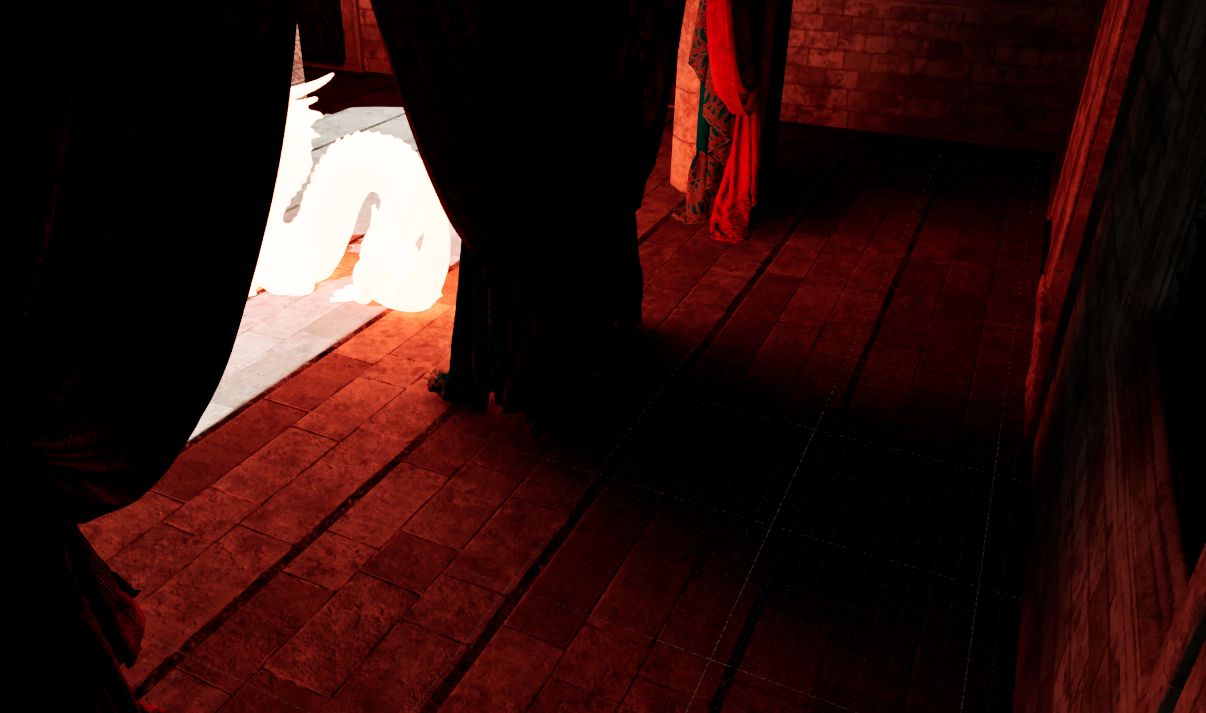
With this we now have our full ray inside of the lowest cascade.
// HLSL, Compute: "Output.hlsl"

... Find probe of the pixel

... Trilinearly interpolate probes

float3 TotalRadiance = 0;
float TotalWeight = 0;

for (uint i = 0; i ‹ BinsPerProbe(DirectionCount); ++i)
{
    float3 Dir = LinearToDir(i, DirectionCount);
    //We have to normalize by NDotL to keep correct incomming light
    float NdotL = max(0.0, dot(Dir, Normal));
    if (NdotL ‹= 0)
    {
        continue;
    }

    uint CascadeIndex = DisplayCascade * HashTableSize * BinsPerProbe(BaseDirections);
    uint BuffIndex = CascadeIndex + Index * BinsPerProbe(DirectionCount) + i;
    float4 MergedRad = ProbeMergedRadiance[BuffIndex];
    if (MergedRad.w > 0.0)
    {
        float Weight = NdotL * UnpackFloatUnsigned(DepositCount);
        TotalRadiance += MergedRad.xyz * Weight;
        TotalWeight += Weight;
    }
}
//Renormalize
if (TotalWeight > 0.0)
{
    RadSum += TotalWeight >= 0 ? (TotalRadiance / TotalWeight) * InterpWeight * LodWeights[Level] : 0;
    WeightSum += InterpWeight * (LodWeights[Level]);
}
LODs
Currently we have a even grid of probes, which works fine for small scenes. But our probes get very small on the screen further away.
// HLSL,

//We compute the level based on distance to the camera
uint ComputeLevel(float3 WorldPos, float3 CameraPos)
{
    //Using Chebyshev distance, aka distance as a square this makes the transition less noticable.
	float3 Distance = abs(WorldPos - CameraPos);
	float Radius = max(Distance.x, max(Distance.y, Distance.z));

	float LodFloat = log2(Radius / LevelBaseDist);
	uint Lower = clamp((uint)ceil(LodFloat), 0, MaxLOD);
	return Lower;
}

//Everywhere where we use the voxel size, we should instead use the size based on the level
float LevelVoxelSize(uint Level)
{
	return BaseVoxelSize * (float)(1u ‹‹ Level);
}

uint64_t MakeProbeKey(float3 WorldPos, float3 CameraPos)
{
	uint Level = ComputeLevel(WorldPos, CameraPos);
	float VoxelSize = LevelVoxelSize(Level);
	int3 Cell = int3(floor((WorldPos / VoxelSize)));

	return PackProbeKey(Cell, Level);
}
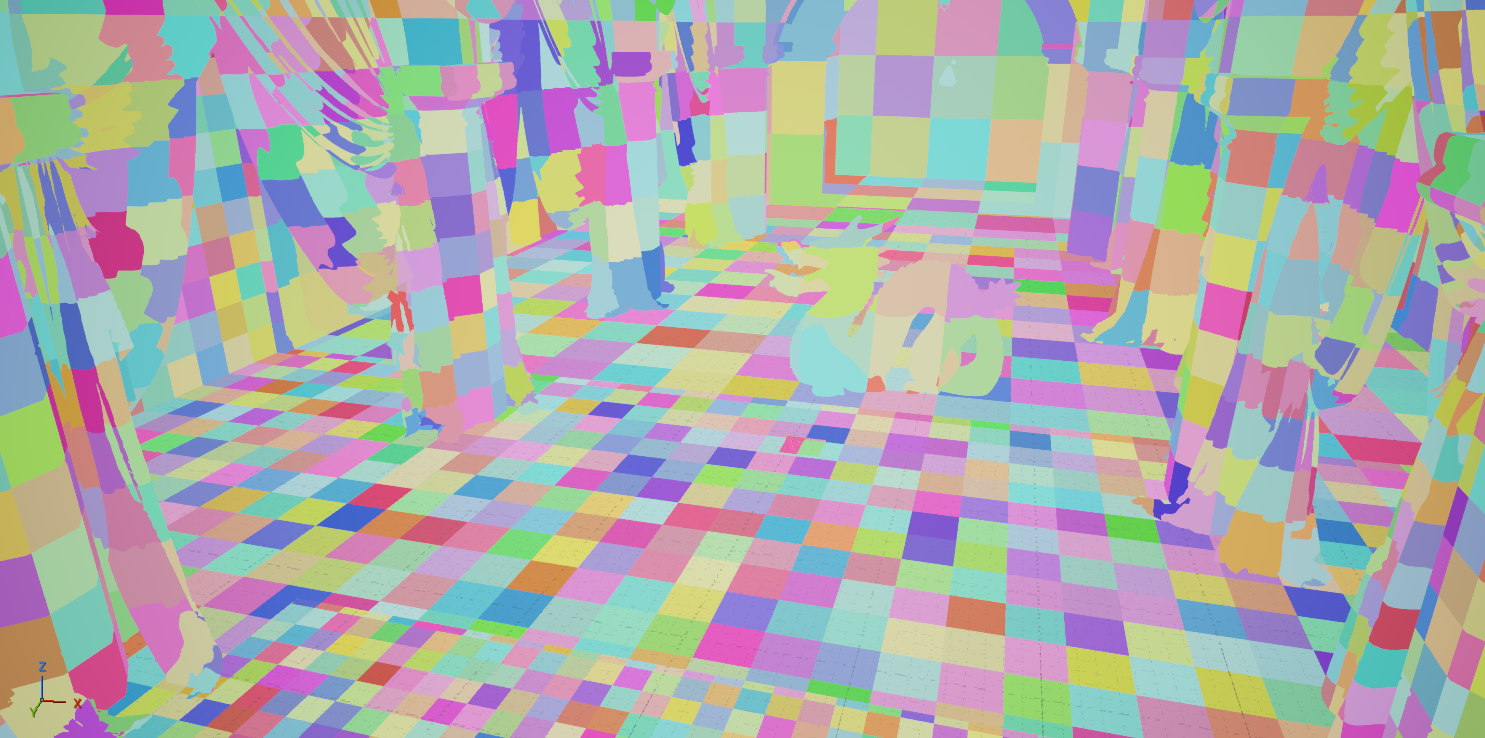
This fixes a lot of flickering or overallocation further away, however it creates big seams where the LODs change.
// HLSL, Compute:

//Compute a range instead, outputs weights so that we blend correctly
void ComputeLevelRange(float3 WorldPos, float3 CameraPos, out uint2 Lods, out float2 LodWeights)
{
	float3 Distance = abs(WorldPos - CameraPos);
	float Radius = max(Distance.x, max(Distance.y, Distance.z));
	float LodFloat = log2(Radius / LevelBaseDist);
	float Blend = min(1.0, (1.0 - frac(LodFloat))); <changed>
	uint Lower = clamp((uint)ceil(LodFloat), 0, MaxLOD);
	Lods = uint2(Lower, Lower + 1); <changed>
	LodWeights = float2(Blend, 1.0 - Blend); <changed>
}

//When depositing and applying
//We loop over the range and deposit/apply both levels, following their weights.
This should result in smooth, although flickering results.
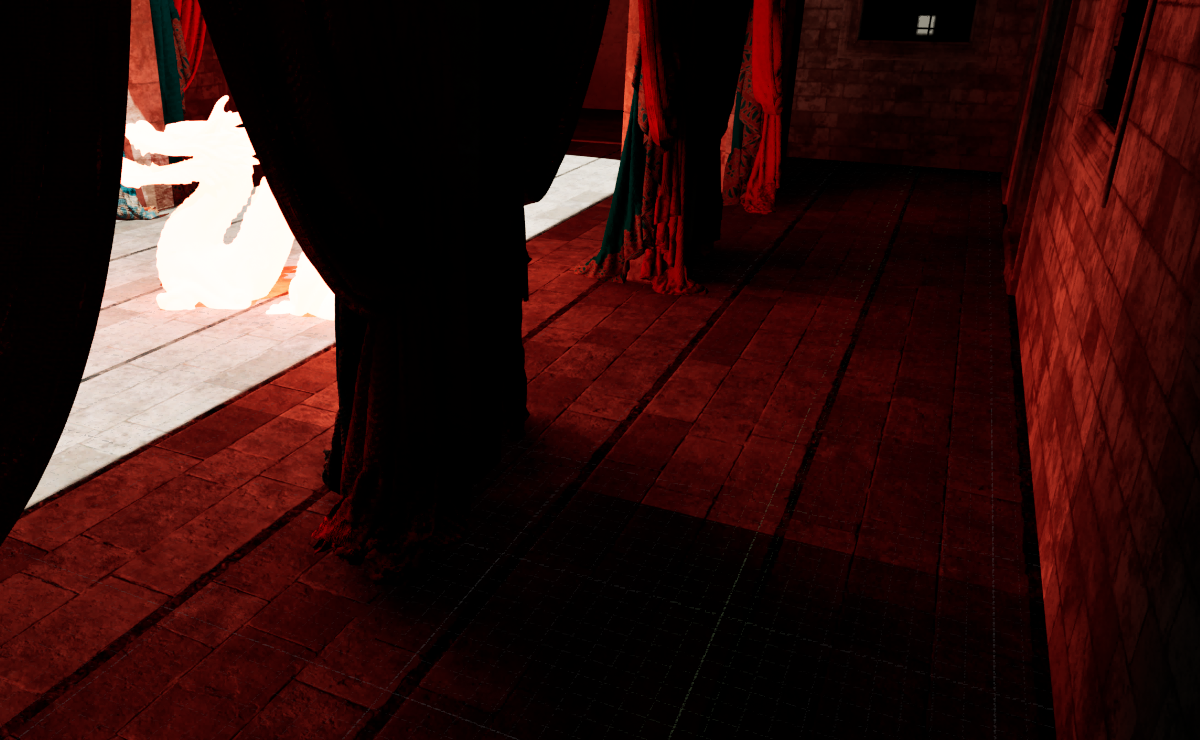
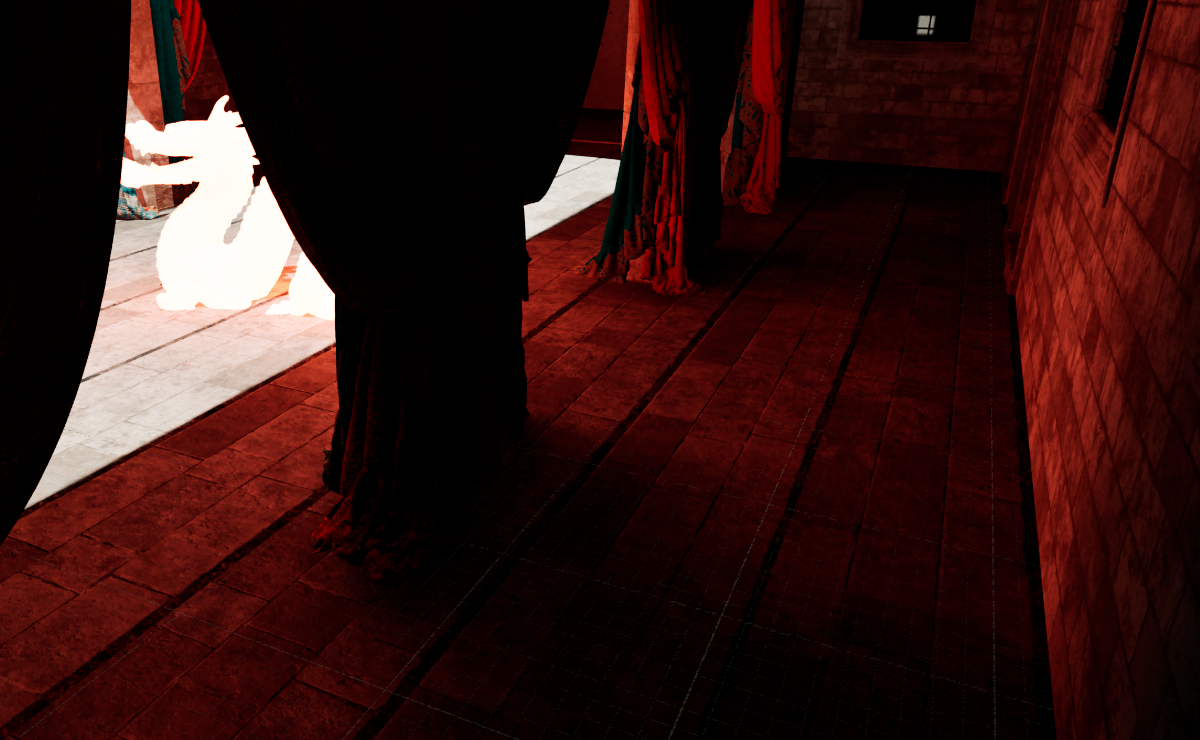
Not blended
Blended
Temporal
Due to the benefits of splitting & merging with RC our single frame result is already pretty good.
Example of smearing using Lumen
No smearing or much ghosting with RC
Stable hash table
Currently we clear and allocate the hashtable every frame, so our probe index moves every frame.
// HLSL, Compute:
#include "StableHashTable.hlsl"

RWStructuredBuffer‹uint› ProbeLifetime;

RWStructuredBuffer‹uint› ActiveProbes;
RWStructuredBuffer‹uint› ActiveCounter;

float HistoryConservation;

RWStructuredBuffer‹uint4› TotalRadiance;
RWStructuredBuffer‹uint› ProbeWeights;
RWStructuredBuffer‹uint› DepositCounts;

//This should be launched for the maximum amount of probes, each thread reallocating that probe if its there
[numthreads(64, 1, 1)]
void MainCS(uint DispatchThreadId : SV_DispatchThreadID)
{
	uint DataKeyId = DispatchThreadId;

    //Get which cascade this probe belongs to
	uint Table = DataKeyId / MaximumProbes;

    uint Local = DataKeyId - BaseTable * MaximumProbes;
	if (Table ›= NumCascades || Local ›= (MaximumProbes ›› (2 * Table)))
	{
		return;
	}

	uint64_t Key = TableKeys[DataKeyId];

    //If the key is invalid i.e. the clear value of 0 dont de or re allocate
	bool Occupied = Key != 0;
	if (Occupied)
	{
		//Remove older probes, ProbeLifetime should be reset whenever the probe is used, i.e. inside of the probe gathering and cascade filling passes
		if (ProbeLifetime[DataKeyId] == 0)
		{
			TableKeys[DataKeyId] = 0;
			Occupied = false;

			//Clear probe data
			DepositCounts[DataKeyId] = 0;

			uint LocalIndex = DataKeyId - Table * MaximumProbes;
			uint CascadeIndex = Table * MaximumProbes * BinsPerProbe(BaseDirections);
			uint Bins = BinsPerProbe(BaseDirections ‹‹ Table);
            //Clear each direction bin
			for (int i = 0; i ‹ Bins; ++i)
			{
				uint SlotIndex = CascadeIndex + LocalIndex * Bins + i;

				TotalRadiance[SlotIndex] = 0;
				ProbeWeights[SlotIndex] = 0;
			}
		}
		else
		{
			// Re-add surviving probe

            // Reduce its lifetime
            ProbeLifetime[DataKeyId] -= 1;

            //Add it to the hashtable with the same index as last frame
			uint64_t Key = TableKeys[DataKeyId];
			uint LocalIndex = DataKeyId - Table * MaximumProbes;
			HashTableAddIndex(Key, Table, LocalIndex);

            //Add it to the active list,
			uint ActiveIndex;
			InterlockedAdd(ActiveCounter[Table], 1, ActiveIndex);
            ActiveProbes[Table * MaximumProbes + ActiveIndex] = LocalIndex;
		}
	}

    //Add any unoccupied (or just deallocated) probe to the freelist for the hashtable to use
	if (!Occupied)
	{
		uint FreeListIndex;
		InterlockedAdd(TableFreeListIndex[Table], 1, FreeListIndex);
		uint LocalIndex = DataKeyId - Table * MaximumProbes;
		TableFreeList[FreeListIndex] = LocalIndex;
	}
}


//Make sure to clear the freelistindex counter to the table's start after this
The hashtable should now be stable, you can test this using the debug output code from earlier, outputting the index. Probes shouldn't change color unless they go off the screen.
Multi bounce
Currently light only bounces once from where we are looking. Things only start looking really good when we do multiple bounces.
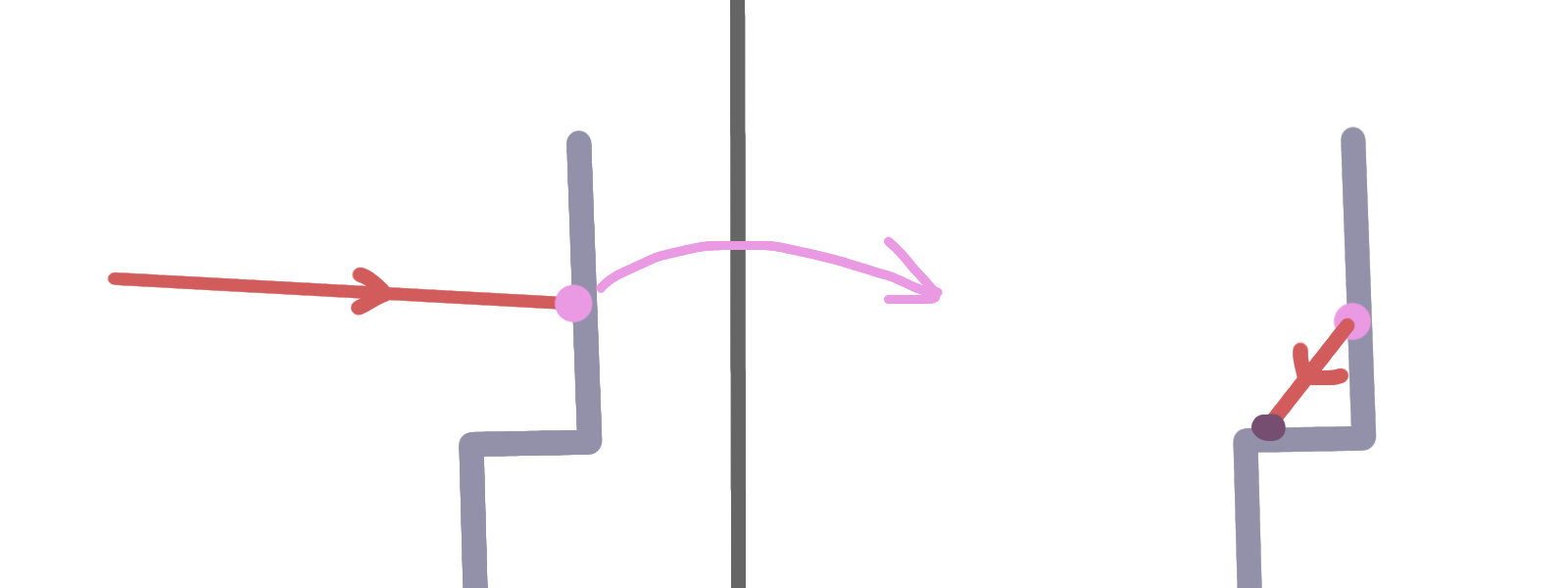
The first hit is stored, then another random ray is sent from that hit position
This gives us a single real bounce, but increasing this to more would be very expensive. Instead we can sample the probes to apply GI to this, with the temporal accumulation that gives us an extra bounce every frame. However since our probes are only allocated where we are looking, we wouldn't be able to get this bounce light from outside of the screen, since there are no probes to sample from.
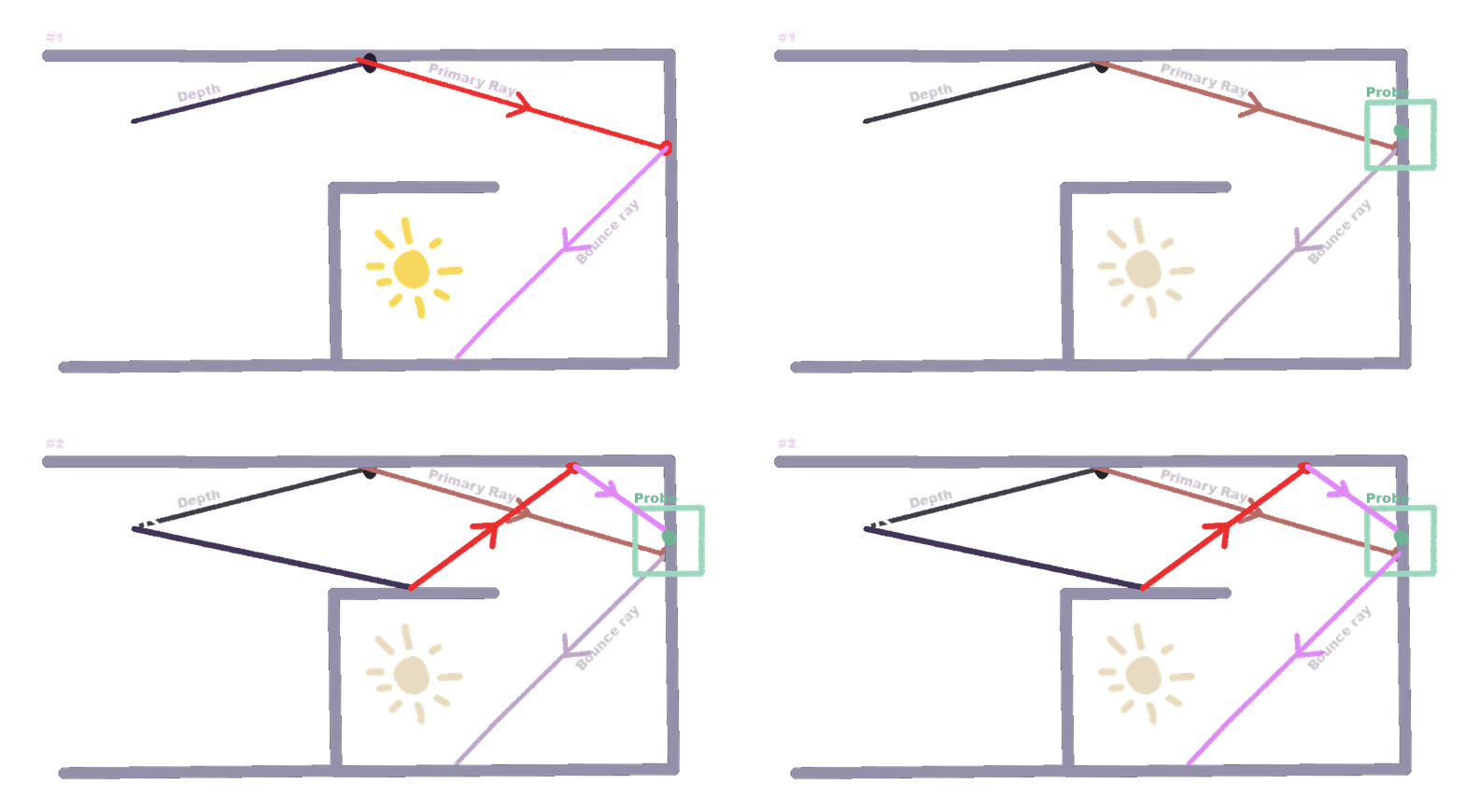
In one frame we send the primary ray, which allocates a probe filled with the bounce ray.
This gives us infinite bounces, however it is limited to only the area covered by the single bounce ray, since that one allocates the secondary probes.
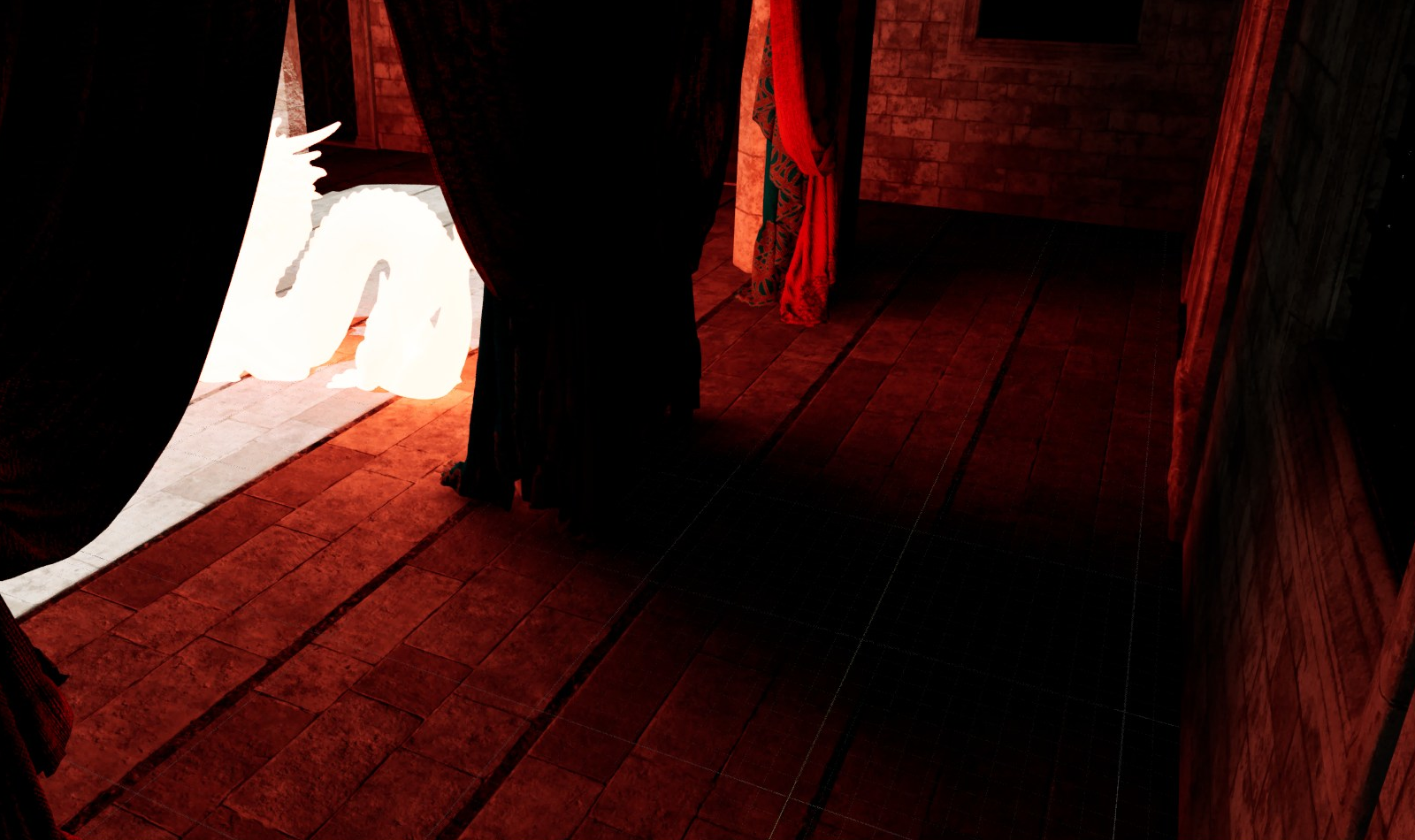
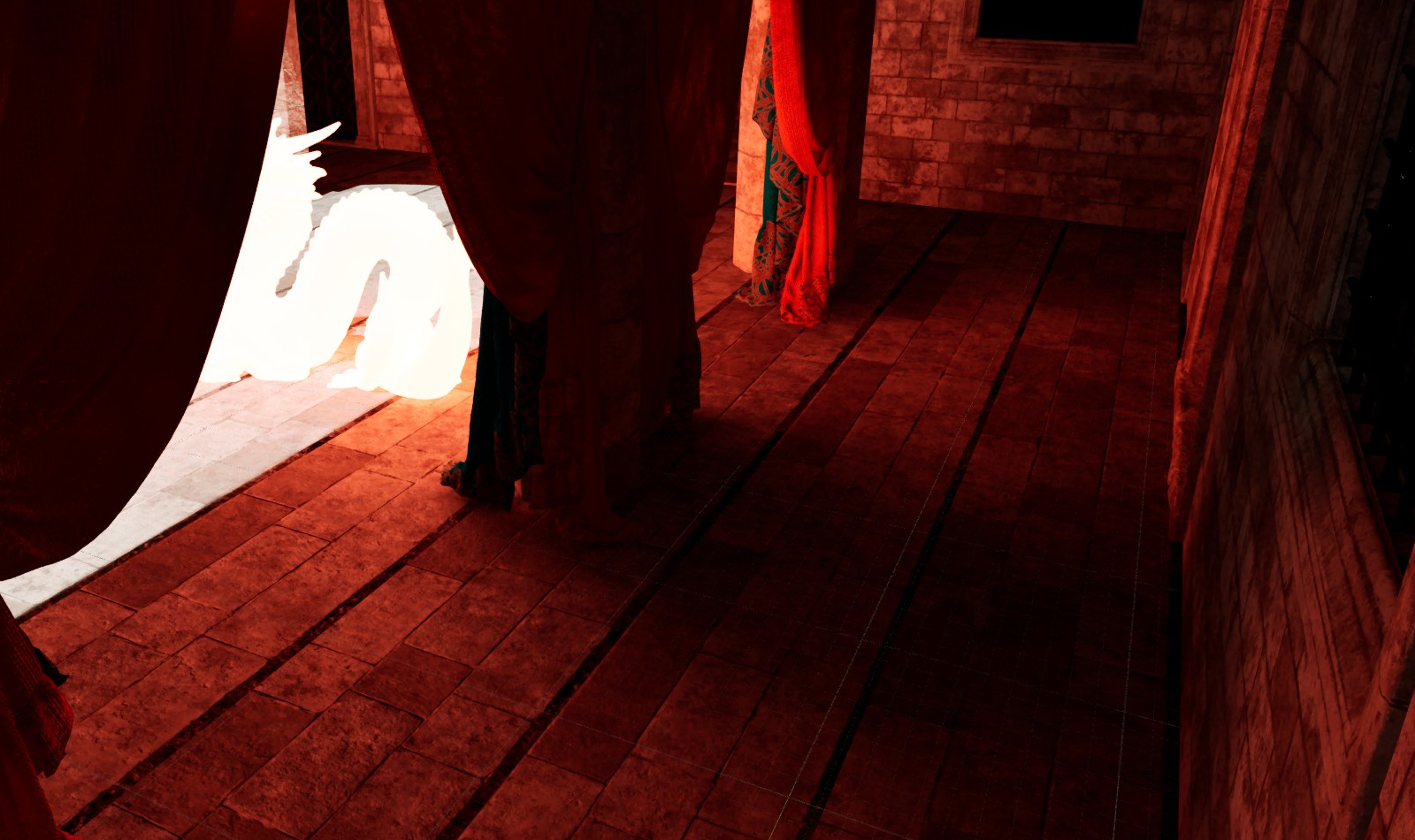
Single bounce
Multi bounce
Basic optimizations & improvements
For simplicity I kept out a lot of optimizations or better ways to do things.
Choosing directions
One big improvement in quality is choosing directions in a better way, currently we choose completely random directions.
Group sharing
Apart from tracing, our merging & applying pass is the most expensive.
Lowering ray count
Raytracing cost is by far the most expensive part.
Conclusions
Performance
Almost all of the cost of this goes to actual tracing.
Comparisons/Showcase
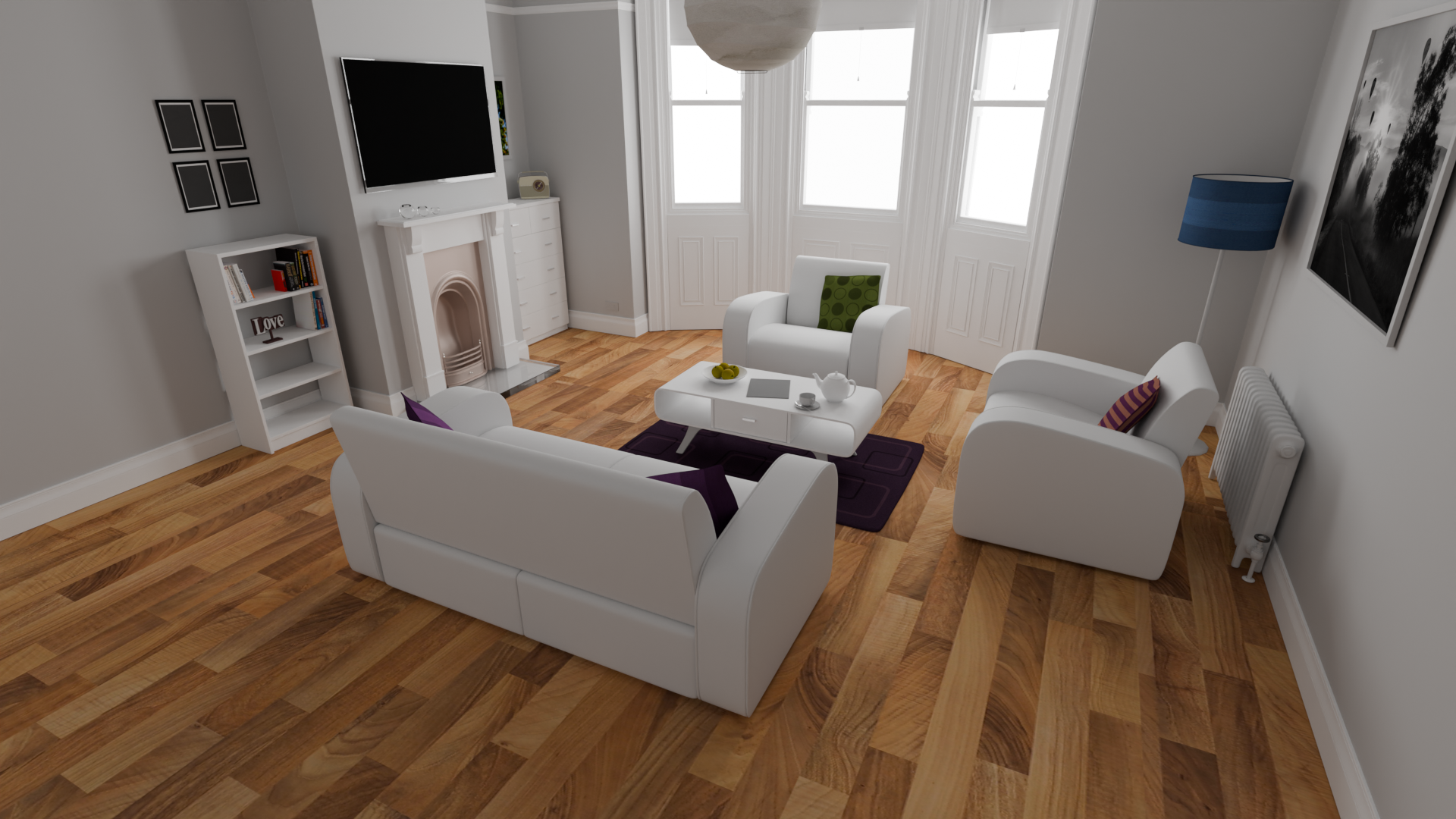
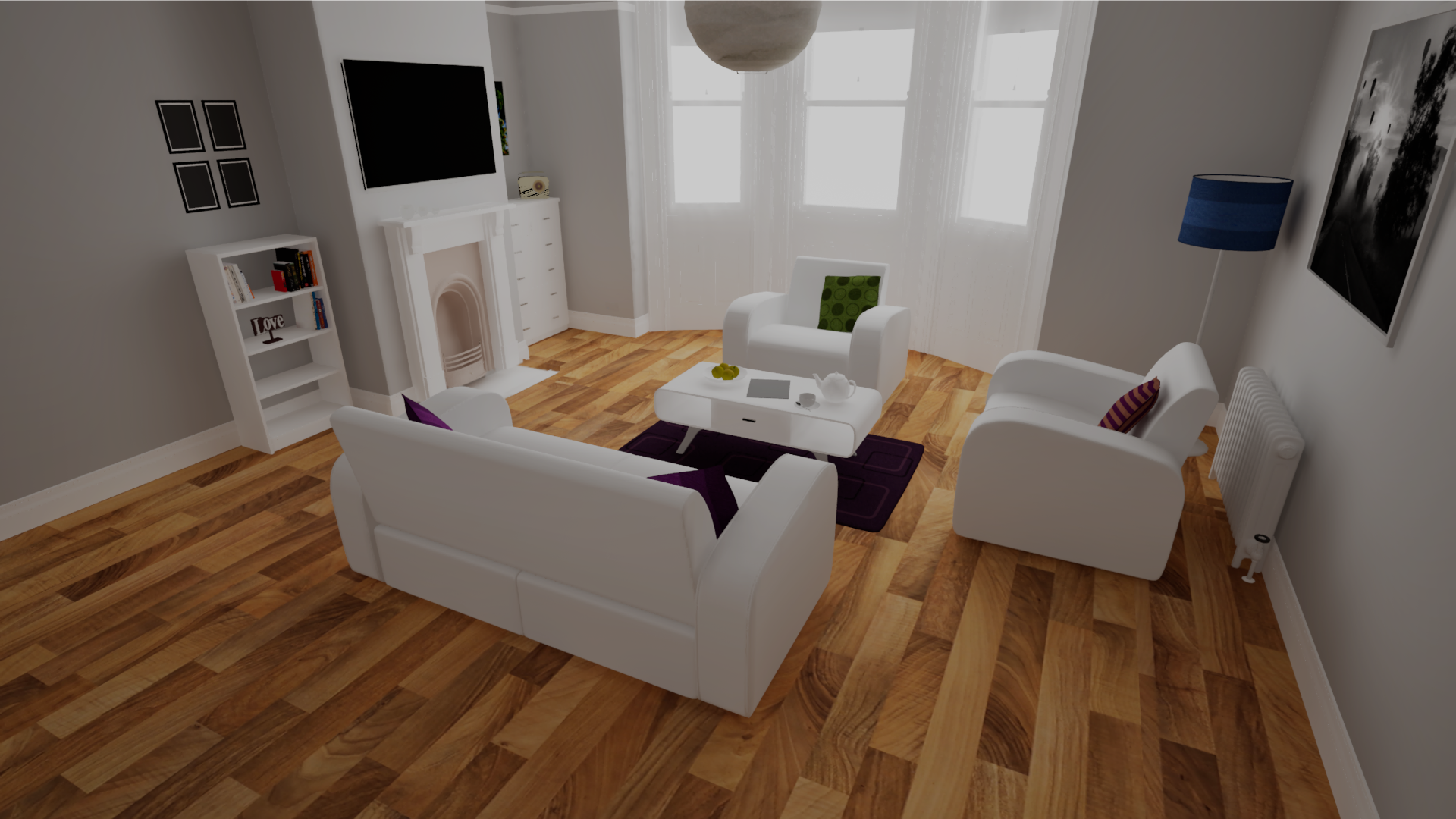
Path traced
RC
The main points of error are light leaking in spots smaller than a (secondary) probe, and softer shadows. (presumably due to not enough base directions)
References
"Split Radiance Cascades: Real-Time Global Illumination via Sparse Radiance Probes": https://arxiv.org/abs/2607.20384
Jason Mcghee's article: https://jason.today/rc
RC Wiki: https://radiance.wiki/