What Are Flock Cameras?
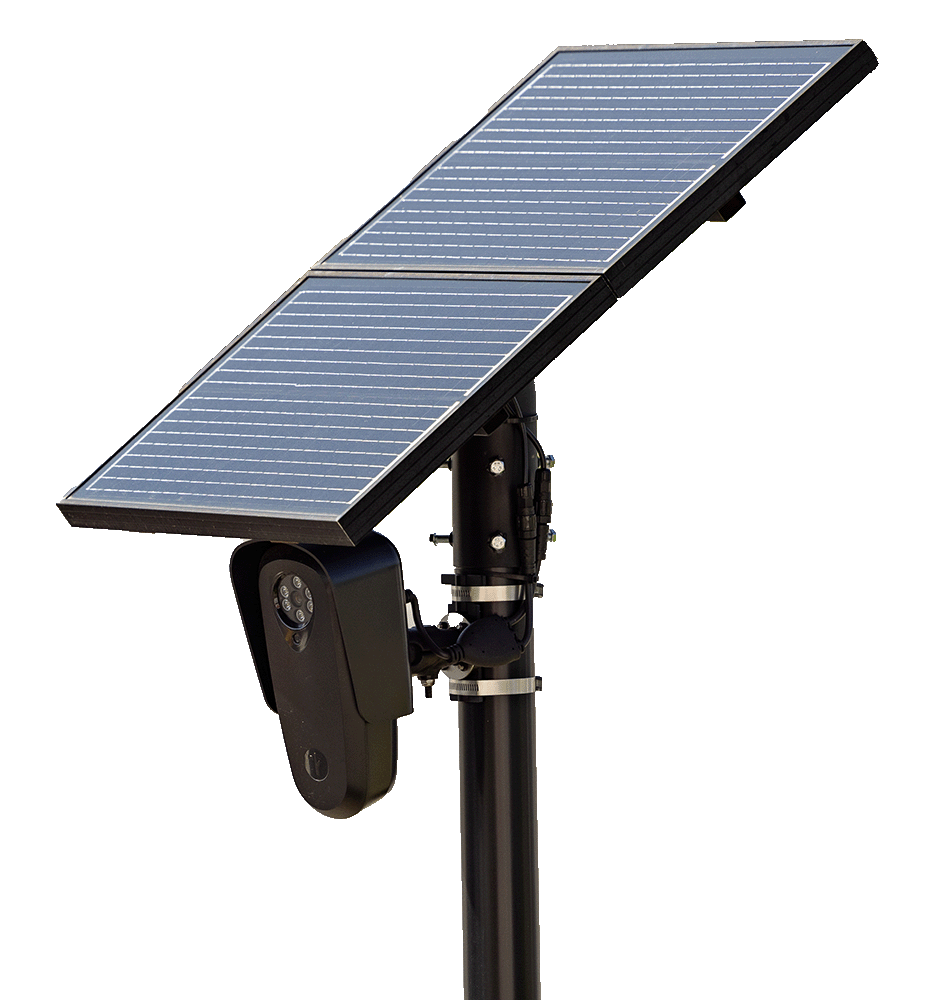
Flock Safety markets its devices as "AI-powered precision policing technology" - far beyond basic license plate readers (ALPRs) (Flock Safety). The system uses AI to create a "Vehicle Fingerprint" - identifying cars not only by license plate, but also by color, make and model, roof racks, dents/damage, wheel type, and more. Even bumper sticker placement is analyzed. This lets law enforcement search for a "blue sedan with damage on the left side" even without a license plate.
But the surveillance goes deeper. Using a feature called "Convoy Analysis", the system can detect vehicles that frequently appear near each other - suggesting associations between drivers or accomplices. The platform can also flag vehicles that routinely travel to the same locations across time. Flock describes this as a way to "identify suspect vehicles traveling together" or "pinpoint associates" - functionality confirmed in both their marketing and police testimonials (GovTech, ACLU).
The data is logged and made searchable across a nationwide law enforcement network - which officers in subscribing agencies can access without a warrant. According to Flock, the system can automatically flag a vehicle based on its history, route, or presence in multiple locations linked to a crime (Flock HOA Marketing).
While these tools may aid in locating stolen cars or missing persons, they also create a detailed record of everyone's movements, associations, and routines. That data has already been misused - like when a Kansas police chief used Flock cameras 228 times to stalk an ex-girlfriend and her new partner without cause (Local12).
The scope of this tracking becomes clear when you see real-world examples. In 2025, a journalist drove 300 miles across rural Virginia and was captured by nearly 50 surveillance cameras operated by 15 different law enforcement agencies. When he requested his own surveillance footage, he discovered the cameras had documented patterns that made his behavior "predictable to anyone looking at it." Most troubling: while the journalist couldn't remember specific dates he'd made certain trips, police would know instantly - without any warrant or suspicion of wrongdoing (Cardinal News).
See also:
How Widespread Are These Cameras?
Understanding what Flock cameras are leads to a natural question: how common are they in our communities?
The crowdsourced map made available on DeFlock.me currently shows roughly half of the >100,000 Flock AI cameras nationwide. Here are examples from three major cities showing how pervasive this surveillance has become:
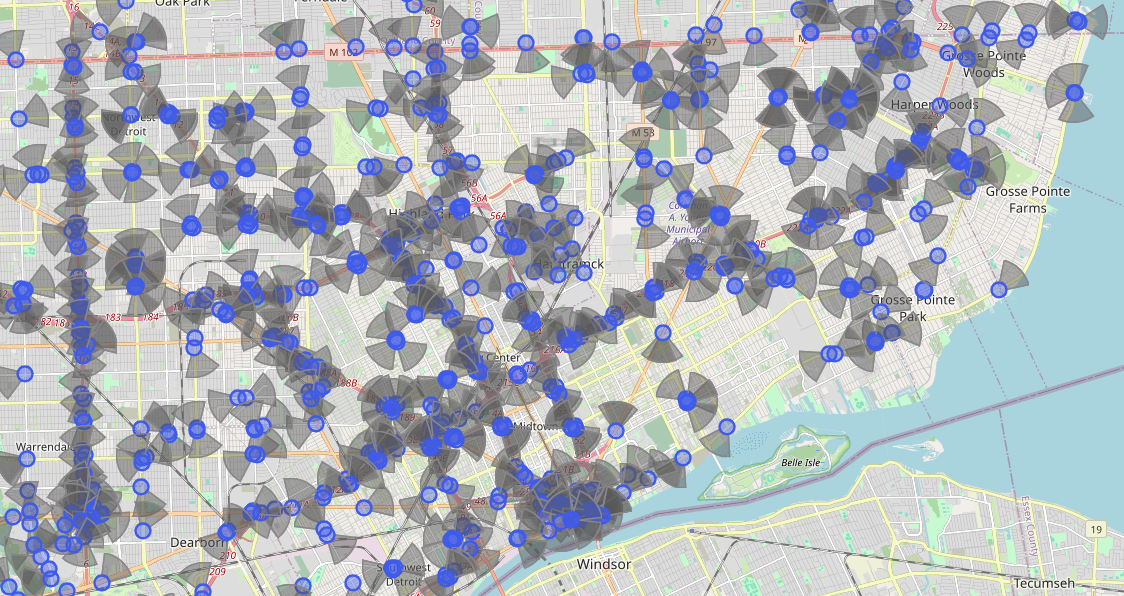
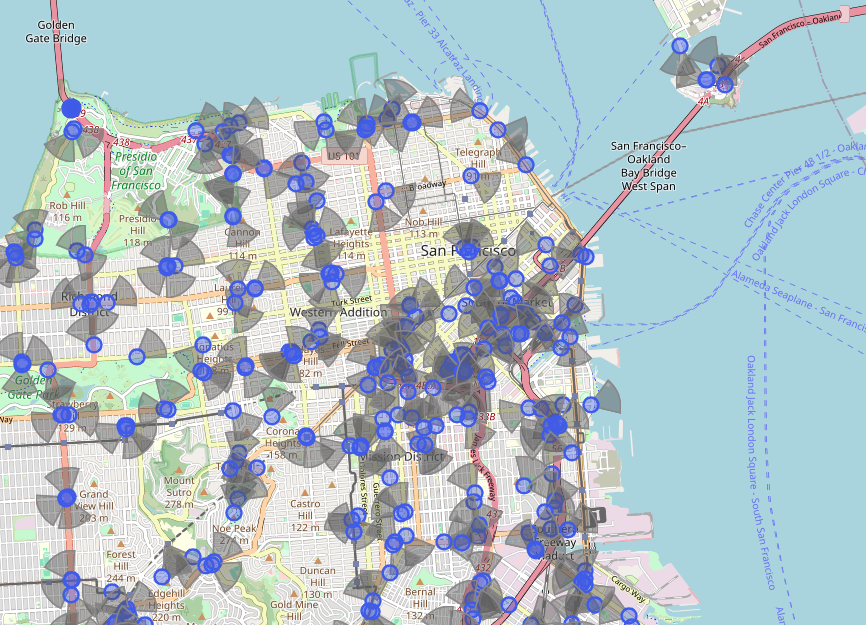
These systems are expanding rapidly, often with little public debate or oversight. The Atlas of Surveillance, maintained by the Electronic Frontier Foundation, has documented over 3,000 law enforcement and government agencies using Flock products as of 2025 - a number growing monthly.
See also:
Why Privacy Matters
The Fourth Amendment was written in response to the British Crown's "general warrants" - broad authorizations to search anyone, anywhere, anytime. Mass surveillance revives that threat in digital form. Simply moving freely in public should not require that you be profiled and scrutinized.
"If you've got nothing to hide, you've got nothing to fear" is a tempting thought - until someone misuses your information. Privacy isn't about hiding wrongdoing. It's about autonomy, dignity, and the ability to live free from unjust scrutiny. "Saying you don't care about privacy because you have nothing to hide is like saying you don't care about free speech because you have nothing to say." - Edward Snowden
As one observer put it: "While today they are no threat to me...circumstances change, leadership changes, laws change. When you really boil this down, what is this nationwide system? What did Flock really make? It's a weapon. A silent weapon. Right now it targets what many would agree are criminals. But with the flip of a switch this system can be used to target or oppress anybody the people in power decide is a threat."
Civil Liberties at Risk
There's a broader constitutional issue at stake.
We are fast approaching a world in which going about one's business in public means being entered into a law enforcement database. Automated license plate readers collect location data on millions of people with no suspicion of wrongdoing, creating vast databases of where we go and when.
The American Civil Liberties Union (ACLU) warns that automatic license plate readers (ALPRs) are becoming tools for routine mass location tracking and surveillance, with too few rules governing their use. These systems can collect and store data on millions of innocent drivers, creating detailed records of people's movements without their knowledge or consent. (ACLU)
Legal scholars have highlighted the broader implications of such surveillance.
Neil Richards, writing in the Harvard Law Review, emphasizes that surveillance can chill the exercise of civil liberties,
particularly intellectual privacy, and increase the risk of blackmail, coercion, and discrimination.
(Harvard Law Review)
Flock's data further enables already biased enforcement. In Oak Park, Illinois, 84% of drivers stopped using Flock camera alerts were Black - despite the town being only 21% Black. (Freedom to Thrive).
See also:
Corporate Incentives and Mass Surveillance
Mass surveillance isn’t just about policing; there are major business interests involved.
Flock Safety collaborates with law enforcement agencies to promote the adoption of its license plate recognition cameras by encouraging private entities such as businesses and HOAs to share their footage. This practice broadens the surveillance net by granting access to what would otherwise have been private data (Flock Safety FAQ).
Additionally, Flock markets its surveillance technology to employers and retail establishments, further blurring the lines between public safety initiatives and profit-driven surveillance. For example, major retail property owners have entered into agreements to share AI-powered surveillance feeds directly with law enforcement, expanding the scope of monitoring beyond public spaces. (Forbes) [Mirror]
Lowe's is a significant private client of Flock Safety, having implemented their systems in numerous locations to enhance security and deter theft.
The Illusion of Security
Some justify these systems as making us safer, but the reality is more complicated.
Flock advertises a drop in crime, but the true cost is a culture of mistrust and preemptive suspicion. As the EFF warns, communities are being sold a false promise of safety - at the expense of civil rights* (EFF).
A 2019 report by the NAACP Legal Defense Fund warned that predictive policing tools premised on biased data will reflect that bias, reinforcing existing discrimination in the criminal justice system. These tools may appear objective, but instead often amplify historic injustice under a veneer of scientific credibility (NAACP LDF).
True safety comes from healthy, empowered communities; not automated suspicion. Community-led safety initiatives have demonstrated significant results: North Lawndale saw a 58% decrease in gun violence after READI Chicago began implementing their program there. In cities nationwide, the presence of local nonprofits has been statistically linked to reductions in homicide, violent crime, and property crime (Brennan Center, The DePaulia, American Sociological Association).
Part of a Larger Trend
Zooming out, Flock is just one part of a larger movement toward ubiquitous surveillance.
Flock's expansion is part of a broader movement toward ubiquitous mass surveillance - where your associations, online comments, purchases, movements, and more may be logged, indexed, analyzed by AI, and made easily searchable by almost any government agency at any time.
This progression from data collection to surveillance follows a familiar pattern in tech: tools sold for convenience often evolve into tools of control.
Bruce Schneier, a prominent cryptographer and privacy advocate, put it simply: "Surveillance is the business model of the Internet." What begins as data collection for convenience or security often evolves into persistent monitoring, normalization of tracking, and the loss of autonomy.
As Edward Snowden warned: "A child born today will grow up with no conception of privacy at all. They'll never know what it means to have a private moment to themselves - an unrecorded, unanalyzed thought."
In Dunwoody, Georgia, drones are now dispatched from Flock Safety "nests" to respond to 911 calls autonomously, often arriving in under 90 seconds (Axios).
In California, 480 high-tech cameras were recently installed to surveil Oakland's highways - tracking license plates, bumper stickers, and vehicle types - with alerts sent to law enforcement in real-time (AP News).
This surveillance infrastructure extends far beyond law enforcement. The U.S. military has spent at least $3.5 million on a tool called "Augury" that monitors "93% of internet traffic," capturing browsing history, email data, and sensitive cookies from Americans - all "without informed consent." Senator Ron Wyden has received whistleblower complaints about this warrantless surveillance program (VICE).
Meanwhile, the current administration is working with Palantir Technologies to create what Ron Paul calls a "big ugly database" - a comprehensive collection of all information held by federal agencies on all U.S. citizens. This would include health records, education records, tax returns, firearm purchases, and associations with any groups labeled "extremist." Palantir, funded by the CIA's In-Q-Tel venture capital firm, is "literally the creation of the surveillance state" (OC Register).
Even basic tools we use daily are being transformed into surveillance instruments. Recent court rulings now allow the government to order companies like OpenAI to indefinitely preserve all ChatGPT conversations. Users who thought they were having private conversations - like "talking to a friend who can keep a secret" - discovered this only through web forums, not company disclosure. The judge's order enables what one user called a "nationwide mass surveillance program" disguised as a civil discovery process (TechRadar).
This pattern repeats throughout history: people abandon liberty for promises of safety. After 9/11, many supported the PATRIOT Act. During COVID, many embraced mask and vaccine mandates. After the 2008 financial crisis, many supported bailouts because leaders said they had to "abandon free-market principles to save the free-market system." Today, some support mass surveillance because they believe it will target only "the right people" - but circumstances change, leadership changes, laws change.
See also:
Where This Leads
So where is all of this heading? The trajectory is troubling.
Flock's cameras capture detailed information about the daily lives of anyone passing by, without offering a genuine opt-out mechanism. Concurrently, Palantir Technologies has secured a $30 million contract with ICE, aiming to develop a system that consolidates sensitive personal data such as biometrics, geolocation, and other personal identifiers from various federal agencies, facilitating near real-time tracking and categorization of individuals for immigration enforcement purposes (Wired). It should be no surprise that this will also not offer any meaningful opt-out mechanism.
These developments raise concerns about the erosion of privacy and the potential for misuse of aggregated data. The pervasive nature of such surveillance systems means that individuals are monitored without explicit consent, and the data collected can be repurposed beyond its original intent. As these technologies become more entrenched, the line between public safety and invasive oversight blurs, prompting critical discussions about the balance between security and individual freedoms.
Words from the Watchers
Some of the most chilling validations of mass surveillance come not from critics - but from the very people promoting it. These aren't out-of-context slips; they are open endorsements of a world where privacy is sidelined in favor of control, compliance, and convenient enforcement.
"Anything technology they think, ‘Oh it's a boogeyman. It's Big Brother watching you,' … No, Big Brother is protecting you."
"Instead of being reactive, we are going to be proactive... [we] use data to predict where future crimes are likely to take place and who is likely to commit them... then deputies would find those people and take them out."
"The use of net flow data by NCIS does not require a warrant."
"Tech firms should not develop their systems and services, including end-to-end encryption, in ways that empower criminals or put vulnerable people at risk."
"The risk [of built-in weaknesses]... is acceptable because we are talking about consumer products... and not nuclear launch codes."
China exploited a covert surveillance interface - originally built for lawful access by U.S. law enforcement - to tap into Americans' private phone records, messages, and geolocation data. (CISA)
Take Action
We don't have to accept this future. You can:
- Stay informed about local meetings: ALPR.watch provides a calendar and map of upcoming public meetings with agenda items related to Flock and other surveillance systems. You can sign up for email alerts when meetings near you are scheduled.
- Contact your local officials and demand transparency and oversight of surveillance programs. (See 5 Calls)
- Support organizations like the ACLU and the EFF who challenge mass surveillance in the courts and legislatures.
- Start conversations with neighbors and community groups about the risks of systems like Flock.
- Share this website and make your community aware.
* Some quotes paraphrased for clarity. See linked sources for full context.
Further Reading
For deeper exploration of surveillance technology, privacy rights, and related issues:
Recent Investigations and Reports
- Cardinal News: "I drove 300 miles in rural Virginia, then asked police to send me their public surveillance footage" - A journalist's firsthand investigation into police surveillance tracking
- ACLU: "Surveillance company Flock now using AI to report us to police if it thinks our movement patterns are suspicious" - How Flock's AI escalates beyond license plate reading
- Ryan O'Horo: "Spotting Flock Safety's Falcon Cameras" - Technical analysis of how to identify these surveillance systems
Video Resources
- Documentary: Understanding Modern Surveillance - In-depth analysis of current surveillance technologies and their implications
- @BusinessReform on YouTube - Recent videos analyzing business and technology trends in surveillance
Broader Surveillance Trends
- VICE: "US Military Bought Mass Monitoring of Americans' Internet, Email Data" - How surveillance extends beyond traditional law enforcement
- OC Register: "Ron Paul: President Trump is unleashing a 'great big ugly surveillance state'" - Political perspectives on expanding surveillance powers
- TechRadar: "New judge's ruling makes OpenAI keeping a record of all your ChatGPT chats one step closer to reality" - How everyday AI tools become surveillance infrastructure
Data and Transparency Tools
- Have I Been Flocked - Pulls FOIA audit logs from around the country and cross-references them in searchable form. Their blog contains excellent analysis of surveillance trends and specific case studies.
- ALPR.watch - Tracks upcoming public meetings with surveillance-related agenda items, with email alerts for meetings near you
- Atlas of Surveillance - EFF's database tracking surveillance technology deployments
- DeFlock.me - Community efforts to map and understand surveillance camera networks
Organizations and Advocacy
- Electronic Frontier Foundation (EFF) - Digital rights advocacy and legal challenges
- American Civil Liberties Union (ACLU) - Civil liberties protection and surveillance oversight
- 5 Calls - Easy way to contact representatives about privacy and surveillance issues