Until June 19, the Federal Palace in Bern will once again be bustling with activity. Numerous important issues will be on the agenda during the summer session of the National Council and Council of States.
No time? blue News summarizes for you
- From June 1 to 19, 2026, the Federal Parliament’s summer session will take place at the Federal Palace.
- Topics up for debate include the 13th AHV pension, the armed forces, and federal finances.
- blue News is providing updates from the Federal Palace here in this live feed.
-
Thursday, June 18, 10:47 a.m.
Parliament Lifts Ban on New Nuclear Power Plants After Marathon Debate
The construction of new nuclear power plants is set to become possible again in Switzerland. Following the Federal Council and the Council of States, the National Council now shares this view. On Thursday, it approved the counterproposal to the Blackout Initiative. The final decision will rest with the people.
By a vote of 100 to 98, the National Council rejected a motion to refer the matter back to the Federal Council for clarification of financing issues. On Monday, the lower house had voted 100 to 97, with 2 abstentions, in favor of referring the matter back to the Federal Council. The Council of States subsequently rejected this by a clear margin.
-
10:50 a.m.
Parliaments Raise VAT for 13th AHV Pension
Value-added tax will be increased for the 13th AHV pension, but not the payroll contribution rates. This is because the National Council approved only one of the two parts of the financing bill on Wednesday. Additional payroll deductions for the AHV are thus off the table for the time being.
-
4:35 a.m.
Financing of the 13th AHV pension to be decided
The National Council will decide today whether or not the 13th AHV pension will be paid out without funding. The issue of funding is controversial. The Conciliation Conference is proposing a mixed funding model involving higher VAT and higher payroll contributions. The Council of States has already approved this proposal. However, the National Council had previously insisted on financing solely through the value-added tax. Regarding the Conciliation Conference’s proposal, it can now only vote “yes” or “no”—or, more specifically, approve the additional percentage points of the value-added tax. If the Council votes “no” on both partial proposals, the financing plan will have failed.
-
Wednesday, June 17, 2026, 4:32 a.m.
National Council to Decide on the Mercosur Free Trade Agreement
The National Council will vote on the Mercosur free trade agreement today, Wednesday. Although the majority of the relevant committee supports it, discussions are expected, as minority groups wish to propose several amendments.
The agreement was negotiated by the EFTA states—Switzerland, Iceland, Liechtenstein, and Norway—with the Mercosur states—Argentina, Brazil, Paraguay, and Uruguay—which have a combined population of approximately 270 million. In 2024, Swiss exports to the Mercosur countries totaled over 4 billion Swiss francs.
Under the agreement, 96 percent of Swiss exports to Mercosur are to become duty-free. In return, Switzerland grants the Mercosur countries 25 bilateral import quotas for sensitive agricultural products, including meat and wine. Most of the quotas are limited, and Switzerland can manage them autonomously.
The majority of the relevant National Council committee sees the agreement as an opportunity to diversify Switzerland’s trade relations. By a vote of 15 to 3, with 7 abstentions, the Foreign Policy Committee (APK-N) endorsed the agreement. However, the majority is calling for an amendment: The additional article they proposed requires the Federal Council to adopt the provisions of the EU’s Deforestation Regulation. This would be effective in preventing deforestation, they stated.
-
5 a.m.
Council of States Debates Expansion of Sunday Sales
The Council of States is debating today, Tuesday, whether the cantons could in the future authorize up to twelve Sunday sales per year. Currently, the maximum is four. The bill is intended to address changing shopping needs and competition from online retail.
The bill stems from a cantonal initiative by the Canton of Zurich, which was recently endorsed by both relevant parliamentary committees. The Federal Council also supports the proposal. The bill presented by the Council of States’ Economic Affairs and Taxation Committee (WAK-S) introduces “moderate flexibility,” leaving it up to the cantons to decide how to handle Sunday work.
The majority of the WAK-N wants to give cantons and municipalities more leeway in authorizing Sunday sales. The majority believes that the discretionary wording allows for flexible adaptation to local needs without requiring an overall amendment to the Labor Act.
-
Tuesday, June 9, 2026, 4:30 a.m.
National Council to Decide on Lifting the Ban on New Nuclear Power Plants
The National Council plans to decide today on lifting the ban on the construction of new nuclear power plants. On Monday, members of the National Council already spent several hours discussing the counterproposal to the “Blackout Initiative.” This counterproposal would lift the ban on the construction of new nuclear power plants at the legislative level. The SVP and FDP clearly supported the counterproposal, while the SP, GLP, and the Greens were firmly opposed. Ultimately, the exact balance of power within the centrist bloc is likely to be decisive. The issue had already caused quite a stir on Monday evening. The environmental organization Greenpeace projected images onto the Federal Palace in protest against the pro-nuclear debate.
![On Monday evening, Greenpeace activists projected an image onto the facade of the Federal Palace that resembled Edvard Munch’s painting “The Scream”: the eyes and mouth were depicted using the symbol for radioactivity.]()
On Monday evening, Greenpeace activists projected an image onto the facade of the Federal Palace that resembled Edvard Munch’s painting “The Scream”: the eyes and mouth were depicted using the symbol for radioactivity. Image: Keystone/Alessandro della Valle
-
Monday, June 8, 2026, 4:30 a.m.
National Council to Debate Ban on New Nuclear Power Plants Today
The National Council is debating today whether to lift the ban on the construction of new nuclear power plants. It is beginning its deliberations on the counterproposal to the Blackout Initiative. The Federal Council and the Council of States would like to make it possible once again to grant framework permits for new nuclear power plants. A narrow majority of the preliminary review committee shares this view. A significant minority opposes the legislative changes and is moving to dismiss the proposal. Ultimately, the balance of power within the centrist faction is likely to be decisive. A debate lasting several hours is expected.
-
12:33 p.m.
Council of States Rejects the Center Initiative Against the Marriage Penalty
Voters approved the introduction of individual taxation in March, and that is how it should remain. The Council of States has decided by a narrow majority to recommend that voters reject the Center Party’s initiative against the “marriage penalty” in taxation.
The initiative calls for the elimination of the “marriage penalty” in direct federal taxation. However, it does not propose individual taxation regardless of marital status; rather, it aims to continue taxing married couples jointly, as is currently the case.
Legislative provisions would then prevent married couples from being discriminated against compared to cohabiting couples. For the Council of States, this is not a viable approach: On Thursday, it voted 24 to 21 to reject the initiative. The National Council and the Federal Council also reject the proposal.
-
Thursday, June 4, 4:30 a.m.
Council of States Debates “Marriage Penalty” Again
The “marriage penalty” in taxation is back on the agenda after the public approved individual taxation in March. The Council of States is discussing today, Thursday, a popular initiative by the Center Party calling for the abolition of the “marriage penalty” in federal taxes.
However, the Mitte initiative does not propose individual taxation regardless of marital status. Instead, it aims to tax married couples jointly, as is currently the case. Legal provisions would then prevent married couples from being discriminated against compared to cohabiting couples.
Following the “yes” vote on individual taxation, the Center Party stood by its popular initiative, which contradicts this law. The Center Party and the SVP had rejected the separate taxation of married couples. Representatives of these two parties proposed a “yes” vote on the initiative in the Economic Affairs Committee of the Council of States (WAK-S).
However, the committee recommends a “no” vote on the initiative by a vote of 7 to 6 and does not wish to propose a counter-proposal. The majority believes that individual taxation should now be implemented following its approval by the electorate.
-
12:47 p.m.
National Council Wants to Better Support Victims of Violence
Victims of violence in Switzerland should have easier access to emergency medical care. The National Council has approved a bill to that effect. It also wants to require the cantons to provide sufficient shelters.
On Wednesday, the lower house approved the revision of the Victim Assistance Act by a vote of 139 to 55, with no abstentions. Next, the Council of States must consider the bill.
With this legislative revision, the Federal Council is implementing mandates from Parliament. Another key provision requires the cantons to provide shelters for victims of violence—most of whom are women—and their family members.
The majority of the committee responsible for the preliminary review wanted to explicitly stipulate that the number of shelters must be sufficient. A minority of the committee, consisting of members of the SVP, however, wanted to delete the provision entirely.
The Council ultimately rejected the motion to delete the provision by a vote of 131 to 63, with two abstentions.
-
12:44 p.m.
Council of States Seeks Equal Treatment in Electronics Disposal
Electrical and electronic devices originating from abroad should be subject to the same take-back and disposal obligations as those applicable to Swiss manufacturers. This is what the Council of States is calling for in a motion adopted on Wednesday.
It approved a motion by Andrea Gmür-Schönenberger by a vote of 39 to 4; the motion will now go to the National Council. In her motion, the Lucerne-based Center Party member of the Council of States states that there are currently unfair cost advantages and distortions of competition.
Online platforms are currently able to distribute these foreign products without being bound by the take-back and disposal obligations that apply to Swiss manufacturers. It is essential to level the playing field between domestic and foreign market participants.
Federal Councilor Albert Rösti moved to reject the motion. Work is already underway to specify the provisions for online mail-order companies and online platforms at the ordinance level. In addition, a parliamentary motion with a similar focus has already been submitted.
-
9:30 a.m.
National Council Wants to Push Through VAT Increase
The financing of the 13th AHV pension remains a contentious issue. The National Council narrowly approved a temporary increase in the value-added tax—against the wishes of the SP, the Greens, and the Center.
-
9:29 a.m.
Parliament Wants to Ban Firecrackers Nationwide
Setting off firecrackers is to be banned nationwide. This is the view of Parliament. The Council of States approved the relevant legislative provisions on Wednesday as the second chamber. There are no differences between the chambers.
The tightening of regulations was triggered by the popular initiative “For a Restriction on Fireworks (Fireworks Initiative).” In light of public sentiment, the relevant National Council committee had drafted an indirect counterproposal.
According to this proposal, fireworks designed solely to produce loud bangs are to be banned. The import of sparklers, cake fountains, firecrackers, table bombs, and other small fireworks is to be limited to 2.5 kilograms per day per person.
There will be no stricter requirements regarding the ID check. A cantonal permit requirement for setting off fireworks that pose a medium or high risk has also been ruled out.
-
5:17 a.m.
Next Round in the Debate Over AHV Funding in the National Council
Should the 13th AHV pension be financed solely through the value-added tax, or through a combination of a value-added tax increase and higher payroll contributions? The National Council is addressing this question once again this Wednesday morning. Its Committee on Social Security and Health (SGK-N) wants to finance the “thirteenth” AHV pension solely through a higher value-added tax, with this measure set to expire in 2033. The committee majority is proposing an increase of 0.5 percentage points.
In the first round of deliberations, the National Council had approved an additional 0.7 percentage points. With this lower proposal, the commission majority is responding to the positive results of the AHV Equalization Fund. It therefore aims to place less of a burden on households. However, the commission extended the time limit from 2030 to 2033, in contrast to the National Council’s initial decision. The majority believes that the AHV must be financially stabilized as part of the next major reform and that this will require more time.
By a vote of 14 to 11, the committee approved the additional 0.5 percentage points in value-added tax. It does not intend to raise the reduced rate for everyday goods and services—such as food. The special rate for the hotel industry, on the other hand, is to increase by 0.3 percentage points. The Council of States most recently approved a mixed financing plan for the “thirteenth month” payment for AHV pensioners, involving an increase in the value-added tax and higher payroll contributions. In the view of the National Council committee, this financing approach would place too heavy a burden on the working population and businesses. In March, the Council of States decided to raise payroll contributions for the AHV “thirteenth month” by an additional 0.3 percentage points instead of 0.4, and to increase the value-added tax by 0.4 percentage points instead of 0.5. This decision was also a response to the strong performance of the AHV Equalization Fund.
The plan is to finalize the financing of the 13th AHV pension during the current session. The first payment is scheduled for this coming December.
-
Wednesday, June 3, 2026, 4:30 a.m.
National Council Discusses New Powers for Intelligence Service
The National Council is debating new powers for the Federal Intelligence Service (FIS) today, Wednesday. The key issue is that surveillance measures—such as wiretapping phone calls or attaching tracking devices to cars—should also be permitted in the future as part of the fight against violent extremism. Until now, this has only been permitted in cases involving terrorism, espionage, or attacks on critical infrastructure.
Specifically, the lower house is debating the first part of a three-part revision of the Intelligence Service Act. The Federal Council justifies the proposal by citing the changed threat landscape. Since 2020, the threats addressed by the FIS have multiplied.
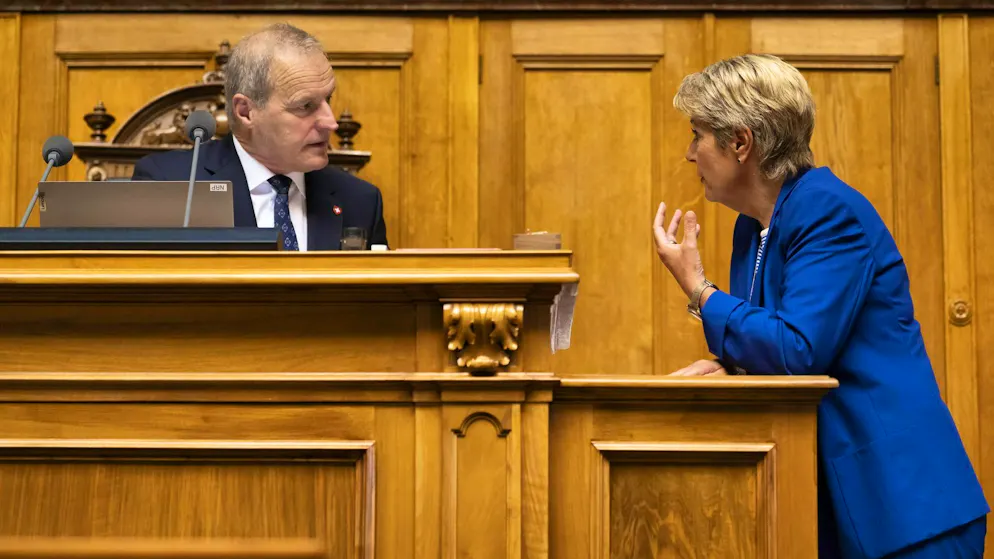
![Federal Councilor Karin Keller-Sutter (right) with National Council President Pierre-Andre Page, SVP-FR, on Tuesday during the summer session of the Federal Assembly.]()
Federal Councilor Karin Keller-Sutter (right) with National Council President Pierre-Andre Page, SVP-FR, on Tuesday during the summer session of the Federal Assembly. Photo: Keystone/Anthony Anex
As before, judicial approval would be required for so-called intelligence-gathering measures. The left wing of the National Council believes the revision goes too far. They criticize that the FIS already fails to fully comply with the current law, particularly regarding the surveillance of political activities. A minority of the National Council’s Security Policy Committee (SIK-N) is therefore proposing to refer the revision back to the Federal Council for further review.
Another key change concerns financial intermediaries. According to the Federal Council, the FIS would now be able to collect data from banks and other financial service providers—for example, in cases of terrorist financing or espionage. In addition, the Federal Office of Police (Fedpol) would be able to impose travel restrictions on violent extremists in the future.
-
3:29 p.m.
Parliament Provides Better Unemployment Protection for Entrepreneurs
Parliament is providing better unemployment insurance protection for entrepreneurs who run their own businesses. Under certain conditions, they will be able to receive benefits more easily in the future.
During the reconciliation process on Monday, the National Council aligned itself with the Council of States without submitting a counterproposal. During deliberations on the bill in the spring session, the Council of States had incorporated additional safeguards against abuse into the draft bill from the National Council’s Committee on Social Security and Health. The bill is now ready for the final vote.
Specifically, the legislative amendment concerns individuals in employer-like positions. Andri Silberschmidt (FDP/ZH) had initiated the change with a parliamentary initiative.
He was particularly troubled by the fact that, although those affected were required to contribute to unemployment insurance, they would not receive benefits until they had completely severed ties with their respective companies.
-
2:45 p.m.
Two New National Council Members Join the Greens and the GLP
The National Council has two new members. Andrea de Meuron, a Green Party member from Bern, and Barbara Portmann, a GLP politician from Aargau, took office on Monday at the start of the summer session. Andrea de Meuron, 52, from Thun, succeeds Aline Trede, who also took office on Monday as the newly elected member of the Bern cantonal government.
De Meuron began her political career in 2007 in the Thun City Council. In 2014, she was elected to the Bern Cantonal Parliament, and in 2018 to the Thun City Government. There, she heads the Department of Finance, Resources, and Environment. She also has her sights set on the Thun mayoralty, which will be filled in June.
Barbara Portmann (GLP/AG), 51, is taking the seat in the National Council vacated by the retiring Beat Flach. She has been a member of the Lenzburg city government since 2022 and heads the Department of Education, Youth, and Family. Previously, she served in the Aargau cantonal parliament and chaired the GLP parliamentary group.
-
Monday, June 1, 2026, 7:04 a.m.
Summer Session Begins Today
This afternoon, the summer session of the Federal Assembly will kick off at the Federal Palace. Over the next three weeks, numerous high-profile issues will be on the agenda. The agenda through June 19 includes, among other things, the controversial free trade agreement with the South American Mercosur countries, the planned lifting of the ban on building new nuclear power plants, and the procurement of new military equipment for the army. Final votes are scheduled for the end of the three-week session. By then, the bill on financing the 13th AHV pension is expected to be finalized.

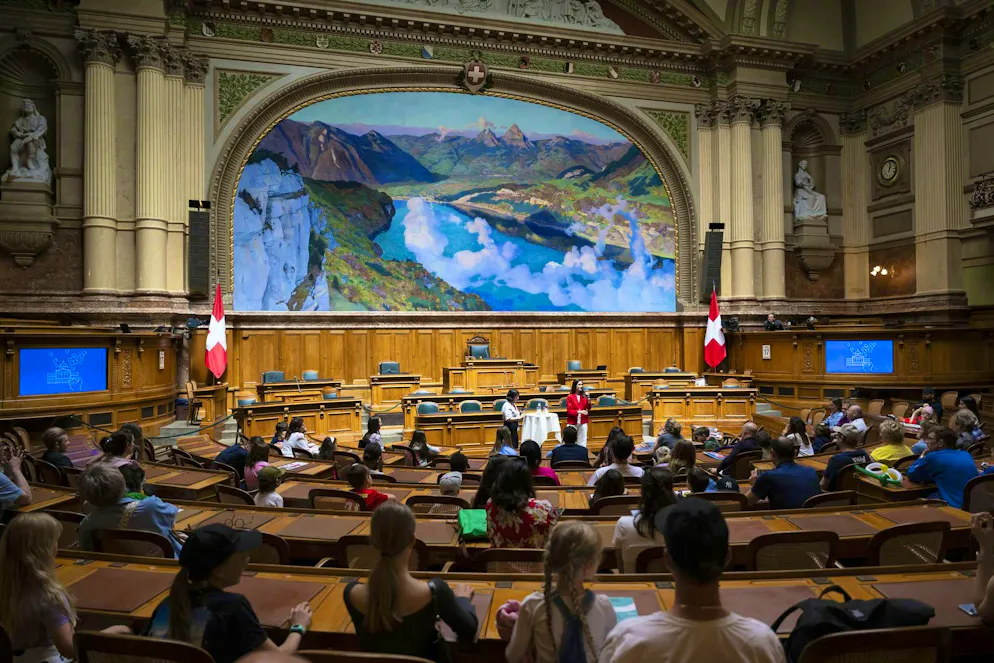
From today, Monday, through June 19, the Federal Palace in Bern will once again be bustling with activity. Numerous high-profile issues will be on the agenda during the summer session of the National Council and Council of States.
Here is an overview in chronological order:
New Members of the National Council
At the start of the summer session in the National Council, two new members will be sworn in. Andrea de Meuron, 53 (Greens/BE), will succeed Aline Trede. The 42-year-old was recently elected to the Bern cantonal government and subsequently resigned from her seat in the lower house. Beat Flach, a GLP National Council member from Aargau who stepped down after 14 years in parliament, will be replaced by 51-year-old Lenzburg City Council member Barbara Portmann. Flach, 61, says he will remain involved in politics—simply in a different role outside the National Council chamber.
Health Insurance: Mandatory Coverage for Inmates
At the start of the session, the Council of States is addressing the financing of healthcare costs for inmates. The Federal Council wants to extend the mandatory insurance requirement to inmates without a Swiss residence. In addition, the cantons should be able to negotiate special insurance plans with insurance companies for all inmates. The relevant committee of the Council of States rejects the proposal. It fears a disproportionate administrative burden, as inmates without Swiss residency are typically enrolled in health insurance for only a few months. Furthermore, the cantons are responsible for ensuring that even inmates without a residence in Switzerland have access to health care.
The promotion of non-profit housing construction is coming before the Council of States. The Federal Council and the National Council want to use subsidies to address the dwindling supply of affordable housing and are therefore proposing to increase the federal fund for non-profit housing construction. This fund provides nonprofit housing developers with repayable loans for new construction, renovation, and the purchase of properties, as well as the acquisition of building land. The guarantee instrument for housing promotion is also to be continued. The relevant Council of States committee supports the proposals, albeit by a very narrow margin. A significant minority opposes them, arguing that expanding the support would be irresponsible given the federal government’s financial situation.
Crans-Montana, VS, Fire Disaster
The Council of States is once again addressing the legal consequences of the Crans-Montana, VS, fire disaster. Specifically, the issue concerns the federal government’s participation in any potential settlement agreements. The relevant committee was unanimous on the principle that the federal government may contribute a total of no more than twenty million to settlements resulting from the roundtable discussions. A narrow majority also wants the law to explicitly list the conditions under which the Federal Council decides on participation in settlements.
KEYSTONE
Half a year before the next budget debate, there is a brief prelude: the National Council and the Council of States are discussing the results of the 2025 Federal Budget. It showed a surplus of nearly 1.2 billion francs instead of the projected just under 500 million francs. The better-than-expected result suits the center-right parties. They point out that many proposed measures currently lack funding—such as the 13th AHV pension or the expansion of the armed forces. The left, however, criticizes the federal revenue estimates, which they say are once again too pessimistic. The federal government actually has sufficient leeway for further investments.
By the end of the session, it should be clear how the 13th AHV pension is to be financed. The two chambers of Parliament have been debating this for some time. The relevant National Council committee wants to finance the supplementary pension solely through the value-added tax and is putting forward a new proposal to that effect. It is proposing a temporary increase of an additional 0.5 percentage points, valid through the end of 2033. In the first round of deliberations, the National Council had approved an additional 0.7 percentage points, valid through 2030. The Council of States, on the other hand, has so far relied on value-added tax and payroll contributions. It has already been decided that the 13th AHV pension will be paid out for the first time at the end of the year. This will require 4.2 billion francs in 2026, around 4.5 billion francs in 2030, and 5.4 billion francs in 2040.
The popular initiative “For a Restriction on Fireworks (Fireworks Initiative)” and the indirect counterproposal are the subject of debate in the Council of States. The relevant committee intends to follow the National Council’s position on most points. This means that setting off firecrackers is to be banned throughout Switzerland. There will be no stricter requirements regarding the obligation to present identification. Unlike the National Council, a narrow majority of the Council of States committee wants to make the use of fireworks posing a medium or high risk subject to a cantonal permit requirement. The Fireworks Initiative is to be rejected in favor of the counterproposal.
In the future, electric trucks are to pay the performance-based heavy vehicle fee (LSVA), just as those with fossil-fuel engines are required to do today. Like the National Council, the relevant Council of States committee agrees in principle. Now the Council of States will decide on the matter. Several motions to amend the bill are under discussion. For example, the Council of States committee opposes adjusting the LSVA’s flat-rate charges and tariffs to inflation if inflation changes by at least two percentage points. The majority wants to give the Federal Council leeway to make adjustments for inflation. The minority, on the other hand, wants planning certainty for businesses. In addition, the committee decided to enshrine in law a minimum value and a rate cap for setting LSVA rates.
The partial revision of the Victim Assistance Act aims to provide victims of violence with better access to emergency medical care. For example, it seeks to ensure a sufficient number of beds in emergency shelters. The National Council is now deliberating on the matter as the first chamber. Its relevant committee considers it necessary to expand victim assistance services. A minority, however, proposes completely removing the relevant provision on shelter services from the draft. In 2024, there were 17 femicides and two men killed in current or former relationships. In a family context, one minor, one woman, and five men were killed. More than half of the 45 homicides thus occurred in a domestic setting.
At the end of January, the Federal Council adopted a bill to revise the Intelligence Service Act and submitted it to Parliament. The aim is to provide the Federal Intelligence Service (FIS) with more tools for the early detection of threats. It also seeks to strengthen oversight of the FIS. The National Council is the first chamber to deliberate on the matter. Its relevant committee intends to further expand the FIS’s responsibilities for intelligence gathering. A minority, however, criticizes the FIS for not fully complying with the current law, particularly regarding the surveillance of political activities. It therefore intends to reject the bill until the oversight mechanisms are functioning properly.
Now that voters have approved it, individual taxation is set to be implemented. The relevant committee of the Council of States therefore rejects the popular initiative calling for the abolition of the “marriage tax penalty” at the federal level. The committee also does not want a counterproposal. It approved the motion to reject the initiative by a vote of 7 to 6. By the same margin, it rejected an indirect counterproposal. The Council of States will make the final decision on the matter. The lines are likely to be clearly drawn: the narrow majority that voted in favor of individual taxation in the Council of States is now expected to reject the alternative proposal put forward by the Center initiative. It remains to be seen whether the initiative will ultimately be withdrawn this summer following deliberations in the Council of States.
Construction of New Nuclear Power Plants
The construction of new nuclear power plants is to be permitted again in Switzerland. This is the view of the Federal Council and the Council of States. The debate is now set to take place in the National Council. Its relevant committee also intends to adopt the indirect counterproposal to the Blackout Initiative. However, the decision was only narrowly passed, by a vote of 13 to 12. A significant minority opposes the legislative changes. They argue that lifting the ban would undermine planning certainty for the expansion of renewable energy. They also fear “considerable financial risks.” Voters are likely to have the final say. The Greens have already announced that they will call for a referendum should the National Council follow the majority of its committee. The popular initiative is subject to a mandatory referendum in any case.
The National Council does not want an import ban on foie gras, but rather intends to rely on mandatory labeling and, if necessary, additional measures to reduce the volume of commercial imports. Now it is the Council of States’ turn. However, its relevant committee intends to make specific additions to the counterproposal for the foie gras initiative. Accordingly, the Federal Council would also be given the option to propose animal welfare requirements and conditions regarding production methods. In addition, the committee wants to specify the order in which the measures should be implemented depending on how the situation develops. A minority, like the Federal Council, is calling for the rejection of the counterproposal.
Twelve Sundays of retail sales per year
The Council of States is debating whether cantons could in the future authorize up to twelve Sunday sales per year. Currently, the maximum is four. The bill aims to address changing shopping needs and competition from online retail. The bill stems from a cantonal initiative by the Canton of Zurich, which was endorsed by both relevant parliamentary committees. The Federal Council welcomes the proposal. It describes it as a “moderate relaxation” that continues to leave it up to the cantons to decide how to handle Sunday work. Criticism is coming from the left. Opponents argue that the proposal is antisocial, endangers employees’ health, and disregards democratic decisions. They point out that the public has regularly rejected Sunday sales at the ballot box.
Expansion of the Power Grid
Switzerland relies on a high-performance power grid, not least for the energy transition. The National Council now wants to move forward with upgrades and expansions to the grid. Now it is the Council of States’ turn. Its relevant committee has also approved the so-called “Netzexpress.” However, it wants to expand the bill and, for example, advocates assigning national significance to distribution grid facilities as well as transmission grid facilities—a significance that would, in principle, take precedence over other national interests. The low-voltage grid, however, is to be exempted. The Council of States committee agrees that high- and extra-high-voltage power lines should generally be overhead.
The Federal Council aims to strengthen the position of spouses on farms. To this end, it proposes, for example, granting spouses a preferential right of first refusal. In addition, the scope for entrepreneurial action by agricultural businesses is to be expanded. To this end, the federal government plans, among other things, to raise the current debt limit for the creation of real estate liens. The National Council is deliberating on the bill as the first chamber. Its relevant committee has largely recommended approving the Federal Council’s draft. In the final vote, the committee unanimously approved the partial revision of the Agricultural Land Act.
E-Prescriptions for Pharmacies
In the future, prescriptions for medications and medication plans are to be issued and filled electronically as a general rule. This is intended to improve the quality of care and patient safety. Like the National Council, the relevant Council of States committee also intends to amend the Therapeutic Products Act accordingly. However, patients should be able to request to receive the prescription or medication plan in paper form. To accelerate the digitization of the medication process, the Council of States committee intends to allow mail-order sales and home delivery services for medications. In addition, it is proposing a new, simplified approval procedure for veterinary drugs to enhance the security of supply. Finally, it generally supports the new regulations on drugs for advanced therapies.
Maintaining Operating Hours at Zurich Airport
Until now, flights at Zurich Airport have been permitted to depart or land until 11:00 p.m. It is also permitted to clear flight delays until 11:30 p.m. without special authorization. The Federal Council now wants to enshrine this current regime in the Aviation Act. The relevant National Council committee agrees. By a vote of 17 to 8, it decided to extend the so-called grandfather clause to the operations of the national airports in Zurich and Geneva. The National Council is deliberating on the bill to amend the Aviation Act as the first chamber. A minority of the committee opposes the amendment because they fear it could weaken noise protection.
Rehabilitation of Swiss Volunteers
Swiss citizens who volunteered during World War II to fight with the Resistance in France or with Italian resistance groups against fascism are to be rehabilitated. This is what the National Council wants. Now it is the Council of States’ turn. Its relevant committee agrees with the bill. The majority views the rehabilitation of Swiss volunteers as a sign of recognition for the historical contribution these individuals made in the fight for freedom and democracy. At the same time, the committee emphasizes that the ban on foreign military service still plays an important role in security and state policy today.
The Council of States is holding an extended debate on the army. The priorities set by the Federal Council regarding military modernization are well received by the relevant committee. It intends to approve the military dispatch as is—including the additional credit for the procurement of an estimated thirty F-35 fighter jets. In total, this involves commitment appropriations of approximately 3.4 billion Swiss francs. In light of the increasingly tense security situation, the committee considers it essential to enhance the army’s defense capabilities and strengthen its ability to counter the most likely threats. Proposals to forgo certain procurements and to increase funding for the defense against mini-drones were clearly rejected by the committee.
Value-Added Tax in Tourism
The National Council is considering the value-added tax rate for the tourism sector. According to Parliament, the hotel industry should continue to pay a lower value-added tax rate than other businesses. The special rate for lodging establishments—3.8 percent instead of 8.1 percent—is to be maintained until 2035. The Federal Council opposes the implementation of a corresponding motion for fiscal reasons. The special rate was originally introduced as a temporary measure to support the crisis-stricken hotel industry. To date, the special rate has been extended six times, most recently until 2027.
List of Safe Countries of Origin
Expanding the list of safe countries of origin, denying residence permits to criminals, and tightening deportation procedures for third-country nationals with criminal records: The two chambers are addressing these and other demands during an extraordinary session on the topic of security. In the National Council, motions from the SVP, FDP, and GLP will be discussed. The Federal Council is recommending that most of these motions be rejected. In the Council of States, two SVP motions are up for debate.
Free Trade Agreement with the Mercosur Countries
The free trade agreement with the Mercosur countries is coming before Parliament. The National Council is the first chamber to deliberate on it. The majority of the relevant committee views the agreement as an opportunity to diversify Switzerland’s trade relations in the current geopolitical climate. The committee wants to add an additional article to the federal resolution. This article requires the Federal Council to adopt the provisions of the EU’s Deforestation Regulation. The agreement is not without controversy. The Greens have already announced a referendum against the proposal. And the agricultural sector is also far from satisfied. It is calling for a commitment credit in the millions as an accompanying measure to the Mercosur agreement to cushion the negative effects.
New rules on the adoption of stepchildren should be considered in a broader context. This is what the relevant Council of States committee is calling for. It therefore intends to refer the bill on simplified stepchild adoption back to the Federal Council. Accordingly, the federal government should integrate the simplified stepchild adoption provisions into the ongoing revision of the law of parentage and the Reproductive Medicine Act and submit a comprehensive package to Parliament. A minority proposes rejecting the motion to refer the bill back to the Federal Council. Another minority proposes not to consider the bill. The Council of States will now decide on the matter.
Toward the end of the session, the Council of States is debating a ban on severance pay for federal executives. This was prompted by a parliamentary initiative from former Schaffhausen Council of States member Thomas Minder (independent). Severance pay can currently be paid, for example, to department directors. In the case of voluntary resignation, however, no severance pay is provided. The Federal Council opposes a ban. Severance pay could be appropriate in certain situations but should be used sparingly, it wrote in its statement on the proposed legislative amendment. A ban could have a negative impact on the attractiveness of top executive positions within the federal government.