You're receiving this email because you're a Commoncog member. Boy do I have a special announcement for you.
Last week, NDM researcher Jared Peterson ran a successful Tactical Decision Game (TDG) session with many Commoncog members present. A TDG is an accelerated expertise training exercise that was originally designed for the US Marines. If you don't know what that is, you may scroll down; I'll explain more in the section after next.
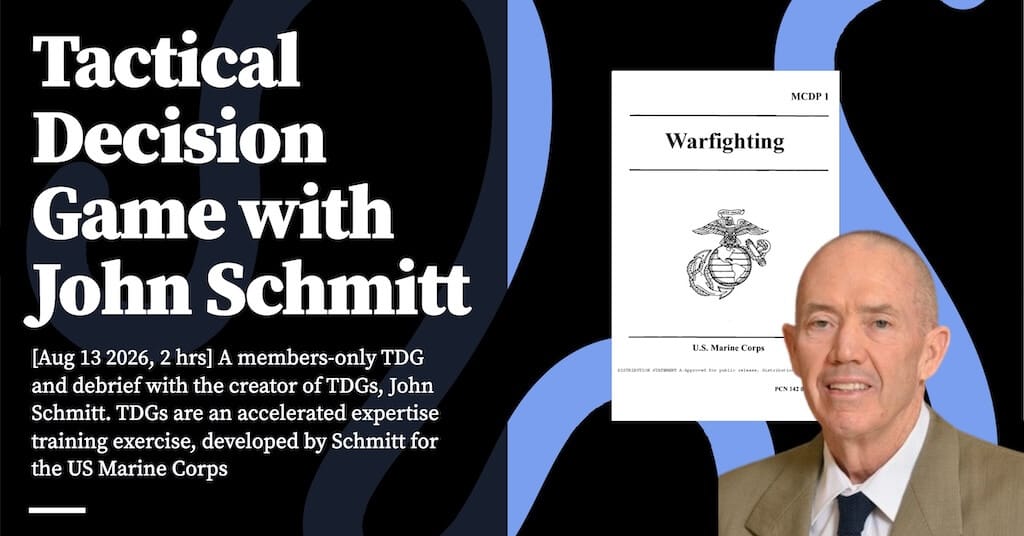
I'm pleased to announce that the next TDG session will be run by the inventor of TDGs himself, John Schmitt.
Here are the details:
This session, like the previous one, will be limited to 20 participants. (TDGs work best with 20 people max). To make sure registration is fair, registrations will be first-come-first-served, and will open on Wednesday 29 July 2026, at exactly the same starting time as the event:
In order to explain TDGs to you, I'm going to have to tell you a story.
After the Vietnam War, the four branches of the US military that were involved — the Army, the Marine Corps, the Navy, and the Air Force — did a period of soul-searching in response to their (fairly horrible) experiences. The Army and the Marine Corps, in particular, went through the most reflection because these two branches experienced the worst of the war.
This led to a number of reforms. The Army's reforms led to the Air-Land Battle doctrine, which was very successful and led to decisive victories in the 1990 Gulf War. The Marine Corps, on the other hand, adopted manoeuvre warfare as its doctrine. Colonel John Schmitt, under the direction of General Al Gray, wrote Marine Corps Doctrinal Publication Number 1 (MCDP 1): Warfighting, which remains the foundational doctrine document for Marine manoeuvre warfare to this day. If you're interested in what a decentralised organisation actually looks like, I recommend reading Warfighting; it's well written and not very long.
What is manoeuvre warfare? Manoeuvre warfare is a method of combat that allows a small fighting force to defeat a much larger one.
It does so by:
If all of this sounds like the ideas of John Boyd, that's because it is — Boyd was one of the influences.
Manoeuvre warfare requires improvisation and autonomy from lower-level units, and this creates a training challenge. How do you train soldiers to improvise on the fly in this decentralised manner? How do you help them make better decisions under the heat of battle?
The answer that Schmitt came up with was TDGs.
At its core, TDGs teach sensemaking in order to accelerate expertise. Put differently, it teaches novices to see as more experienced soldiers, so that they are able to spot tactical opportunities that they may exploit.
If you want to learn more about TDGs, you may listen to Schmitt's interview on the NDM podcast here. You may also find the book he wrote on TDGs, Mastering Tactics: A Tactical Decision Games Workbook here.
If you'd like to sign up to experience this training approach for yourself, add a reminder to your calendar for Wednesday 29 July 2026 at the time above, and wait for an email.
Warmly,
Cedric
PS: As a side note, I believe Schmitt is the reason the science fiction novel Ender's Game is on the Marine Corps Commandant's Professional Reading List. First, because the fighting in Ender is a perfect demonstration of manoeuvre warfare. Second, because the key phrase "the enemy's gate is down" is a perfect demonstration of how important sensemaking is.
(Skip the next bit if you don't want spoilers for the book).
If you're not familiar with the book, Ender is a young boy who is recruited to train, with other children, in a 'battle school' — a space station orbiting around Earth. Their goal is to become good enough to bring the fight to aliens that very nearly destroyed Earth years ago. The children train in zero gravity battle rooms, where they fire stun guns at each other. The objective of the battle simulations is to have at least one member of your team enter through the opposing team's gate. Initially, everyone enters the zero-G room with their sense of 'down' carried over from the corridor outside. Ender's insight is that if you reframe the situation as "the enemy's gate is down", you can enter the battle room with your legs first, presenting a smaller target, plus you can use your legs as a shield, and you can come at the opposing army from angles they would never expect, giving you an advantage. Here's a clip from the movie (which, naturally, is inferior to the book):