Every spring, as sure as the seasons, and for generations unknown, screwworms began their annual march northward from their overwintering sanctuaries in Mexico and South Texas. Pushed by an unknown force as inexorable as gravity, screwworms moved north — ever moving, ever spreading, ever multiplying, ever destroying. No army ever advanced any more surely or methodically. No army was ever more destructive. Attacking, killing, maiming, and destroying, screwworms literally ate their way north. Reaching upper South Texas, they fanned east and west - all the while moving north - dotting the countryside with the dead carcasses of hapless wildlife, cattle, sheep, and goats, filling the “wormy” pens of farmers and ranchers. - C.G. Scruggs, The Origin of the Screwworm Control Problem
Screwworms completely dominated our life. - T.A. Kincaid Jr., Texas rancher, quoted in The Peaceful Atom and the Deadly Fly
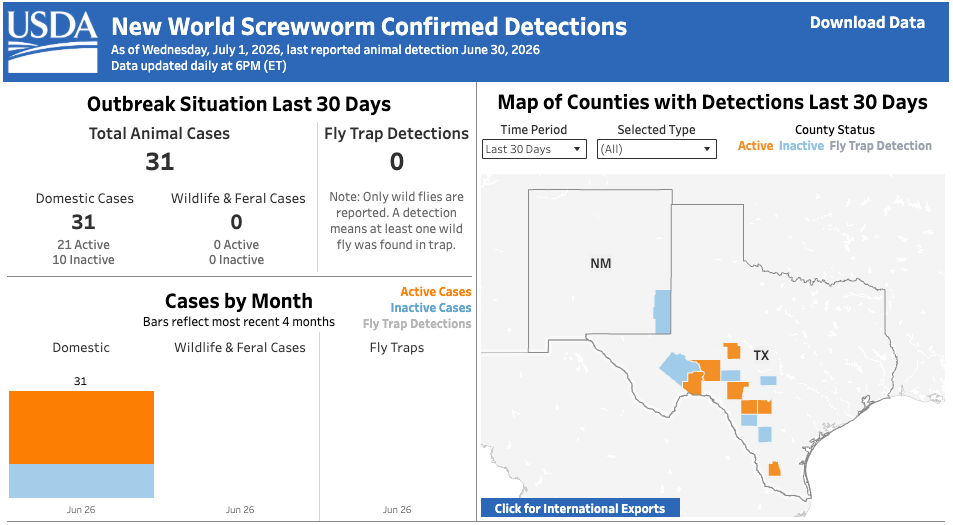
On June 3 of this year, a flesh-eating parasite, the screwworm, was found in a three-week-old calf near the Texas town of La Pryor. Since then, dozens more cases have been discovered in Texas and New Mexico. Outside of a screwworm outbreak in the Florida Keys in 2016 (which was contained), this marks the first screwworm infestation in the US since the 1980s.
Until now, the US has been free of screwworm not due to luck, but because of a decades-long program to eradicate the parasite by breeding it out of existence. By dropping millions of sterile male screwworm flies in an infested area, agricultural agencies can overwhelm the native, fertile male screwworms. Female screwworm flies, who only mate once in their life, will mostly mate with sterile males, producing no living offspring. Drop sterile flies for long enough, and eventually there will be no viable offspring at all, and the pest will be eliminated.
Over the course of several decades, this “sterile male technique” was used by the USDA to eliminate screwworm from the US, Mexico, and Central America. Since the early 2000s a joint US-Panamanian organization, COPEG, has maintained a “screwworm barrier” at the Darien Gap between Colombia and Panama. Every week, millions of sterile male screwworm flies are dropped over the gap, preventing the screwworms from spreading north from South America (where it remains endemic).
Sometime around 2023, the barrier at Panama failed, and for the last several years screwworm has been marching north. It’s now reached the US. Efforts are underway to eliminate screwworm from North and Central America once again, but it will likely be years before they succeed.
The screwworm eradication program was so effective at eliminating the parasite that we’ve collectively forgotten what an enormous problem it used to be. It’s worth understanding the costs inflicted by screwworm prior to its elimination, how a program emerged for eliminating it, and how control was allowed to lapse.
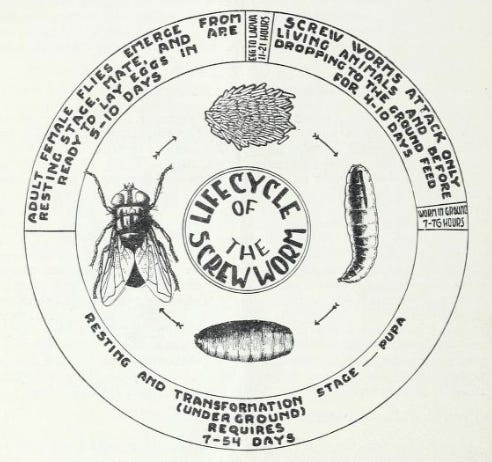
New World Screwworm (scientific name Cochliomyia hominivorax) is a species of fly native to the Western Hemisphere. While the larvae (maggots) of most flies feed on dead or decaying tissue, screwworm is unique in that its larvae feed on living tissue. The grisly cycle begins when a screwworm fly lays its eggs on the open wound of an animal. The eggs soon hatch into wriggling white worms, which can grow up to two-thirds of an inch long. These worms burrow into the flesh as they eat their way into the animal, making the wound even worse and attracting even more flies to lay their eggs. After a few days of eating, the worms transform into shell-covered pupae, falling out of the animal and emerging as fully grown flies about a week later. Untreated, a screwworm infestation in an animal is typically fatal.
Since at least the early 19th century, and likely much earlier, screwworm was a miserable fact of life for raising livestock in the Southwestern US. The screwworm fly would find and lay her eggs on even the smallest open wound, and animals had to be inspected for worms constantly. One author notes that “[p]eople would not leave home for more than a day for fear of finding their animals had been eaten alive while they were away. Anyone who didn’t check their animals at least every two days — or have someone do it for them — knew that they would pay a heavy toll in damaged or dead animals.” When worms were inevitably found, they had to be dealt with, typically by applying various insect-killing chemicals, though occasionally by manually removing the worms, a task described as “disgusting and sickening.” Often animals couldn’t be saved — an infection in a horse, for instance, was described in the late 19th century as “typically fatal.” The amount of time and effort required was such that ranchers employed ranchhands whose entire jobs were inspecting animals for screwworm.
Despite efforts to prevent infection, such as by covering animals’ open wounds with tar, screwworm infestations occurred by the millions — in cattle, sheep, goats, horses, and occasionally humans (the first documented screwworm infection in a person in the US dates to the 1830s). One history of the scourge noted that by the early 20th century, infestations had reached “such a disastrous level that it was becoming unprofitable to raise livestock. Producers were forced to hire more and more cowboys to check and treat animals.” A 1935 USDA survey found more than 1.2 million infections and 180,000 dead livestock in Texas alone, with actual totals likely being far higher. A year earlier the USDA estimated that screwworm had killed 1.3 million animals across the Southeast. Some estimates suggested that in the 1930s and 40s, 60% to 80% of white tail deer in Texas were killed by screwworm infections.1
By the 1930s, the situation appeared grim. Screwworms had, by then, found their way into Florida, a climate warm enough that they could survive in the southern portion of the state year-round, spreading up through the southeast during the spring. Prospects for dealing with the pest appeared bleak:
Even with the best efforts of scientists and the use of the latest insecticides, repellents, and liver-baited traps, US livestock producers were losing the war. After more than one hundred years of struggle, the screwworm had spread out of control — and there was no solution in sight. - History of the Mexico-United States Screwworm Eradication Program
The toll inflicted by screwworm inspired vigorous efforts to try and combat it. In 1929 the USDA began a screwworm research program at Menard, Texas. This program initially focused on developing better chemical treatments for infections, and would ultimately generate the research that would banish the screwworm from the US.
The first breakthrough occurred thanks to USDA entomologist Emory Cushing. At the time the primary methods to battle screwworm were insecticides to treat infections and traps to capture the flies. After several years of research at Menard, Cushing became convinced that these measures wouldn’t be enough. Believing that something was missing from “the screwworm puzzle,” Cushing applied for a grant to study entomology at the University of Liverpool with Walter Scott Patton, a world expert on flies. Working under Patton, Cushing closely studied the internal structure of different flies, determining for the first time that the screwworm was a unique species with a unique lifecycle. Prior to this, the screwworm fly had often been confused with other, similar flies whose larvae fed on decaying, rather than living, flesh. The identification of screwworm as a distinct species, one whose larvae ate only living flesh, was critical: previous eradication efforts had included using traps baited with carrion to attract flies, but Cushing’s work showed that these efforts were useless. Following Cushing’s discovery, research efforts shifted focus to understanding the screwworm specifically.
In 1931, shortly before Cushing left for England another entomologist, Edward Knipling, joined the USDA. Initially posted at the Menard laboratory in Texas, Knipling was moved to a series of other labs, before eventually arriving at a newly formed lab in Valdosta, Georgia, established in 1934 to help combat the worsening screwworm problem in the Southeast. By then, thanks to Cushing’s research, it had become clear that the screwworm was a unique species, and Knipling and other USDA researchers began studying it more closely to understand and characterize its lifecycle and behavior. This meant watching the flies closely; at one point, Knipling spent every waking hour for a week straight doing nothing but watching screwworms all day. From “The Peaceful Atom and the Deadly Fly:”
He placed a wounded goat in the open. From daylight till dark for a week he watched the goat. Upon seeing a female screwworm fly deposit eggs on the wound in the goat, Knipling would mark her with fingernail polish. He would then watch the marked female and plotted all her activities for the rest of the week if she remained in the area. Day after day, fly after fly, Knipling observed. What time were flies most active? How many eggs were laid? Dozens of questions were asked. Knipling and his fellow workers tried to pry into the very basic life functions of the screwworm.
These studies revealed two important facts about the screwworm. One was that compared to other flies, the number of screwworms in a given area was surprisingly low: later studies eventually put the figure at around 100 flies per square mile. The other was that screwworms would not infect dead animals, only living ones.
In 1935 another young entomologist, Raymond Bushland, joined the USDA and was soon tasked with studying the effects of pesticides on screwworms. This required a steady supply of fresh screwworms, which could only be created by deliberately wounding caged animals allowing them to be infected. Bushland spent his days extracting screwworm pupae from the carcasses of dead rabbits, a task so repulsive that Bushland spent every morning of the first few weeks on the job vomiting.
Desperate to find a way to grow screwworms that didn’t require live animals, Bushland was, after months of work, eventually able to create an artificial growth medium consisting of “hamburger, blood, water, and a little formaldehyde to delay putrefaction.” The disgusting mixture made it much easier to grow screwworms, and before long Bushland was harvesting them by the thousands.
In 1937, Knipling, who had continued to move between various USDA locations, arrived at Bushland’s lab in Texas. Knipling was astounded at the huge number of flies that could be grown in the lab, compared to the relatively small number of flies that seemed to exist in the wild, and he began to ponder whether there might be some way to take advantage of the fact. Bushland’s screwworm husbandry operation also allowed Knipling to confirm a hunch he had from his own observations of the screwworm in the wild: the female screwworm fly only mated once in her life.
As Bushland and Knipling discussed their various observations and discoveries, the outlines of a plan began to emerge. What if you could overwhelm the wild population of screwworm by dumping huge numbers of sterile male flies into an area where cold temperatures had already reduced the number of wild flies? If sterile males greatly outnumbered wild males, most females would mate with sterile males, producing no viable offspring and greatly reducing the size of the next generation. Keep dumping sterile male flies, and eventually the population would simply breed itself out of existence.
It seemed like it would potentially work, but nothing like it had ever been tried before. And it wasn’t obvious how you could produce huge numbers of sterile male flies. After getting ridiculed by their entomologist colleagues — “who ever heard of castrating flies?” — Knipling and Bushland kept the idea to themselves. But the seed had been planted.
For the next decade, a combination of professional skepticism, lack of obvious sterilization method, and the exigencies of World War 2 prevented much further work on screwworm eradication. At points during the Second World War Knipling continued to toy with models of screwworm population dynamics, and in 1947 he tasked Bushland with investigating chemical methods of sterilizing insects. But no method appeared promising. Without a way of mass-sterilizing the male flies, Knipling and Bushland’s idea was nothing but a pipe dream.
The final piece of the puzzle to eliminate screwworm wouldn’t fall into place until 1950. That year, Knipling read a journal article by Nobel Prize-winning scientist Hermann Muller. Muller had been awarded the prize for his groundbreaking work in genetics, discovering that mutations could be introduced into living things by exposing fruit flies to radiation. Muller’s 1950 article was a warning against the dangers of nuclear war, cautioning that the resulting radioactive fallout could create “a world of sterile human beings.”2 Knipling contacted Muller and asked him if radiation could be used to create large numbers of sterile male screwworms. Muller responded: “I know nothing of screwworms but your theory is sound.”
Invigorated by the Nobel Prize-winner’s vote of confidence, Knipling and Bushland set to work to see if they could use radiation to sterilize screwworms. With no research funds, Bushland dedicated his nights and weekends to the project, finding creative ways to make progress. Muller had done his radiation research using X-rays, but when a local hospital wanted $200 per test to use an X-ray machine, Bushland leveraged his Army connections to use the X-ray machine at a nearby Army hospital for free. The results were promising. Wanting to try an even more powerful radiation source, Bushland was able to convince Oak Ridge National Lab to lend him a sample of highly radioactive cobalt-60, capable of generating gamma rays. Meanwhile, Knipling was eventually able to secure $20,000 in research funds from the Atomic Energy Commission, who were interested in radiation’s effect on fly sterility.
The tests were a success: with a high enough dose of radiation, males were completely sterilized. They survived and would still mate with females, and the females would lay eggs, but the male chromosomes had become so riddled with mutations that the eggs didn’t hatch.
With a method of industrialized screwworm sterilization in hand, the only thing left to do was to try the idea and see if it worked. A USDA team in Florida began working out ways to distribute huge numbers of sterile screwworm flies.
They first tried simply scattering sterilized screwworm pupae on the ground, but this didn’t work: ants and other insects quickly devoured them. Dropping live flies seemed like it would work better, but it would have to be done in an isolated location to see if elimination was really possible — otherwise the area would be continuously reinfested by screwworms from outside the test area. After looking at several possible locations, the team eventually settled on Sanibel Island, a small island near Fort Myers on Florida’s Gulf Coast. After a few months of dropping boxes of flies onto the island from a small plane, the number of wild screwworms dropped to virtually nothing. While they couldn’t be eliminated completely — likely because wild flies continued to migrate from the mainland — the results were highly encouraging.
Buoyed by their success, the team began looking for an even larger stage for their next test. By chance, as they were searching, Knipling received a letter from a Dutch agricultural officer recently stationed on the Dutch Caribbean island of Curaçao, off the coast of Venezuela. The island was overrun with screwworm, and the officer wondered if Knipling had any suggestions for dealing with it. The location seemed perfect, and Curaçao soon became the location of the next test.
The Curaçao test began in the summer of 1954. A screwworm production facility, complete with a cobalt-60 gamma-ray source, was set up in Orlando. Sterilized screwworms were flown into Curaçao, then dropped from a small plane in a carefully planned pattern across the island. For the first few weeks, results were poor, with 85% of screwworm offspring still viable. But when the density of dropped sterile flies was raised from 100 to 400 flies per square mile, results quickly improved. Within 14 weeks, no viable offspring could be detected. In November 1954, Curaçao was declared free of screwworm.
With the success in Curaçao, the USDA was ready to try eliminating screwworms in the US mainland. In 1955 a new, larger screwworm factory was constructed on the outskirts of Orlando, capable of producing two million sterilized flies a week. This new insectary would use a new strain of fly, bred specifically to outcompete wild flies. (The new flies, which had been selected for their high mating frequency, were nicknamed “the sexual athletes”.) Thanks to lobbying from the Florida Cattlemen’s Association, whose members were collectively losing $20 million per year due to screwworm infestations, the Florida legislature allocated $3 million to the eradication program, a figure which was matched by the federal government.
In April of 1958, while screwworms were still confined to the southern half of the state due to an unusually cold winter, USDA planes began dropping sterile screwworm flies over Florida. Flies were first dropped across a 100-mile-wide swath cutting through the center of the state, effectively creating a “barrier” that flies in the southern half of the state wouldn’t be able to penetrate. Inspection stations were set up to prevent the movement of any infected livestock into northern Florida and Georgia, and by July no screwworm cases were being reported north of the quarantine line. The USDA then pushed into south Florida, aided by an even larger screwworm factory in the city of Sebring capable of producing 50 million flies a week, and by September reported screwworm infections in the southeast had dropped to virtually nothing. Over the next several months, the occasional outbreak occurred, but these were dealt with by carpet-bombing the area with ever-higher concentrations of sterile flies. By February of 1959 screwworm cases in the Southeast had dropped to zero.
By the early 1960s screwworms were inflicting more than $100 million worth of damage in the southwest annually. Impressed by the success of the Florida program, ranchers in Texas and the Southwest began clamoring for similar efforts. But Texas would prove to be a much tougher nut to crack than Florida. Unlike Florida, which was surrounded on three sides by water, Texas had no natural barriers preventing screwworm transmission across the 1,000+ mile border that the state shared with Mexico, where screwworms survived year-round. In October of 1959, the USDA issued an official statement that screwworm eradication in the US Southwest did not appear feasible.
But despite the USDA’s official stance, Knipling, Bushland, and a few others in the USDA realized that a strategy used in the Florida eradication program might work in Texas and the Southwest. Florida’s eradication effort began by creating a 100-mile-wide screwworm barrier across the center of the state. This barrier, once in place, had virtually halted the spread of screwworms into the northern half of the state. What if the same thing were done in the Southwest? Create a 100-mile-wide barrier across the entire US-Mexican border. The challenges were many: this barrier would stretch far longer than the one that had been created in Florida and, unlike in Florida, this barrier would have to be continuously maintained. It would also require eliminating screwworm everywhere north of the barrier, a potentially massive undertaking. But not only could this plan eliminate screwworm from the Southwestern US, it could prevent re-infestation of the Southeast, a constant threat that was warded off by an involved, expensive livestock inspection operation.
For the next several years, the official position of the USDA remained that a Southwestern elimination program wasn’t feasible. But eventually the USDA changed its policy, thanks to the efforts of the Southwest Animal Health Research Foundation (SWAHRF), an organization formed by a small group of Texas livestock producers. SWAHRF broke the logjam by raising millions of dollars in voluntary donations from Texas ranchers for screwworm eradication. The show of grassroots enthusiasm convinced the Texas Legislature to allocate money to a Southwest eradication program, which in turn helped convince the federal government to support it. Credit also goes to newly elected Vice President Lyndon Johnson, who owned a ranch, was familiar with the scourge of screwworm, and pulled strings to kickstart the program.
The Southwest eradication program began in February of 1962, when winter temperatures had pushed the screwworm down into Mexico. USDA aircraft began dropping sterile flies across the US-Mexico border to create the North-South barrier. But the effort failed, and before long Texas had been reinfested. There simply weren’t enough flies: sterilized flies were being produced at a small insectary near Kerrville, Texas, at a rate of 20 million per week, but creating an effective barrier would require more than ten times that rate of production.
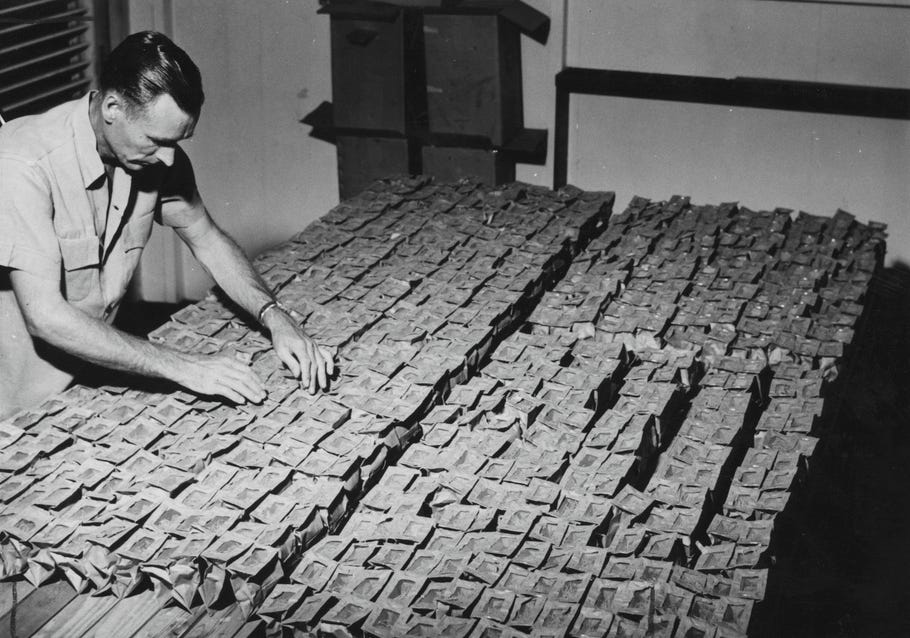
By spring 1962, construction had begun on the biggest screwworm factory yet, at an abandoned Air Force base near Mission, Texas. Eventually capable of producing more than 200 million screwworm flies a week, the Mission factory was a grotesque marvel of insect-producing efficiency. Operating 24 hours a day, 365 days a year, it was, in essence, a 76,000-square-foot artificial wound. Trays full of meat, blood, and water, each one heated to the exact right temperature to stimulate screwworm growth, moved through the facility on a monorail system timed to the lifecycle of the screwworm. Eggs would be placed in on the trays, hatch into larvae, and collectively feed on the bloody nutrient sludge, creating a “seething mass that is difficult to believe unless you’ve seen and smelled it.” After several days of growth, the larvae would wriggle out of the feed and fall into a water-filled trough, which gently carried them into sawdust-filled trays where they would pupate. The pupae would then be collected into canisters, which in turn were loaded into large casks containing highly radioactive cobalt-60. The irradiated, sterilized pupae were then packed into cartons, loaded into refrigerated trucks, and sent to distribution centers, where they would eventually hatch, be loaded onto planes, and dropped by the millions.
By June of 1962 the Mission factory was fully online, and flies began to be dropped in July. However, the program soon made an unfortunate discovery. It had previously been believed that the maximum range of the screwworm fly was around 35 miles traveled per week. Because the fly only lived for a few weeks, a 100-mile barrier was believed to be sufficient to prevent the passage of migrating flies. However, recent research had shown that in some cases a screwworm could fly much farther — up to 180 miles in a week. Consequently, the barrier would have to be much wider as well: 400 miles. Left with no choice, the USDA ramped up fly production at the Mission factory as fast as possible to support a widened barrier, and an agreement with Mexico was worked out to allow USDA planes to fly hundreds of miles into Mexican airspace to drop sterilized screwworm flies.
The expanded barrier worked. By 1963, the rate of screwworm cases in the US had fallen by 90%. In 1964, they fell even more, and by 1965 the states of Texas, New Mexico, Oklahoma, and Louisiana were declared screwworm free. California and Arizona soon followed, and by 1966 screwworm had been eliminated from the entire US.
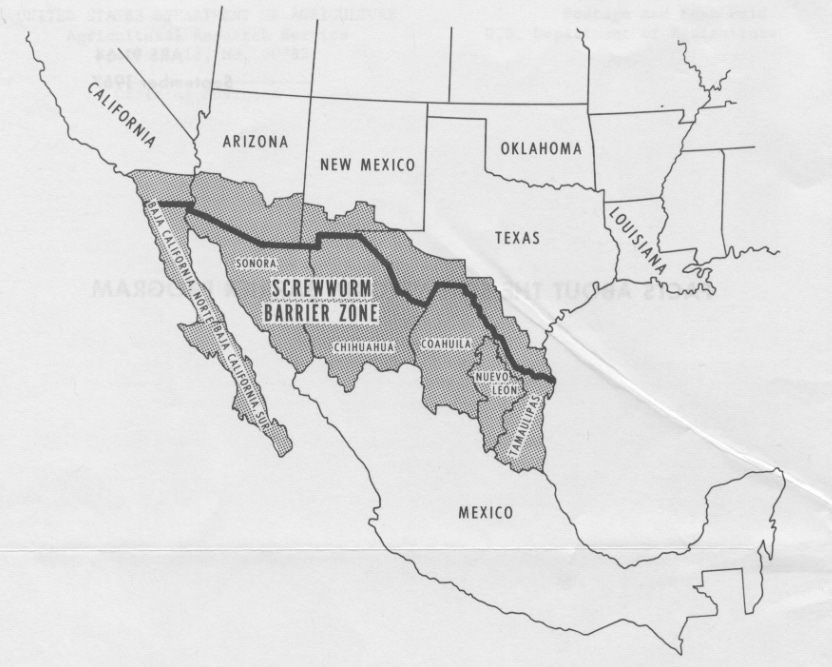
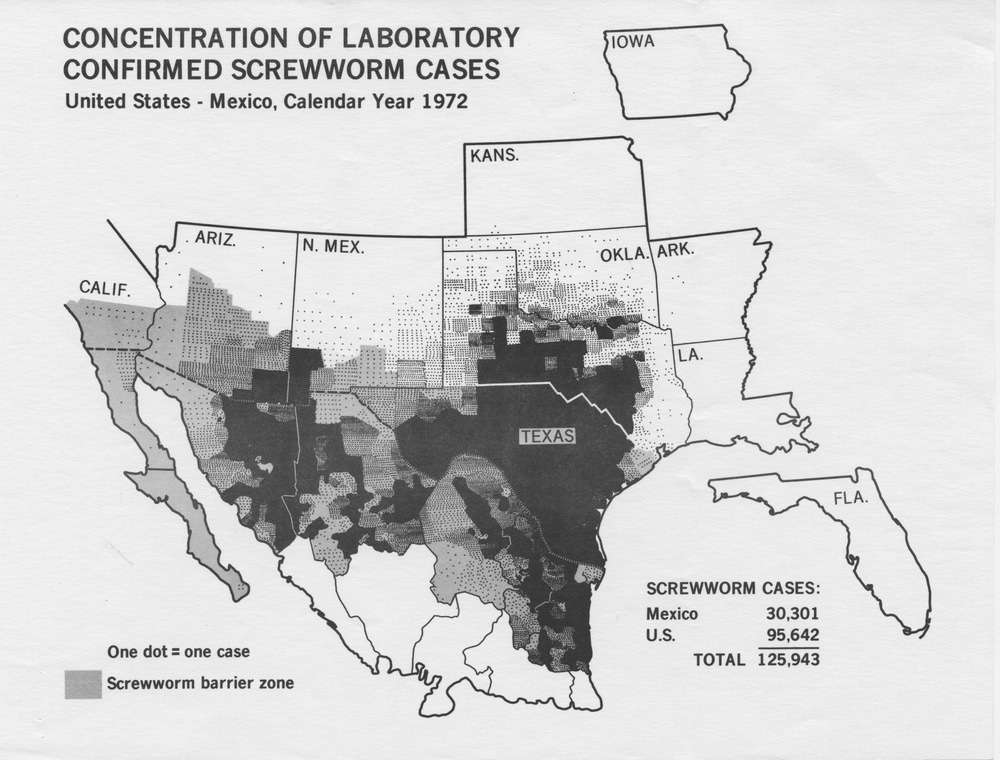
But the national elimination of screwworm from the mainland United States was hard-won and not easy to maintain. It required continuously dropping millions of sterile male flies across the US-Mexico border to create a screwworm barrier. And no barrier is perfect. Over the next several years screwworm infections continued to crop up in the US, as worms from Mexico found their way into the US. 1972 was particularly bad, when US cases (which had fallen as low as 170 in 1970) surged to more than 95,000 that year.
The solution? Push the US barrier even farther south, down to the Isthmus of Tehuantepec in southern Mexico. Not only would this reduce the likelihood of Mexican screwworms reaching the US, it would eliminate screwworm from most of Mexico. And a barrier at Tehuantepec, which was only 118 miles across at its narrowest point, would be far easier to maintain than the nearly 2000 mile barrier across the entire US-Mexican border.
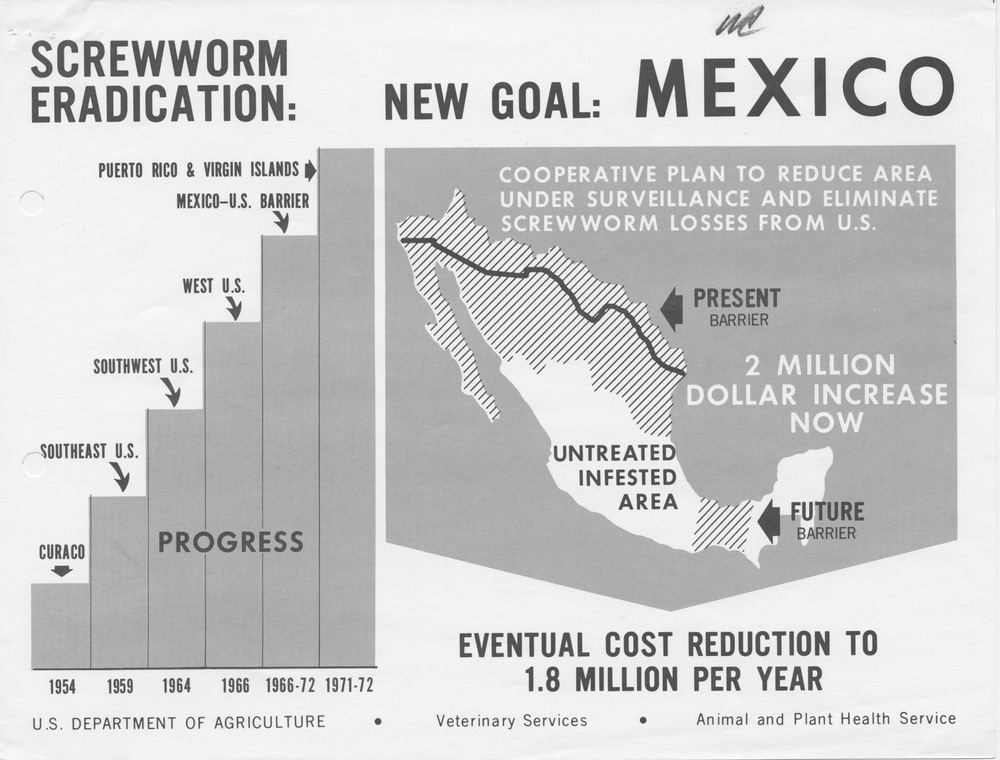
In 1972, the US and Mexico signed a Screwworm Eradication Agreement, creating a joint commission to oversee the elimination of screwworm from northern Mexico. A new screwworm insectary, which would eventually produce more than 400 million sterilized flies per week, was built near Tuxtla Gutiérrez in southern Mexico. The factory began producing flies in 1976, and the first flies were dropped on Baja, Mexico that September. Progress was initially slow, but after a program reorganization (which included more livestock inspectors and a new strategy for quickly deploying experts to areas where outbreaks occurred) results improved. By late 1979 the Baja peninsula was free of screwworms, and by 1980 many Northern Mexican states followed. Starting in 1981, the program established a “critical line” across the width of Mexico, marshalling all possible resources to squash any infections that appeared north of it. Over the next several years the critical line was steadily pushed downward, until it reached the Isthmus of Tehuantepec in 1984, one year ahead of schedule.
But establishing a final barrier across the Isthmus of Tehuantepec left something to be desired. Mexican livestock producers below the barrier, who continued to deal with screwworm, complained that the government was favoring northern producers, and hundreds of thousands of livestock that passed from the south to livestock markets in the north, requiring tedious inspection and creating a constant risk of reinfestation. And while the Tehuantepec barrier was much smaller than the US-Mexico one, it still required dropping 150 million sterile flies a week, every week.
Fortunately, an even better location for a barrier existed: the Darien Gap, on the border of Colombia and Panama. At this narrow stretch of land, the barrier would need to be just 60 miles wide. And the densely forested, difficult-to-navigate terrain, which had no roads crossing it, would further hinder the passage of any infected livestock. Pushing the barrier all the way to Panama would also have the benefit of eliminating screwworm not just from the rest of Mexico, but all of Central America as well.
Eradication in Central America posed new challenges: the favorable climate conditions for the screwworm meant that far more flies would need to be dropped per square mile, and new international agreements would need to be signed with each country involved to allow the USDA to fly over their airspace and drop millions of insects. But the benefits would be substantial, and the decision was made to extend the program.
In 1986 the US-Mexico commission signed an agreement with Guatemala, and began dropping flies over the country in 1988. That same year an agreement with Belize was signed, which was followed by agreements with El Salvador, Honduras, and Nicaragua in 1991, Costa Rica in 1993, and Panama in 1994. As sterile fly dispersal began across the new territories, screwworm infections in each country quickly fell. In 2006, a new screwworm factory was built in Panama to replace the aging Mexican factory (which had been operating continuously since 1976), opening on the same day that the country was declared screwworm free.
For the next decade and a half, the barrier at Panama held. Administered by a joint US-Panamanian organization called COPEG, the program continued to drop millions of flies a week across the Darien Gap, and employed inspectors to monitor livestock in the surrounding area. When the occasional infestation flared up — in Aruba in 2011, the Florida Keys in 2016 — flies kept in reserve were quickly dispatched, dropped in huge numbers to quash any spread.
At some point in the last few years, screwworms broke through this barrier.
In 2021, screwworm cases were confirmed within the Darien Gap area in Panama, and Panama was added to the list of countries where screwworm is confirmed by the USDA’s Animal and Plant Health Inspection Service (APHIS). Initially, this didn’t appear concerning: since 2001, Panama has had occasional small screwworm outbreaks in the Darien Gap area. But in 2022, screwworm was detected in Panama beyond the barrier at the Darien Gap. Though initially this was just a few cases, the infestation quickly spread: in 2023 there were 6,500 screwworm cases in Panama, and cases were detected in nearby Costa Rica. By 2024 screwworm had spread to every Central American country, as well as Mexico; there were 18,000 detected cases in Panama, 8,600 in Costa Rica, and 3,300 in Nicaragua. In 2025, total cases in Mexico rose to over 12,000, and as of this writing have exceeded 30,000.
It’s not 100% clear what caused the breach, and most sources point to a confluence of different factors. The disruption caused by COVID-19 seems to be partly to blame: during the pandemic livestock inspectors were forced to stay home, vehicles broke down and couldn’t be repaired due to a lack of replacement parts, and power outages in the screwworm plant killed millions of sterilized flies.
Another issue seems to be large-scale movement of both people and livestock. Starting in 2021, the number of migrants passing through the Darien Gap skyrocketed. Illegal cattle trafficking also likely played a role. Ranchers throughout Central America will illegally graze cattle on protected forests, often as part of a larger money-laundering operation for narcotics cartels. These cattle are then illicitly moved north to livestock markets in Mexico. It’s been estimated that hundreds of thousands of cattle are trafficked through Central America each year, and the speed at which screwworms have spread through the region suggests they’re moving by truck, being carried by infected cattle.
Also contributing are the changing circumstances in the Darien Gap itself. When the barrier was established the Darien Gap was a wild, untamed rainforest. Today that forest is increasingly being cut down and replaced with grassland for cattle to graze on, making it much easier for a screwworm infection to spread through the area. Amplifying this risk is the fact that many ranchers are absentee owners, people who treat the ranch as something of a vacation property without closely monitoring its operations.
The USDA didn’t simply sit back in response to this spate of outbreaks in Central America. APHIS drew on hundreds of millions of dollars in emergency funding in 2023 and 2024, and began dropping sterile flies in infected countries. Cattle imports from infected countries ceased, (though they later reopened in a limited fashion with increased inspection protocols). Fly production at the Panama facility was ramped up from 20 million flies a week to more than 100 million. But these efforts were nowhere near enough to stop the spread. The facility at Panama could produce enough flies to maintain a dense, narrow barrier of sterilized flies at the Darien Gap, but not to fight an infestation which had spread widely throughout Central America; at the peak of Central American operations in the 1980s and 1990s, over 400 million flies were being produced weekly.
New screwworm facilities are coming online — in 2026 the USDA broke ground on a facility at Moore Air Force Base in Texas meant to produce 300 million flies a week, and is converting an existing fruit fly insectary in Mexico to produce screwworms. And earlier this year APHIS announced a $100 million “Grand Challenge” for projects related to screwworm eradication or treatment. (Some anti-screwworm efforts may have been hindered by DOGE, which cut APHIS staff, screwworm monitoring programs, and may have delayed funding for the Mexico facility, but it’s hard to be confident about this, and the administration has unsurprisingly rejected these claims.)
Overall, the reemergence of screwworm seems like it’s being taken quite seriously, and if this level of investment is maintained it seems likely we’ll be able to re-eradicate it from the US and Central America. But this will probably take “close to a decade of sustained work:” bringing new production facilities online, and dropping millions of sterile flies over the infected areas week after week, month after month, year after year as the pest is gradually pushed back.
Overall, the screwworm program seems like a classic case of something becoming a victim of its own success: a problem got solved so thoroughly that we forget how big of a problem it was, and we gradually undermine the conditions that made the solution possible. Prior to the push of screwworms all the way south to Panama there were a series of other screwworm eliminations that only partly solved the problem: eliminating it in Florida and the Southeast didn’t do anything for the livestock in the Southwest, and required an involved inspection regime to keep screwworm entering from the rest of the country. Pushing the pest population down to Mexico required continuously dropping hundreds of millions of flies over an enormous, 400-mile-wide barrier that was frequently breached. The barrier at Tehuantepec left much of Mexico still exposed to screwworm, and was expensive to maintain.
The barrier at Panama, by contrast, worked amazingly well and cost only $15 million per year to operate. As a result of this success, other screwworm facilities were shut down (the Tuxtla factory closed in 2012, against the protests of COPEG), and production at Panama gradually declined to the level needed to maintain the barrier and not much else. Barrier conditions in the Darien Gap were allowed to deteriorate, the dense rainforest replaced with grassland occupied by ranchers paying insufficient attention to their herds. What had once been very thorough cattle inspection processes were allowed to lapse: one article notes that in Panama ranchers, veterinarians, and trade organizations became less diligent about inspecting cattle prior to shipping them, and that “a carbon copy of all these issues happened in every country all the way to Mexico.” And when it was clear that screwworms had breached the barrier, responses were sometimes delayed by political disputes — Mexico apparently initially made it very difficult for USDA screwworm flights to operate until the US Agricultural Secretary called to force the issue.
Unfortunately, it looks like we’re going to re-learn how much of a problem screwworm was the hard way.